Vikings were on average a little shorter than people today, often but by no means always blond, better groomed than their reputation and dressed in colour. Two metres tall, shaggy beard, furs over the shoulders: that picture comes from film and television. We have gathered what research knows today about the appearance of the people of the Viking Age, from height, hair colour, beards and clothing to two body modifications that surprised even the specialists: filed teeth and reshaped skulls.
The short answer: a little shorter than we are today, but not short for their time. The long answer comes from skeletons in graves. Anthropologists estimate stature from the length of the thigh and shin bones.
For Viking-Age men in Scandinavia this gives values of around 170 to 176 centimetres, for women around 157 to 161 centimetres. In a much-cited analysis, the economic historian Richard Steckel arrived at an average of just over 173 centimetres for men in northern Europe in the 9th to 11th centuries. His samples are small: a few dozen skeletons for Iceland, just eight for Sweden.
For comparison: men in Denmark, Norway and Sweden today average just over 180 centimetres. Steckel's data also show something surprising: in the 17th and 18th centuries, people in northern Europe were on average considerably shorter than in the Viking Age. A Viking did not stand at the start of a steady growth in height. Giants they were not. When Ibn Faḍlān describes the Rus on the Volga as "like palm trees", that says above all something about the people he was comparing them with.
A skeleton tells you more than its length. Muscle attachments, joints, healed fractures and teeth show how a person lived. One well-studied example lies not in Scandinavia but in England. At Repton in Derbyshire, the so-called Great Army of the Vikings spent the winter of 873/874. Excavations between 1980 and 1986 uncovered, beneath a low mound, the jumbled bones of at least 264 people: a charnel deposit, meaning a collective burial of bones moved there from elsewhere.
Where sex could be determined, about four in five were men and one in five women, most of them aged between roughly 18 and 45. In 2018 Catrine Jarman and her colleagues showed that a fish-rich diet had skewed older radiocarbon dates; corrected, every sample fits the late 9th century. Strontium isotopes in tooth enamel also reveal that few of these people grew up locally, and many fit an origin in Scandinavia.
Close by lay a double grave. The older of the two men, at least 35 to 45 years old, wore a Thor's hammer pendant, had a sword, and bore severe injuries: stab wounds to the head and a deep cut to the left thigh. The National Museum of Denmark notes that some male skeletons show severe cut marks and that violence was a significant cause of death for men.
No. But many were.
The largest genetic study of the Viking Age so far examined the genomes of 442 people from graves across Europe in 2020. One result concerned pigmentation, that is, hair, skin and eye colour. Among the people of the Viking Age there were more dark-haired individuals than in Scandinavia today. Study leader Eske Willerslev said this disproved the image of the blond Viking, since many had brown hair. His co-author Ashot Margaryan put it more cautiously: the majority were indeed blond, just not all of them.
It pays to look at the study itself, because the headlines were sharper than the science. The abstract in Nature only says that the genetic loci linked to pigmentation have changed markedly over the past thousand years. The Aarhus University press release went further and stated that most Vikings had brown hair. Ancient genes give hair colour only as a probability, not like a photograph.
So both are true: blond was common but not the rule without exception. And there were red-haired Vikings too, as bynames like Erik "the Red" show. What else the study reveals about origins and mixing, and what a modern DNA test can actually measure, is covered in our article Am I descended from the Vikings?. A special genetic trail is followed in DNA and Vinland.
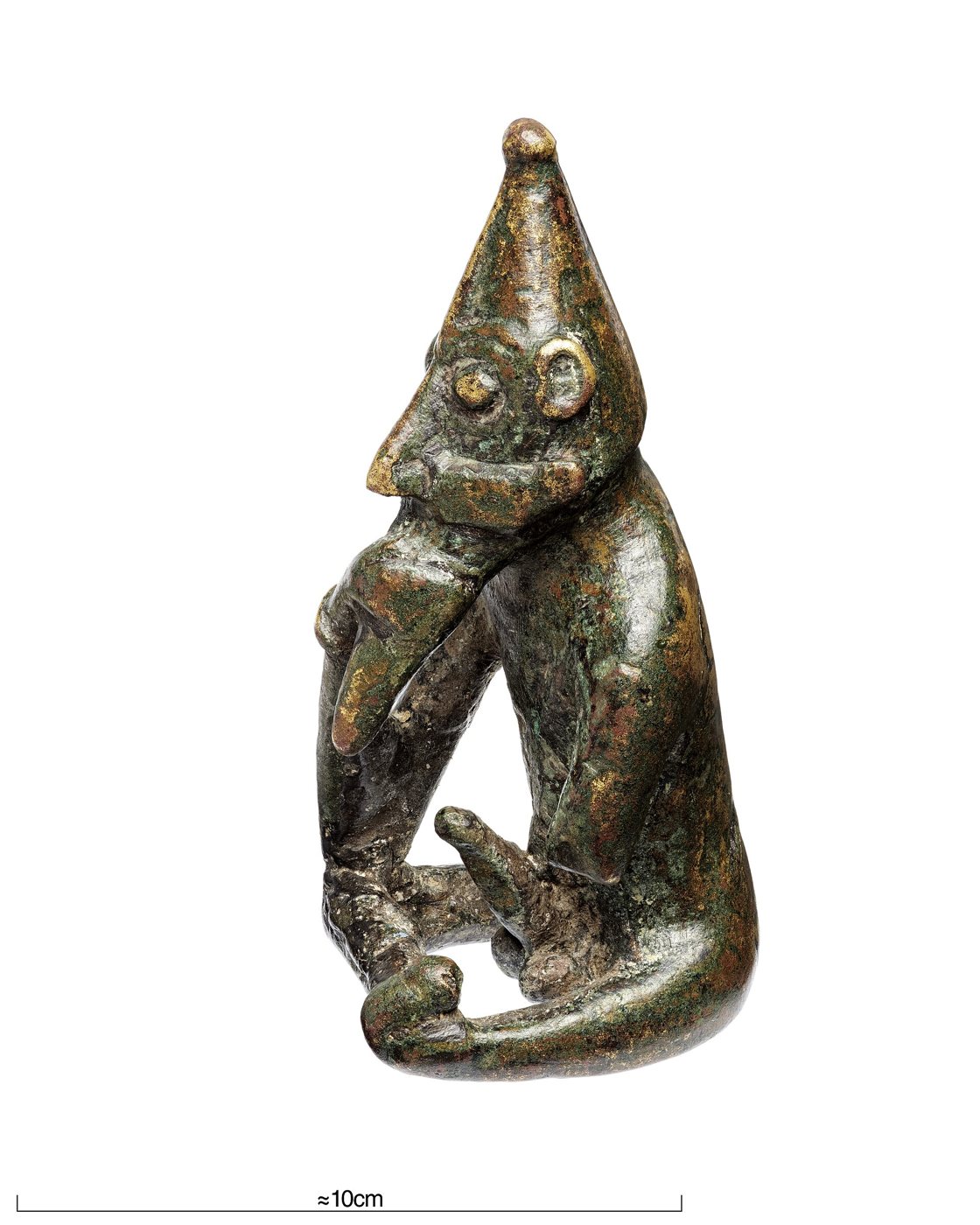
Faces from the Viking Age are rare, but they exist. The best known is the small bronze figure from Rällinge in Södermanland, just under seven centimetres tall and made around the year 1000. It shows a seated man with a pointed cap or helmet, a large upturned moustache and a pointed, braided chin beard. Whether it depicts the god Freyr, as is often said, is not certain. The beard, however, is clear to see, and so is a ring on each wrist.
A small walrus-ivory figure from Fløgstad in Norway looks very similar: moustache, braided pointed beard, centre parting. Curator Peter Pentz of the National Museum of Denmark called it as close as we get to a portrait of a Viking. The figure, only about three centimetres tall, probably comes from a rider's grave opened in 1796 and lay unnoticed in the stores for more than two hundred years. It also shows wavy hair, a cropped back of the head and strong sideburns.
The textile scholar Marianne Vedeler points to an intriguing contrast. On the Oseberg tapestry, buried with two women in the Oseberg ship in 834, the men have no visible beards. The Fløgstad figure is probably one or two centuries younger. Beard fashions changed, in other words, and "the" Viking beard is a simplification. The famous elk-antler head from Sigtuna shows a man with a pointed helmet and nose-guard, with a short beard. It dates, however, from the late 11th century.
Women appear mainly on Gotland's picture stones and on small pendants usually interpreted as valkyries. They wear their long hair gathered at the back of the head in a knot or ponytail. The silver figure from Hårby, found on Funen in 2012 and just 3.4 centimetres tall, shows exactly that: a woman with sword and shield, her hair tied at the nape. Valkyrie, goddess or fighter remains open.
What the figures show, the finds confirm: combs are among the most common objects in Viking-Age graves and settlements, belonging to men and women alike. Someone who took a comb into the grave cared about their hair. An English contemporary confirms it, if reluctantly. Abbot Ælfric of Eynsham (died around 1010) scolded a fellow Englishman in a letter for dressing himself "in Danish fashion", with bared neck and blinded eyes. That probably means a shaved nape with long hair in front falling over the face. Which other hairstyles the sources attest is collected in our article on Viking hairstyles, and how combs were made from antler is shown in the article on the comb makers.
An English chronicler of the 13th century, long known as "John of Wallingford", wrote of the Danes in England that by their custom they combed their hair daily and bathed on Saturdays, and so seduced the women. The passage is often quoted as proof of Viking cleanliness, with two caveats. The text was written some two hundred years after the events, and it is anything but friendly: the well-groomed Danes are presented as a threat to the honour of English women.
That Saturday was called laugardagr, "washing day", in Old Norse, and is still called so in the Scandinavian languages (lørdag, lördag), fits this. Tweezers, ear spoons and nail cleaners from graves show the same. The rest is in our article on hygiene in the Viking Age. Ibn Faḍlān, incidentally, considered the Rus on the Volga "the filthiest of God's creatures". He meant mainly that they did not wash as his own religious rules required.
A second Arabic author, the geographer Ibn Rusta, wrote about the Rus a few years before Ibn Faḍlān. In the commonly quoted translation, they carry clean clothes and the men adorn themselves with bracelets and gold. Caution is needed here. The word "clean" goes back to a 19th-century Russian translation, and later editors note that the Arabic original may well mean the opposite. Only the remark about the gold is safe.
Now it gets surprising. In the 2000s the Swedish osteologist Caroline Arcini noticed something while examining skeletons: some Viking-Age men had horizontal grooves filed into their upper front teeth. Not chance wear, but neat, regular work by a skilled hand, probably not the wearer's own.
Arcini published her results in 2005. Today more than 130 such cases are known. About four fifths come from Gotland, the rest mainly from other parts of Sweden, plus a few from Denmark and one from a mass grave in Dorset in England where Vikings were executed. The fashion has not so far been found in women.
What did the grooves mean? Calcified deposits in the furrows show that they were made long before death. Their grave goods show them neither conspicuously rich nor clearly warriors, and Arcini does not regard the grooves as a coming-of-age ritual. Perhaps they marked a group, a profession or an origin, such as traders who travelled a lot. Arcini has also suggested that the grooves may have been coloured. That, however, is not attested. Only this is certain: whoever smiled was showing something off.
A newer interpretation comes from Matthias Toplak, head of the Viking Museum Haithabu, and Lukas Kerk of the University of Münster. In their study published in 2024 in Current Swedish Archaeology, they suggest reading the grooves as a sign of membership in a closed group of merchants. All the men with grooves were at least 20 years old, which points to a voluntary change made in adulthood. This is not proven either, but it fits the trading island of Gotland.
The same study deals with a second, even rarer modification of the body. On Gotland, three women from the late 11th century have been found whose skulls were artificially elongated. That is only possible in infancy, by binding the head for months. The graves lie at Havor, Ire and Kvie. The oldest of the women, from Havor, lived to 55 to 60 and was buried with rich jewellery in typical Gotlandic dress, including four animal-head brooches.
Elsewhere in Scandinavia the custom is unknown. Toplak and Kerk see the closest parallels in south-eastern Europe, for example in what is now Bulgaria in the 9th to 11th centuries. Whether the women were born there or the custom was adopted on Gotland remains open. These are three individual cases, not a "Viking beauty ideal", but they show how far Gotland's connections reached.
Ibn Faḍlān writes of the Rus on the Volga that every man was covered from his toes to his neck in dark-green lines. It is the only contemporary source of its kind, and it raises questions: did he mean tattoos, paint or something else entirely? No skin survives from the Viking Age, so there is no archaeological proof. We have examined the question in detail in our article on Viking tattoos.
The image of the Viking in a grey sack and furs does not stand up to the finds either. People of the Viking Age wore wool and linen, often dyed red, blue, yellow and green, with tablet-woven bands, and the wealthy also wore silk from the East. Women fastened their strap dress with two large oval brooches on the shoulders, men their cloak with a brooch on the right shoulder so that the sword arm stayed free. Ibn Faḍlān describes exactly this: the man wears a cloak that covers one half of his body and leaves one arm free.
How do we know, when cloth rots? First, from graves where scraps of textile stuck to metal: under the brooches, corrosion preserved tiny pieces of fabric. As early as 1938 the textile scholar Agnes Geijer analysed the cloth from the more than a thousand graves at Birka that Hjalmar Stolpe had excavated in the late 19th century, among them silk and bands woven with silver thread.
Second, from the harbour of Hedeby (Haithabu) near Schleswig. Archaeologists found many 10th-century textile fragments there that had been used as torn-up old clothes, soaked in tar, to caulk ships. The tar preserved them remarkably well. Inga Hägg identified shirts, trousers, tunics and possibly parts of a strap dress, many cut to fit the body with diagonal and curved pieces.
Third, from rich burials like the one at Mammen in Jutland. The timber of the burial chamber in the Bjerringhøj mound was felled in the winter of 970/971. The dead man wore a woollen cape lined with marmot fur, embroidered with leopards and other four-legged beasts, animal masks and acanthus leaves in red, blue and yellow, along with lilac silk bands containing gold and silver thread. According to recent work by the National Museum of Denmark, he also wore long trousers with finely decorated, padded cuffs. More in our articles on Viking clothing and colours of the Viking Age.
Ibn Faḍlān saw that each Rus woman wore on her breast a small disc of iron, silver, copper or gold, depending on her husband's wealth, with a knife attached. That fits well with the oval brooches from graves, between which strings of beads often hung. Around their necks, he reports, the women wore bands of gold and silver: for every ten thousand dirhams a man owned, he had such a band made for his wife. They prized dark-green beads above all, often interpreted as glass beads.
For men, arm rings belong to the picture, as the Rällinge figure and Ibn Rusta show. Silver rings were jewellery and cash at the same time; if needed, they could be hacked into pieces and weighed. How that worked in detail is in our article on Viking jewellery.
"The Viking" did not look the same everywhere. Between the Mammen man in silk and fur and an unfree labourer on a farm lay worlds, even if the clothing of the poorest has hardly survived. And there were regional costumes. Women on Gotland, for example, wore their own animal-head brooches instead of the oval brooches common elsewhere, as with the woman from Havor. Elsewhere, from England to Russia, the basic women's dress was similar, but brooch types and tastes in jewellery varied.
The question of whether you could have recognised a woman warrior by her appearance belongs here too. Grave Bj 581 at Birka, long presented as the textbook warrior grave, turned out in a 2017 DNA analysis to belong to a woman. What that means and what it does not, we have traced in our article on the warrior woman of Birka.
In the end, only a face can show what a Viking really looked like. Modern facial reconstructions try to provide one: muscles and skin are modelled onto a cast of the skull using tables of tissue depth. A well-known example is the woman from Solør in Norway. She was buried around the year 900, was about 18 or 19 when she died, and lay in a grave, excavated as early as 1900, with sword, spear, axe, arrows and a horse. Her skull shows a deep, partly healed injury consistent with a sword blow. In 2019 researchers at the University of Dundee reconstructed her face for a television documentary.
It helps to know where the science stops. The shape of the bones, the base of the nose and the jawline can be worked out fairly well. Hair colour, eye colour, hairstyle and expression, on the other hand, are additions, and without DNA they are pure assumption. Whether the Solør woman was really a fighter also remains open.
Here the picture turns serious. The National Museum of Denmark sums up the state of research like this: child mortality was high, and most people did not live beyond 35 to 40. Only a few reached an age over 50. Women lived slightly longer than men on average, if they survived childbirth.
That does not mean a person looked old at 40. Averages are pulled down sharply by infant deaths. Those who survived childhood had considerably better chances. Even so, bodies were hard pressed: more than a quarter of people had tooth decay, arthritis was widespread, and teeth were often heavily worn by grit in the flour. Many had already lost several teeth during their lifetime. What healers could do about it is in our article on medicine in the Viking Age.
Never happened. Not a single Viking-Age helmet had horns. The only largely complete helmet, the Gjermundbu helmet, is a plain iron cap with eye guards. Where the image comes from is explained in our myth check on the horned helmet.
How tall was the average Viking? Skeletons suggest men stood about 170 to 176 centimetres and women about 157 to 161 centimetres. That is a little shorter than today, but taller than northern Europeans in the 17th and 18th centuries.
Did Vikings have blond hair and blue eyes? Many did, but far from all. The large DNA study of 2020 shows that dark hair was more common in the Viking Age than in Scandinavia today.
Did Vikings have long beards? Figures from Rällinge and Fløgstad show groomed, partly braided pointed beards with moustaches. The men on the earlier Oseberg tapestry, by contrast, are beardless, so fashions changed.
Why did Vikings file their teeth? Nobody knows for sure. Grooves in the front teeth are documented in more than 130 men, most from Gotland. One suggestion is that they marked a group, such as merchants.
How long did Vikings live? Most died before 35 to 40, partly because of high child mortality. Those who survived childhood could well reach 50 or 60.
Did Vikings wear furs and horned helmets? Horned helmets, no: that image comes from the 19th century. Fur did occur, for example as a cloak lining in the Mammen grave, but everyday clothing was made of wool and linen.
For courage. For remembrance. For legends that live on.

Viking hairstyles & beards · Viking clothing & fashion · Viking Body Care · Viking tattoos · Viking medicine · The horned-helmet myth.
All Everyday Life & Craft articles →
When we hear "Viking", we picture warriors on longships. Yet the vast majority of people in the North never went …
Read more →When we picture drinking in the North, foaming mead horns and roaring halls spring to mind at once. Yet the drink that …
Read more →A stew leaves nothing behind. No recipe, no quantities, no cooking time. What it leaves behind is charred grain in a …
Read more →
