 Almost everything we think we know about Viking helmets comes from the 19th century. The one genuine helmet actually dug out of Viking-Age ground looks nothing like the cliché – and it has remained a single specimen to this day.
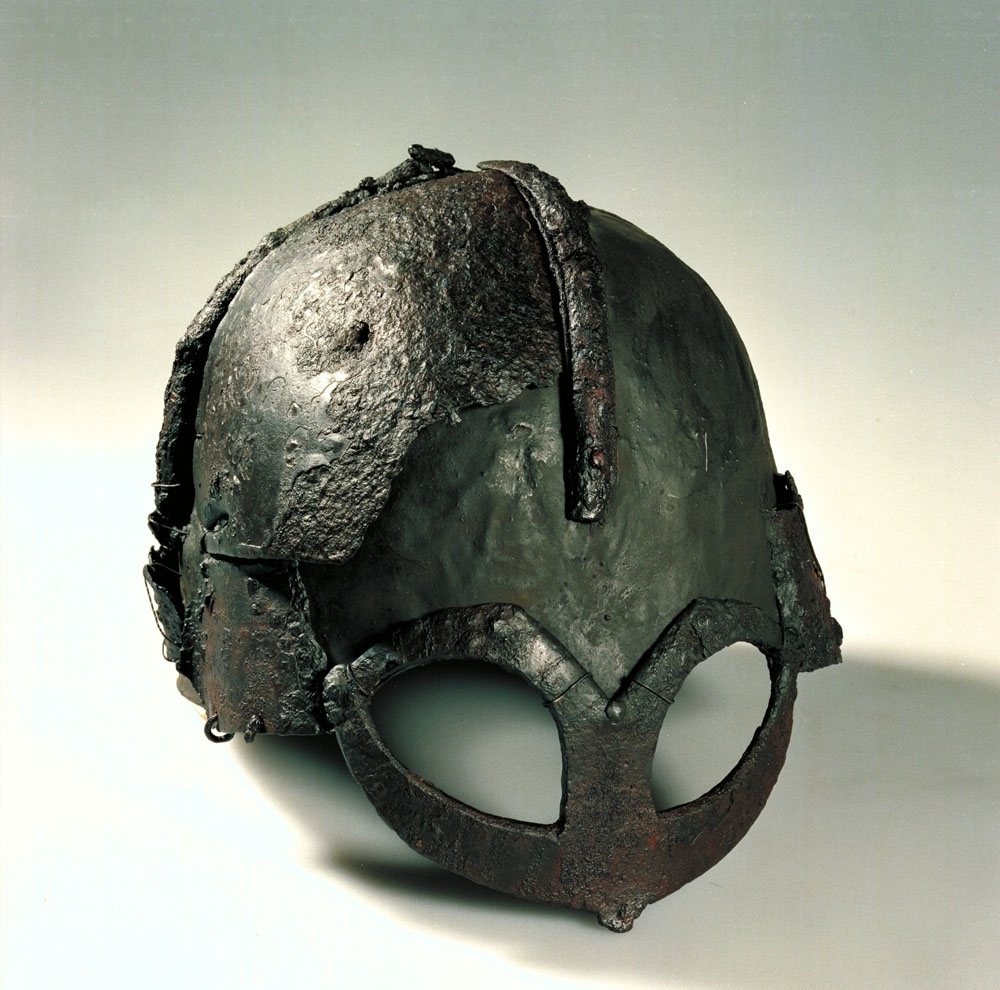
In the spring of 1943 a farmer at Gjermundbu in Ringerike, some 60 kilometres north-west of Oslo, hit metal while digging into a burial mound. What he unearthed would become the most famous piece of headgear in all Viking research. The archaeologist Sigurd Grieg of the Historical Museum in Oslo took over the investigation, and it was soon clear this was no ordinary grave. Among rusted weapons, fittings and mail lay the broken but reassemblable pieces of an iron helmet.
The find is dated to the second half of the 10th century, usually around 950 to 975 – the high point of the Viking Age. The helmet is now kept at the Kulturhistorisk museum (University of Oslo). It is famous for one disarmingly simple reason: it is the only one of its kind.
That Norway of all places produced this find is no accident: the pagan custom of burying the dead with weapons and gear held on comparatively long here, and the soil conditions of some burial mounds preserved iron better than elsewhere. Even so, Gjermundbu remained a stroke of luck – a single dig into the earth that opened a whole chapter of armour history that would otherwise lie in the dark.
The bowl of the Gjermundbu helmet is not a smooth dome but is assembled from four iron segments held together by a brow band and two crossing bands – the so-called spangenhelm construction, a long-established technique already common in Late Antiquity and the Vendel Period. A small knob or spike sits where the bands meet. It is a sober, practical build: several smaller iron pieces are easier to forge than one deep-drawn skull.
Two things hung from this frame and made the helmet a star: a face mask at the front and, at the back and sides, the remains of a mail curtain. Both survive only in fragments, yet the joints and rivet holes allow a fairly confident reconstruction. This was no mere iron pot but a considered piece of protection for head, face and neck.
What is notable is what is absent: any ornament. The Gjermundbu helmet is bare and plain, all tool – no gilded pressed foils, no animal-style decoration like the parade helmets of the Vendel Period. The iron is only a few millimetres thick; the helmet was worn over an inner padding of leather or textile, now lost, that cushioned blows and held it firmly on the head. Such organic parts vanish completely in the ground, so we can only infer them.
The most striking feature is the so-called spectacle guard: two rounded eye arches joined by a broad nasal bar, together resembling a heavy iron pair of glasses. The mask protected the eyes and bridge of the nose without seriously narrowing the field of view – a sensible compromise between cover and vision in the press of battle.
The spectacle mask is not a Viking one-off. It sits in a line with the splendid helmets of the Swedish Vendel Period (Vendel, Valsgärde) and with the Anglo-Saxon pieces from Sutton Hoo and the Coppergate helmet from York. The Gjermundbu helmet is the later, plainer relative of those richly decorated parade helmets: the same idea, less gold, more tool.
In today's medieval and re-enactment scene "Gjermundbu helmet" has long become a type name: countless reproductions appeal to this single original. One should simply keep in mind that many modern details – a fully formed nasal, particular rivet patterns – are additions of the reconstruction. The find itself gives the basic form; the finer points are partly well-founded, partly debated filling of the gaps.
Among the weapons and fittings lay a tangle of mail. Part of it belonged to the helmet: a curtain of linked iron rings hanging from the lower edge to cover the neck and the sides of the throat. Reconstructions restore it as a short skirt of ringmail. The rings had outer diameters of roughly 7.5 to 8.7 millimetres – fine, laborious handwork, since every single ring had to be bent, riveted and threaded into its neighbours.
Harald Sigurdarson had drawn up his men so that most of them had left their coats of mail behind; for the day was hot with sunshine, and the men had only their shields, helmets and spears.Snorri Sturluson, Heimskringla – Saga of Harald Sigurdarson (Stamford Bridge, 1066), public-domain translation after Samuel Laing 1844
The scene from Snorri's kings' saga is a reminder that protective gear was a deliberate choice – and that in a pinch it might be left at home. A mail shirt plus a helmet with a ring curtain: that was equipment you had to be able to afford and to carry.
The helmet did not lie alone. The Gjermundbu burial (the material is spread across two neighbouring graves in the same mound) held a rich warrior's kit: the remains of a ringmail shirt – itself a great rarity – swords, axe blades, spear- and arrowheads, shield bosses, stirrups and horse harness, plus everyday and gaming gear. Those buried here belonged to the upper class, to people who could afford cavalry, iron and imported status goods.
This combination – helmet plus mail plus riding gear – is the real evidence. It shows a wealthy warrior of the late 10th century, not the average fighter. That is exactly what makes the find so valuable: it is a window onto the equipment of the few, not the many.
The inventory also included gaming pieces and dice – a fine touch that shows the dead man not only as a warrior but as a man of rank and leisure. Cavalry and board game, sword and dice: that is the profile of a leader given, in death, the things that defined his standing. In this ensemble the helmet is no isolated showpiece but part of a complete elite kit – and it is precisely the context that makes it so eloquent for research.
The obvious question is: if Vikings wore helmets, where are the others? The honest answer mixes economics, chemistry and burial custom. First, a good iron helmet was expensive; most fighters simply did not own one in metal. Those who could afford protection may have reached for leather or felt caps, which vanish entirely in the ground. Second, iron perishes: in most soils a thin helmet rusts to fragments over a thousand years, or disappears altogether. Third, costly metal was handed on in life, repaired and reforged, rather than committed to the grave in numbers.
So Gjermundbu remains, for now, the only Viking helmet complete enough to be recognised as a helmet at all. Everything else is isolated scraps – an eye arch here, a nasal bar there.
One such scrap is the eye-guard fragment from Tjele in Denmark, a single spectacle-mask remnant without its bowl. It shows that the helmet type was more widespread than the one complete find suggests – of most helmets we see only the hint. That is exactly why Gjermundbu is so irreplaceable: it is the key with which the scattered splinters can be interpreted at all.
Typologically the Gjermundbu helmet is not quite alone. It belongs to the family of spectacle-masked spangenhelms whose ancestors are the Vendel-Period helmets and Sutton Hoo. More recently a find from Yarm (North Yorkshire, England) drew attention: an iron helmet with a spectacle mask that lay long in a museum store and was only studied scientifically around 2020, discussed as a possible second (nearly) complete helmet from a Viking-Age context. Its precise dating is still being weighed, but even as a candidate it underlines how uniquely Gjermundbu has stood. Two pieces in a century and a half of research – that is the whole tally.
No Viking helmet anywhere bore horns. Not one surviving piece, not one contemporary image shows a horned warrior. The popular picture is a 19th-century invention: the stage designer Carl Emil Doepler created horned and winged helmets for the première of Richard Wagner's Ring of the Nibelung in Bayreuth in 1876, and from the opera stage the motif migrated to postcards, advertising and finally every fancy-dress shop. The genuinely horned helmets of the past – such as the bronze helmets of Veksø in Denmark – are cultic showpieces of the Bronze Age, roughly 1,800 years older than the Viking Age. Linking them to Vikings is about as accurate as arming a medieval knight with a stone axe.
Where did the image of the horned Northman come from at all? Artists and scholars of the Romantic era already confused Bronze-Age finds and ancient reports of distant peoples with the Vikings, and equipped their heroes with horns and wings. Wagner's stage made the motif popular, and because a horned helmet simply looks more dramatic than a plain iron cap, it has clung on stubbornly – to this day on every fancy-dress costume. The real Gjermundbu helmet is less spectacular and more practical: a sober, well-considered iron cap that was useful in battle rather than dazzling on stage. That is exactly what makes it so valuable.
The Gjermundbu helmet was found in 1943 in a burial mound in Ringerike (Norway) and dates to the late 10th century. It consists of a four-part iron spangen bowl with a knob, a mounted spectacle mask (two eye arches and a nasal bar) and the remains of a mail curtain. It lay in a rich warrior grave together with ringmail remains, weapons and riding gear. It is still the only nearly complete surviving Viking-Age helmet; it is held at the Kulturhistorisk museum in Oslo.
Viking helmets had no horns. The horned helmet is a 19th-century stage invention (Carl Emil Doepler for Wagner's Ring, Bayreuth 1876). Genuine horned helmets such as those from Veksø are Bronze Age and about 1,800 years older. Equally misleading is the idea that every Viking wore a metal helmet: helmets were expensive and rare, and most fighters had none that survives – Gjermundbu shows the kit of a wealthy warrior, not the average.
The horned-helmet myth · The Viking Shield · The Viking Sword · The shield wall · Berserkers.
All History & Finds articles →
Somewhere a story must begin. For the kingdom of Denmark this beginning is a man named Gorm – Gorm the Old, the first …
Read more →In 865 an army landed in England that did not want to raid and sail home, but to stay: the „Great Heathen Army". Two …
Read more →The name says it all: Gudme means „home of the gods". On the Danish island of Funen lay one of the richest cult and …
Read more →