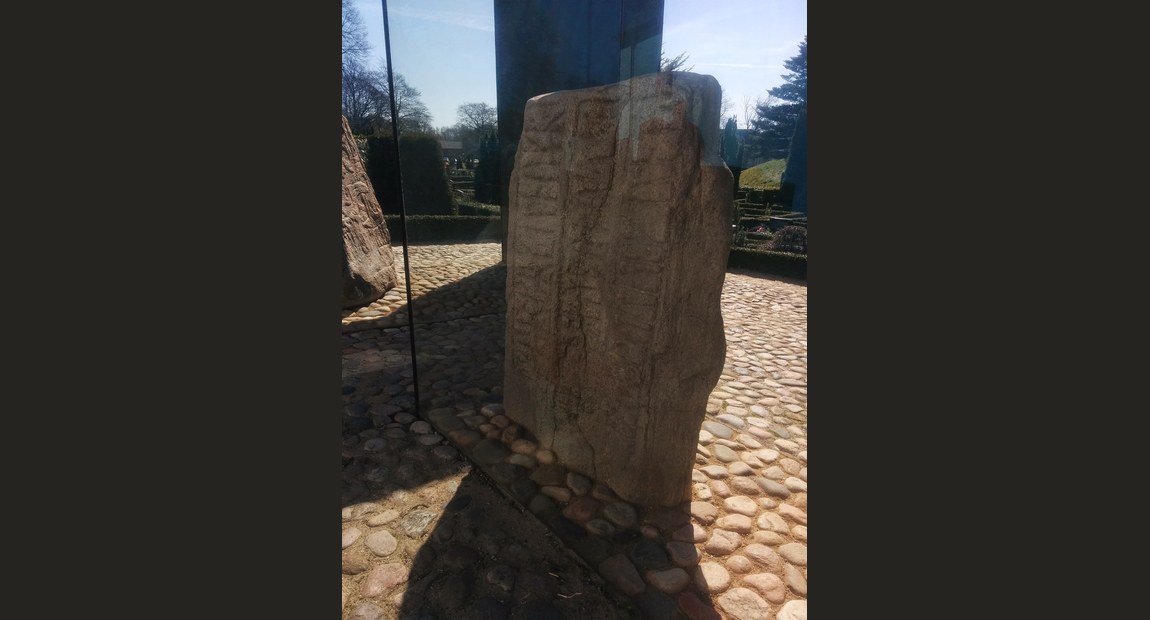
Gorm the Old is the first king of Denmark whose existence is proven by a monument of his own: in the mid-10th century he raised a runestone at Jelling for his wife Thyra, and his son Harald Bluetooth named him as his father on the great Jelling stone. Gorm probably died in the winter of 958/59. Here is where he came from, what Adam of Bremen and the sagas say about him, how he dealt with Christianity, and why his bones may lie beneath the floor of Jelling church.
Imagine a king who left us not a single word of his own. No portrait, no charter, no coin with his name on it. What we have is a few dozen runes on a granite boulder, a mention by his son – and perhaps an incomplete skeleton beneath a church floor in central Jutland. Yet the Danish royal line, which runs unbroken for more than a thousand years to today's monarchy, starts with this man. His name was Gorm. Later generations called him the Old.
Precisely because so little is certain, Gorm repays a careful look. Danish chroniclers, Icelandic saga writers and romantic history painters wrapped him in legend. Underneath lies a narrow but hard core of stone, timber and bone. We'll keep the two layers apart – the same way we sort fact from fancy in our workshop before any motif goes onto slate or wood.
Search for "first king of Denmark" and you will almost always land on Gorm. That is not quite right. Danish kings appear in Frankish sources long before him. Around 700 the missionary Willibrord met a Danish king called Ongendus, according to Alcuin's Life of Willibrord. In the early 9th century King Godfred (Gudfred) appears in the Royal Frankish Annals as a dangerous opponent of Charlemagne; he moved craftsmen from the Slavic trading place of Reric to Hedeby and strengthened the border rampart we now know as the Danevirke. After him come Horik, Harald Klak and others whose power base is hazy.
What sets Gorm apart is that with him a line begins that never breaks. His son Harald Bluetooth, his grandson Sweyn Forkbeard, his great-grandson Cnut the Great – the so-called Jelling dynasty. The Danish royal house still traces its descent back to Gorm. "First securely attested king of the present line" is the honest phrasing. It is clunkier, but it is true.
One more caveat: whether Gorm ruled all of the territory we now call Denmark is an open question. On his stone Harald boasts that he "won for himself all of Denmark". Many scholars read this to mean that Gorm's power base was mainly Jutland, perhaps only part of it. He was probably not a founder of the realm in the later sense – more the man whose foundations his son built upon.
Before the stories, a look at the toolkit. There are three kinds of evidence for Gorm, and they carry very different weight.
At the top stand the Jelling runestones. They are contemporary – carved in Gorm's lifetime or shortly after his death – and they name him. Next to them stands archaeology: the burial mounds, the church, the timber samples, the skeleton. The third group is the written sources, and here things get tricky. The Saxon monk Widukind of Corvey wrote around 967–973, while Harald was still alive – but he never mentions Gorm. Adam of Bremen wrote around 1075, more than a century later. Saxo Grammaticus and the Icelandic sagas date from around 1200 and the 13th century.
This matters because many familiar details – his ancestry, his hostility to Christians, the manner of his death – come from those later texts. They may be true. They need not be.
The Jelling monuments have their own in-depth article on our site: Jelling – mounds, stones and the birth of Denmark. Here we stick to what concerns Gorm directly.
The small Jelling stone (DR 41) carries a short inscription in the Younger Futhark. In our own rendering it reads:
"King Gorm made this monument in memory of Thyra, his wife, Denmark's adornment."Small Jelling stone (DR 41), our own translation
The Old Norse Danmarkar bót at the end is one of the earliest uses of the name "Denmark" on Danish soil. Exactly what bót means – "adornment", "strength", "remedy", "salvation" – is still debated. Recent Danish research has even suggested that the phrase points to Thyra's origins in the Danish border march of southern Jutland. A minority view applies the honorific not to Thyra at all but to Gorm himself. That reading has not won general support.
The great Jelling stone (DR 42) is Harald's. He raised it for "Gorm, his father, and Thyra, his mother", adding that he won all of Denmark and Norway and made the Danes Christian. So the family link Gorm–Thyra–Harald is set in stone. For Harald's career, see our article on Harald Bluetooth.
The stones are silent about Gorm's father. This is where Adam of Bremen comes in, the historian of the archbishopric of Hamburg-Bremen. His Gesta was written around 1075/76, and by his own account part of what he knew about Danish royal history came from the mouth of King Sweyn Estridsen – one of Gorm's descendants. That makes Adam valuable, but also partisan. More on his methods in our portrait of Adam of Bremen.
Adam's story runs roughly like this. Denmark was first ruled by a family that had come from Sweden, founded by one Olaf and continued by his sons Gyrd and Gnupa. Then Hardegon, a son of Sven, came from "Nortmannia" and drove the young king Sigerich (Sigtrygg) from the throne – during the time of Archbishop Hoger, so around 909–917. Adam also hints that the realm was divided among several kings.
Two puzzles hide in this short account. First: what was Nortmannia? Norway, Normandy, Northumbria or simply northern Jutland have all been proposed. A silver penny inscribed AIRDECONUT from the Silverdale Hoard in northern England (early 10th century) has livened up the debate: it could name an otherwise unknown Viking king in Northumbria – or a Harthacnut who later turned up in Denmark. Neither can be proven.
Second: is Adam's Hardegon the same person as the Hörðaknútr (Harthacnut) of later Icelandic and Danish tradition, which consistently makes Gorm the son of a Cnut? Many scholars equate them. The Danish runologist Lis Jacobsen thought they were two different people. To add to the confusion, in a later passage Adam names the Danish king attacked by Henry I as "Hardecnudth Vurm" in some manuscripts and "son of Hardecnudth Vurm" in others. Vurm or Worm is the German form of Gorm. You can read it as "Gorm, son of Harthacnut" – or as a double name.
Adam's Swedish dynasty would be easy to dismiss as a fable – were it not for two stones from the area around Hedeby, the great trading town on the Schlei inlet. Both were raised by a woman named Ásfríðr for her dead son Sigtrygg.
The first, DR 2, was found at Haddeby in 1797. Ásfríðr made "this monument in memory of Sigtrygg, her son" – the rest of the line is disputed. It can be read as "…and Gnupa's" or as a reference to a vé, a sanctuary, belonging to Gnupa. The second stone, DR 4, turned up in 1887 in the ramparts of Gottorf Castle in Schleswig. It is fuller: Ásfríðr, daughter of Óðinkárr, made the monument in memory of King Sigtrygg, her son and Gnupa's. A man called Gorm carved the runes.
And the rune carver Gorm on DR 4? In all likelihood he is not the king but a craftsman with the same name – Gorm was evidently a common name. Still, it is a lovely coincidence: in an inscription for the dynasty that Gorm's family pushed aside, his name appears as a signature.
One detail matters for the chronology. According to Adam, Hardegon deposed Sigtrygg as early as 909–917. That fits badly with what happened in 934.
In his Deeds of the Saxons, Widukind of Corvey reports that King Henry I, having subdued all the neighbouring peoples, attacked the Danes, who were raiding the Frisians by sea. He defeated them, made them pay tribute and forced their king, Chnuba, to accept baptism. Other annals date the campaign to 934. Chnuba is none other than Gnupa – the same name as on the Sigtrygg stones.
So in 934 the south around Hedeby was apparently still ruled by a Gnupa, not by Gorm. Adam of Bremen tells of the same campaign but casts "Worm" as Henry's opponent, and has the Saxon king fix the border at Schleswig, install a margrave and settle Saxons there. Most historians prefer Widukind here: he wrote much closer to the events and had the names first-hand. Adam probably slotted the best-known Danish king of the age into the story.
As early as the 19th century the Norwegian historian Gustav Storm concluded that Gnupa's family ruled in the south longer than Adam believed, and that it was Gorm who displaced them. Snorri Sturluson's Heimskringla does indeed say that Gorm took part of the kingdom from Gnupa by force. Snorri wrote around 1230 and is no reliable witness for the 10th century – but on this point his claim fits remarkably well with stone and chronicle. For the wider situation on the southern border, see our article on Widukind.
Few figures of early Danish history have become as legendary as Gorm's wife. Around 1200 Saxo Grammaticus made her the daughter of an English king Æthelred; other texts name a Jutish magnate called Klakk-Harald as her father. Both are chronologically awkward and backed by nothing contemporary. All that is certain is what Gorm had carved himself: she was his wife, and he honoured her with a stone calling her "Denmark's adornment". A king raising such a monument for his wife is remarkable and speaks to her standing.
Recent research suggests why the marriage may have mattered politically. If Thyra came from southern Jutland and had her own power base there, the union tied the north around Jelling to the contested border region in the south. That is a hypothesis, not a certainty, but it explains a good deal. Saxo and the chronicler Sven Aggesen credit Thyra with building the Danevirke. Archaeology shows the rampart is much older; whether work was done on it under her and Gorm remains open.
Her life, her later fame as guardian of the southern border and the question of who died first are covered in our article on Thyra Danebod. Just this much: since Gorm raised the stone for a dead Thyra, she very probably died before him. Saxo tells it the other way round.
Gorm was a pagan. There is no doubt about that – his son Harald explicitly boasts of having made the Danes Christian. How hostile Gorm actually was to the new faith, however, we know only from Adam of Bremen.
Adam relates that Archbishop Unni of Hamburg-Bremen, following in the footsteps of Saint Ansgar, travelled to the Danes. With Worm, as he calls Gorm, he achieved nothing: Adam paints the king as a furious enemy of the Christians. Gorm's son Harald, by contrast, received the missionary kindly and allowed him to preach in the land, though he was not yet baptised himself. Unni went on to Birka in Sweden and died there in 936. That is also the earliest date we can attach to Gorm – albeit only through an 11th-century text.
Adam's black-and-white picture should be taken with a pinch of salt. For a church historian from Bremen it was the perfect story: the stubborn pagan father, the open-minded son who would later convert the country. Whether Gorm really destroyed churches and persecuted priests, or simply had no interest in foreign missionaries, cannot be checked. What is certain is that Christians lived in the land: Hedeby and Ribe had churches from Ansgar's time in the 9th century.
The written sources are little help with the date of Gorm's death. Older estimates range from the 940s to the 960s. The answer came from timber.
The North Mound at Jelling, traditionally called "Thyra's mound", contains a large wooden burial chamber. When it was opened in 1820 it was empty apart from a few grave goods, among them a small silver cup in the Jelling style. Dendrochronology – dating wood by the pattern of its tree rings – showed that the oaks used for the chamber were felled in 958. The mound was heaped up afterwards. That points to a death in the winter of 958/59, assuming the chamber was built for Gorm. This is the most widely cited date today, although some older accounts still give 963 or 964.
The South Mound beside it was raised later and never contained a grave. It was probably a pure monument from the start. How the mounds, the vast palisade and the ship setting fit together is explained in our Jelling article.
If the North Mound was Gorm's grave – where is Gorm? The answer may lie beneath the whitewashed stone church of Jelling, which stands right between the two mounds.
Excavating inside the church between 1976 and 1979, Danish archaeologists found traces of several wooden churches that preceded the present stone building. Under the floor of the first wooden church lay a burial chamber holding the remains of a man. The bones came to light in 1978. The skeleton was incomplete and not in its natural position – a clear sign that the body had been moved. With it were fragments of gold brocade, costly fabric woven with gold thread, and two small silver mounts. These mounts match the style of objects grave robbers had apparently overlooked in the North Mound.
The National Museum of Denmark interprets the find cautiously: the dead man was aged about 40 to 50, he was moved from the North Mound into the new church, and he may be King Gorm. The logic is compelling. Harald was baptised around 965. A Christian king whose father lay as a pagan in a mound had good reason to bring him into consecrated ground – and to reconcile his own family with the new faith. If this is Gorm, his age at death implies he was born somewhere between about 908 and 918.
The identification is not proven. No DNA has so far been recovered from the bones, and reopening the grave would require permission from the church and the royal family. A later CT study even gave a broader age range of 35 to 50. During a 3D reconstruction of the skull, researchers from the universities of Copenhagen and Aarhus noticed a pronounced bony bump at the back of the head, where the neck muscles attach. It was probably harmless but would have made lying on his back uncomfortable. A rare, almost intimate glimpse of a man who died more than a thousand years ago.
In 2000 the bones were reburied beneath the floor of Jelling church. Adam Bak, curator at the Kongernes Jelling museum, has pointed out that the dead man has already been disturbed three times. Whether to disturb him a fourth time is also a question of respect.
Gorm did not demonstrably bear the nickname in his lifetime. In Old Norse literature he is Gormr gamli, "Gorm the Old". What that meant is debated. The obvious reading: he was "the Old" in the sense of forefather, the ancestor with whom the royal line began. That fits the fact that the Danish royal house still puts him at the head of its lineage.
Saxo took the name literally. He describes Gorm as an aged king who was already blind when his son Cnut fell. A man of 40 to 50 under the church floor sits badly with that – if he is Gorm. It does not disprove Saxo, but it is a strong hint that the chronicler was painting a picture rather than keeping a record.
Other nicknames are less flattering. Danish texts call him "the Sluggish" (Gorm den Dvaske or Gorm Løge), and some Icelandic sources know him as Gormr hinn heimski, "the Foolish". The Historia Norwegiae explicitly contrasts Thyra's wisdom with Gorm's foolishness. Whether that preserves a genuine memory or just a literary pattern – the clever wife beside the ponderous husband – we cannot say.
In the Icelandic kings' sagas Gorm is mostly a side character, the father you pass through on the way to the more exciting Harald. The 13th-century Jómsvíkinga saga tells of Gorm's family and how he won Thyra as his wife. The saga of the famous Jomsvikings is, however, a literary work full of travelling motifs, not a chronicle.
Saxo Grammaticus, who has his own article on our site (Saxo Grammaticus), builds a little novella around Gorm in the ninth book of his Gesta Danorum. Thyra demands all of Denmark as her bride-price and asks for three nights before the wedding night, in which a dream is to decide the future; Gorm lays his sword between them. He dreams of birds, one of which returns bloodied – an omen about their sons. One of those sons, Cnut, falls according to Saxo on a campaign in Ireland.
Best known is the tale of Gorm's death, embroidered by later Danish chroniclers, most vividly in Arild Huitfeldt's chronicle of the realm around 1600: the old king swore to kill anyone who brought him news of his favourite son's death. When the news came, nobody dared speak it. Thyra had the hall hung with mourning cloths; Gorm saw them, said aloud himself that Cnut was dead – and died the next day. A wonderful story. It is, however, hard to square with the Jelling stone, according to which Thyra died before Gorm.
In the end surprisingly little remains – and yet enough. A name on two stones. A burial chamber of oaks felled in 958. An incomplete skeleton with a bony bump at the back of the neck. And a dynasty that spread through Harald Bluetooth, Sweyn Forkbeard and Cnut the Great as far as England. If you want to follow the line of Scandinavian rulers further, start with our overview of Norse kings.
Perhaps the finest thing about Gorm is how he introduced himself to posterity. He did not have his victories carved, nor his treasures, nor his ancestors. He had his wife's name cut into stone and called her "Denmark's adornment". A man who wanted someone else not to be forgotten. That is the idea behind every runestone – and, if you like, behind every good engraving we put onto slate or wood in our Alsdorf workshop.
Who was Gorm the Old? Gorm the Old was a 10th-century Danish king based at Jelling, father of Harald Bluetooth and founder of the Jelling dynasty. He probably died in the winter of 958/59.
Was Gorm the first king of Denmark? No – there were earlier Danish kings such as Godfred around 800. But Gorm is the first king whose rule is secured by a monument of his own and from whom the present royal line descends.
Who was Gorm the Old's father? Later sources name a Harthacnut (Hörðaknútr); Adam of Bremen tells of a Hardegon from "Nortmannia". Whether they are the same man is disputed, and there is no contemporary evidence.
Where is Gorm the Old buried? Probably first in the North Mound at Jelling, whose chamber was built in 958. A skeleton found under Jelling church in 1978 may be his; it was reburied there in 2000.
Was Gorm the Old a Christian? No, Gorm remained a pagan. According to Adam of Bremen he rebuffed the missionary Unni around 936, while his son Harald tolerated the mission and later accepted baptism himself.
Why is Gorm called "the Old"? The nickname comes from later sources and probably means the forefather of the dynasty. Saxo took it literally and portrays Gorm as an aged, blind king.
For courage. For remembrance. For legends that live on.
Thyra Danebod – Denmark's mightiest woman · Stiklestad – the fall of Saint Olav · Trelleborg – Harald's ring fortresses · Danegeld & the Battle of Maldon · Ribe & the North's first coins.
All History & Finds articles →
In 865 an army landed in England that did not want to raid and sail home, but to stay: the „Great Heathen Army". Two …
Read more →The name says it all: Gudme means „home of the gods". On the Danish island of Funen lay one of the richest cult and …
Read more →They are so small and so thin that you can barely hold one without creasing it: the guldgubber, “gold men,” tiny …
Read more →In 1891 peat-cutters in a bog near Gundestrup in Jutland struck something metallic: a dismantled cauldron of pure …
Read more →