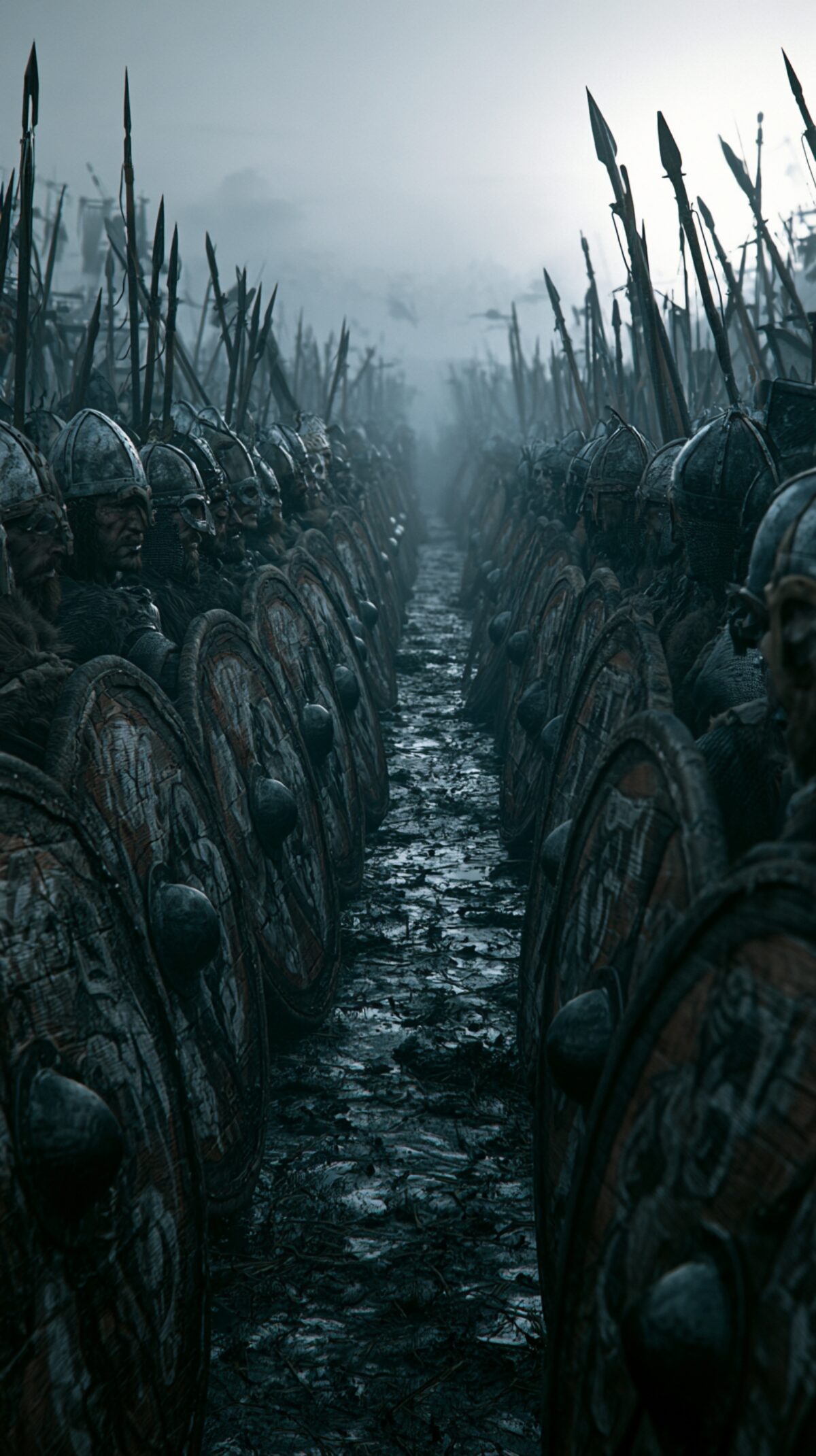
A name that outlasted three decades of war: Widukind was the most famous leader of Saxon resistance against Charlemagne. We tell what the sources actually allow – and separate the man from the legend that later centuries made of him.
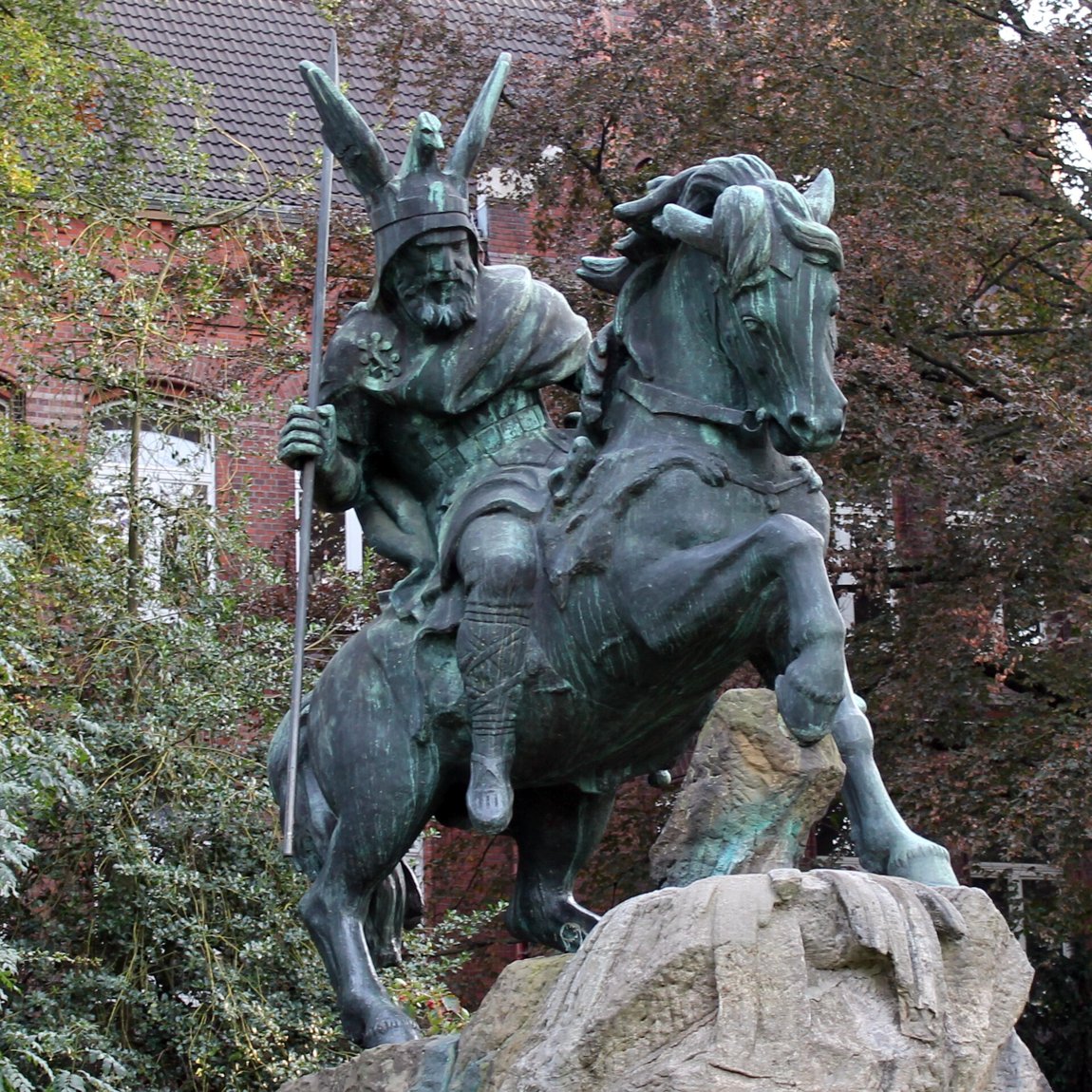
Widukind (also Wittekind) was a Saxon nobleman of the 8th century, probably from Westphalia, the westernmost of the three great Saxon regions alongside Engern and Ostfalen. His name means roughly "child of the woods" – from Old High German witu (wood, forest) and kind (child). About his origins, his year of birth and his end the sources are almost entirely silent. What we have is a thin framework drawn from Frankish annals, in which his name appears whenever the Saxons rose against Charlemagne.
This is the first and most important point: Widukind is a figure we know almost exclusively through the eyes of his enemies. He left no words himself, and the Saxons of his time did not write about themselves. Everything we think we know about him comes from the camp that defeated him.
To understand Widukind you have to understand the Saxon Wars: the longest and bloodiest conflict of Charlemagne's entire reign. From 772 to 804 the Frankish king marched again and again against the Saxons between the Rhine, the Elbe and the North Sea. It was about subjugation, about tribute, about borderland – and, as Charlemagne saw it, about the christianisation of a pagan people.
The Saxons were not a unified kingdom but a loose confederation of free tribes and nobles who deliberated in popular assemblies. That is exactly what made them so hard to defeat: there was no capital whose fall would end the war, and no king whose submission bound everyone. Wherever a Frankish army withdrew, the revolt flared up again. Widukind became the face of this stubborn, decentralised resistance.
To place Widukind, you have to know what order Charlemagne was battering against. The Saxons of the 8th century lived in three great regions – Westphalia in the west, Engern in the centre on the Weser, Ostfalen in the east towards the Elbe – together with the Nordalbingians beyond the lower Elbe. They were held together not by a king but by language, law and common assemblies. The chronicler Bede and later sources report a great yearly gathering at which free men, nobles and half-free spoke justice and decided on war and peace.
This society was agrarian, warlike and strongly shaped by kinship. Farmsteads, clans and warrior followings formed its backbone; whoever held standing led in war. Widukind was one such magnate – not a "king of the Saxons," as later legends liked to make him, but an influential nobleman whose authority rested on descent, following and success. It is precisely this loose, many-headed structure that explains why the war lasted so long: the Saxons could be beaten, but not subdued with a single blow.
Charlemagne's first great campaign in 772 struck at the sanctuary of the Saxons: he had the Irminsul destroyed, that wooden pillar which for the Saxons apparently held up the sky and marked a central cult site. For the Franks it was a calculated blow against the pagan self-understanding of an entire people; for the Saxons an attack on the heart of their order. You can read more about this symbol in our own article on the Irminsul.
Remarkably, Widukind does not yet appear in the accounts of 772. He is first named in 777 – not for a deed, but for an absence.
In 777 Charlemagne held a great imperial assembly at Paderborn. Many Saxon nobles appeared, submitted and had themselves baptised. Widukind did not come. The Royal Frankish Annals note tersely that he had fled to the Danes – to King Sigfred. This refusal to bow is the very first recorded act of Widukind. From this moment his name becomes, for the Franks, a byword for breach of faith and rebellion.
That he found refuge precisely among the Danes is no accident: the realm north of the Elbe lay beyond Charlemagne's reach and became a base of retreat. From there Widukind returned repeatedly once the Frankish troops had withdrawn, rekindling the revolt.
But Widukind, the author of all evil and instigator of the breach of faith, had fled with a few of his followers to the Northmen.paraphrased from the Royal Frankish Annals (Annales regni Francorum), a Carolingian-era chronicle
While Charlemagne was tied down in Spain in 778 (the year that ended with the disaster of Roncesvalles), the Saxons seized the chance and pushed as far as the Rhine. In 782 came the next great rising. At the Süntel, a ridge on the Weser, a Frankish army suffered a heavy defeat – several of Charlemagne's high-ranking nobles fell. It was a humiliation that cried out for revenge.
In the sources Widukind is presented as the driving force behind this rising. Whether he personally commanded the battle at the Süntel the annals do not say clearly – but in the Frankish narrative he is the mind behind everything.
Charlemagne's reaction was appalling. After the revolt of 782 he had, according to the Royal Frankish Annals, 4,500 Saxons executed on a single day at Verden on the Aller. Widukind himself was not among them – he had once again escaped to the Danes. Those who suffered were the ones attributed to him or the ones who could be seized.
This event is the darkest point of the whole story, and it must be named honestly: even if one doubts the number, an act of cold, state-decreed mass killing remains. Historians still debate its exact meaning. Some consider the reported figure of 4,500 exaggerated; others have proposed a textual confusion, that the original spoke of a resettlement (delocabat) rather than a beheading (decollabat). Today, however, this linguistic thesis is regarded as unconvincing; most specialists take the report as it stands: a mass execution. What is certain is that Verden intensified the war rather than ending it.
Charlemagne relied not only on the sword. His instrument was a whole system of coercion and conversion. In the infamous Capitulatio de partibus Saxoniae, the Saxon law, he set the death penalty on a series of offences: on refusing baptism, on clinging to the pagan custom of cremating the dead, on attacks against churches and clergy. Rarely does a medieval text state so bluntly that a faith was to be imposed by force.
Added to this were mass resettlements: entire Saxon population groups were transplanted into the Frankish realm to break up nests of resistance. Noble sons were taken as hostages, missionaries such as Sturmi and later Willehad were sent into the land, and bishoprics were founded – from this period places such as Paderborn, Münster and Osnabrück emerge as ecclesiastical centres. Only in 797 did Charlemagne soften the harshest provisions of the Saxon law again. Widukind's revolts were the answer to exactly this pressure – and Charlemagne's harshness was the answer to the revolts. The two drove each other ever higher, until the settlement came in 785.
After further years of struggle the turning point came in 785. Widukind and his ally Abbio negotiated, received safe conduct and submitted. At Attigny Widukind was baptised – and none other than Charlemagne himself stood beside him as godfather. Pope Hadrian ordered days of thanksgiving to be held for the occasion. For the Franks it was a triumph of propaganda: the "author of all evil" had accepted the cross.
With this moment Widukind vanishes from history. No date of death, no grave, no further word. What became of him afterwards we simply do not know. The historical Widukind ends with his baptism – and it was precisely into this gap that, over the following centuries, legend poured.
Almost everything said here rests on the Royal Frankish Annals and related Frankish works, plus Einhard's biography of Charlemagne. These are texts from the circle of the royal court, written by victors and Christians about a defeated pagan enemy. They call Widukind the "author of all evil," the perjurer, the agitator. That is not a neutral description but an image of the enemy.
There is not a single Saxon self-testimony about Widukind. How he saw himself, what goals he pursued, whether he was a "freedom fighter" or a power-conscious nobleman defending his position – none of this can be answered from the sources. Whoever speaks of Widukind is always first speaking of what the Franks told about him.
Precisely because so little is certain, the figure grew over the centuries. In the Middle Ages Saxon noble houses claimed descent from Widukind; through the Ottonian and later the Welf line this tradition-building reaches down to Henry the Lion. Widukind became the noble ancestor, the christianised, purified hero.
In Westphalian Enger (district of Herford) a "Widukind grave" is venerated to this day in the collegiate church. The tomb monument there, however, is clearly younger than the 8th century and cannot be verified as an authentic burial place – it is a site of memory, not archaeological proof. Enger and the surrounding region of East Westphalia keep the memory alive with a museum and a Widukind memorial site; here the Saxon leader remains part of local identity.
Part of the Widukind reception must be named clearly and seriously. In the 19th and above all the 20th century Widukind was inflated into a national and then a völkisch symbol – as a Germanic hero who resisted "foreign" Christianity. In the Nazi era völkisch circles and parts of the SS leadership took an interest in Widukind and the Externsteine region; the Saxon Wars were instrumentalised for an anti-Christian, "Nordic-Germanic" ideology. Charlemagne was defamed by some as the "butcher of the Saxons."
This is historically untenable and ideologically poisoned. The real Widukind was a Saxon nobleman of the 8th century who in the end had himself baptised – not a projection screen for racial ideologies. We tell his story because it is a genuine chapter in the history of our home region, and for that very reason without any völkisch glorification.
A common misunderstanding: the Saxon leader is not the same as Widukind of Corvey. He was a monk and historian of the 10th century who wrote the "Res gestae Saxonicae" (History of the Saxons) at Corvey Abbey on the Weser – some 150 years after the rebel. Both bear the same Saxon name, which shows how widespread it remained in the region. The chronicler reports on early Saxon history, but is an entirely different person.
For us in the region between the Rhine and the Weser, Widukind is more than a footnote: he stands for a time when our ancestors stood between old belief and new order, when freedom, subjugation and adaptation lay close together. The Saxons lost their war – but their landscapes, names and stories live on. To remember Widukind honestly means to seek the human being behind the legend and to call the myth by its name.
The Irminsul · The Externsteine – an invented cult site? · Law & the Thing · Nordalbingia.
All History & Finds articles →
Vikings and Aachen? Sounds like two worlds with nothing to do with one another. Yet in the winter of 881/882 the …
Read more →The axe is the most honest tool of the Viking Age. It split firewood, built ships, cut paths through the forest - and …
Read more →