Almost everything we think we know about the Norse world of gods and heroes comes from Iceland. But there is a second great voice: a Danish cleric around the year 1200 who set down the "Deeds of the Danes" in brilliant Latin. His name is Saxo Grammaticus, and his tales often diverge from the Icelandic tradition in surprising ways – sometimes filling gaps, sometimes openly contradicting it. Anyone who wants to understand the sagas honestly cannot ignore him.
As vast as his work is, our knowledge of the author is thin. Saxo was born around 1150 and died after 1208; more precise dates are lacking. He was an educated Danish cleric, probably from a warrior family on Zealand – he himself notes that his father and grandfather had served Danish kings. He likely did not even bear the byname "Grammaticus" during his lifetime; the epithet, meaning "the learned" or "the lettered," first appears about 150 years later, in the Jutland Chronicle of the 14th century, honouring his extraordinary command of Latin.
What is certain is this: Saxo served the powerful Archbishop Absalon of Lund (c. 1128–1201), the closest adviser of King Valdemar I. Absalon was churchman, warlord and statesman all at once – and it was he who charged Saxo with writing a great history of the Danish people. Without this patron, the Gesta Danorum would not exist.
Saxo's life's work bears the title Gesta Danorum, "The Deeds of the Danes." It comprises sixteen books and arches from the grey primordial past into Saxo's own present around 1200. He probably began in the 1180s, but the work was completed only after Absalon's death, around 1208; the dedication is addressed to Absalon's successor, Archbishop Anders Sunesen, and to King Valdemar II.
What sets this work apart from all other medieval histories of the North is its language. Saxo wrote not in the vernacular but in an ornate, highly rhetorical Latin, deliberately modelled on Roman authors of the so-called Silver Age – writers such as Valerius Maximus and Justin. He wanted to prove that the Danes possessed a past in no way inferior to that of the Greeks and Romans. The Gesta Danorum are therefore less a sober chronicle than a patriotic monument: the celebration of a people that deserves its own heroes, kings and origin legends.
I, Saxo, least among the companions of Absalon, was moved by the will of my lord to take upon myself a labour beyond my powers: to rescue the deeds of the Danes from oblivion and set them down in writing, so that they might no longer remain unspoken.Paraphrased from the preface of the Gesta Danorum; translation: Glanz & Gravur
Saxo's work can only be understood if one knows his patron. Absalon of Lund was no pale cloister figure but one of the most powerful personalities of the Danish High Middle Ages: bishop of Roskilde, then archbishop of Lund, at the same time a fleet commander in the wars against the heathen Wends on the Baltic coast, and the right hand of two kings. Copenhagen owes him its first castle, and the Danish church owes him much of its rise.
Such a man wanted the greatness of his people and his lords fixed forever – in the learned language of Europe, Latin, so that it would command respect beyond the North as well. Saxo was the instrument of this ambition. That also explains the tone of the Gesta Danorum: they are not neutral but the cultural prestige project of a centre of power that wished to give the young Danish monarchy a glorious prehistory. When Absalon died in 1201 the work was not yet finished; Saxo completed it under his successor and remained loyal in dedication to his late lord.
The Gesta Danorum fall clearly into two halves. The first nine books portray the mythical and legendary past: a world full of giants, sorcerers, monsters and superhuman warriors, in which the old gods still walk. Books ten through sixteen, by contrast, approach tangible history – the conversion to Christianity, the Danish kings of the High Middle Ages, and finally Absalon and Valdemar themselves.
For us, the first half is especially precious. Here Saxo preserves legendary material found nowhere else, or only in an entirely different form. He had access to oral tradition, to Icelandic informants and evidently also to poems now lost. Some of what he recorded would have vanished without a trace if he had not written it down.
The most striking difference from the Icelandic tradition concerns the gods themselves. Saxo was a Christian cleric, and he could not allow heathen deities to count as true gods. So he reached for a device widespread in medieval scholarship: euhemerism. In his pages the gods of the North appear not as heavenly powers but as human beings – as especially cunning, powerful or deceitful mortals who had secured a reputation for divinity through sorcery.
Odin (Saxo's Othinus) is such a man: a crafty ruler and magician, taken for a god by credulous peoples, but whom Saxo also lets fail, disgrace himself and pay penance. This reinterpretation is no accident but deliberate strategy. It allowed Saxo to write down the old stories at all without clashing with his Christian worldview – while of course also distorting the original religious meaning considerably.
Saxo's most famous tale stands in the third and fourth books: the story of Prince Amleth (Latin Amlethus). His father, the Jutish governor, is murdered by his own brother, who then seizes both throne and widow. Amleth feigns madness to escape the murderer's suspicion, sees through every trap laid for him, and in the end takes cold-blooded, cunning revenge for his father.
Anyone who recognises Shakespeare's Hamlet here is right. By a detour – the French retelling by François de Belleforest in the 16th century – Saxo's Amleth material reached England and became the source for one of the most famous dramas in world literature. The feigned madness, the murdered father, the usurping uncle, the mother at the murderer's side: all of it is already in Saxo, centuries before Shakespeare. Anyone seeking a Viking-age root for Hamlet finds it in a Danish history of around 1200.
Nowhere is the distance between Saxo and Iceland so tangible as in the death of Baldr. In the Icelandic tradition (in Snorri Sturluson and the Eddic poems) Baldr is the radiant, innocent god whom no one can harm – until the guileless, blind Höðr, deceived by Loki, kills him with a sprig of mistletoe. It is a tragedy about envy, deceit and the loss of what is good.
In Saxo (in the third book) everything is different. Balderus and Høtherus (Hother) are not unwilling victim and unwitting killer but declared rivals – two demigods or heroes contending for the same woman: the beautiful Nanna. Hother is no blind innocent but a vigorous hero who faces Balderus in open enmity and finally slays him with a special sword. Saxo turns the heavenly tragedy into an earthly story of jealousy, cunning and competition. Both versions tell of the same name – and yet mean almost the opposite.
Among Saxo's most impressive figures is Starkad (Latin Starcatherus), a giant-like, extraordinarily long-lived warrior of superhuman strength, who moves through the centuries, serves countless kings, and finally stages his own death as a last heroic deed. Starkad is known from Icelandic sources too, but Saxo devotes especially broad space to him and shapes him into the very embodiment of the Old Norse warrior ideal – hard, honourable, unbending against the softening of the times.
Equally legendary is the Battle of Bravalla (Bravellir), which Saxo describes in the eighth book with enormous effort: a fabled struggle between the aged Danish king Harald Hilditönn ("War-tooth") and the Swedish king Sigurd Ring, drawing in the heroes of the entire North. This battle is not historically verifiable; it is legend, not chronicle. But it shows how Saxo composed, out of inherited material, a monumental image of the heroic past.
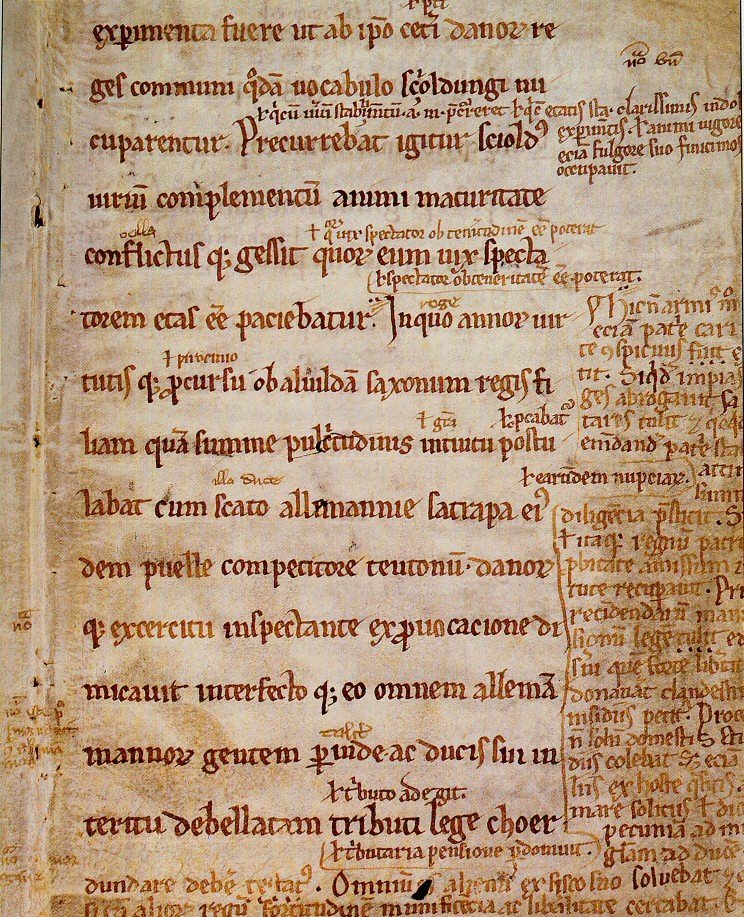
As significant as the Gesta Danorum are, their survival hung by a thread. No complete medieval manuscript of the work is preserved. What we read today rests essentially on the first printed text: the Paris edition of 1514, produced by the Danish scholar Christiern Pedersen and printed in the workshop of Jodocus Badius Ascensius. Pedersen had searched deliberately for manuscripts in order to save Saxo's work from oblivion – and indeed our knowledge of the full text still rests at its core on this printed edition.
Of the medieval parchment itself only tiny remnants survive. The most important is the so-called Angers Fragment, a leaf discovered in France in 1863, bearing corrections and rearrangements, which some scholars even interpret as a working copy from Saxo's immediate circle. It is a moving detail: of one of the greatest historical works of the North, scarcely more than a handful of lines survives in the original.
As valuable as Saxo is, he must be read with caution. Three things colour his work throughout. First, the Christian gaze: a cleric around 1200 could only depict the old gods as men or impostors, not as what they had once meant to the heathen. Second, the patriotic purpose: Saxo wrote a glorious history of the Danes at the behest of the Danish crown and church. Danish kings and heroes appear correspondingly great, their opponents often small. Third, the gap in time: some two hundred years lie between the end of heathenism and Saxo's pen. He describes a world of belief he never experienced himself.
On top of this, Saxo shaped his material into literature. He ordered, interpreted, wove sagas into one great arc, and put well-turned Latin speeches into his characters' mouths. Where the Icelandic sources are often terse and angular, Saxo is elaborate and rhetorical. That makes him magnificent literature – and a source whose statements must never be taken at face value as pure heathen truth.
Saxo and the Icelandic writers worked at almost the same time: Snorri Sturluson composed his Prose Edda and the Heimskringla in the 1220s and 1230s, only a generation after Saxo. Both drew on a shared Germanic store of legend passed down orally over centuries – and both gave it their own stamp. Saxo himself, in his preface, expressly honours the Icelanders as keepers of ancient tradition; he knew that on the distant island a memory survived that had faded elsewhere.
But their paths diverged. The Icelanders wrote in their own language and stayed closer to the poetic form of the old lays; Saxo cast the same material into Roman Latin and into the garb of ancient historiography. Where the Icelander quotes a verse, Saxo delivers a speech. Where Snorri tells of the gods as gods (and only afterwards places them in a learned frame), Saxo turns them into men from the outset. So from one root grew two very different trees. Whoever knows only one sees only half the crown.
Despite all these reservations, Saxo Grammaticus is indispensable for anyone who takes the Norse world of legend seriously. He is the great counterweight to Iceland: an independent tradition that confirms much, supplements some things and tells others entirely differently. It is precisely in this friction that his value lies. Where Saxo and the Edda agree, we may suspect that an old core shines through. Where they contradict each other, we learn something about the variety and mutability of tradition – and about what Christianity, national pride and centuries of distance can make of old stories.
Without Saxo we would know nothing of Amleth, and thus perhaps nothing of Hamlet. We would know only the one Baldr story, not the second. And we would lack the reminder that the legends of the North never lived in only one place, but were told, reshaped and reinterpreted across the seas again and again. Saxo Grammaticus is the proof that there is no single, pure truth about the old gods – only many voices, all of which we must hear in order to stay honest.
Snorri Sturluson · The Edda · Ragnar Lodbrok · Baldr · The Norse pantheon.
A dwarf's curse, a re-forged sword and a thrust from below: how young Sigurd slew the gold-greedy dragon Fafnir …
Read more →It is the most famous smithing scene of the North: two dwarf brothers, a wager on Loki’s head, and a fly that stings at …
Read more →Almost everything we think we know about Odin, Thor and the end of the world runs through a single figure: an Icelandic …
Read more →Some heroes set out with a sword. Svipdagr sets out with the protective charms of his dead mother – and with a task he …
Read more →