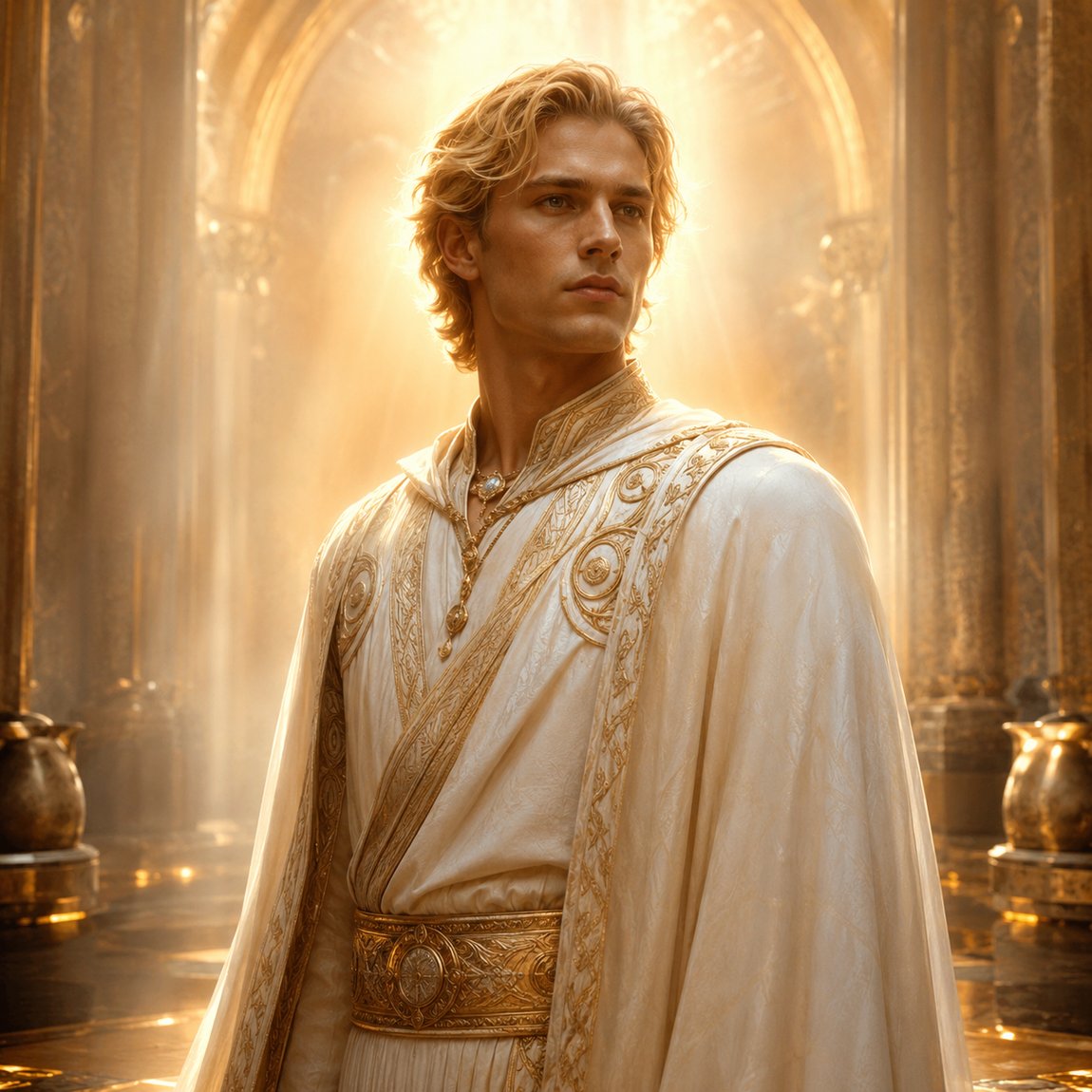
Baldr (also Balder or Baldur) is the Norse god who is the son of Odin and Frigg, husband of Nanna and father of Forseti – so fair and bright, says Snorri, that light shines from him. He is famous for his death: Frigg makes everything in the world swear never to harm him, except the mistletoe. Loki puts it into the hand of blind Höðr, Baldr dies and stays with Hel – until he returns after Ragnarök. Here is what the sources really say, and where they disagree.
Most gods are known for what they do. Thor smashes giants, Odin gives up an eye, Loki makes trouble. Baldr, by contrast, does remarkably little in the sources. He fights no battles, goes on no journeys, wins no treasure. He is simply there – bright, kind, beloved. And then he is dead. That empty space at the centre is what makes him perhaps the most puzzling figure of the North: a god whose most important deed is his own dying.
Baldr is one of the Æsir, the family of gods around Odin. His mother is Frigg, the highest goddess, who will fight for his life like no other figure in the myths. His wife is Nanna, daughter of Nep according to Snorri. Their son is Forseti, god of justice, who settles disputes in the hall Glitnir. His brothers include blind Höðr, the later avenger Váli and – depending on how you read it – Hermóðr, whom Snorri calls sveinn Óðins, which can mean "Odin's son" or "Odin's lad, his retainer".
Baldr lives in Breiðablik, "Broad-gleaming". The Eddic poem Grímnismál (st. 12), in which Odin lists the halls of the gods, describes it as the land where there is least of anything baleful. Snorri follows this: nothing unclean can be in that place. Baldr also owns a ship, Hringhorni, "the greatest of all ships" – it will become his funeral pyre.
The name has no certain explanation. Old Norse baldr appears in poetry as a word for "lord, prince", like Old English bealdor. Others think of "brave" (English bold) or of bál, "fire", and so of "the shining one". None of this is proven.
The fullest description comes from Snorri Sturluson, the Icelandic scholar who wrote the Prose Edda around 1220. In its first part, Gylfaginning ("The Tricking of Gylfi"), he presents the gods in a question-and-answer frame. Chapter 22 says, in essence: Baldr is the best of the gods and all praise him. He is so fair of face and so bright that light shines from him. One plant is so white that it is compared to Baldr's brow – Snorri calls it Baldrs brá, "Baldr's brow", a white-flowered chamomile-like plant. He is the wisest, most eloquent and most gracious of the Æsir.
Then comes a sentence that still keeps translators busy. The Old Norse says it is part of Baldr's nature that engi má haldask dómr hans – literally something like "none of his judgements can hold". Older English translations turned this into its opposite: that no one may gainsay his judgements. The literal reading is the more likely one, and it is striking. The wisest god pronounces verdicts that achieve nothing. Baldr is perfect but powerless. Only his death changes the world.
Snorri tells the actual story in chapter 49, and it begins with sleep. Baldr has heavy dreams that threaten his life. He tells the Æsir, and they take counsel. Frigg makes a decision as large as her fear: she takes oaths from all things that they will not harm Baldr. Snorri lists them – fire and water, iron and every kind of metal, stones, earth, trees, diseases, animals, birds, poison and snakes.
What follows is one of the strangest scenes in the mythology. Now that Baldr cannot be hurt, the gods make a game of it. They stand him up at the assembly place, the þing, and throw at him, shoot at him, strike at him. Nothing wounds him, and everyone thinks this a great honour. Boisterous fun – or an eerie ritual of aiming at a god until something hits.
One guest does not enjoy the game at all: Loki. He takes the shape of an old woman, visits Frigg in Fensalir and casually asks whether really everything has sworn. Frigg gives away the gap. West of Valhalla grows a young shoot called mistletoe – she thought it too young to ask for an oath.
Loki pulls up the mistletoe and goes to the assembly. At the edge stands Höðr, Baldr's brother, who is blind and therefore not throwing. Loki asks why he does not honour Baldr. Höðr answers that he cannot see where Baldr is standing and has no weapon either. Loki puts the twig into his hand and guides his aim. The twig pierces Baldr and he falls dead to the ground. Snorri calls it the greatest misfortune among gods and men; revenge is impossible, for the place is a sanctuary.
Note the detail: in Snorri it is a twig, a teinn, that Höðr "shoots" or throws. The famous mistletoe arrow of nineteenth-century paintings is an obvious but later embellishment.
What follows is the most detailed funeral in Norse myth. Baldr's ship Hringhorni will not budge until the giantess Hyrrokkin arrives riding a wolf with snakes for reins and launches it with a single push, so hard that sparks fly from the rollers. Nanna's heart breaks at the sight of the body, and she is burned with him. Thor hallows the pyre with his hammer and kicks the dwarf Litr, who runs in front of his feet, into the fire. Odin lays the ring Draupnir on the pyre. Mourners come from everywhere: Freyr with the boar Gullinborsti, Heimdall on horseback, Freyja with her cats, even frost giants and mountain giants.
Frigg, however, will not give up. She asks who will win her favour by riding to Hel and offering a ransom for Baldr. Hermóðr the Bold volunteers and takes Odin's horse Sleipnir. For nine nights he rides through dark valleys to the gold-roofed bridge over the Gjöll, where the guardian maiden Móðguðr points him "down and north". At the gate of the dead Hermóðr makes Sleipnir leap over the bars and finds Baldr in the high seat.
Hel sets a condition: if all things in the world, living and dead, weep for Baldr, he may return. If even one refuses, he stays. Baldr sends the ring Draupnir back to Odin. The Æsir send messengers across the world, and everything weeps: people, animals, earth, stones, trees and all metals – Snorri compares it to the way things weep when they come out of frost into warmth.
Only in a cave sits a giantess who calls herself Þökk ("Thanks"). She speaks a verse, here in our own rendering:
"Þökk will weep with dry tears
at Baldr's funeral fire.
Alive or dead, I had no joy of the old man's son.
Let Hel hold what she has."
— Gylfaginning 49, our own translation
People believe, Snorri adds, that this was Loki himself. Baldr's fate is sealed – and soon Loki's too, as the gods hunt him down and bind him. We follow the whole sequence from the killing to the funeral in more detail in our article on Baldr's death.
The short poem Baldrs draumar ("Baldr's Dreams", 14 stanzas, date of composition unknown) tells the prelude from Odin's point of view. The gods debate Baldr's bad dreams. Odin saddles Sleipnir, rides down to Niflhel and wakes a long-buried seeress with grave-magic. Calling himself Vegtamr, he questions her. She answers reluctantly: mead already stands brewed for Baldr in Hel's hall. Höðr will kill him. And Rindr will bear a son, Váli, who at one night old will avenge his brother. At the end Odin asks a question no one can answer and gives himself away. The seeress recognises him; he in turn calls her the mother of three giants. Who she really is remains open.
The Völuspá, "the Prophecy of the Seeress", gives Baldr only a few stanzas, but crucial ones (31–33 in the standard numbering; Bellows counts them as 32–34). The seeress foresees his fate and – important for the mistletoe question – a plant that has grown tall above the plains:
"I saw for Baldr, the bleeding god,
The son of Othin, his destiny set:
Famous and fair in the lofty fields,
Full grown in strength the mistletoe stood."
— Völuspá, translated by Henry Adams Bellows (1923, public domain)
Then come Höðr's shot, the birth of the one-night-old avenger, and an image of great stillness: Frigg weeping in Fensalir for the grief of Valhalla. Of the oath of all things, the gods' game, Hermóðr's ride or Þökk, the Völuspá says nothing. Whether Snorri knew these details from lost poems or shaped them himself cannot be decided.
Two more poems take the story for granted. In Lokasenna (st. 28) Frigg tells Loki that if she had a son like Baldr in the hall, Loki would not get out alive. Loki sneers back that it is his doing that she will never again see Baldr ride home. And in Vafþrúðnismál (st. 54) Odin asks the giant the winning question: what did Odin himself whisper into his son's ear before he was lifted onto the pyre? No one but Odin can know. It remains one of the most haunting open questions in the Edda.
The Eddic poems were written down only in the thirteenth century. Older and datable is a skaldic poem – a praise poem by a named poet. According to Laxdæla saga, the Icelander Úlfr Uggason performed the Húsdrápa ("House Poem") at a wedding feast in the newly built hall of Óláfr pái at Hjarðarholt; it is usually dated to around 985. The poem describes scenes carved on the hall's panelling, among them Thor's fishing trip and Baldr's funeral.
All that survives are the stanzas Snorri quotes in his handbook of poetic diction. In them Freyr rides a boar to the pyre, Heimdall comes on horseback, Odin with valkyries and ravens, and the giantess – Hyrrokkin – pushes the ship into the sea while Odin's warriors fell her mount. That is strong evidence: even before Iceland's conversion around 1000, Baldr's funeral was carved into a hall. Snorri's funeral scene rests on old foundations.
Around 1200, a generation before Snorri, the Danish cleric Saxo Grammaticus wrote his Latin history of the Danes, the Gesta Danorum. In Book 3 Baldr appears as well – as Balderus, and barely recognisable.
In Saxo the hero is Hotherus (Höðr), a human prince, strong, a fine swimmer, archer and harp player, and not blind at all. He loves Nanna, daughter of his foster father Gevarus, and she loves him back. Balderus, a demigod and son of Odin, sees Nanna bathing and desires her. Forest maidens warn Hotherus and tell him that only one sword can wound Balderus: the sword of the forest being Mimingus. Hotherus wins it.
War follows. Even Odin and Thor fight for Balderus, yet Hotherus lops the handle off Thor's club. Hotherus marries Nanna. Balderus, though, is so weakened by unrequited love that he has to be carried in a cart. Three maidens prepare him a strengthening food mixed with snake venom. Hotherus meets the maidens, receives a belt of victory, comes upon Balderus and wounds him with the sword. The next night Proserpina, the goddess of the dead, appears to the wounded man in a dream and promises him her embrace; on the third day he dies. He is buried in a mound. Saxo even reports that grave robbers later tried to break into it and were driven off by a sudden burst of water.
For revenge, following a prophecy by the Finn Rostiophus, Odin wins the princess Rinda – only after several failed wooings in disguise, and finally by force and trickery. The son is called Bous in Saxo; he kills Hotherus and dies of his own wounds – unlike the Váli of the Edda.
Which version is older? Saxo deliberately turned the gods into humans and is no neutral witness. Yet his weapon is a sword – which fits the suspicion that mistilteinn was once a sword name. Most likely neither version is "the original". There were evidently different tales of Baldr's death, told one way in Denmark and another in Iceland.
A manuscript in the cathedral chapter library of Merseburg contains an Old High German healing charm for an injured horse, entered in the tenth century. Georg Waitz found it in 1841, and Jacob Grimm published it in 1842. The Second Merseburg Charm begins: Phol ende Uuodan uuorun zi holza. du uuart demo balderes uolon sin uuoz birenkit – "Phol and Wodan rode into the wood. Then the foal of the balder sprained its foot." Goddesses then chant over the foot, and finally Wodan himself sets it right.
Who is this balder? There are two camps. One reads a proper name: Baldr, the same god as in the North, with Phol as another name for him. That was already Grimm's idea. The other reads an ordinary word for "lord", like Old English bealdor – in which case it is simply "the lord's foal", meaning Phol's. And no one knows who Phol is anyway. Suggestions include a male counterpart of the goddess Volla, Apollo, and even the apostle Paul.
The most exciting clue is also the least certain. From the Migration Period we have hundreds of bracteates: thin gold pendants stamped on one side, modelled on Roman imperial medallions and worn as amulets. A small group shows three figures and is therefore called the "three-god bracteates".
The best-known piece was found in 1844 at Faxe (Fakse) on Zealand. It measures 27 millimetres and dates to around 500. In the centre stands a figure with a branch-like object at its chest; on the right a figure with a spear, on the left another holding something in its hand. The Münster medievalist Karl Hauck interpreted the scene as Baldr's death: Baldr in the middle, struck by the twig, Odin behind him, Loki on the left. Other scholars are more cautious, pointing out that the imagery reworks Roman models and that no inscription names the figures.
If Hauck is right, the myth of the stricken god would be some 700 years older than Snorri. That would be a bombshell – but it remains an interpretation.
Baldr's death is the turning point of the mythology. From here on everything runs towards Ragnarök: Loki is bound, breaks free, the world burns. Yet Baldr is not lost for ever. Because he is with Hel, he in a sense survives the end of the world in the realm of the dead.
The Völuspá (st. 62) describes the new world rising from the sea:
"Then fields unsowed bear ripened fruit,
All ills grow better, and Baldr comes back;
Baldr and Hoth dwell in Hropt's battle-hall."
— Völuspá 62, translated by Henry Adams Bellows (1923, public domain), excerpt
It is one of the most moving lines in the Edda: killer and victim, the two brothers, living side by side. Snorri takes this up at the end of Gylfaginning: Baldr and Höðr come from Hel, sit down with the surviving gods and talk about the old days. We tell the story of what follows the world's end in What comes after Ragnarök?
Few Norse figures have been interpreted as often. The main lines:
The dying god. In The Golden Bough (the volume "Balder the Beautiful", 1913) James George Frazer placed Baldr beside Adonis, Attis and Osiris: gods who die and return like vegetation. Frazer linked this to midsummer fires and to mistletoe as a sacred plant. The idea has been influential, but the category of the "dying and rising god" is heavily criticised today, and Baldr does not return every year – he returns once, after the end of the world.
The Christ parallel. From 1881 onward the Norwegian philologist Sophus Bugge argued that the Baldr myth took shape under Christian influence: the innocent, beloved son of the highest god, killed through betrayal, mourned by all creation, returning in a new world. For blind Höðr he pointed to the legend of blind Longinus, who pierced Christ's side with a spear. Opponents reply that the Húsdrápa and – if Hauck is right – the Faxe bracteate show a pre-Christian foundation. Probably both are true: an old pagan myth, retold and coloured anew in Christian Iceland.
Killing and feud. The Scandinavianist John Lindow reads Baldr's death above all as a story of slaying and blood vengeance of the kind that shapes the Icelandic sagas: a killing within the family for which there can be no settlement, because the killer is himself a brother. That is why a specially begotten avenger, Váli, is needed.
Which brings us to the question that leads so many readers here. The short answer: he was bright – but not in the sense of a portfolio. Snorri describes him as so radiant that light shines from him, and as wise, eloquent and gentle. Yet no source gives Baldr a domain, the way Thor has thunder or Njörðr the sea. No cult, no sacrifice, no prayer for light or sun has come down to us. Reliable place names after Baldr are scarce as well; the village of Baldersbrønd near Roskilde echoes Saxo's tale of Balderus opening a spring for his thirsty army – a learned legend, not evidence of cult.
The title "god of light" is therefore a modern label. Nineteenth-century nature mythology turned Baldr into the summer sun and blind Höðr into darkness, and poets and painters followed. As an image it is not wrong, but it says more than the sources do. If you want to do Baldr justice, call him the bright god: the one whose beauty nobody needs until it is gone.
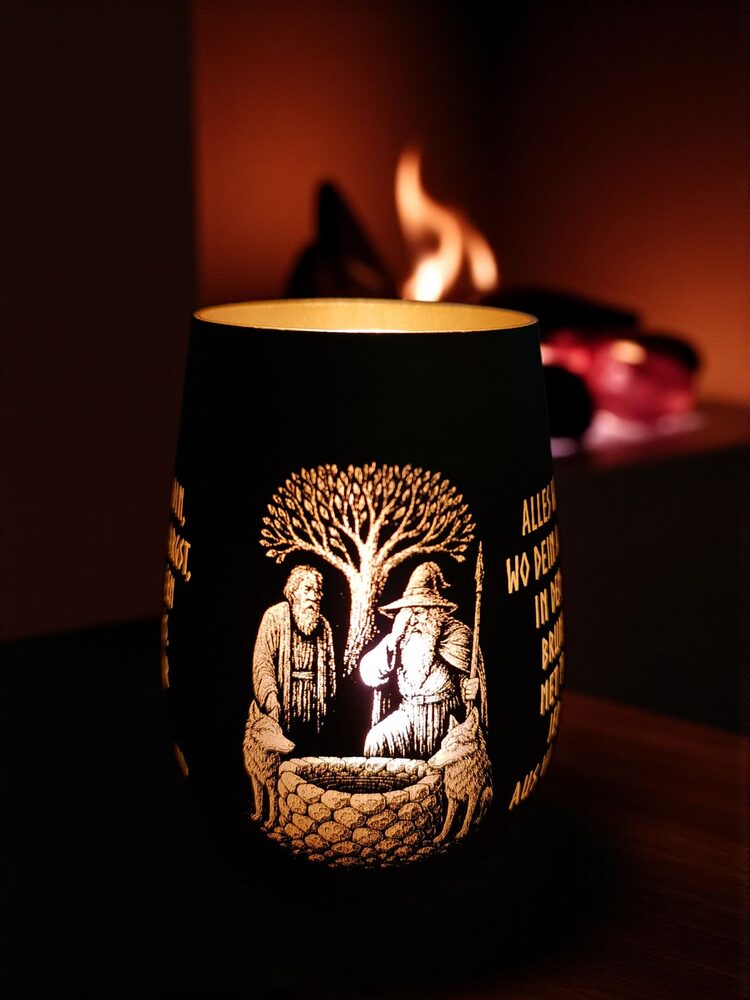
What moves us about Baldr is something else: the mother who asks every thing in the world for mercy, and the one small plant she overlooks. The stones that weep, and the one voice that does not. That is why we engrave Baldr motifs not as battle scenes but as remembrance.
Who is Baldr in Norse mythology? Baldr is one of the Æsir, son of Odin and Frigg, husband of Nanna and father of Forseti. He is the fairest and gentlest of the gods; his death by the mistletoe sets the world on the path to Ragnarök.
How did Baldr die? According to Snorri, blind Höðr, guided by Loki, threw a sprig of mistletoe at him – the one thing Frigg had not taken an oath from. In Saxo Grammaticus, by contrast, Hotherus kills him with a magic sword.
Is Baldr the god of light? No medieval source calls him that. Snorri says light shines from him; the title "god of light" comes from nineteenth-century scholarship.
Does Baldr come back after Ragnarök? Yes. According to the Völuspá and Snorri, Baldr and Höðr return from Hel and live in the renewed world with the surviving gods.
Why did Þökk not weep for Baldr? The giantess Þökk said she had no joy of Baldr, alive or dead. Snorri suggests Loki was hiding behind her.
For courage. For remembrance. For legends that live on.
Frigg · Hel · Loki · Sigyn & Loki’s Punishment · What comes after Ragnarök? · Draupnir & the Treasures.
All Gods & Goddesses articles →
In the halls of the gods sits one who would rather turn a fine phrase than swing an axe: Bragi, the long-bearded lord …
Read more →Every great deity of the North has a dwelling. That of Frigg, the highest of the goddesses, is called Fensalir – „the …
Read more →Where there is strife, one is needed who settles it. The North gave that idea a face: Forseti, the god of law. Whoever …
Read more →Freyja is far more than the „Norse goddess of love" she is often reduced to. She is a war-mistress, a master of magic …
Read more →