Where there is strife, one is needed who settles it. The North gave that idea a face: Forseti, the god of law. Whoever comes to him with a quarrel goes home reconciled, it is said. And an old legend leads him to the North Sea – to a holy island called Fositesland, which since Adam of Bremen has been equated with Heligoland. A god closer to us than one might think.
Forseti is the son of the shining Baldr and of Nanna. In the Poetic Edda he dwells in a hall called Glitnir, the “gleaming” – Snorri describes it with pillars of red gold and a roof of silver.
“Glitnir is the tenth; on golden pillars rests the hall's silver roof. There Forseti dwells the most of days and settles every strife.” Grímnismál 15 (after Bellows 1923, public domain)
Snorri puts it briefly: all who come to Forseti with a lawsuit go away reconciled – he is “the best court among gods and men”. Elsewhere in the Edda he scarcely appears, and yet his role is clearly drawn.
Why is the god of law Baldr's son – and not Baldr himself? Snorri gives the key: Baldr is the wisest and mildest of the Æsir, “but this quality attaches to him, that none of his judgments holds”. Baldr's mildness satisfies both sides – until they get home and find their quarrel unsolved.
Forseti is different. His strength is not pity but balance: a decision both parties can accept, and which therefore holds. That is a strikingly modern idea of law – not the victory of one over the other, but a settlement both can live with.
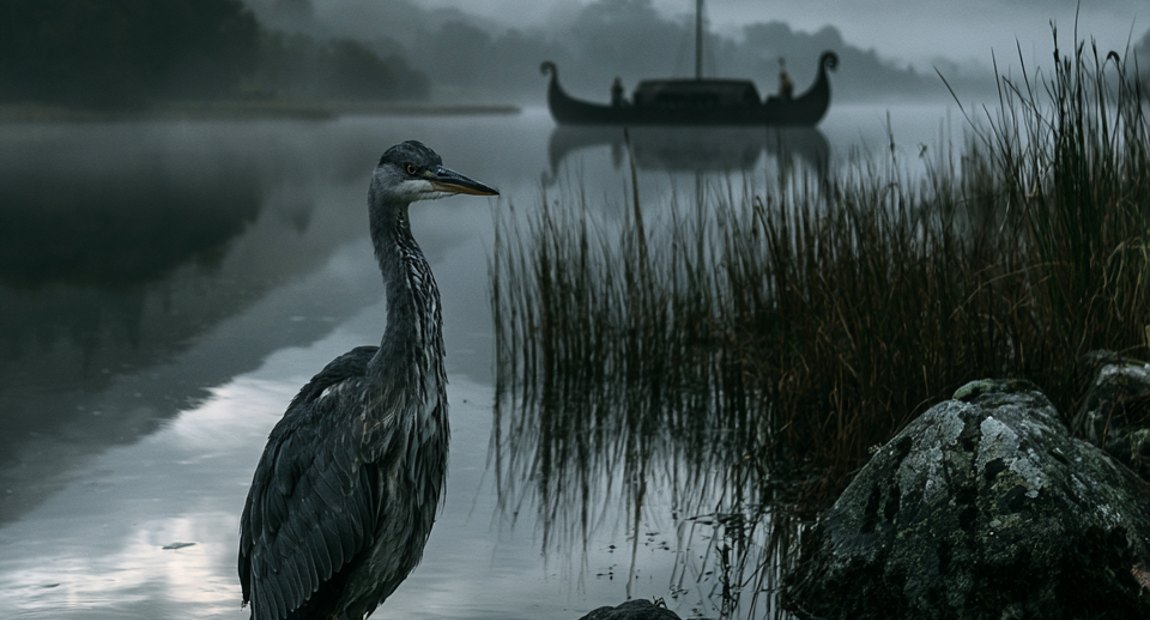
The finest tale about him tells how Frisian law came to be. Charles, the Frankish king, demands that the Frisians name their law. Twelve Asega – law-speakers of the seven Frisian sea-lands – travel to him, but cannot declare the law. As punishment Charles pushes them out to sea in a rudderless boat. As they pray, a thirteenth comes into the boat, a golden axe on his shoulder. He steers to an island, throws the axe ashore – and where it comes to rest, a spring wells up. At this spring the god teaches the twelve the law, and vanishes. So, says the legend, Frisian law arose: with the help of the gods, and at a spring.
The god's path in the legend is tellingly called eeswey – “way of the Æsir”. The spring as a place of finding law the North knows elsewhere too: at Urd's well beneath Yggdrasil the gods gather for their counsels.
And here it becomes tangible. In the life of Saint Willibrord, written by Alcuin around 790, it says Willibrord came “to the border between Danes and Frisians”, to an island the inhabitants called Fositesland after their god Fosite. The god was so revered that no one dared touch the cattle grazing there, and drew water from the holy spring only in silence. Willibrord broke the taboo, baptised and had cattle slaughtered – and was brought before the Frisian king Radbod. Later Saint Ludger destroyed the island's sanctuaries. Still in the 11th century it was held so holy that not even pirates dared take booty there.
Adam of Bremen equated Fositesland with Heligoland – “Holy Land” – and the location “on the border between Danes and Frisians” fits. The identity of the island-god Fosite with the Edda god Forseti is regarded as certain. So this god reaches into our North Sea: a piece of heathen heritage right off the German coast.
Forseti stands as god of law in Grímnismál 15 and in Snorri's Gylfaginning (Glitnir; “the best court”). The Frisian island-god Fosite and the holy island Fositesland are attested by Alcuin's Vita of Saint Willibrord (c. 790); Adam of Bremen equates the island with Heligoland. The identity Fosite = Forseti is regarded in scholarship as certain; in Norway there is the place-name Forsetalund (grove of Forseti) near Onsøy.
In the Edda Forseti is very thinly attested – essentially only the hall Glitnir. The legend of Frisian law is medieval Frisian legal tradition; the frame with King Charles is probably a later addition, while the core (law arising at a spring with a god's help) is heathen. And exactly where Fositesland lay cannot be said for certain: Heligoland is the most likely, but not the only proposed island.
Týr – the god who gave his hand · Ægir & Rán – sea and mead · Njörðr – god of the sea · The Norse pantheon · How do heathens celebrate today?.
All Gods & Goddesses articles →
Freyja is far more than the „Norse goddess of love" she is often reduced to. She is a war-mistress, a master of magic …
Read more →Freyr is the god the Vikings offered to for good weather, rich harvest and peace – the „foremost of the Æsir", as …
Read more →Above all the goddesses of the Æsir stands one: Frigg, Odin’s wife and queen of Asgard. She knows the fate of all …
Read more →Heimdall is the watchman who never sleeps – the god who hears the grass grow and the wool sprout on the sheep. Born of …
Read more →