The Vikings had no police, no prisons and no king who could enforce his will everywhere – and yet they built a surprisingly sophisticated legal order. Its heart was the Thing: the assembly of free men where law was spoken, disputes were fought out and peace was made. To understand how the North held together, you have to look there. And you have to set aside one stubborn myth.
The Old Norse word þing denotes the public legal assembly – an institution ancient among the Germanic-speaking peoples. As early as the 1st century, Tacitus describes gatherings where free men signalled approval by clashing their weapons or rejected a proposal with a murmur. In the Viking Age the Thing was where a community settled its affairs: quarrels over land and cattle, killing and theft, inheritance, marriage, trade. It was court, parliament, marketplace and news exchange all at once.
What matters just as much is what the Thing was NOT: a bureaucracy with officials. There was no state prosecutor, no judge who enforced a verdict, no jails. Justice was the business of the parties themselves. The assembly supplied the framework and the rules; in the end you had to make your right stick through kin, allies and standing. That is precisely why the Thing mattered – it dragged the dispute out of private blood-feud and into an ordered, public arena.
Most Things were local. A district, a valley, a region gathered several times a year at a fixed place, often at a striking landmark – a mound, a stone setting, a ford. Across Scandinavia many such assembly sites can still be traced through place-names and monuments. Above the small Things stood larger regional Things, where the free men of a whole province met and set law binding on far wider territories.
In Norway these were the great law-provinces such as the Gulathing in the west and the Frostathing around the Trondheim fjord – each with its own body of law, carried at first by memory. In Sweden people assembled at Uppsala among other places, in Denmark for instance at Viborg in Jutland. The underlying idea was everywhere the same: law was not decreed from above but carried by the assembly.
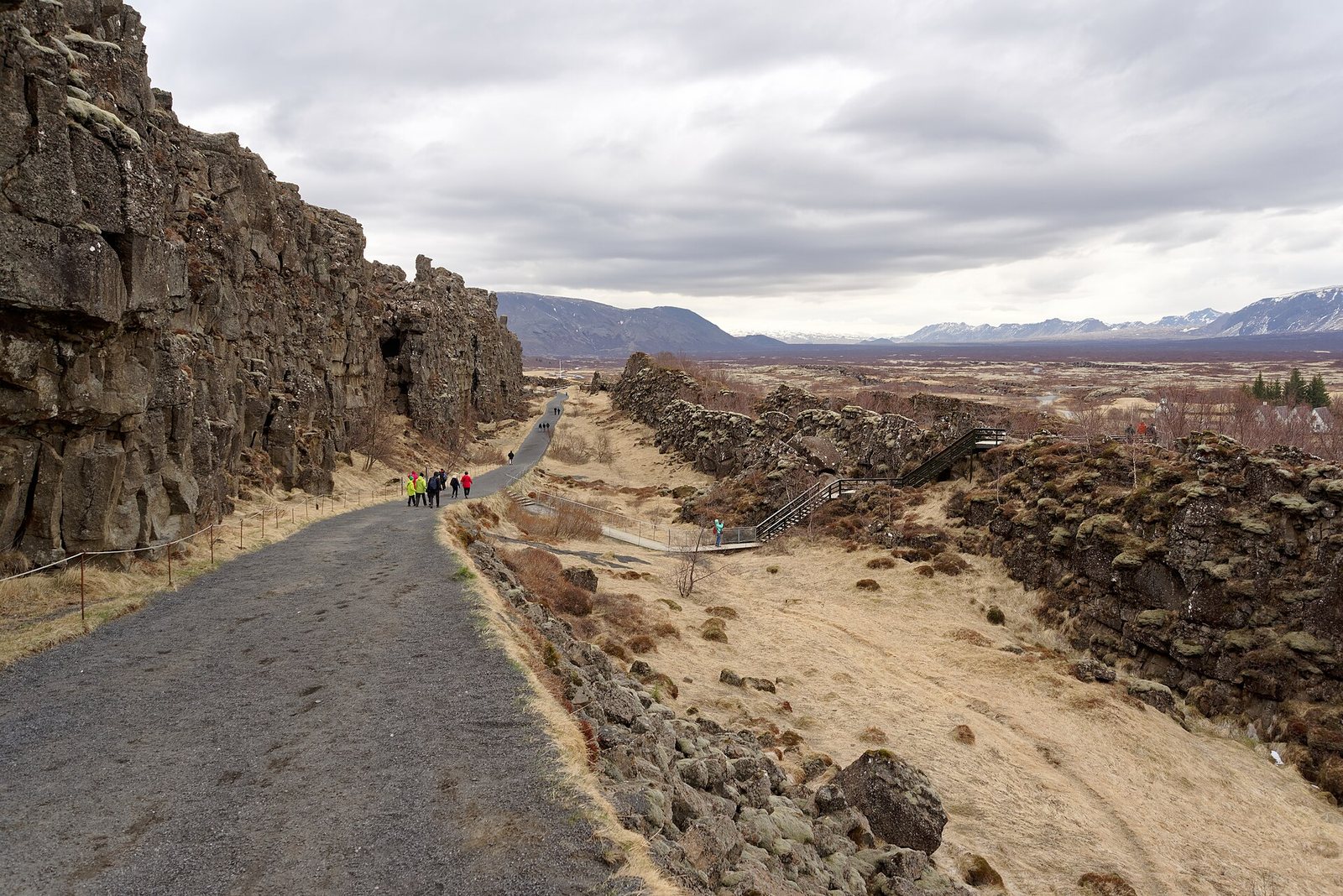
The most famous example is the Icelandic Althing (Alþingi), founded around the year 930. Iceland had been settled by Norwegian emigrants who deliberately tolerated no king over them. Instead of a crown they created a common Thing for the whole island – one of the oldest still-existing assembly institutions in the world. Once a year, in early summer, the chieftains (goðar) travelled with their followers to the plain of Þingvellir.
There, for about two weeks, the lögrétta convened, the legislative council made up of the chieftains and their advisers. It passed new rules, reviewed old ones and decided difficult cases. Alongside it sat courts where concrete disputes were tried. And around all this legal activity a vast social event unfolded: people traded, feasted, betrothed their children, forged alliances and swapped news from all over Iceland.
Þingvellir – "the assembly plains" – is still a striking place today: a broad rift where the tectonic plates pull apart, with rock walls that carry sound. At its centre stood the Lögberg, the "Law Rock". From here announcements were made, cases opened and – most importantly – the law in force was recited aloud. Anyone who wanted to bring a suit or learn a rule came to the Law Rock.
The exact location of the Lögberg is debated among scholars, but its function is clearly attested: it was the acoustic and symbolic heart of the Althing. In a society without books and without general literacy, the law needed a place where it could be heard. The spoken word, called out before the assembled crowd, carried weight.
The key figure of the Althing was the law-speaker (lögsögumaðr). Elected for three years at a time, he had a remarkable duty: to hold the entire body of law in his head and recite it publicly. According to tradition he recited one third of the law each year at the Law Rock, so that over his three-year term the complete law had once been spoken aloud. He also announced the procedural rules each year, so that no one came to grief through ignorance of the form.
The law-speaker did not judge himself and commanded nothing. He was living legal memory and arbiter in one: if people disputed the wording of a rule, his statement decided it. This role vividly shows how much the early legal culture of the North was a culture of remembering and of the spoken word – law as something a human being embodied.
For most of the Viking Age, law was purely oral. That changed in Iceland in the winter of 1117/18: by decision of the Althing, the laws began to be written down. This written collection is preserved under the later name Grágás ("Grey Goose") – a large, often minutely detailed work that opens a unique window onto the thinking of the time.
One must stay honest here: the surviving Grágás manuscripts date only from the 13th century and do not give us the law of the Viking Age unfiltered – they are partly younger, partly contradictory, partly already shaped by Christianity. Even so, they preserve a great deal of old legal thinking. With the writing-down, incidentally, the law-speaker lost part of his power: what stood in black and white he no longer had to carry in memory alone.
Cattle die, kinsmen die, / you yourself will die; / but one thing I know that never dies: / the fame of a dead man's deeds.Hávamál 77, after Henry Adams Bellows (1923), public domain
Perhaps the single most important principle of Norse law was compensation instead of vengeance. For almost every injury – from an insult through a wound to a killing – there was a fixed price. A person who killed could avert the blood-feud by paying a wergild (man-price). The Icelandic technical term baugatal refers to the precisely graded division of such payments between the kin of the offender and the kin of the victim.
This tariffing feels cold, but it was deeply civilising: it set an alternative against bloodshed. The amount depended on the rank and social standing of the person killed – a free farmer was "worth" more than an unfree man, a respected man more than a lowly one. Law was therefore by no means equal for all; it mirrored the strict hierarchy of society.
The sagas are full of feuds – and that is exactly why so many misunderstandings cluster here. Blood vengeance was real and legitimate: the kin of a slain man had the right, and often the duty, to restore honour. Yet the ideal of the law was not endless revenge but the settlement (sætt). The goal of the Thing and of shrewd mediators was to end a feud through compensation and reconciliation before it wiped out whole families.
Here the essence of this legal order shows itself: without state force, peace had to be negotiated again and again. A good chieftain was one who could settle a quarrel. Whoever refused every settlement and insisted on revenge was quickly seen as foolish and dangerous – for everyone. Law and peace were fragile, and precisely for that reason precious.
Since there were no prisons, the harshest penalty was expulsion from the legal community. A man declared outlaw stood outside all protection: he could be killed without penalty, and no one was allowed to give him food or shelter. Icelandic law knew two degrees. Full outlawry (skóggangr, literally "going to the forest") meant lifelong lawlessness and loss of all property. The milder form (fjörbaugsgarðr) meant three years of banishment – the condemned had to leave the country but could return afterwards.
Outlawry was a terrifyingly effective punishment precisely because it needed no walls. It turned the condemned into an outcast in a world where survival depended on belonging. Famous saga figures such as Grettir the Strong or Gísli spent years as outlaws – a life on the margins that the sagas tell as both heroic and tragic.
How did people establish the truth without police and without investigators? Not through a jury in the modern sense. The Icelandic kviðr, a summoned panel of neighbours, did not deliver a verdict of guilt as independent jurors; it gave information about facts that were known in the neighbourhood. A central means of proof was the oath – and with it the oath-helpers: whoever swore brought kin and respected men who swore to his credibility. Not the better evidence but the greater weight of honourable co-swearers could tip the balance.
This sounds alien, but it follows its own logic: in a community where everyone knew everyone, standing was itself a form of evidential weight. A man who had many respectable people swear for him stood in good stead. Procedural mistakes, on the other hand, could overturn an entire case – knowing the correct form was often more decisive than being in the right.
If no other route to a decision was found, the duel remained. The holmgang was a regulated single combat – the name points to the small island or the marked-off field on which it was fought. There were rules for weapons, shields and procedure; the outcome counted as a legally valid decision. In the sagas the holmgang serves sometimes honour, sometimes as a pretext for unscrupulous fighters to strip land or wife from the weaker.
It was precisely this abuse that led to its end: the holmgang was banned in Iceland and Norway towards the close of the 10th and during the 11th century. That is a telling development – a society recognises that the right of the stronger undermines law itself, and abolishes it. The road led from the rule of the fist to procedure.
Women did not stand as equals beside men in Viking-age law – but they were by no means without rights. At marriage a mundr, a bride-price, passed which remained legally the woman's own; a dowry often came with it. Women could own property, inherit and manage estates; widows ran farms. Notable is the right of divorce: according to the tradition a woman could, under certain circumstances, separate from her husband – for instance in cases of serious mistreatment – and keep the property she had brought in.
Before the Thing itself, men generally appeared as plaintiffs and representatives; formal agency lay with them. But the sagas show women as driving forces behind feuds and settlements, as keepers of honour and property. The real picture is more nuanced than either cliché – neither downtrodden housewife nor modern equal.
On the mainland the great law-provinces of Norway set the tone. The Gulathing in the west and the Frostathing in the Trondheim region each had their own body of law, at first carried orally and later written down. These laws regulated everyday life in detail: succession and landholding, the levy for coastal defence (leiðangr), trade, oath and compensation. As the Norwegian kings expanded their power, law increasingly became the affair of the crown – a slow road from the law of the assembly to the law of the king.
Here too the caveat holds: the writing-down and unification of the laws belong largely to the High and Late Middle Ages, no longer to the Viking Age proper. What we know of the older law we must read back cautiously from younger manuscripts – one reason why historians always keep the state of the sources in mind whenever the phrase "Viking law" comes up.
The Thing · Viking women · Everyday Viking life · Slavery among the Vikings · Erik the Red.
All Everyday Life & Craft articles →
Viking jewellery was rarely just decoration. A pair of brooches held the dress, an arm-ring was status symbol and …
Read more →Barely an image of the „real Viking“ reaches us today without dark runic and knotwork tattoos. But how do we actually …
Read more →No calendar page, no clock, no numbered day of the year — and yet the people of the North knew exactly when to sow, to …
Read more →Most Vikings were not raiders but farmers, traders and craftspeople. A look inside the long house where their lives …
Read more →