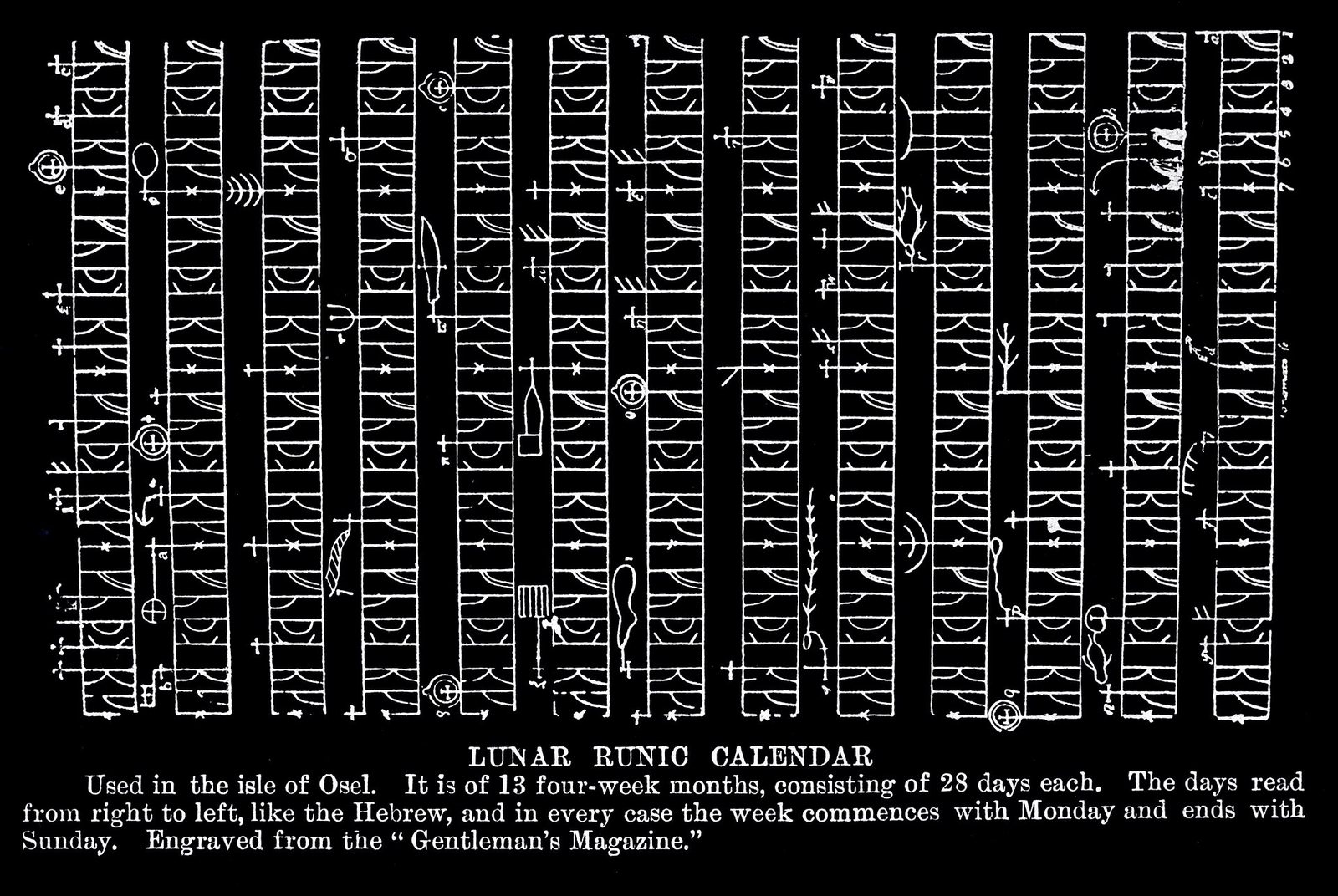
No calendar page, no clock, no numbered day of the year — and yet the people of the North knew exactly when to sow, to sail, to slaughter and to hold the Thing. Their time did not run by figures but by sun, season and week. To understand how a Viking thought about the year, we first have to set aside our own idea of a „date".
Ask about the „when" today and we think instantly in numbers: the 6th of September, half past two, calendar week 37. To someone of the Viking Age this would have been a foreign tongue. There were no mechanical clocks, no unified numbered year, no minutes. And yet their reckoning of time was anything but vague or „primitive" — it was simply anchored to something else: to what was visible in the sky and in the landscape anyway. The sun above the horizon, the turn from warm season to cold, the ever-steady rhythm of the seven weekdays. If your life depends on when the cattle can go to pasture and when the sea is fit to cross, you do not need a wristwatch — you need a sense of time that breathes with the land.
That is exactly what makes this subject so rewarding: Norse timekeeping shows us a world in which people and nature still shared the same beat. And because much of it survived in the Icelandic manuscripts, in law texts and in the very names of our weekdays, we can trace it with surprising precision — provided we keep a clean line between what is evidenced and what later romance simply invented.
The heart of Norse timekeeping is a radical simplicity: the year did not consist of four seasons, and certainly not of twelve equal months, but of two great halves — the summer half-year (sumar) and the winter half-year (vetr). The Old Norse word for such a half-year is misseri. Two misseri made a full year, and each began on a fixed weekday, in spring and in autumn respectively.
This division is more than a curiosity. It mirrors the reality of life in the far North, where there were in effect only two states: the bright, warm, busy half in which one worked, traded and sailed — and the dark, cold, inward-turned half by the hearth fire. Spring and autumn were not seasons in their own right but the thresholds between, the doors through which one stepped from one misseri into the other.
If the dark half is the one you get through, the one you survive, then it follows that you measure your lifetime by it. And that is exactly what the people of the North did: they counted their age and the years gone by not in summers but in winters. A man was „eighteen winters old"; an event lay „three winters back". The sagas are full of this way of counting, and it has even survived into our own languages — winter remained, across the Germanic world, the measure of time. To reckon in winters is to know that every year come through is a victory over cold and darkness.
Norse timekeeping becomes clearest in the Icelandic calendar handed down to us in the manuscripts of the high and late Middle Ages. It is a small masterpiece of practical arithmetic — and it clears up the most stubborn misunderstanding at once. For this calendar was not a lunar calendar. It was thoroughly built on the week and on the course of the sun.
The framework: a year of twelve months of 30 days each makes 360 days, plus four inserted „summer days" — 364 days together, exactly 52 weeks. And there lies the trick: because 364 divides evenly by 7, every date fell on the same weekday every year. Summer always began on a Thursday, winter always on a Saturday. For a society that knew no numbers on a calendar but had the seven weekdays firmly in hand, this was an ingenious solution: you did not have to remember a figure, only a weekday.
The price: 364 days are about a day and a half shorter than the true solar year. Without correction the calendar would slowly drift against the seasons. So every few years a whole extra week was inserted — the sumarauki, the „summer addition". This leap week kept the whole thing in step with the solar year, and did so in such a way that the start of summer always fell within the same window. No moon, no numerical juggling — pure observation of the sun, cast into a week-perfect system.
Nothing has survived so thoroughly from the old timekeeping as the week — and with it the gods whose names we still carry on our tongues every working day without noticing. The seven days did reach the North through Roman-Hellenistic mediation, but the Germanic peoples translated the Roman planetary gods into their own. The day of Mars became the day of the war- and Thing-god Týr — Tuesday (via the southern Germanic form Tiw/Ziu). The day of Mercury became Óðinn's day — Wednesday, in English immediately „Woden's day". Thursday belongs to Þórr, the thunder god — Thursday, „Thor's day". And Friday bears the name of a goddess: Frigg (or Freyja — here the readings diverge).
So a whole pantheon is hidden in our humdrum working week. Whoever moves from Tuesday to Friday wanders unnoticed from Týr past Odin and Thor to Frigg — four figures who have their firm place on many of our slate plaques. Only two days resist: Sunday is the day of the sun, Monday the day of the moon, and Saturday still owes its English name to Roman Saturn — while in the North it was simply the „washing day", laugardagr, the day of the bath. Yes, the Vikings bathed regularly, and the weekday still gives it away.
And the months? They existed, as twelfths of the year, but with an important caveat: their poetic names — Þorri, Gói, Harpa, Skerpla and the rest — are only fixed in writing comparatively late, in the high Middle Ages. That does not mean no one named the months; it means that for the Viking Age itself we cannot document the precise, settled list of names as the later Icelandic sources give it. Þorri, the deep-winter month, is alive in Iceland to this day — the feast Þorrablót carries its name. But today's Þorrablót as a convivial winter feast is a 19th-century revival, and the month's name tells us little about how a farmer of the 10th century actually counted his weeks: mostly not by month names at all, but by the half-years and the weeks elapsed since each began.
Just as the year fell into halves, the day too was not cut into hours but into larger stretches — the eykt. Instead of „at three o'clock" one said it was the time of dagmál (the morning meal, in the forenoon) or of náttmál (the evening meal, in the early evening), that it was miðnætti (midnight) or miðr morgunn (mid-morning). The day was a circle of such named time-marks, mostly tied to meals and to work.
And how did one tell which eykt it was? By sighting the sun over the horizon. The decisive device: one linked a time of day to a compass direction. When the sun stood in a certain direction over a fixed landmark — a ridge, a rocky outcrop, a notch on the horizon — a particular eykt had arrived. Thus the landscape itself became the clock. From a settled farm, everyone knew that „the sun over the north-east hill" meant a certain moment in the morning. Here time was inseparably bound to place — a beautiful, almost poetic idea: your clock was the sky above your own home.
Over everything stood the course of the sun itself: the longest night of the winter solstice, the endless day of the summer solstice, the two equinoxes in between. These turning points gave the year its frame, and around them lay the great feasts — first among them Jól, the Yule feast around the winter solstice, and the Blót celebrations at the start of summer and at the „winter nights" (vetrnætr) in autumn. The important framing: these feasts were bound to the course of the sun and to the fixed weekday starts of the half-years, not to a lunar calendar. Jól marked the turn from the waning to the once more waxing sun — the return of the light, celebrated at the year's darkest point.
Where there is talk of the sun and of sighting, the famous sólarsteinn soon appears — the „sun-stone", a crystal with which seafarers supposedly found the sun's position even under overcast skies. Physically the principle does work with birefringent crystals such as Icelandic calcite, and a crystal was found in the wreck of a (post-Viking-Age, admittedly) ship. But: a sólarsteinn from a genuine Viking context, clearly used for navigation, remains without solid proof to this day. The Vikings demonstrably navigated above all by experience, coastal landmarks, the watching of birds and waves, and confident latitude sailing. The sun-stone is a fascinating possibility — but honestly more well-attested physics plus a thin source base than proven Viking daily life. We prefer the honest answer to the pretty one.
The lovely thing about Norse timekeeping is that it does not gather dust in manuscripts but can be followed — with a glance at the sky and a little arithmetic. Anyone who wants to live or celebrate today by the half-years, the solstices and the old feast dates will find a good starting point in our moon-calendar tool: it makes the turning points of the year visible and helps to bring your own wheel of the year back into connection with the course of sun and moon — exactly in the spirit in which the North thought about time. Not as a rigid date, but as a living rhythm.
For in the end that is the real lesson of this timekeeping: for the people of the North, time was not an abstract net of numbers laid over everything, but something lived — the winter you came through, the summer you made use of, the sun above the familiar ridge. Whoever thinks that way does not merely measure time, they feel it.
They count not by days but by nights; thus they fix their appointments and terms. Night, it seems, leads the day onward.Tacitus, Germania, ch. 11 (rendered from the public-domain Latin text)
For courage. For remembrance. For legends that live on. Skál!
Forgotten Germanic month names · The old year's cycle up close · Jól – the Yule feast · The solstice festivals · The Thing.
All Everyday Life & Craft articles →
Most Vikings were not raiders but farmers, traders and craftspeople. A look inside the long house where their lives …
Read more →An entire heroic epic on a single teak panel: rider, ship and figures. Our Atli motif stands in an ancient Norse …
Read more →It is glass-clear, harder than almost any other ornamental stone, and it hung around necks and lay in the graves of the …
Read more →A stone that is warm rather than cold, light as wood, honey-gold in the light – and sometimes carrying within it an …
Read more →