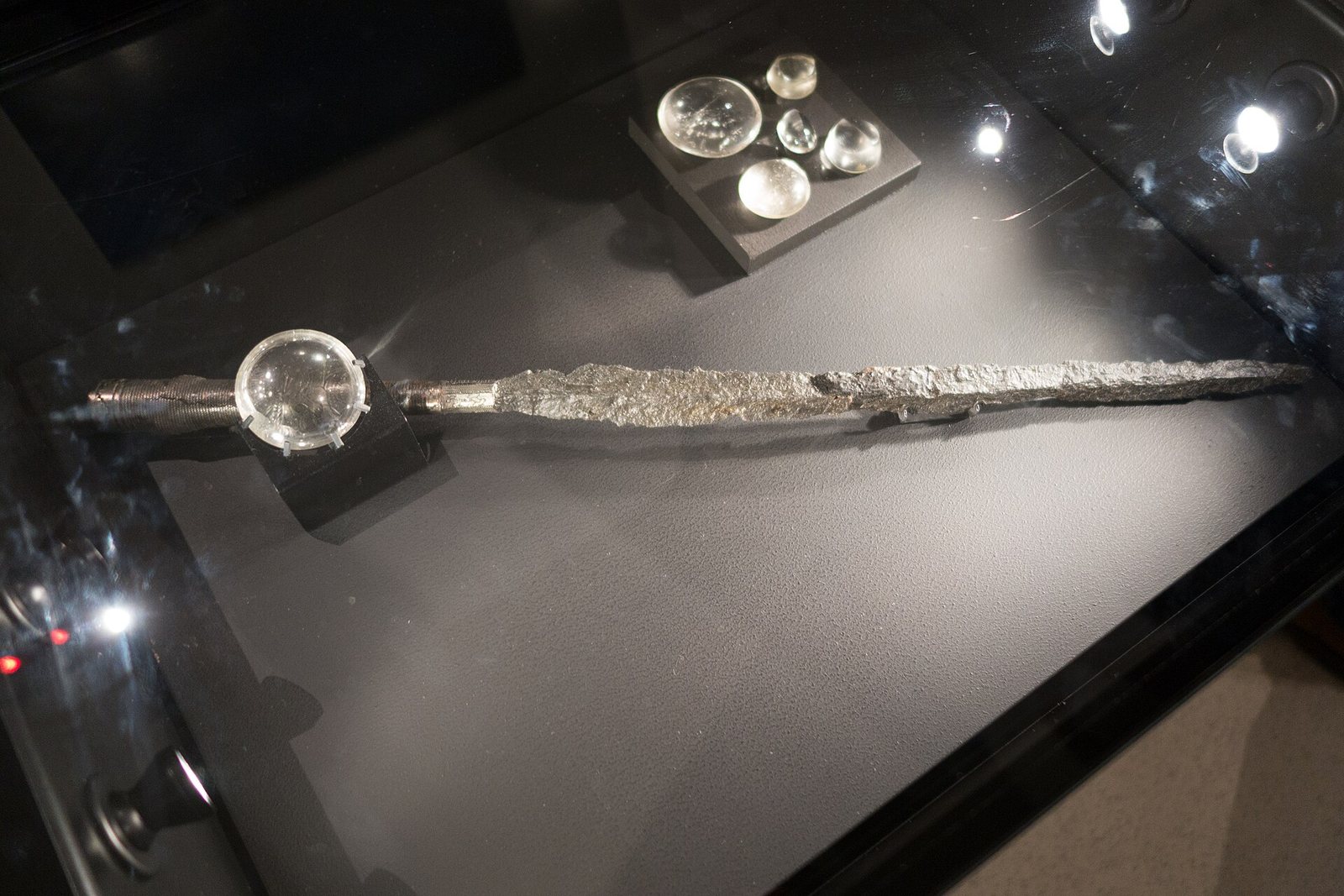
It is glass-clear, harder than almost any other ornamental stone, and it hung around necks and lay in the graves of the North a thousand years ago: rock crystal. Not a magic stone, but a fascinating piece of craft and trade history – from silver-mounted pendants in Birka to the ground lenses of Gotland, whose purpose still divides scholars today. We separate cleanly what is proven, what stays disputed, and what is pure modern esotericism.
Let us start with the stone itself, because the first bit of demystification – in the best sense – begins right here. Rock crystal is nothing mysterious; it is the clear, colourless variety of the mineral quartz, chemically just silicon dioxide (SiO₂). Over long spans of time it grows in fissures and cavities of the mountains into six-sided prisms with a pointed cap – the very shape that makes it unmistakable. On the Mohs scale of hardness it sits at 7, which means it scratches window glass with ease and can itself be scratched only by a few harder materials. Precisely this hardness makes it a rewarding, durable ornamental stone – and one that medieval craftsmen cut their teeth on, because grinding and polishing it takes real patience.
The name is slightly misleading: the „rock" here does not mean some random boulder but the pure, water-clear quality that looks like frozen water. That is exactly how the ancient authors understood it too – more on that later. For us in the workshop, rock crystal is above all one thing: an honest natural stone with a clarity no glass quite reaches, and a history that goes back far further than any esoteric brochure.
Scandinavia is not poor in quartz – on the contrary, rock crystal does occur there. And yet the clear crystal worked into beads and pendants in the Viking Age was often a trade good, and a far-travelled one. Together with red carnelian and other semi-precious stones it reached the North along the great eastern routes: down the rivers of the Rus, across the Caspian Sea and through the trading centres of the Islamic world. Anyone familiar with the silver dirham coins in the Northern silver hoards knows the same road – along it travelled stones, glass and silk as well.
The Swedish archaeologist Mårten Stenberger suggested that part of the raw crystal was brought from the Middle East into western and south-western Russia, set in silver there, and then bought by merchants from Gotland. That is a plausible reconstruction, not an excavation find with an address label – but it shows the pattern: the North was not a sealed-off end of the world but the northern end of a network reaching as far as Central Asia and the Orient. A clear stone at the neck of a woman from Birka could have a journey of thousands of kilometres behind it.
If we want to know what mattered to the people of the Viking Age, we look where they took their treasures into the afterlife: into the graves. And there rock crystal turns up regularly, usually in the context of richly furnished female burials. In Birka, the famous trading site on the island of Björkö in Lake Mälaren, beads of glass, carnelian and rock crystal were found as part of necklaces and festoons. These necklaces were not random assemblages; they were status objects, carefully composed from whatever trade and craft could supply.
Especially lovely are the rock-crystal pendants set in silver – some in fine filigree, that art of hair-thin twisted silver wire that ranks among the very best the fine-smiths of the Viking Age could do. A transparent stone in a silver frame, worn visibly on the chest: that was wealth, long-distance connection and beauty in a single piece. Rock crystal, then, was not an everyday material for everyone; it belonged to the upper stratum – where imported treasures could be, and wanted to be, afforded.
One special form deserves its own attention: ground spheres of rock crystal, often set in metal bands and worn on a festoon that hung from the oval brooch or the belt. We know such crystal balls from several high-ranking female graves of the Viking Age and the early Middle Ages, in the Norse world and in the more southerly Germanic sphere alike – the Merovingian and Anglo-Saxon parallels are impossible to overlook.
What these spheres meant, we honestly do not know for certain. Interpretation ranges from status symbol to amulet to a combination of both. That a rare, clear, far-travelled stone in spherical form on the festoon of a wealthy woman carried a special, perhaps protective meaning is a reasonable guess – but proven in the sense of a written source it is not. We handle it here the way we always do: we tell what lay in the ground and label the interpretation for what it is – a well-founded reading, not a proven spell.
Gotland, the great Baltic island, is a treasure chamber for the Viking Age – think only of the enormous silver hoards. Less well known, but decisive for our subject: at Fröjel, a trading and craft site on the western coast of Gotland, excavations in 1999 produced evidence that beads and lenses of rock crystal were made on the spot. Among finished pieces lay unworked raw crystals and half-finished beads and lenses – the finest proof archaeology can wish for: the workshop itself, with the material in every stage of working.
This matters because it topples a comfortable assumption. One might believe all the finished crystal objects were imported. Fröjel shows: at least part of the working – the grinding and polishing of the hard quartz – happened in the North itself, at the hands of Gotlandic craftsmen. Raw material from far away, craft done on site: a pattern that feels rather familiar to us as a small manufactory.
And so to the most spectacular chapter: the lenses of Visby. In several graves on Gotland, lens-shaped objects ground from rock crystal were found, dating to the 11th and 12th centuries. Some look at first glance like jewellery. But some of them are optically remarkably precise: bi-aspheric in cut, that is, with curved surfaces whose form does not follow simple spherical-cap geometry but the more complex curve that reduces imaging errors. The best example measures about 50 millimetres across, is roughly 30 millimetres thick at its centre and reaches an imaging sharpness one would not readily credit to a piece from the 11th century.
The astonishing thing is the head start in time: a deliberately calculated aspheric lens form is usually first described theoretically in modern optics with René Descartes in the 17th century. The Visby lenses lie centuries earlier – and nobody left a formula behind. Whether the good optical quality was conscious construction or the result of skilful trial and error at the grinding wheel cannot be said. Only one thing is certain: the pieces exist, they lie in museums, and they are no modern fairy tale.
Now to the question on which minds divide: what did these lenses serve? The short, honest answer is: we do not know for sure. And that is exactly why it is a gripping subject and not a cheap effect. Scholarship holds several possibilities side by side, none of them proven.
One reading: magnifying glasses. Anyone making the finest filigree work, tiny runes or detailed carving would welcome a magnifying glass – and the optical quality of some pieces would allow it. A second reading: burning glasses, with which one could kindle fire in sunlight or – so an older suggestion – cauterise wounds. A third, sober reading: they were primarily ornaments and prestige objects whose good optics are a by-product of fine grinding. In between run further ideas, right up to vision aids and sky-watching.
One should not, however, make the picture of „Viking spectacles" too easy. There is no frame, no drawing, no written source proving that these lenses were worn as vision aids. That they would have worked as glass – yes, the measurements show that. That they were used that way – that is hypothesis. We find this openness more honest (and, frankly, more exciting) than any smooth assertion.
The idea of holding clear crystal against the sun to concentrate heat is no invention of the Viking Age. It is ancient. As early as the 1st century the Roman scholar Pliny the Elder describes in his „Naturalis historia" the crystallus – for him frozen water that never thaws again – and notes a medical application pointing exactly this way:
I find it stated by medical men that the very best cautery for the human body is a ball of crystal acted upon by the rays of the sun.Pliny the Elder, Natural History, Book 37; public-domain translation by Bostock & Riley (1855)
A thousand years lie between Pliny's Rome and the Gotlandic workshops – so we claim no direct line. But the passage fits a broad, long-lived knowledge: clear crystal concentrates light, and people knew it. Whether the Northern lenses were meant for this nonetheless stays open. The old text explains the idea, not the find.
With Christianisation the beautiful, clear stone did not vanish – it changed its frame. In the Christian Middle Ages rock crystal became a highly prized material for reliquaries, the precious containers in which the relics of saints were kept and shown. The logic behind it is disarmingly simple: a transparent stone lets the venerated be seen without exposing it to touch. Purity, light and visibility – qualities ascribed to crystal – translated effortlessly into the Christian image-world.
So an arc is drawn: the same material that in heathen times hung as bead and sphere on the festoon of a noble woman becomes, a little later, a window onto the holy in church treasuries. That is typical of the transition in the North – much was not erased but reinterpreted and carried on. The stone remained. Only the story told about it changed.
And now we tidy up, because with rock crystal the modern myth grows especially rank – and we do not want to sell you anything that is not true.
The lovely thing is: rock crystal does not need these exaggerations at all. A far-travelled, glass-clear stone, ground by Gotlandic craftsmen with astonishing skill and lying in the graves of the powerful – that is history enough.
For us in the workshop, rock crystal is a special material precisely for this reason: not because of invented energies, but because of its honest qualities and its real history. The clarity, the hardness, the light that seems caught inside – all of it joins with a piece of Northern craft and trade history that can be passed on without blushing. When we offer it as an ornamental or oracle stone, we offer it as what it is: a beautiful piece of nature with a past that speaks of long-distance trade, fine grinding and the clear eye of the old craftsmen.
No healing promise, no kitsch – but real knowledge in the pack. Exactly the way we like it best.
For courage. For remembrance. For legends that live on.
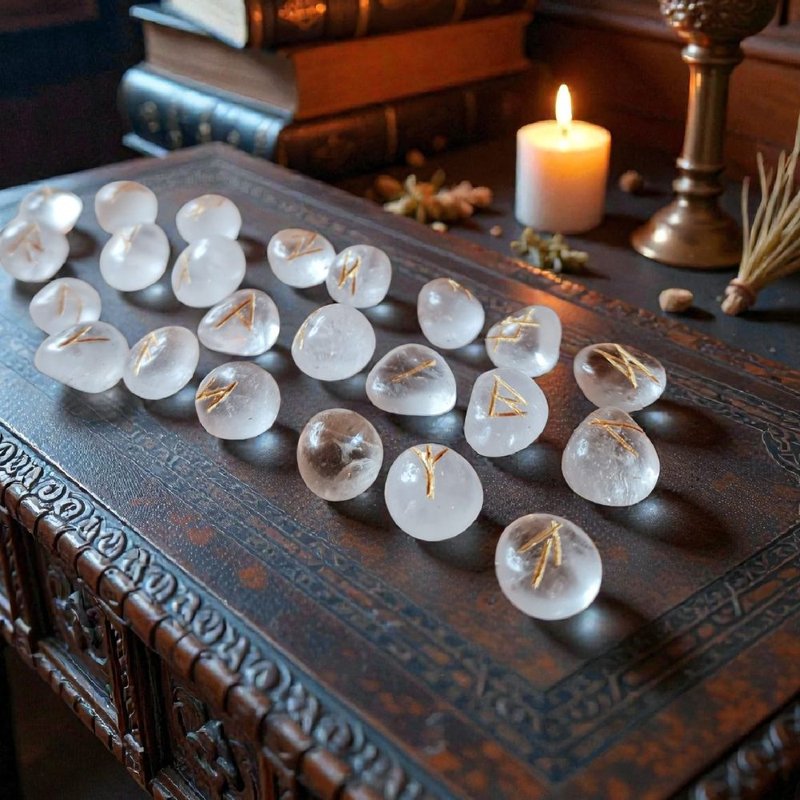
Gemstones in the North · Carnelian – the Vikings' red beads · Runes & their meaning · Seiðr – the magic · Viking navigation.
All Everyday Life & Craft articles →
A stone that is warm rather than cold, light as wood, honey-gold in the light – and sometimes carrying within it an …
Read more →Talk of Vikings and gemstones today, and you quickly hear about amethyst for stress and tiger's eye for courage. It …
Read more →When we think of Vikings, we often see grey-brown figures in undyed wool. That is a mistake. Whoever could afford it …
Read more →The Viking of film and television wears grey, brown and grime. The real Norseman wore red, blue and yellow – and was …
Read more →