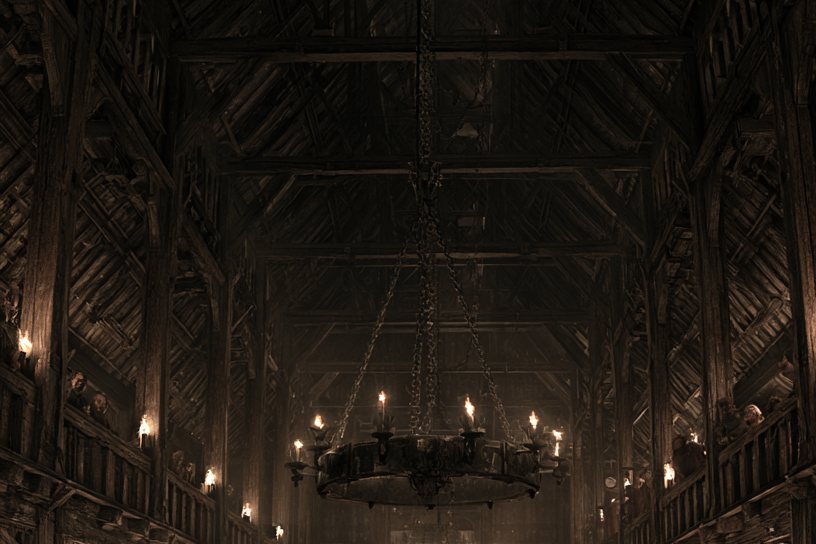
Did the Vikings and the Germanic peoples celebrate the solstice? Yes – but not in the way most modern guides claim. What we can actually document is a great midwinter feast called Jól, a festival of the returning sun in the far North as early as the 6th century, and a single “midsummer sacrifice” in a 13th-century saga. St John’s fires, the maypole and “Litha”, on the other hand, are Christian, early modern or entirely modern. Here is what stones, chroniclers and sagas really give us – and where the gaps begin.
Twice a year the sun seems to stop. In June it climbs higher at noon than at any other time; in December it creeps low along the horizon and is gone again after a few hours. If you lived in a longhouse with no glass windows, lit by a fish-oil lamp and the hearth, this was not a calendar entry. It was daily life. Light decided how much work got done, how fast the stores ran down, how people felt. No surprise, then, that people feasted around the solstices. The real questions are what they celebrated, when exactly – and how we know.
The Earth’s axis is tilted by roughly 23.4 degrees relative to its orbit. That is why the sun’s noon height rises and falls over the year. The summer solstice falls on 20 or 21 June: the sun stands over the Tropic of Cancer and the northern hemisphere has its longest day. The winter solstice follows on 21 or 22 December with the longest night. Why does the date shift? Because a calendar year of 365 days plus leap days never matches the solar year exactly; the precise moment moves by several hours from one year to the next.
The Latin term solstitium literally means “the sun standing still”. For several days around the turning point, the sun’s noon height and its rising and setting points on the horizon barely change. Anyone watching without instruments saw no sharp deadline but a phase of several days in which the sun “stood” and then turned back. Old Norse had a word for this, sólhvörf, “sun-turnings” – a plain term for a movement in the sky, not the name of a festival.
Here in Alsdorf, near Aachen, at just over 50 degrees north, the longest day lasts a little over 16 hours and the shortest about 8. North of the Arctic Circle the winter sun does not rise for weeks; in Tromsø the polar night runs from late November to mid-January. Up there the big event is not the astronomical turning point but the day the sun comes back.
One more trap: the medieval Julian calendar drifted almost a day per century against the sun. By the late Middle Ages the winter solstice fell around 12 or 13 December on the calendar – hence the old saying that St Lucy’s night is the longest of the year. For how the North counted time, see our Old Norse calendar and the article on Viking timekeeping.
Articles on “Germanic solstice festivals” love to use Stonehenge or Newgrange as illustrations. Yet those monuments are thousands of years older than anything we can call Germanic. They show how early people built the solstices into architecture – but not what Vikings believed in the 9th century.
Goseck in Saxony-Anhalt was spotted on an aerial photograph in 1991, excavated from 2002 and rebuilt in 2005 with around 1,675 oak posts. The circular enclosure dates to around 4900 BC, in the Neolithic; its two southern gates point roughly to sunrise and sunset at the winter solstice. Whether “solar observatory” is the right label is debated – some think it overstated.
At Newgrange in Ireland’s Boyne Valley, a passage tomb of about 3100 BC, the first light on the mornings around the winter solstice shines through an opening above the entrance deep down the passage into the chamber, for about 17 minutes. In modern times it was first witnessed on 21 December 1967 by the excavator Michael J. O’Kelly.
The Nebra sky disc, found by looters on the Mittelberg in 1999, is dated by most researchers to the Early Bronze Age, around 1800–1600 BC (a 2020 attempt to move it into the Iron Age was promptly rebutted). Its golden horizon arcs span about 82 degrees – exactly the stretch of horizon covered by sunsets between summer and winter solstice at that latitude. More in our article on the Únětice culture and the sky disc; another Bronze Age sun image is the Trundholm sun chariot.
The first written source that genuinely describes a sun festival in the North comes from Constantinople. The Byzantine historian Procopius of Caesarea, writing around 550 in his Gothic Wars (II.15; Wars VI.15 overall), describes a huge northern island called “Thule” – generally taken to be Scandinavia. His informants were Heruli; the most numerous people there, he says, were the Gauti.
At the summer solstice, Procopius says, the sun does not set there for forty days, and in winter it is not seen for forty days. After thirty-five days of that long night, men are sent to the mountain tops. When they glimpse the sun, they tell the people below that the light will return within five days.
“And the whole population celebrates a festival at the good news, and that too in the darkness. And this is the greatest festival which the natives of Thule have.”Procopius, History of the Wars VI.15, trans. H. B. Dewing (1919)
The striking point: the festival is tied not to the astronomical turning point but to the observed return of the sun – which makes sense north of the Arctic Circle. That Procopius mentions human sacrifice to an “Ares” in the same chapter shows he is passing on hearsay in Greek terms. Still, it is the oldest concrete reference to a festival of light in the northern winter, some 250 years before Lindisfarne.
The great winter feast of the North was Jól, Yule. The word is old: the 6th-century Gothic calendar names a month fruma jiuleis, “the first Yule”, probably November. We cover the feast itself in Yule – the feast of the long nights; here the only question is whether Yule was a solstice festival.
The key Norse passage is in the Saga of Hákon the Good, part of Snorri Sturluson’s Heimskringla (c. 1230). King Hákon, raised in Christian England, ruled Norway in the mid-10th century. He is said (ch. 13, ch. 15 in older editions) to have made a law that Yule should begin at the same time as Christians held it, and that every man, under penalty, should brew a set measure of malt into ale and keep Yule holy for as long as it lasted.
“Before him, the beginning of Yule, or the slaughter night, was the night of mid-winter, and Yule was kept for three days thereafter.”Snorri Sturluson, Heimskringla, Saga of Hákon the Good, trans. Samuel Laing (1844)
The Old Norse word behind Laing’s “slaughter night” is hökunótt, and his rendering is a guess. The word occurs only in this one passage and its origin is unknown. Laing also added “Dec. 14” in brackets in his edition; that is his explanation, not the saga’s text.
What did “midwinter” mean? The Norse winter began with the Winter Nights in mid-October, summer in mid-April. “Midwinter” sat in the middle of that half-year, closer to mid-January – in Iceland later tied to the start of the month Þorri. If Hákon had to move the feast forward to Christmas, the old Yule evidently fell after 25 December. It was a midwinter feast in the rhythm of its own calendar, not necessarily a feast of the astronomical turning day. For how that half-year system worked, see Germanic festivals and pagan holidays.
Ynglinga saga (ch. 8) fits the picture: Snorri has a humanised Odin establish three sacrifices – at the start of winter for a good year, at midwinter for growth, at summer for victory. He describes the same pattern among the farmers of Trøndelag in the Saga of St Olaf. No June date appears; the summer sacrifice belongs to the beginning of summer. More in Viking customs and rituals.
Snorri, of course, wrote more than two centuries after Norway became Christian. That Yule involved feasting, sacrifice and oaths is supported by several sources. That it began exactly at the solstice is supported by none.
One of the most valuable sources comes from northern England. In 725 the monk Bede explained the old English month names in De temporum ratione (“The Reckoning of Time”, ch. 15) – the names of a Germanic-speaking people converted only about a century before he was born.
Bede says the English began their year on 25 December, where Christians now celebrate the birth of the Lord. And that very night, now holy to Christians, they called by a heathen word, Modranecht, “the night of the mothers” – probably, he suggests, because of the ceremonies they performed while keeping vigil that night. He says nothing more. Who these “mothers” were remains open; many scholars think of mother goddesses such as the Matronae of the Rhineland, but it cannot be proven.
More relevant still: the months Giuli (December and January), Bede says, take their name from the turning of the sun towards the lengthening of the day, one preceding it and one following. That is a genuine early link between Yule and the winter solstice – as a month name, not a described festival. June and July he calls Litha, “gentle” or “navigable”, because the breezes are calm and people sail the sea. He mentions no festival of that name. Keep the word in mind. How carefully Bede must be read is shown by his sentence on Eostre, which we take apart in our article on Ostara.
And summer? The record is thinner still. As far as current scholarship knows, Old Norse literature contains exactly one passage naming a midsummer sacrifice. In Snorri’s saga of Olaf Tryggvason, the farmers of Trøndelag demand that the Christian king sacrifice like his predecessors. A miðsumarsblót is agreed at Mære on the Trondheimsfjord. Olaf turns up – and forces the farmers into baptism by threatening to sacrifice not slaves but their most prominent men. The scene is set in 998 and was written down around 1230.
So Snorri found a major summer sacrifice in Trøndelag believable. Excavations under the later church at Mære in 1969 did find traces of a pre-Christian cult site, probably a ritual post according to recent reassessments. When exactly the sacrifice took place, which gods it honoured, whether the sun mattered – the text is silent. Old Norse “midsummer”, like “midwinter”, was a calendar marker; in Norway mid-July long counted as midsummer.
The history Ágrip (c. 1190) adds an indirect trace: Olaf Tryggvason abolished sacrifices and sacrificial drinking and replaced them with Christian ale feasts – Yule, Easter and St John’s ale on 24 June. That fits the Church’s habit of occupying old dates, but it does not prove a pagan festival on that very day.
And the gods? Older guides, including the first version of this article, liked to assign Midsummer to Sunna/Sól, Baldr or Freyr. There is no source for it. Reading Baldr’s death as the waning summer sun is a 19th-century idea, associated with James Frazer among others – a theory, not a tradition.
Most summer customs belong to St John’s Day, the feast of the birth of John the Baptist on 24 June, six months before Christmas. His words “He must increase, but I must decrease” (John 3:30) were read by Church fathers such as Augustine as the course of the sun: after St John’s Day the days shorten, after Christmas they lengthen. Solstice symbolism is also Christian symbolism.
An early hint of popular customs comes from the sermon preserved in the Life of St Eligius, bishop of Noyon in the 7th century: no one should practise solestitia, dances, round-dances or “devilish songs” on the feast of St John. What exactly was meant, the text does not say – and we are in the Frankish kingdom, not Scandinavia.
The St John’s fire comes into view in the 12th century: the Paris theologian John Beleth describes fires and torches on St John’s Eve around 1162. English sermons of the 13th century mention bone-fires and a wheel rolled to show that the sun has reached the top of its circle and now descends. In 1333 Petrarch saw women in Cologne washing in the Rhine on St John’s Eve. From the 14th century the German evidence multiplies, followed later by bans: in 1653 the Nuremberg council prohibited the “sonnenwendt or zimmet fire”.
Pagan? Maybe. Many folklorists assume pre-Christian roots. But the evidence begins in Christian dress, in France and England, and the clergy explain the sun-wheel in Christian terms. A direct line to a Germanic sun cult cannot be drawn. How the Church took over old dates is the subject of our article on the Christianisation of the Germanic peoples.
In Sweden the midsommarstång stands everywhere in June, for many people the image of “pagan Midsummer”. The Nordiska museet is sober about it: the pole probably came from Germany in the Middle Ages, and the oldest depictions are in Erik Dahlberg’s Suecia antiqua et hodierna (late 17th century). The name majstång has nothing to do with May but comes from maja, “to decorate with leaves”, and there is no evidence for reading it as a phallic symbol.
The oldest detailed description comes from Olaus Magnus in 1555: dancing by bonfires on St John’s Eve. Whether Sweden celebrated Midsummer before Christianisation is unknown, the museum says. Since 1953 Swedish Midsummer Day has fallen on the Saturday between 20 and 26 June; in Finland the feast is Juhannus – John again.
In Norway and Denmark the evening of 23 June is Sankthans, in Norway also Jonsok. The fires were thought to protect on a night when witches flew to the Blocksberg. In Denmark, according to the usual account since the early 20th century, a straw witch goes on the fire, and people sing Holger Drachmann’s Midsommervise of 1885. Protestant witch belief, a Harz peak, Danish Romanticism: Nordic, yes. Viking, no. Herb customs such as St John’s wort are well documented too – for the 18th to 20th centuries.
Search for “Litha” and you will find countless pages on the “ancient Germanic summer solstice festival”. Yet the Wheel of the Year, with eight festivals – four at the solstices and equinoxes, four Celtic-inspired ones in between – is a creation of 20th-century British modern Paganism, associated with Gerald Gardner and Ross Nichols; the phrase was in use by the mid-1960s.
The names Litha, Ostara and Mabon were assigned by the American writer Aidan Kelly in the early 1970s. He took “Litha” from Bede, where it names a pair of months, not a festival. “Yule” pins the historical Jól to 21 December, which the sources do not support.
None of that makes modern celebrations wrong. They are just not a reconstruction but a new creation from old pieces. How Heathens celebrate today is the subject of How do Heathens celebrate today?.
We end with a list of honest gaps:
What the people in the longhouses felt when the days began to lengthen, no source tells us. Procopius’ Thulites on the mountain tops come closest – one of the oldest moments of northern festive culture we can grasp.
Around the turning points we engrave many lanterns, slate plaques and wooden slices with sun motifs in our Alsdorf workshop. That is exactly why a sun-wheel modelled on a Bronze Age original is labelled “Bronze Age” on our pieces, not “Viking cult”. Real knowledge does not make a gift smaller; it makes it more honest. More on the dark season in honouring the ancestors at Yule.
When is the solstice? The summer solstice falls on 20 or 21 June, the winter solstice on 21 or 22 December. The exact date shifts slightly from year to year because of the leap-year cycle.
Did the Vikings celebrate the winter solstice? They celebrated Jól, a great midwinter feast with drinking and sacrifice. According to the Saga of Hákon the Good it originally began on “hökunótt” and was only moved to Christmas in the 10th century; whether it fell exactly on the solstice is uncertain.
Is Yule the same as the winter solstice? Not necessarily. Bede links the month name Giuli to the solstice, while Snorri speaks of “midwinter”, which in the Norse half-year calendar points more to mid-January.
Is Midsummer a pagan festival? Today’s Midsommar and St John’s customs are shaped by Christianity and the early modern period; the maypole probably reached Sweden from Germany in the Middle Ages. A pre-Christian midsummer sacrifice is mentioned only once, in a 13th-century saga.
Where does the name Litha come from? In Bede (725) Litha is an Anglo-Saxon month name for June and July. It was first used for the summer solstice festival by modern Pagans in the 1970s.
What does the Nebra sky disc have to do with the solstice? Its golden horizon arcs cover about 82 degrees – the range between the summer and winter solstice sunset points at the find site. It dates to the Bronze Age, some 2,400 years before the Viking Age.
For courage. For remembrance. For legends that live on.
Sunna / Sól · Ostara, Várblót & Sigrblót · Nerthus · The Norse pantheon.
All Festivals & Belief articles →
The Vikings had no capitals, but they had places of power: sites where law was spoken, sacrifice made and the ancestors …
Read more →In the middle of January, when the wind scours Iceland and the days have only just begun to lengthen again, Icelanders …
Read more →Through the long winters of Iceland's farmsteads ran a fear that had nothing to do with trolls or giants and everything …
Read more →When the nights are longest and the fire in the house is warmest, the departed draw nearer. Yule, the midwinter feast …
Read more →