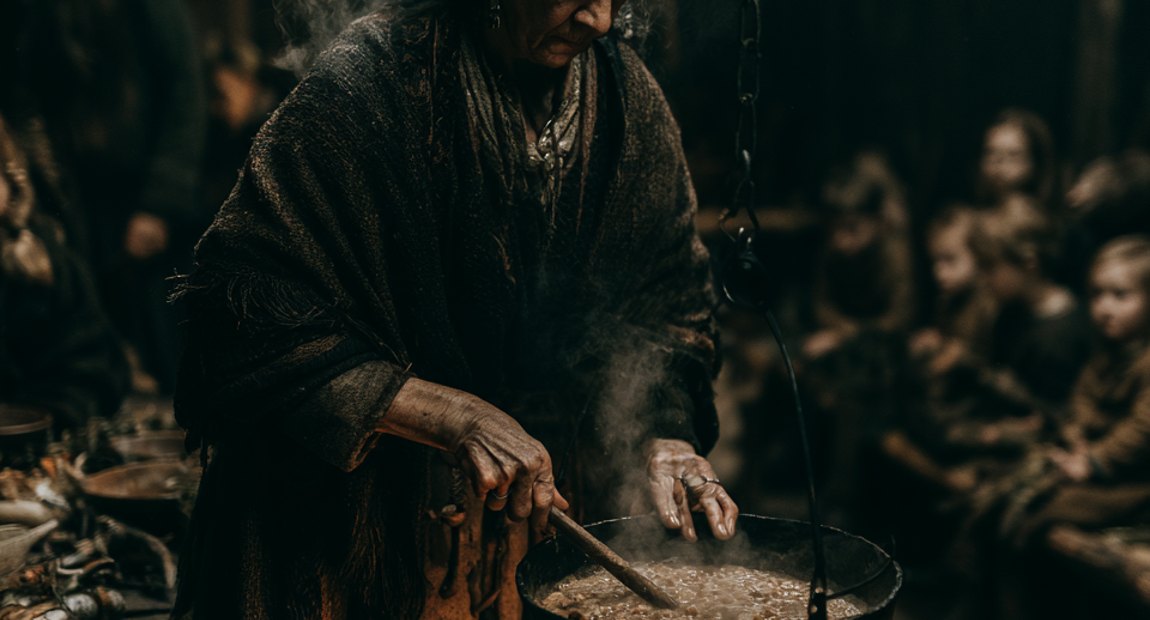
When the nights are longest and the fire in the house is warmest, the departed draw nearer. Yule, the midwinter feast, is not only a feast of light and joy – it is also the time of the ancestors. The dead were thought to be among the living then, and one set the table for them and drank to their memory. A look at a quiet, warm custom that echoes into our own Christmas.
In the North, ancestor veneration grew stronger in winter and reached its height at Yule. The autumn Winter-Nights feast already counted as a feast of the dead; but at midwinter, when the sun stands still and is born anew, the borders are thinnest. The departed were thought near then – guests in one's own house.
The finest expression of this nearness is the memory-draught. At the Yule feast one drank in turn: first to the gods, then the minni, the remembrance, to the departed kinsmen.
“At Yule one should drain the full horn – to Óðinn and the gods for a good year, then the minni to the departed kinsmen.” after Hákonar saga góða, Heimskringla (public-domain translation tradition)
The custom reached into daily life. At Yule one covered open pots, so that no spirit settled uninvited, and at the same time set food ready in the god's-corner – milk or cream – so that the passing ancestors could refresh themselves. The hearth-fire itself counted as the seat of the shades: to it one threw fat and crumbs into the flames.
Certain animals, too, counted as representatives of the ancestors. The Lombards in the 7th century honoured the house-snake with golden serpent-images; to the house-otter, the cricket, the toad, milk was offered in the hearth-corner. And the German legends know the kobolds as house- and guardian-spirits who kindly finish the undone work at night. Behind it all stands one thought: the forebears are not gone. They are part of the house.
The bond was no one-way street. Again and again an ancestress appears in the sagas who warns her descendants: in the Völsunga saga she advises Signý against marrying Siggeir, in the Vatnsdœla saga she warns Thorstein against riding to the Thing. The dead take a lively part in the fate of the kindred – one need only leave them a place. That place became visible on the carved high-seat pillars that bore the images of the ancestors.
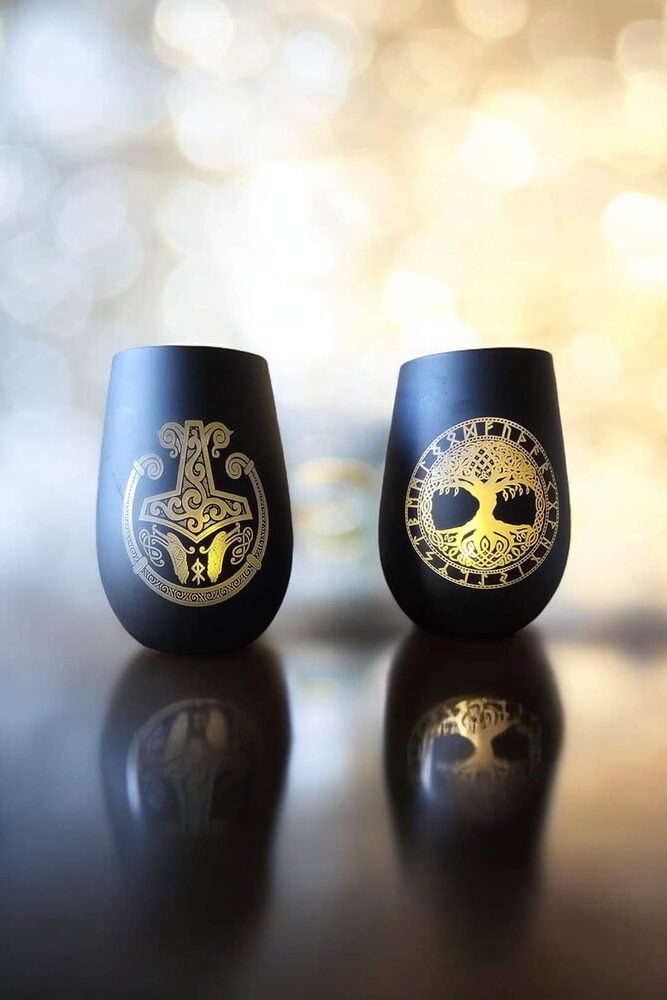
One need not stage a great ritual to share in this old thought. One more place set at the Yule meal, a quiet toast to someone missed, or simply a light that burns for the ancestors: that is exactly what tealight holders are for. A warm light in the darkest time that says: you are not forgotten. Whoever wishes to understand the whole winter feast-cycle will find it in our Blót calendar.
The ritualised drinking at Yule, including the memory-draught to gods and departed kinsmen, is attested in the Hákonar saga góða (Heimskringla); Yule originally lay at the full moon of the first lunar month after the winter solstice and was moved by Hákon the Good to 25 December. The strengthening of the ancestor cult in winter, the Winter Nights as a feast of the dead, and the house-snake as ancestor-spirit (Lombards, 7th c.) belong to attested or well-documented folk practice.
Much of the domestic Yule custom – food in the god's-corner, milk for the house-otter and cricket, the kobolds – is largely younger folk belief and cannot be directly shown as Viking-age ritual. The fixed equation “Yule = ancestor feast” is partly reconstruction. What is attested and old is the core: the shared drinking to gods and ancestors and the significance of the dark time. The modern “light for the ancestors” is a fitting present-day gesture, not a transmitted rite.
How the Germanic peoples honoured their dead · The Rauhnächte & Mother's Night · The Wild Hunt · The old year's cycle up close · Þorrablót – the winter feast.
All Festivals & Belief articles →
For our ancestors the year was no sheet on the wall but hard, beautiful work: to sow, to tend, to harvest, to store …
Read more →The old faith of our ancestors has not died out – it is being lived again. “Ásatrú”, literally “true to the Æsir”, is …
Read more →“Under all roots is rest.” More and more people wish, at the end, not for a cool stone but for a tree – a living place …
Read more →Scarcely an image is so bound up with the Vikings as the burning ship drifting out to sea with the dead. The ship was …
Read more →