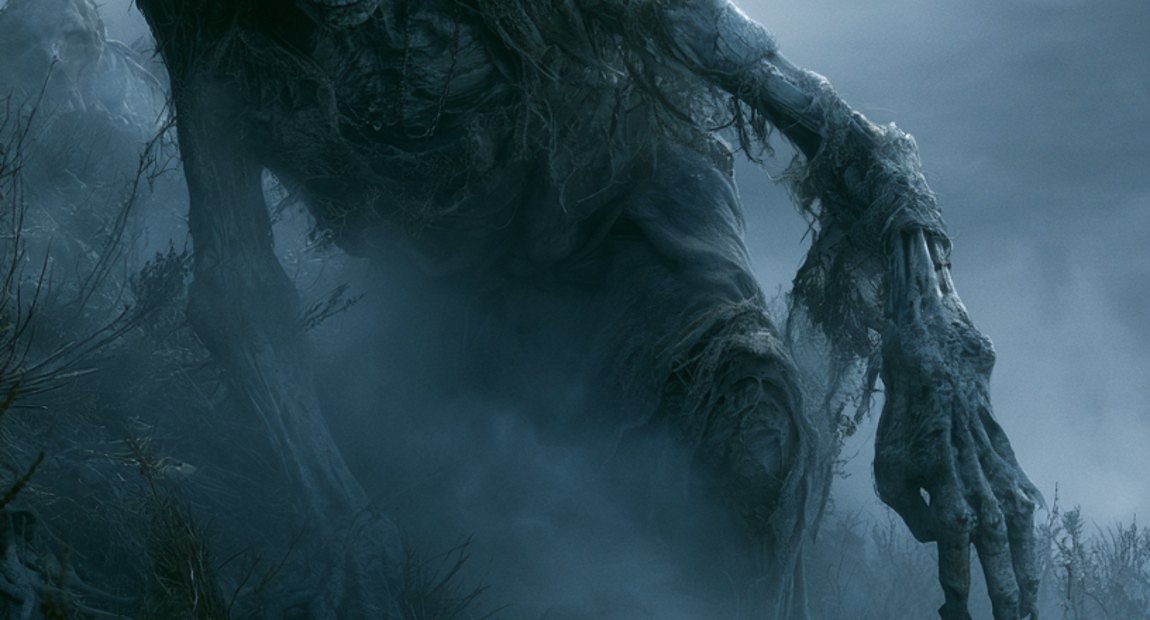
A draugr is a dead person who comes back from the grave in their own body: not a see-through ghost but a heavy, dark-swollen corpse with inhuman strength that kills livestock, breaks necks and rides the roofs at night. The Icelandic sagas of the 13th and 14th centuries describe these revenants in remarkable detail. We look at the words behind them, climb into Kárr's burial mound with Grettir, wrestle Glámr under the moon, sit in on the court held against the dead at Fróðá and ask what Viking Age graves can and cannot tell us.
A cloud slides off the moon. In the snow a dead man lies on his back, and a young man kneels on top of him, still breathing hard from the fight. The corpse stares up into the pale light, and the living man, who has never backed down from anything, suddenly finds he can barely draw his sword. The dead man is Glámr, the living one is Grettir, and the words the corpse speaks next will shape the rest of Grettir's life.
This scene from Grettis saga is the most famous draugr encounter in Old Norse literature, but it is far from the only one. The Icelandic sagas are crowded with the restless dead, and they are rarely side notes. Often they are turning points in the story. If you want to understand how medieval Icelanders thought about death, you have to meet them.
Old Norse draugr (plural draugar) means a revenant, a dead person who walks among the living in their own body. Linguists trace it to a Proto-Germanic *draugaz, connected with deception and illusion. Its relatives include German Trug (deceit), Old High German gitrog (phantom, illusion) and Dutch bedrog. How exactly to phrase the original meaning is debated; the family resemblance to words for deceiving is not.
Here is a surprise: draugr is not the most common word for these figures in the sagas themselves. More often a text simply says that a dead man "walked again", and the technical term is aptrganga, literally "again-walking" or "after-walker". Glámr is called a troll and a fiend in Grettis saga more readily than a draugr. The habit of filing all these corpses under "draugr" owes a good deal to modern scholarship and pop culture. The word itself survives: in Norwegian folklore, draug is above all the ghost of a drowned man who sails in half a boat and foretells death at sea. For how blurry the line between corpse, giant and monster could be in Old Norse, see our article on trolls.
What matters most is the body. A draugr is not a shadow drifting through walls. It has weight, far too much of it. You can grab it and throw it, and it can crush you in return. That is why saga heroes face it with their fists, not with prayers alone.
Since Nora K. Chadwick's 1946 study, scholars have often split the undead into two basic types. The haugbúi, "mound-dweller" (from haugr, burial mound, and búi, dweller), stays inside its grave, sits on its treasure and only becomes dangerous when someone breaks in. The aptrganga leaves the grave and seeks out the living: it rides roofs, kills cattle, spreads sickness and empties whole farms.
The difference is moral as well as spatial. The mound-dweller defends what is his, and whoever climbs down to him is the intruder. The walker attacks without being disturbed at all. And not every dead man in a mound is evil. In the Poetic Edda, dead Helgi rides back to his burial mound and Sigrún spends a night with him there (see Helgi and Sigrún). Hervör wakes her dead father Angantýr inside his mound to win the sword Tyrfingr from him (see Hervör wakes the dead). In the North, the mound was a kind of dwelling in which the dead stayed present on their own terms. How people were laid in it, with ships, horses and grave goods, is explained in Death and the afterlife in the North.
The classic mound-dweller appears in chapter 18 of Grettis saga, and the scene is set in Norway rather than Iceland. Young Grettir is staying with the farmer Þorfinnr on the island of Haramsey when he sees a fire flickering on a headland one night. That, he learns, is where Þorfinnr's father, Kárr the Old, lies in his mound, and the fire marks his treasure.
Grettir digs down to the timber roof of the grave chamber and lowers himself on a rope. In the dark he finds horse bones, then a high seat with a dead man sitting in it, surrounded by gold and silver. As he carries the treasure to the rope, the dead man seizes him. They wrestle until everything in the chamber is smashed and the mound-dweller crashes backwards over the horse bones. Grettir cuts off his head with a short sword and lays it against the corpse's buttocks. The Old Norse word is þjó, the backside or upper rear thigh; Magnússon and Morris politely rendered it "thigh" in their 1869 translation.
Grettir sets the treasure on the table in front of the dead man's son. Þorfinnr takes it calmly: wealth hidden in earth or mound, he says, is badly kept. He holds on to the fine short sword from the grave, though, until Grettir has earned it with a deed of note. The treasure belongs to the living, and whoever beats the dead man mostly proves his own nerve.
The great revenant story begins in chapter 32. The farm of Þórhallsstaðir in Forsæludalr, a side valley of Vatnsdalr in northern Iceland, is haunted, and no shepherd will stay. The farmer Þórhallr asks the lawspeaker Skapti Þóroddsson for advice at the Althing, and Skapti recommends a man called Glámr, a Swede from Sylgsdalir: huge, with staring grey eyes and wolf-grey hair, afraid of nothing, but surly and a hater of church singing.
On Christmas Eve Glámr demands food although the household is fasting and sneers that things were better when people were called heathens. Then he takes the sheep out into a snowstorm and never comes back. When he is found dead, the saga describes him with a formula that recurs across saga literature: blár sem hel en digr sem naut, "blue as Hel and thick as an ox". Hel here is both the realm of the dead and the colour of death itself; more in our article on Hel.
People try to carry Glámr to the church for burial in consecrated ground, but the corpse grows so heavy that they only get as far as the edge of a gully. Even draught horses cannot shift him once the ground stops sloping downhill. In the end they bury him where he lies. Soon after Christmas he is seen again, riding the roofs at night until the beams nearly break.
Chapter 33 tells how it escalates. A new shepherd, Þorgautr, mocks the haunting and is found the next Christmas Day dead beside Glámr's grave, neck broken and every bone smashed. The old cowherd is found in the byre with his back snapped over a stone edge, the cattle are killed, farms in the valley are abandoned and the farmer's daughter dies. That the haunting peaks at Christmas fits a season when the dead were felt to be close, as we also show in honouring the ancestors at Yule.
In chapter 34 Grettir hears about the haunting and rides to Þórhallsstaðir. On the first night Glámr breaks the back of his horse. On the third night, in chapter 35, Grettir lies on a bench in the hall wrapped in a fur cloak. Glámr comes in, so tall that he has to stoop beneath the roof, and pulls at the cloak. They wrestle through the entire hall, smashing everything; Glámr tries to drag Grettir outside, Grettir braces against him, until both crash through the doorway into the open, Glámr on his back and Grettir on top.
Then the clouds tear open, Glámr stares up at the moon, and that look paralyses Grettir. Glámr speaks his curse. Here it is in our own rendering, based on the public-domain translation by Magnússon and Morris (1869):
The strength you have gained so far I can no longer take from you. But you will never be stronger than you are now. Until today you have won fame by your deeds; from now on wrongs and killings will fall on you. You will be made an outlaw and live alone out in the wilds. And you will always see these eyes of mine before you, so that being alone will be hard for you, and that will drag you to your death.Grettis saga, ch. 35, our rendering after Magnússon/Morris 1869
Grettir then strikes off Glámr's head and lays it against his buttocks. With Þórhallr he burns the body to cold ash, and they bury the ashes in an animal skin far out where people and livestock seldom pass.
The curse comes true. Grettir becomes so afraid of the dark that he will no longer go out alone at night. The saga even turns this into a saying: when someone sees things as they are not, "Glámr lends him his eyes". Grettir is outlawed, lives for nearly twenty years as a fugitive and dies on the island of Drangey. The hero wins the fight and still loses his life to the dead man. For an overview of this and other sagas, see the Icelandic sagas at a glance.
Eyrbyggja saga, written around the middle of the 13th century, contains several revenant stories. Þórólfr bægifótr, "Twist-foot" or "Halt-foot", is a quarrelsome old man who falls out with everyone, including his own son Arnkell. After losing a dispute, he sits down in his high seat, speaks to no one, eats nothing and is found dead the next morning, still sitting upright (ch. 33).
Arnkell approaches the body from behind so as not to look it in the face and performs the nábjargir, the last service to the dead: closing the eyes, nostrils and mouth. Then he has the wall behind the corpse broken open and carries his father out through the gap, not through the door. Þórólfr is buried under a cairn in Þórsárdalr.
It does no good. The oxen that hauled the body behave as though troll-ridden, and livestock near the grave go mad and die. In chapter 34 a shepherd is found dead by the cairn, coal-black with every bone broken, and birds that land on the grave drop dead. Arnkell finally moves his father to a headland, known ever since as Bægifótshöfði, and has a wall built around the grave. As long as Arnkell lives, there is peace.
After Arnkell's death the haunting starts again. In chapter 63 Þóroddr Þorbrandsson opens the grave and finds the body undecayed, once more "blue as Hel and thick as an ox". They roll it down to the shore and burn it, but the wind scatters the ash. A cow licks the stones where it fell and later gives birth to a bull calf named Glæsir, which in the end kills Þóroddr. Evil, it seems, always finds a way back.
Even denser are the Fróðá wonders (ch. 50–55). A rich, mysterious woman from the Hebrides named Þórgunna comes to the farm of Fróðá. A rain of blood falls on the hay, Þórgunna falls ill and dies, leaving instructions that her splendid bed linen be burned. The lady of the house, Þuríðr, wants to keep it, and her husband Þóroddr gives in. On the way to her burial at Skálholt, the dead Þórgunna appears naked and cooks a meal for her bearers. She harms no one, but her last wish has been ignored.
Then the dying starts. An eerie moon appears on the wall, the urðarmáni or "moon of fate", an omen of death. A shepherd dies and comes back, then Þórir Wooden-leg and more of the household. Þóroddr drowns at sea with his crew. At the funeral feast the drowned men walk in dripping wet and sit down by the fire, while from the other side come the dead from the churchyard, caked in earth. Night after night this repeats, until Kjartan, the son of the house, rides to his uncle Snorri goði at Helgafell for help.
Snorri's advice is deeply Icelandic. Burn the bed linen, fetch a priest, and above all hold a duradómr, a "door-court", against the dead. The dead are summoned one by one and charged with walking in the house without leave and robbing the living of life and health. Witnesses are named, verdicts given.
And the dead obey. One after another they rise and leave, each with a brief remark. Þórir Wooden-leg says, in Morris's wording, "Here have I sat while sit I might." Þóroddr observes that there seems little peace here, so they had best all go elsewhere. Then the priest carries holy water through the house and the haunting ends. John D. Martin showed in 2005 how closely this scene is bound up with legal thinking: the haunting is not just exorcised, it is litigated. For more on how law shaped this society, see our piece on Njáls saga.
In Laxdæla saga the violent Víga-Hrappr asks to be buried standing upright in the doorway of his fire hall, the better to keep watch over his household (ch. 17). After his death he walks so savagely that he kills most of his servants and the farm is deserted. Höskuldr has him dug up and reburied far away, which only eases the problem. Finally, in chapter 24, Óláfr pái confronts him at the cattle shed. Hrappr grabs Óláfr's spear and wrenches it until the shaft breaks. Óláfr has the grave opened, finds the corpse undecayed, burns it and has the ashes thrown into the sea.
Very different is dead Gunnarr of Hlíðarendi in Njáls saga (ch. 78; ch. 77 in Dasent's English numbering). He was buried sitting up in his mound. One evening Skarpheðinn and Gunnarr's son Högni see the mound standing open, four lights burning inside, Gunnarr turned towards the moon with a cheerful face, reciting a verse: better to die than to yield. Gunnarr threatens nobody; he urges revenge. A dead man in a mound was not automatically a monster. What made him dangerous was his character.
Read side by side, the sagas show a pattern, though nobody spells it out as a rule. Revenants tend to be people who were already difficult, greedy or violent in life: Þórólfr the troublemaker, Hrappr the killer, Glámr the outsider who mocked the Christian fast. Add restless deaths and broken order: Glámr cannot lie in consecrated ground, Þórgunna's will is ignored, the drowned men of Fróðá have no grave at all.
Ármann Jakobsson has pointed out that medieval Icelanders did not sort their dead into neat categories. A revenant could be a monster, a watchman or the sad remnant of a person. What they share is unfinished business: a possession, a grudge, a claim. Where the dead were really supposed to go is the subject of Valhalla, Hel, Fólkvangr: where did the dead go?
The logic is strikingly practical. The wall-hole hides the way back, the displaced head makes the body useless, the fire wipes it out. The draugr is a problem of the body, so the body is what gets treated.
The sagas were written down roughly three centuries after the events they describe. Did people in the Viking Age already fear the walking dead? Here we tread carefully.
Archaeologists speak of deviant burials: the dead laid face down, weighed down with stones or with the head removed. In 2009 Leszek Gardeła gathered a series of Late Iron Age and Viking Age graves from Scandinavia, mostly Denmark with some from Sweden and Iceland, in which the dead were pinned down with stones. One example is a man buried face down with two stones on his body at Bogøvej on the island of Langeland.
The stones on the woman are real. Whether they were meant to stop her from returning, or meant something else entirely, cannot be read from the find alone. Gardeła himself asks whether such people were criminals, practitioners of magic or perfectly ordinary people treated differently for reasons we cannot see. The sagas offer one possible interpretation, not an excavation manual.
A sober eye also helps with the draugr's looks. Paul Barber showed in 1988 that many features of European revenant reports match what happens to a corpse as it decomposes: bloating from gases, darkening skin, a seemingly fresh appearance when kept cold. Read plainly, "blue as Hel and thick as an ox" describes a swollen, discoloured body. That is a modern interpretation, but one that fits the texts well.
The draugr is often called the "Norse vampire". The overlap is real: a physical corpse that harms the living, is found undecayed and ends up burned. But the vampire in the strict sense comes from the folklore of southeastern and eastern Europe, and the word only reached western European languages in the early 18th century through reports from Serbia. Its signature is blood. The Icelandic sagas never mention a draugr drinking blood. The draugr strangles, crushes, breaks bones and lays waste to farms. Garlic and stakes play no part; fists, swords, fire and a properly conducted court do.
In our own time the draugr became famous above all through the video game The Elder Scrolls V: Skyrim (2011), where mummified warriors lurk in ancient tombs and swarm adventurers in packs. The barrows, treasure and fights in the dark come from the sagas; the hordes do not. In the sources a draugr is almost always an individual with a name, a life story and a motive. Tolkien's barrow-wights are generally thought to owe something to mound-dwellers like Kárr; more on his Norse sources in Tolkien and the Edda.
When you think of the draugr, think of Glámr: a man who died alone, was refused consecrated ground and cursed his conqueror with fear of the dark. For the people who heard these stories through the long Icelandic winter, they were a way of thinking about what the dead still owe the living, and what the living owe the dead.
What is a draugr in Norse mythology? A dead person in Old Norse tradition who returns from the grave in their own body. It is heavy, immensely strong and dark-skinned, and it harms people and livestock.
What is the difference between a draugr and a haugbúi? The haugbúi, or mound-dweller, stays in its burial mound and defends its treasure against intruders. The walker (aptrganga) leaves the grave and seeks out the living.
How do you kill a draugr? In the sagas the hero overpowers it in a wrestling match, cuts off its head, lays the head against its buttocks and burns the body. As a precaution, dangerous corpses were carried out through a hole in the wall.
Is a draugr a vampire? No. Both are bodily revenants, but no saga draugr drinks blood. The vampire comes from southeastern European folklore and only became known in the West in the 18th century.
Who is the most famous draugr? Glámr from Grettis saga, chapters 32 to 35, whom Grettir defeats under the moon and who curses him with fear of the dark.
Did Vikings really believe in draugar? The sagas date from the 13th and 14th centuries. Viking Age graves weighed down with stones, such as Gerdrup, show that some dead were treated differently, but whether out of fear of their return is uncertain.
For courage. For remembrance. For legends that live on.
Hel – goddess and realm of the dead · How the Germanic peoples honoured their dead · Draumar – dreams as omens · The sleeping kings in the mountain · Seiðr – the magic.
All Festivals & Belief articles →
In the sagas of the North, no one sleeps harmlessly. A dream there is rarely a mere echo of the day, but a messenger …
Read more →A ring is a closed circle – no beginning, no end. No wonder the people of the North laid their most binding promises …
Read more →The old Norse people did not think of a person as a sealed self inside a skin. A life involved more powers than that: a …
Read more →A word that tastes of cold air and carved staffs: Gandreið. The “magic ride” carries us to the dark frontier of Norse …
Read more →