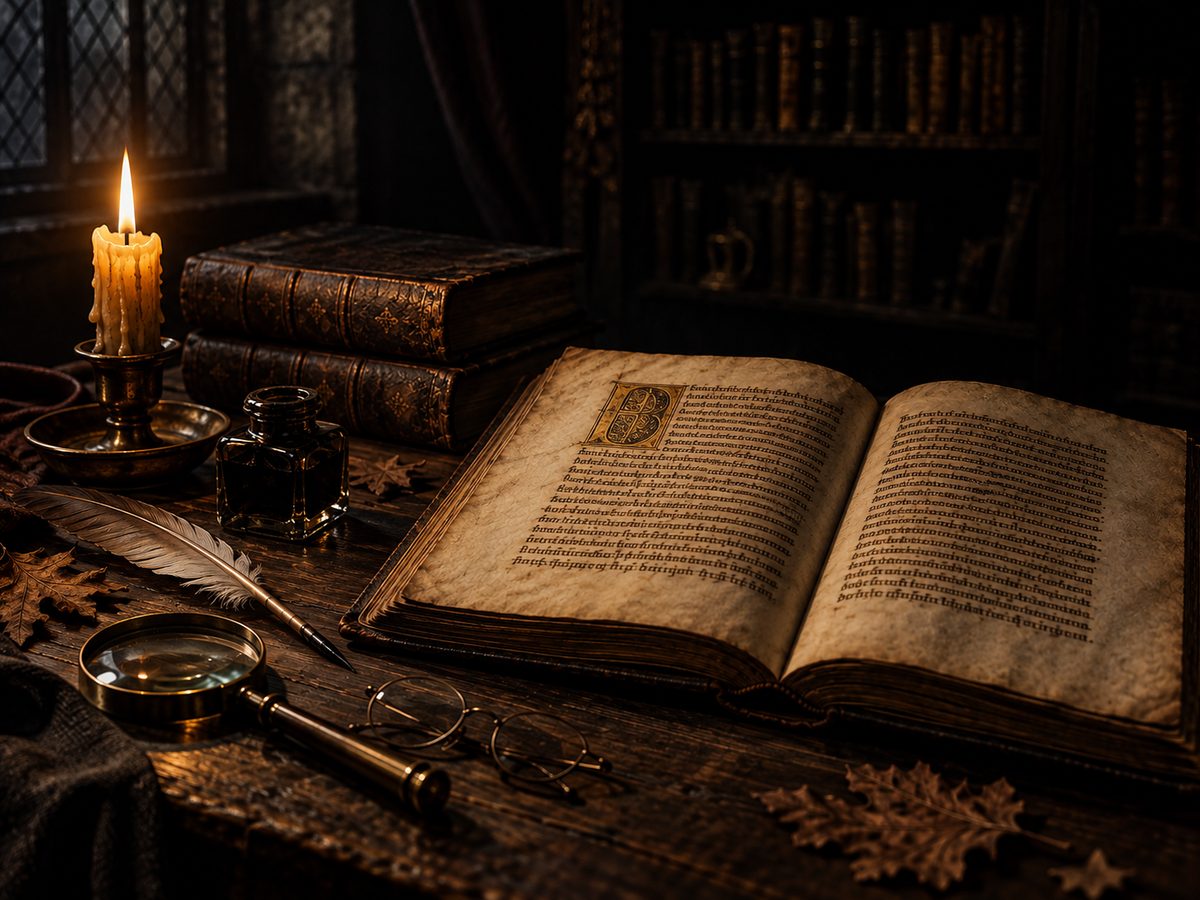
In an Old English poem from the 9th century, two words sit in the same line: éarendel and middangeard. A young student at Oxford read them, understood them, and never let them go. One became Eärendil. The other became Middle-earth. And that is only where it starts.
Hardly any name comes up as often in conversations about Norse mythology as his, and hardly any is as thoroughly misunderstood. To many people, John Ronald Reuel Tolkien is the man who helped himself to the Edda. True enough. It is also roughly a third of the story, and the dullest third at that.
Tolkien was not an author who did a little Norse research for his novel. He was a professional philologist. He read the sources in the original, edited them, and argued with colleagues about single words. What grew out of that is not borrowing but something stranger: an invented world that grew out of real words the way a plant grows from a seed.
We have only brushed past Tolkien so far in our articles: with the dwarves, with Midgard, with Hervör, with the wolf. Here he is in one piece. With what can be shown. And with what gets wrongly credited to him, or to the mythology.
Tolkien was born in 1892 in Bloemfontein, South Africa, grew up in England and spent his working life at Oxford. From 1925 to 1945 he held the Rawlinson and Bosworth Chair of Anglo-Saxon there; from then until 1959 the Merton Chair of English Language and Literature. He died in 1973. His day job was not novels. It was Old English, Old Norse, Middle English, Gothic: dead languages, and what single word forms reveal about the people who used them.
That is not a footnote to his work. It is the engine.
Tolkien said more than once that with him the languages came first and the stories afterwards, invented to give those languages a world in which somebody speaks them. Once you have grasped that, you read Middle-earth differently. The names are not pretty-sounding inventions. They are linguistic reconstructions, built along the rules of real Germanic sound history.
As a student, Tolkien came across the Old English Crist, a Christian poem attributed to Cynewulf. Two of its verses floored him: Éala éarendel engla beorhtast / ofer middangeard monnum sended - "Hail Éarendel, brightest of angels, sent to men over Middle-earth."
In Old English, éarendel denotes a shining light, probably the morning star. For a philologist a word like that is an open window: it is older than the Christian text it sits in, it has no clean explanation, and it sounds as though it belongs to a story nobody remembers. Tolkien decided to write that story. His poem about the voyage of the evening star was written in September 1914; in November he read it to the Essay Club at Oxford.
Hold on to what happened there. The entire cosmos of Middle-earth - decades of work, thousands of pages, a world history with its own ages - goes back to an attempt to give one unexplained word a narrative to stand on. And the second word of the same line, middangeard, became the name of the world it all takes place in.
In 1926 Tolkien founded a reading club at Oxford with a name worth remembering: the Kolbítar, the "Coalbiters". That is an Old Norse jibe for people who crouch so close to the fire they all but bite the coals - stay-at-homes, in other words. The group met to read Old Norse texts in the original: the Edda, the sagas, Snorri. Not in translation. Line by line, aloud, together.
It was there that he came to know C. S. Lewis, the later author of Narnia, more closely. Two men both seized by what Lewis called "Northernness" - that peculiar longing that takes hold of you when you read Norse poetry and resists explanation. Cold, distance, doom, and in the middle of it people who refuse to back down anyway.
This is the point where philology turns into an attitude. In 1936 Tolkien devoted a lecture to it that still echoes: Beowulf: The Monsters and the Critics. His argument, briefly: scholarship had treated Beowulf for decades as a quarry for historical data and overlooked that it is poetry. The monsters are not childish trimmings but the core, because the poem is about fighting something you cannot defeat, and fighting it regardless.
That is the Norse stance sometimes called northern courage: courage without prospect of victory. The gods lose at Ragnarök. They know it. They line up anyway. Tolkien did not copy that idea out of the Edda - he dissected it out as a specialist and then made it the moral backbone of his own work. If you want to know why it is always the smallest figures who tip the balance in his books, this is the answer.
Now for the specifics. We go through the models one by one, and each time we say what the source actually contains and what Tolkien made of it. Because those are almost always two different things.
The best-known and most easily checked case sits in the Völuspá, the opening poem of the Poetic Edda. It contains the Dvergatal, the "catalogue of dwarves": a long list of dwarf names that strikes modern readers as fairly dry. A list.
Open The Hobbit and read the names of the company: Thorin, Dvalin, Fili, Kili, Dori, Nori, Ori, Óin, Glóin, Bifur, Bofur, Bombur, Durin - every one of them is in that list. And one further name from the Dvergatal went on to particular fame: Gandalf. Old Norse Gandálfr, roughly "wand-elf" or "staff-elf".
So Tolkien did not merely populate his dwarves from an Eddic name list; he named his wizard from it too. Who the dwarves of the tradition actually are, we have written up elsewhere - in short: master smiths of stone and darkness, grown from the body of the primordial giant Ymir, and a good deal less cosy than The Hobbit suggests.
Old Norse Miðgarðr, Old English middangeard, Old High German mittilagart, Gothic midjungards: the word for the world of men is common Germanic and therefore very old. Literally it means the "middle enclosure" - the fenced inside, surrounded by a threatening outside of wilderness and giants.
Tolkien did not invent this word and never claimed to. He translated it: middangeard became Middle-earth. What surprises many readers is that in his stories Middle-earth is not a fantasy planet but explicitly our own world in a very early, invented epoch. The name says as much - it comes from the language in which our ancestors spoke about their own world. More on the term and its history in our article on Midgard.
Beowulf was Tolkien's life-long subject, and he drew more from it than from any other single text. Three examples that can be traced word for word:
Orcs. Beowulf contains the Old English word orcnéas, usually understood as a kind of corpse-demon or evil spirit. Tolkien picked up the stem and made his own creature of it. The word is real - the orcs as we know them are his invention.
Ents. Old English poetry speaks of eald enta geweorc, the "old work of giants": that is what the Anglo-Saxons called the ruined Roman stonework whose builders they no longer knew. A people who see ruins and conclude giants. Out of that enta came Tolkien's Ents - tree-herds older than everything else, who speak slowly because they measure time differently.
The dragon. In the last third of Beowulf a thief wakes a dragon by stealing a single cup from its hoard. The dragon wakes, counts, notices the loss and burns the land. Anyone who knows The Hobbit knows this scene: Bilbo takes a goblet, Smaug wakes, and the people of Esgaroth pay for it. Tolkien never disguised this.
This is where it gets delicate, because two things constantly get mixed up. In order, then.
The cursed ring of the Sigurd tradition does not fall from the sky. It has a back story, and you need it, or the curse makes no sense.
Three gods are on the road: Odin, Hœnir and Loki. At a waterfall Loki sees an otter eating a salmon and kills it with a stone. It was not an otter but Otr, the son of the farmer Hreidmar, in animal shape. That evening the three take lodging with Hreidmar of all people and proudly show the pelt. Hreidmar and his remaining sons Fáfnir and Regin overpower the gods and demand weregild: the otter skin is to be filled with gold and completely covered with it from the outside.
Loki, who caused the damage, has to fetch the gold. He goes to the waterfall of the dwarf Andvari, who lives there in the shape of a pike, catches him with a borrowed net and squeezes his whole hoard out of him. Andvari tries to keep back one ring, Andvaranaut. Loki takes that too. So the dwarf lays a curse on it: whoever owns the ring shall be destroyed by it.
The gold fills the skin - all but a single whisker still showing. To cover it, Odin has to give up the ring he had meant to keep. At that moment the curse is loose in the world. And it works its way through in order: Fáfnir kills his father Hreidmar for the gold, withdraws with it into the wilderness and becomes a dragon. Regin later sets his foster-son Sigurd on his brother; Sigurd kills the dragon - and then Regin too, who meant to kill him from behind. In the end Sigurd himself is murdered.
A cursed gold ring that ruins its bearer, a hoarded dragon treasure, a broken sword reforged, a hero who tastes dragon's blood and then understands the birds - all of it is there, long before anyone invented a hobbit. Tolkien's idea of the sword that shatters and is reforged for the rightful heir has its origin here too: Sigurd's father's sword Gram is remade from the fragments.
Tolkien did not engage with this material in passing. In the 1930s he wrote his own retelling in Old Norse metre, The Legend of Sigurd and Gudrún, published posthumously only in 2009. He knew the material from the inside.
Less famous, but important to Tolkien: the Hervarar saga with the lay of Hervör. A daughter goes to the burial island by night, calls her dead father out of the mound and demands the family sword Tyrfing - a blade loaded with a curse. Her father warns her. She holds firm. She gets it.
Tolkien knew this poem closely and translated it. Barrows with something inside that is better left asleep; weapons with a will of their own; an heiress who will not be turned away - all of it resurfaces in his world, most plainly in the barrow-mounds from which the hobbits get their blades.
Odin appears again and again in disguise: an old man with a broad hat, a cloak and a staff, one-eyed, travelling, testing. He arrives at courts, poses riddles, helps, disappears. Anyone picturing the grey wanderer in Tolkien sees the family resemblance at once.
For once this is not just outside interpretation. Tolkien called Gandalf exactly that himself. When the German interested party Horus Engels sent him illustrations in which Gandalf came across as a figure of fun, he complained to his publisher Stanley Unwin: he had imagined an Odinic wanderer, not a comedian.
So one of the most popular claims about Tolkien is documented - by him. You just should not conclude from it that Gandalf is Odin. Odin is also the god of war, of frenzy and of betrayal, one who drops his followers when it suits him. That side is entirely absent from Gandalf. Tolkien took a figure and left out half of it.
Hardly any figure has drifted further between the tradition and the modern picture. Say "elf" today and people see tall, immortal beings of melancholy beauty. The sources hold something else, and it is a good deal more unsettling.
The elves (Old Norse álfar, Old English ælfe, Old High German alb) were not marginal. In Eddic poetry they stand in fixed formulas right beside the gods: "Æsir and álfar" is the phrase when the meaning is "every power that counts". The Grímnismál names Álfheim, the world of the elves, as a tooth-gift for the young Freyr - nobody gives away a whole world over a triviality.
They even had a cult of their own. Around 1019 the Icelandic skald Sigvatr Þórðarson describes a journey through western Sweden on which farm after farm turns him away at the door: the álfablót, the sacrifice to the elves, was under way and strangers were not admitted. That is unusually solid evidence - not a myth, but an irritated traveller left standing in the cold.
The other side is the one that survived in our languages. Elves made people ill. Old English has ælfsiden for a sickness caused by elves and ælfscot, "elf-shot": invisible beings were imagined shooting tiny darts at people and cattle, and where they struck came pain and paralysis. Anglo-Saxon healing charms carry whole remedies against it.
In German the same being became the Alb or Alp that sits on a sleeper's chest at night and takes his breath - hence Alpdruck, and hence the ordinary German word for a bad dream, Alptraum or Albtraum. The English word works the same way: nightmare has nothing to do with a horse. The mare in it is that same pressing night-being, the German Mahr.
In the Prose Edda Snorri had already tidied up what the older poems leave blurred: Ljósálfar, light-elves, "fairer than the sun", and Dökkálfar or Svartálfar, dark and black elves living underground. That clean division is a piece of 13th-century systematising, some two hundred years after the conversion of Iceland, and whether it matches the older ideas is an open question. In the poems themselves, elves and dwarves are at times barely distinguishable.
Tolkien knew all of this. And he deliberately set himself against it - not against the Edda, but against what the 19th century had made of it. In his day the English "elf" was a dainty flower-being with dragonfly wings, nursery furniture. Tolkien found that intolerable and said so more than once: he wanted to give the word its dignity back.
His method was that of a philologist. He insisted against his printers on the older forms - elven rather than elfin, dwarves rather than the correct English plural dwarfs - because the usual forms sounded to him like the nursery and the old ones like something older than us. His elves became tall, dangerous, sorrowful and deathless. That is not a restoration of the tradition. It is a counter-invention.
Three more cases that can be traced cleanly:
Mirkwood. Old Norse Myrkviðr, "dark wood", is a mythical boundary forest in Eddic poetry that must be crossed and in which nothing good is waiting. Tolkien took the name over as Mirkwood.
Wargs. Old Norse vargr means two things: wolf - and outlaw, a man cast out of the community. Both in one word, which says a great deal about the world view behind it. Tolkien made Wargs of it, a creature of his own. What the wolf in the north really meant, we have written up separately.
Beorn. The shape-changer in The Hobbit who appears as man and as bear carries an Old English word for a name: beorn means "warrior, man", but it is related to the word for bear. Behind it stands the Old Norse idea of the berserkr - probably "bear-shirt" - and of fighters who take animal shape. The hero's name Beowulf is likewise usually read as "bee-wolf", a kenning for the bear.
One point that almost always drops out of the usual Tolkien-and-the-Vikings story, and it happens to be among the most important.
The most tragic figure in Tolkien's world is Túrin Turambar: a man under a curse who destroys everything he loves, marries his sister without knowing it, and finally throws himself on his own sword. In its outline this story does not come from the north but from Finland - from the Kalevala, the Finnish epic, and there from the figure of Kullervo.
As a young man Tolkien wrote his own version of that tale; it appeared in 2015 as The Story of Kullervo. Finnish, which is not related to the Germanic languages at all, also shaped the sound of Quenya, his high-elven tongue.
Now we turn the direction around. So far this has been about what Tolkien took from the tradition. The more interesting part for us in the workshop is the other one: what do people today take for old Norse knowledge when it actually comes from Tolkien? These questions reach us regularly, and we would rather answer them once at length.
"Wargs are Norse mythical beasts." No. Vargr is an ordinary Old Norse word for wolf and for outlaws. The warg as a supernatural giant wolf with its own people and its own speech exists only from Tolkien onwards.
"Middle-earth is a place from the Edda." Half right. The word is real and ancient; the place is not. In the tradition it simply means the world of men - the earth you are standing on. Middle-earth as a map with the Shire and Mordor is 20th-century fiction.
"Elves are the tall, immortal beings of light of the Germanic peoples." Essentially Tolkien's shaping - see the section on the elves above. In short: the elves of the tradition are harder to pin down, and the mare in nightmare is the same night-being that sits on a sleeper's chest.
"The dwarf runes in The Hobbit are real." Those actually are - and it is the only such case. For The Hobbit Tolkien used the Anglo-Saxon futhorc, a genuinely attested runic row. For The Lord of the Rings, by contrast, he invented his own system of characters, the Cirth or Angerthas. They look like old runes because he knew what runes look like. Historical they are not. And the Tengwar, the flowing "elvish script", certainly not.
"Thorin, Durin, Gandalf are Tolkien names." The other way round. They stand in the Völuspá, centuries before him. Anyone having one of those names engraved is carrying genuine Eddic material - not because Tolkien invented it, but because he found it. Gimli has an Eddic ring to it as well: in the Völuspá, Gimlé is the place where the righteous dwell after the end.
"Balrog, Mordor, hobbits, the Eye - old as well, surely?" None of it. That is Tolkien, entirely, built from his own languages.
Very practically: we regularly receive enquiries that mix the two. Someone wants a line in "elvish script" on a slate plaque, a dwarf name in "real runes", a motif from a particular film. We tell them how it stands - even when it costs us the order.
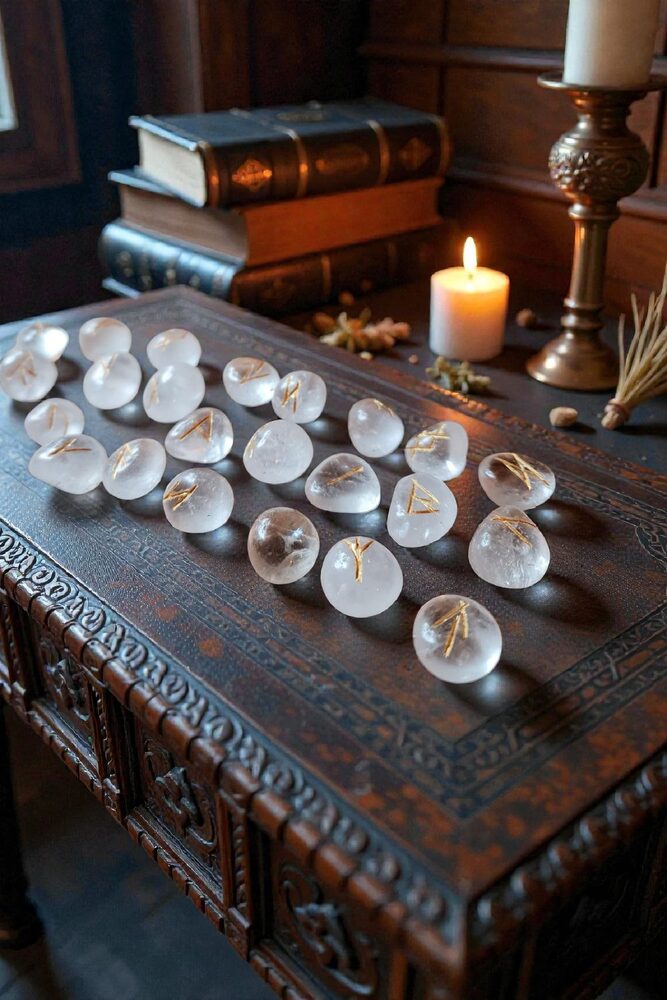
What we do engrave: genuine runes of the Elder and Younger Futhark, names in correct transliteration, verses from the Edda and the Hávamál, motifs based on archaeological originals. What we do not offer: characters, names and motifs from Tolkien's work. Those are protected by copyright and trade mark - we are not lawyers, but the position is clear enough that we keep our hands off. And frankly it is not our craft either: we work with what is attested.
The good part: the detour nearly always pays. People who come to us because Middle-earth got hold of them often leave with something older - their own name in the Elder Futhark, a line from the Edda, the world tree on natural slate. Not as a substitute. As the source.
Tolkien has done more for the Norse tradition than almost any excavation. Millions of people know there is such a thing as the Edda only because dwarf names and a grey wanderer led them there. That is no falsification, as long as you know the difference.
And the difference is simple in the end. The Edda is handed down - written by people who believed in that world, or at least told of people who did. Middle-earth is invented, by a man who knew the tradition so well that his invention rings true. You may love both. You should only not claim they are the same thing.
Tolkien himself would probably have put that most sharply. He spent his life looking closely at where a word came from. That is the attitude we like in him, and the one we try to carry into every engraving: look first, then cut.
For courage. For remembrance. For legends that live on.
The dwarves & the dwarf catalogue · Midgard · Odin · Elves · Hervör · The wolf in the north · The Eudoses & Finnsburg · Sigurd · Rune handbook.
Primary sources: Poetic Edda, Völuspá (Dvergatal, st. 10-16), Codex Regius; Hervarar saga ok Heiðreks; Völsunga saga; Snorri Sturluson, Prose Edda, c. 1220; Beowulf (lines 112 and 2278-2311, Cotton Vitellius A. xv); Crist (Christ I), lines 104-105, Exeter Book; Kalevala, ed. Elias Lönnrot, 1849. By Tolkien: Beowulf: The Monsters and the Critics (lecture, 1936); Finn and Hengest, ed. Alan Bliss, 1982; The Legend of Sigurd and Gudrún, ed. Christopher Tolkien, 2009; Beowulf: A Translation and Commentary, 2014; The Story of Kullervo, ed. Verlyn Flieger, 2015; The Letters of J. R. R. Tolkien, ed. Humphrey Carpenter and Christopher Tolkien, no. 107 (7 December 1946). Scholarship: Tom Shippey, The Road to Middle-earth; Humphrey Carpenter, J. R. R. Tolkien. A Biography, 1977; Rudolf Simek, Dictionary of Northern Mythology; John Lindow, Norse Mythology, 2001.
Master smiths of Svartalfheim - and the dwarf catalogue of the Völuspá that gave Tolkien nearly every name in The Hobbit …
Weiterlesen →The world of men between Asgard and Utgard - and the word middangeard that became Middle-earth …
Weiterlesen →God of wisdom, poetry and death - and the grey wanderer that Gandalf was measured against …
Weiterlesen →The daughter who wrests the cursed sword from her dead father's barrow - a lay Tolkien translated …
Weiterlesen →