There are Germanic peoples you can write books about, and then there are the Eudoses. Exactly one sentence survives about them – and in that sentence they are not even described, merely listed. Tacitus names them fifth in a row of seven peoples who share the worship of a goddess, and adds expressly that nothing about any of them individually is worth noting. That sounds like half a page of material. In fact it is one of the most instructive chapters in the study of Germanic antiquity. A whole chain of conjecture hangs on this single word: a possible confusion in Caesar's text, a possible identity with the Jutes, and a debate that comes down, in the end, to one letter.
The source situation for the Eudoses can be summed up in a sentence, because it consists of a sentence. The name occurs exactly once in the whole of ancient literature: in Tacitus, chapter 40 of his Germania, written around AD 98. No second author picks it up, no inscription carries it, no coin, no military diploma, no gravestone. Anyone writing about the Eudoses is therefore not working with sources in the plural, but with one source in the singular – plus everything five centuries of scholarship have attached to it.
That is less unusual than it sounds. A substantial share of the peoples named by Tacitus survives in exactly this form: a name in a list, without history, without location, without a face. The difference is that in the case of the Eudoses, two of the most interesting questions in Germanic studies converge at precisely this thinnest of points. The first asks whether the name already appears in Caesar, forty years earlier, merely miscopied. The second asks whether it produced a people that would later shape half of England.
This article deals with both. Above all, though, it deals with the craft behind them: how history is extracted from a single word, where the boundary runs, and how you notice that you have just crossed it.
Towards the end of his section on the Suebi, Tacitus reaches the North Sea and Baltic coasts. He has just dealt with the Langobardi, whose small numbers he praises, and then strings together seven names without transition. What follows is the most famous passage in the entire work: the account of the Nerthus cult, with its veiled wagon, its island in the ocean, and the attendants swallowed by the lake.
Reudigni deinde et Aviones et Anglii et Varini et Eudoses et Suardones et Nuithones fluminibus aut silvis muniuntur. Nec quicquam notabile in singulis, nisi quod in commune Nerthum, id est Terram matrem, colunt.
Tacitus, Germania 40; own translation
Next come the Reudigni and the Aviones and the Angles and the Varini and the Eudoses and the Suardones and the Nuithones: they are protected by rivers or forests. Nor is there anything notable about any one of them individually, except that in common they worship Nerthus, that is to say, Mother Earth.
That is the whole of it. Five words of context, a collective observation, and a cult report that is not about the Eudoses but about the group. You can learn this sentence by heart and afterwards know precisely as much about the Eudoses as the entire discipline does.
Before interpreting, it pays to count the gaps. Tacitus does not say where the Eudoses lived. He names neither river nor coast nor neighbours beyond the other six names on the list. He does not say how numerous they were, whether they had kings, what they traded, how they fought. He does not even say that they were an independent people in our sense – he uses gens and natio loosely throughout the Germania.
Nor does he say that these seven peoples formed a league. The Latin contains nothing about alliance, treaty or joint leadership. What it contains is in commune … colunt: they worship in common. That is a statement about cult, not about constitution. The term Nerthus league, established in the literature, is a modern ordering device – useful, but not the language of the source. We have treated it at length in our article on the Nerthus league.
Finally, Tacitus assigns the group to the Suebi. This emerges not from chapter 40 itself but from the opening sentence of chapter 41, where he speaks of "this part of the Suebi" extending into the more remote regions of Germania. In Tacitus' own scheme, then, the Eudoses are a Suebian subgroup – which opens the question of their location rather than settling it.
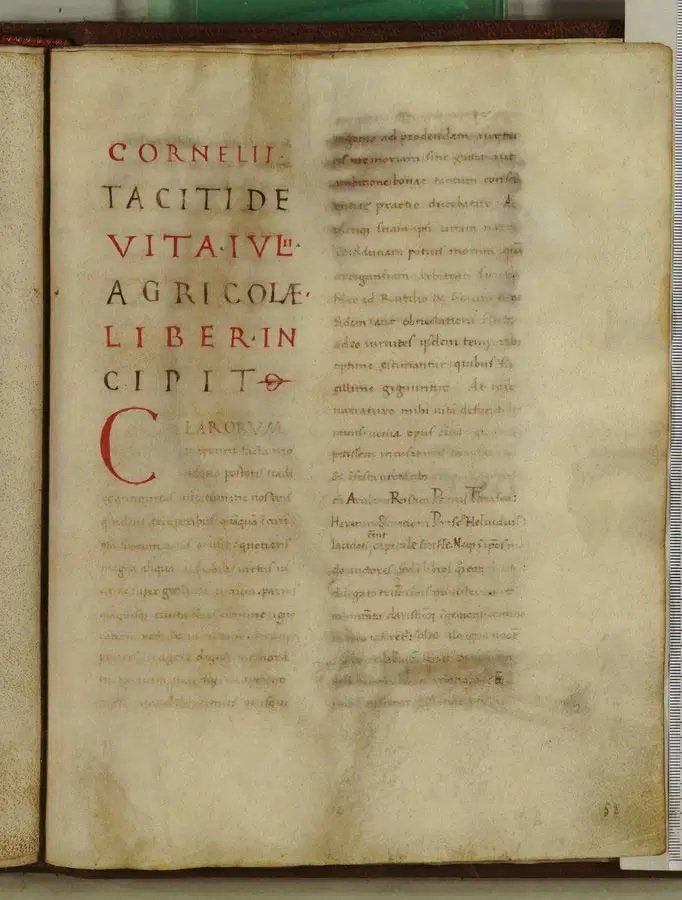
Here the matter turns technical, and here its real interest lies. The Germania survives neither in the original nor in an early copy. The entire text depends on a single medieval manuscript, the Codex Hersfeldensis, brought to Italy in the middle of the fifteenth century and now lost. No Carolingian leaf of the Germania survives; the celebrated Codex Aesinas carries the text complete in a fifteenth-century hand, and the eight Carolingian leaves in that codex belong to the Agricola, not the Germania.
What does that mean in practice? Every name form in chapter 40 stands or falls with what an Italian humanist copied from a lost German monastic manuscript – and with what later editors made of it. With proper names this is especially precarious, because a scribe cannot correct them from the sense of the passage. An unfamiliar word is copied as he believes he sees it.
The same sentence demonstrates this. The sixth name appears in the manuscripts as Suarines; the form Suardones, printed by older editions and by the classic English translation of Church and Brodribb in 1877, occurs in one manuscript only as a marginal note. Modern critical editions therefore print Suarines. The seventh name, Nuithones, has been regarded as corrupt since Gudmund Schütte, who proposed Teutones or Euthiones instead. One quickly sees how free this game becomes: adopt Schütte's Euthiones and the Jutes appear twice in the same list.
That textual criticism is no side issue in this chapter is shown by the goddess's own name. The manuscripts do not uniformly offer Nerthum. Also transmitted are Nertum, nethum, Neithu and neithum. The form Nerthum printed today is an editorial decision, not seamless transmission.
More consequential still was the humanist reading Herthum. Out of it, the eighteenth and nineteenth centuries manufactured a Germanic goddess "Hertha" who never existed. She can still be visited in the landscape: the Herthasee and the Herthaburg on Rügen bear the name of a misreading. Anyone inclined to file textual criticism under footnotes should remember that here a single misread letter invented a deity and generated place names.
For the Eudoses this is the decisive lesson. If, within the same sentence, the name of the goddess, the name of the sixth people and probably that of the seventh are all uncertain, the question is not whether the fifth name might wobble too. The only question is how badly.
This brings us to the first major hypothesis. In the first book of the Gallic War, Caesar lists the peoples Ariovistus led against him in 58 BC: Harudes, Marcomanni, Triboci, Vangiones, Nemetes, Sedusii, Suebi. The Sedusii appear there – and nowhere else. They too are a people attested exactly once.
There is, however, a second textual witness to this list, though not a second witness to the events: Orosius, writing around AD 417 and excerpting Suetonius for the Gallic campaigns. In Carl Zangemeister's edition his version reads: fuerunt autem in exercitu Ariouisti Arudes Marcomanes Triboci Vangiones Nemetes Eduses et Suebi. Where Caesar's manuscripts give Sedusios, Orosius gives Eduses; Edures and Eudures are recorded as further variants.
From this follows a philologically clean proposal. In continuous script the two names stand immediately adjacent: Nemetes Eduses. If the final s of the first word is accidentally written twice – dittography, the commonest of all copying errors – the result is Nemetes Sedusii. The ethnic name Sedusii would then be no ethnic name at all but a slip of the pen, and the Eudoses would be meant.
A good deal speaks for the hypothesis. It solves two puzzles at a stroke: why the Sedusii otherwise vanish without trace, and why a people otherwise located on the Baltic might suddenly appear on the Upper Rhine. It rests on a genuinely attested rather than an invented type of error. And it builds on a transmitted variant rather than a conjecture out of thin air: Eduses stands in Orosius manuscripts; it is not reconstructed.
A good deal speaks against it as well. Orosius is roughly four hundred and seventy years later than Caesar and works at second hand; his name forms may be secondarily corrupt just as easily as Caesar's. That the Harudes have become Arudes in his text shows how loosely the tradition handles these words – the Harudes are independently well attested, yet garbled here all the same. And a geographical problem remains: Tacitus places the Eudoses in the north, Caesar places his Sedusii on the Upper Rhine.
Stated honestly, the position is this. The equation is possible, methodologically well founded, and represented in the literature. It is not proven, and with the available material it cannot be. It is a hypothesis about one letter, resting on a text that is not itself an original.
An inconspicuous but telling detail: the Reallexikon der Germanischen Altertumskunde, the standard work of the field, does not enter this name under Eudoses. Günter Neumann's article in volume seven, published in 1989, carries the headword Eudusii. That is not arbitrary but a position. To file the name under Eudusii is to signal that the forms in Tacitus, in Caesar and in Orosius are being treated as variants of a single name.
The same reference work carries a separate article on Eutii, Eucii by Neumann in volume eight, and a substantial article on the Jutes by Eggers, Hardt and Neumann in volume sixteen. Keeping those headwords apart is the more cautious option: the names are treated separately precisely because their unity is not established.
For non-specialists this matters more than it looks. Encyclopedia entries feel like neutral information, but at points like this they are already interpretation. If someone shows you a table with Sedusii, Eudoses, Eutii and Jutes in a single row, you are not looking at a source. You are looking at three hypotheses stacked on top of one another.
The second major hypothesis is the better known one. It runs: the Eudoses of Tacitus became the Eutii and Euthiones of Merovingian sources, thence Old English Eote and Ytas, Old Norse Jótar, and finally the Jutes, who according to Bede crossed to Britain alongside Angles and Saxons and settled Kent, the Isle of Wight and part of what became Wessex.
The intermediate links are real. Theudebert, king of the Franks, names a people called Saxones Eucii in his letter to the emperor Justinian. Venantius Fortunatus mentions Euthiones in 583 under the overlordship of Chilperic I, in northern Francia, roughly the area of modern Flanders – directly opposite Kent. Bede, a good hundred and fifty years later, explicitly derives the people of Kent from the Jutes. It is a plausible chain, but it is a chain built of name resemblances, and each link carries only as much as the weakest.
The archaeology does not make matters easier. Bede placed the Jutish homeland on the Jutland peninsula; the grave goods from east Kent, southern Hampshire and the Isle of Wight, however, show predominantly Frankish and North Sea influence in the fifth and sixth centuries and little connection with Jutland. There is simply no scholarly consensus on the origins of the Jutes.
One argument, though, deserves to be taken more seriously than mere assonance. The Old English poem Widsith contains a catalogue of rulers in which, in immediate succession, Billing rules the Wernas, Oswine the Eowan and Gefwulf the Ytas. Three peoples in two lines of verse – and those same three stand in a row in Tacitus: Varini, Aviones, Eudoses.
The equations Wernas equals Varini and Eowan equals Aviones are linguistically unproblematic and accepted in the specialist literature, for instance by Heinrich Beck in the Reallexikon. If two of three neighbours recur in the same order, the third equation – Ytas equals Eudoses – gains considerable weight. Not as proof, but as a structure one would rather not explain away as coincidence. We have written separately about the Varini and their surprisingly long afterlife.
Caution is still in order. Widsith dates at the earliest from the late seventh century and survives in a tenth-century manuscript; the catalogue is learned poetry, not a register. Leonard Neidorf has moreover suggested that another ethnic name in the poem, sweordwerum, may be corrupted from Suarines. Here too, then: the same fascination, the same imprecision.
A side issue that illuminates the whole nicely. In Beowulf, in the so-called Finnsburg episode, the word eotenas occurs several times. It can mean "giants". It can also denote the Jutes, because in several inflected forms the Old English ethnic name and the Old English word for giant coincide.
J. R. R. Tolkien, a considerably more precise philologist than his reputation as a novelist suggests, built on this his theory of "Jutes on both sides": the conflict at Finnsburg was really a Jutish feud into which Finn and Hnæf were drawn. His lectures appeared posthumously in 1982 as Finn and Hengest. Other scholars continue to read giants in the same passages, arguing that no Jutes are involved in the conflict at all.
What follows from this matters for our subject. The widespread claim that the name of the Jutes means "giants" is not an etymology but a side effect of an Old English homonymy. Two words that happen to look alike do not thereby acquire a common origin.
That leaves the question whether the Eudoses might after all surface a second time in antiquity. In his Geography, Claudius Ptolemy describes the peoples of the Cimbric peninsula: beyond the Saxons at the isthmus come the Sigulones, then eastward the Sabalingii and the Cobandi, above them the Chali, above those the Fundusii to the west and the Charudes to the east, and the Cimbri furthest north of all.
An old conjecture wants to see in the Phoundousioi an original Eundousioi, and thereby to recover the Eudoses in Jutland. It is tempting, because it would confirm the Jutish thesis, and it is suspect for exactly that reason. An initial sound transmitted in the manuscripts is altered in order to yield a desired result. Soberly considered, Ptolemy does not name the Eudoses; he names a people whose name can be bent until it fits.
A note on citation that regularly causes confusion: depending on the edition, this passage is cited as Geography II,11 or II,10. The same problem arises with the Charudes. Anyone citing Ptolemy should name the edition as well.
Let us total up what is absent. Pliny the Elder, who lists the major Germanic groupings in his Natural History, does not know the Eudoses. Ptolemy does not name them. Neither does Strabo, nor Velleius, nor Cassius Dio. There is no inscription, no cohort, no ala, no military diploma, no gravestone giving Eudoses as an origin. No coin legend, no place name securely derived from them.
Archaeologically, too, nothing can be assigned. There is no find group, no pottery style, no brooch type that could be attributed to the Eudoses – not least because nobody knows where to look. And even if one did, the methodological objection would remain that an archaeological culture is not a people.
This finding should not be lamented but stated. A cleanly articulated negative result is worth more scientifically than an elegantly constructed guess presented as knowledge. With the Eudoses, the silence of the sources is the actual datum.
Localisation happens anyway, and in two directions. One places the Eudoses in the north, on or near the Jutland peninsula – the version supported by the Jutish equation and carried along by the Ptolemy conjecture. The other looks further south-east, in the region of modern Mecklenburg, relying on the neighbours in Tacitus' list and on the interpretation of Suarines as an early form of Schwerin.
Both versions use the same trick: they infer the location of an unknown people from the supposed location of its neighbours on a list. That is legitimate so long as one remembers that Tacitus' order is not necessarily geographical. For the Angles, the one people in the row with a substantial later history, we know it reasonably well; for the Reudigni and Nuithones we do not know it at all.
The honest answer is therefore: somewhere between the lower Elbe, the western Baltic and Jutland. That is an area several hundred kilometres across, and any map that marks a point is marking an opinion.
The name itself is no different: there are interpretations, but no generally accepted etymology. The forms in play are Eudoses in Tacitus, Eduses in Orosius, together with Eutii, Eucii and Euthiones in Merovingian sources, Old English Eote and Ytas, Old Norse Jótar. That this series can be connected phonologically is the founding assumption of the Jutish thesis; that it must be so connected is not claimed by the specialist literature.
Two widespread online claims should be set aside. The first is the translation "giants" already mentioned, which derives from homonymy with Old English eoten and is not a reading of the name at all. The second is the occasional statement that the Eudoses spoke "a Gothic language". There is no basis whatever for this; nobody ever heard or read a sentence of theirs.
Linguistically, then, exactly as much is secure about the Eudoses as geographically: nothing. What is secure is a sequence of letters in a copy of a lost manuscript.
That leaves the cult that makes the group worth mentioning in the first place. Tacitus describes a sacred grove on an island in the ocean, containing a wagon draped in cloth which only a priest may touch. When the deity is present, the wagon is drawn by cows through the lands; while she travels, weapons rest, all iron is locked away, and there prevails a peace which, as Tacitus drily notes, is known and loved only at such times. Afterwards wagon, cloths and, if you care to believe it, the deity herself are washed in a secluded lake – and the slaves who serve are swallowed by that same lake.
About the Eudoses in particular this tells us precisely one thing: they belonged to the catchment of this cult. Tacitus does not say where the island lay, and every proposal from Zealand through Funen to Rügen is guesswork. That he glosses the deity as Terra mater is moreover Roman interpretation, not a Germanic self-description. And the name Nerthus corresponds by regular sound change to Old Norse Njörðr – except that Njörðr is a male god. That change of gender remains unexplained.
Anyone hoping to extract a portrait of the Eudoses from this report in fact obtains a portrait of a cult community described by a Roman author from a great distance, whose inside perspective he never had.
One might say: a great deal of noise about a single word. But the Eudoses are a model case, and in both directions. They show how much scholarship can grow out of a single mention – textual criticism, onomastics, migration history, Old English philology, all hanging on eight letters. And they show how easily that scholarship turns into apparent knowledge as soon as the conditionals are deleted.
The chain that leads us from Ariovistus' army to Kent consists entirely of reasonable individual steps: a plausible copying error, a plausible sound development, a plausible parallel in Widsith. But the product of several probabilities is always smaller than any one of them. Four good guesses in sequence do not add up to certainty; they add up to a narrative.
This article therefore ends the way the source ends: with a name, a list, and the honest statement that we know no more. That is not a defect. A people of whom only the name survives is a reminder that ancient authors did not write for us – and that much of what looks today like solid knowledge is in truth a well-maintained assumption.
The Eudoses are named exactly once in the whole of ancient literature: Tacitus, Germania 40, fifth in a row of seven peoples who, in the Latin wording, worship Nerthus in common. Tacitus counts the group among the Suebi; this follows from the linking sentence at the start of chapter 41. It is further certain that the Orosius manuscripts give Eduses in the Ariovistus list where Caesar's text has Sedusios, and that the Reallexikon der Germanischen Altertumskunde treats the name under the headword Eudusii. Not certain, and not capable of being made certain, are: the location of their territory, their size, their etymology, their relationship to the Sedusii and their relationship to the Jutes. No inscription, coin, military diploma or archaeological assemblage can be assigned to them.
First: the statement "the Eudoses were the Jutes" is often printed in reference works without qualification. It is a well-founded hypothesis, not a finding – there is no scholarly consensus on the origins of the Jutes, and the grave goods from Kent and the Isle of Wight point towards Francia and the North Sea rather than Jutland. Second: the circulating translation of the name as "giants" is not an etymology but rests on the accidental identity of Old English eoten (giant) with the ethnic name; whether giants or Jutes are meant in the relevant passages of Beowulf is disputed to this day. Third: the claim that the Eudoses spoke "a Gothic language" and settled on the Caucasian coast around 480 appears in reference works but depends on several stacked identifications; no source names Eudoses there. Fourth, and most plainly: the equation of the Jutes with the jötnar of the Edda, complete with Asgard located in the drowned North Sea, goes back to Jürgen Spanuth's Atlantis speculations and has nothing to do with the study of antiquity. And finally: the phrase Nerthus league is modern scholarly shorthand; Tacitus speaks of shared cult, not of an alliance.
The Nerthus League · The Sedusii · The Angles · The Warni · The Jutes · The Harudes · The Suebi.
All History & Finds articles →
At the southern edge of Europe, on the slopes of Mount Taygetos, two Slavic groups lived for centuries whose names a …
Read more →Picture a jewellery box about the size of a thick book, carved from the bone of a stranded whale, and on every side …
Read more →