
Picture a jewellery box about the size of a thick book, carved from the bone of a stranded whale, and on every side whole worlds collide: a vengeful smith from Germanic legend, the she-wolf of Rome, the Three Magi, and the Roman army storming Jerusalem. Around it all run runes that partly explain and partly pose a riddle. Welcome to the Franks Casket, perhaps the densest picture book to survive from the early Middle Ages.
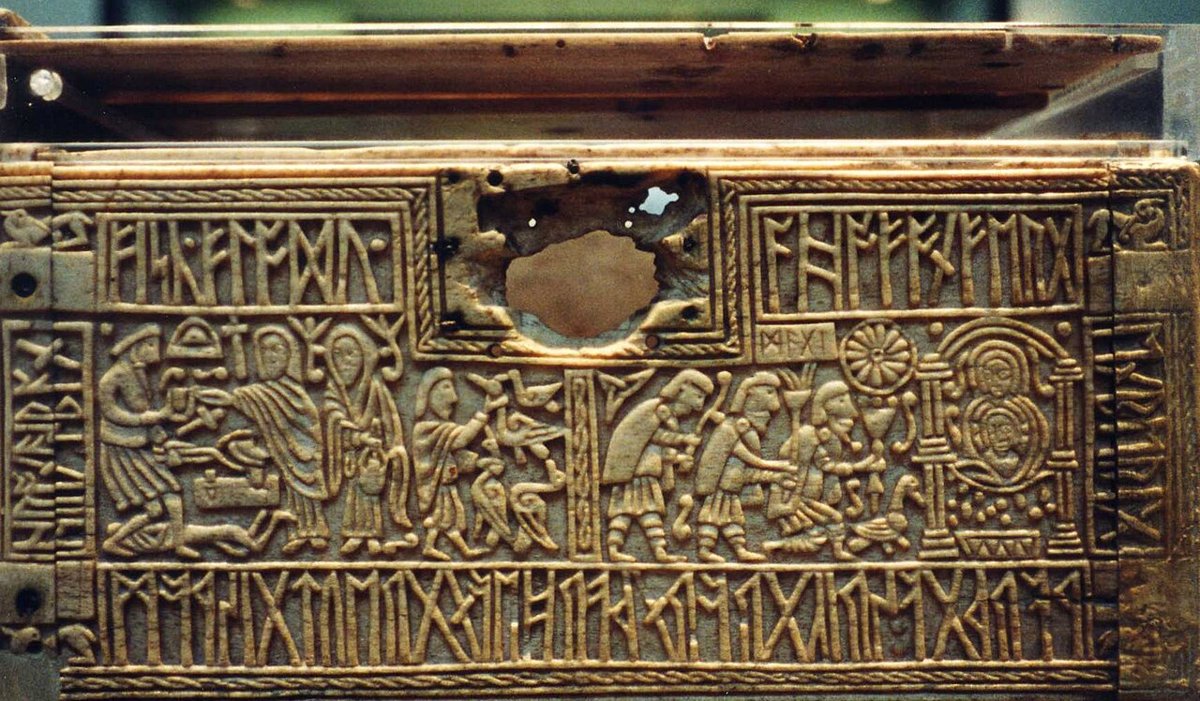
The Franks Casket, also called the Auzon Casket, is a small jewellery or storage box made around the year 700 in Anglo-Saxon Northumbria, in the north of what is now England. It measures only about 23 centimetres in length and is carved from the bones of a whale – not exotic ivory from distant lands, but a material the North Sea washed onto the shore. The casket even tells us this itself, but more on that later.
Its five surviving panels (lid and four sides) are covered from edge to edge with relief images and bands of runes. This is an elite object, most likely made in a monastic or courtly setting where people could read and where Germanic tradition, Roman learning and Christian faith all lived side by side. And that is exactly what makes the casket so remarkable: it shows all three worlds at once – often right next to each other.
The front panel is the most famous. On the left is a scene from Germanic heroic legend: Weland the Smith, Völund in Old Norse, captured and driven to revenge. He stands at his anvil, at his feet lies the headless body of one of the king's sons on whom he takes his terrible vengeance; a female figure approaches, and birds play a part. It is one of the oldest pictorial depictions of this legend anywhere. If you want the full story, you will find it in our deep-dive on Völund the Smith.
Immediately to the right – with no dividing line, in the very same band – the Three Magi kneel before Mary and the Christ child, the word "maegi", the Magi, spelled out above them. The vengeful heathen smith and the adoration of the Christ child share a single carved surface. This pairing is no accident but the key to the whole casket – and also the point where scholars still argue to this day.
The remaining sides widen the view. One panel shows Romulus and Remus with the suckling she-wolf – Rome's founding myth, carved in bone in Northumbria. Another shows Titus and the Roman capture of Jerusalem in the year 70, complete with battle, flight and judgement, labelled in a mix of Latin script and runes. Rome as world power and as bearer of the faith – both are present in these images.
And then there is the back, the so-called Hos panel. It shows a seated, animal-like or horse-headed figure, a warrior figure and a figure named "Hos" – and to this day no one is sure which story is actually being told here. The inscription is partly encrypted, and the scene cannot be firmly matched to any known legend. It is the great open question of the casket, one that generations of specialists have broken their teeth on.
Runic inscriptions run around the images – and not in Norse runes, but in the Anglo-Saxon Futhorc, the Anglo-Saxons' own extended runic row. If you want to know how the different runic rows differ, you will find it in our overview of the runes. The inscriptions on the casket are partly captions, partly names, partly wordplay: in one place the carver even switches into Latin letters and deliberately turns the runes, as if to challenge the reader a little.
The finest piece, though, is on the front: a small riddle-poem that explains what the casket is even made of. It describes a whale that the sea threw onto the coast, and from whose bone the casket was then made. In our own, sense-for-sense rendering it reads:
The flood lifted the fish onto the rocky cliff; the king of terror grew sad when he swam onto the shingle. Whale's bone.Franks Casket, front panel, Futhorc inscription; sense-for-sense rendering: Glanz & Gravur
So the object tells its own origin: a whale strands, dies, and from its bone a work of art is born. For a workshop that takes material and provenance seriously, that is an almost touching idea – here a piece speaks about the very substance it is made from.
The history of the object itself is a small adventure. For centuries it dropped out of sight; in the 19th century it resurfaced in Auzon in France, where it is said to have served for a time as a sewing box. In the process it was broken and the panels were separated. Most of it eventually reached the British Museum in London – donated by Augustus Wollaston Franks, after whom the casket is named today. A single panel, the right-hand side, stayed behind and now rests in the Museo Nazionale del Bargello in Florence. In the British Museum the missing panel is therefore replaced by a cast – to this day the casket is not reunited whole in one place.
The Franks Casket is a window into a moment when world-views overlapped without immediately cancelling each other out. The heathen smith and the Three Magi, Rome and Jerusalem, Germanic legend and biblical history – all of it stands on the same object, carved by one hand. Its fine, flat visual language, with interlocking bodies and an eye for pattern, sits well within the age of the great northern European animal styles and ornament, even though the casket itself is still pre-Viking and Anglo-Saxon. And the runes remind us that writing back then was not only information but craft, ornament and sometimes a deliberate riddle – an idea that also echoes in the consecration of runes and its formulae.
Attested: The Franks Casket is a genuinely surviving object made of whale bone, produced around 700 in Anglo-Saxon Northumbria, today mostly in the British Museum with one panel in the Bargello in Florence. Firmly established are the depicted motifs (Weland/Völund, the Adoration of the Magi, Romulus and Remus with the she-wolf, Titus before Jerusalem, the Hos scene) and the runic inscriptions in the Anglo-Saxon Futhorc, including the riddle-poem about the whale from whose bone the casket was made. The name derives from the donor Augustus Wollaston Franks.
Myth-check: The Franks Casket is an ANGLO-SAXON object with Old English runes (Futhorc) – it is NOT Viking-Age Norse, even if the motifs feel related. "Franks" refers to the collector Franks, not to the Frankish people. The reading of the Hos panel remains unsolved to this day; no known legend fits it with certainty. And whether the combination of heathen and Christian images is a carefully worked theological programme or rather a learned display of erudition is seen differently across scholarship – anyone selling you a single "correct" reading is glossing over honest uncertainty.
Anyone who takes the time to study the Franks Casket soon realises what it is: an entire picture programme crammed onto something the size of a matchbox. Each of the five surviving panels tells its own story, and none of them was chosen by accident.
The front is divided. On the left stands Germanic heroic legend: Weland the Smith in his workshop, tools around him, at his feet the headless body of a king's son. Weland hands a cup, made from a skull, to Beadohild, daughter of the King Nidhad who had him hamstrung and held captive. Beside it, separated by no line and yet a world apart, is the Adoration of the Magi: three magi follow the star to Mary and the Child, with the runic group "maegi" above them. Revenge and redemption, pagan and Christian, side by side. If you want to explore the Weland legend in full, we cover it in our own article on Völund the Smith.
The lid is only partly preserved and shows a siege scene. An archer, labelled "aegili" in runes above him, single-handedly defends a hall against attacking warriors. He is usually read as Egil, Weland's brother and the master archer of Norse tradition. The exact tale behind it is lost to us.
The left side brings in Rome: Romulus and Remus suckled by the she-wolf, surrounded by shepherds. The runic inscription names the two as "two brothers" nourished by a she-wolf far from Rome.
The back shows Titus and the conquest of Jerusalem in AD 70, the temple at the centre, with scenes of flight and judgement. Its inscription is a first-class curiosity: it switches mid-sentence between Latin and Old English, and likewise between Roman letters and runes. The words "dom" (judgement) and "gisl" (hostage) mark the theme.
The right side, finally, is the great riddle. We see an animal (often read as a horse), a seated figure on a mound, hooded figures, and the label "Hos". Who is depicted here, nobody can say for certain to this day.
Attested: All five picture panels survive on the original, or on the cast of the Florentine panel, and their runic labels ("maegi", "aegili", the Romulus and Remus line, "dom"/"gisl", "Hos") have been read epigraphically. The identification of the motifs as Weland, the Adoration, Romulus and Remus, and Titus is secured by image and caption.
Myth-check: That the archer "Aegili" really is Weland's brother Egil is the most likely, but not the only, reading. And the right-hand panel is explained in entirely different ways depending on the scholar. Anyone who claims its meaning is "solved" overstates what we actually know.
Perhaps the finest thing about the Franks Casket is not in any picture but in the frame of the front panel. There an alliterating inscription runs around the images, and it tells us what the casket was made from in the first place: the bone of a whale that had run aground.
The flood cast the fish up onto the cliff-bank; the terror-king grew sad when he swam onto the shingle. Whale's bone.Front-panel inscription of the Franks Casket; free rendering: Glanz & Gravur
At heart this is a riddle whose answer is the object itself: "whale's bone", the final half-line, names the very material the viewer is reading from. A smith or carver letting his workpiece speak, that is exactly the wry spirit we love in pieces like this. Runes could be far more than plain labelling; we write in more depth about their range, from everyday writing to consecration formula, in our piece on the runic consecration.
It gets cleverer still on the right-hand panel. There the vowels are written not as ordinary runes but replaced by specially invented cipher signs. To read the inscription, you have to know the key. That is not magic but a learned game with script, proof that the people at work here truly mastered runes and enjoyed challenging the reader.
Attested: The front frame inscription survives complete and alliterates regularly; the closing term "hronaes ban" (whale's bone) names the material. On the right-hand panel, distinct cipher forms deviating from the standard futhorc are attested for the vowels.
Myth-check: The cipher runes are an encryption game, not a "secret alphabet with magical power". And where individual words on the right panel are damaged, modern readings remain reconstruction, not certainty.
The Franks Casket was made around the year 700 in Anglo-Saxon Northumbria, in the north of England, during the same flowering of monasteries and book art that gave us the great gospel books. It is thus a close contemporary of the world that, only a few decades later, was so abruptly shaken by the raid on Lindisfarne.
The casket is made from whalebone, carved in low relief. The frame inscription, as we saw, points to a stranded whale as the source of the raw material. Its find history is almost as tangled as its picture programme: the casket surfaced in the 19th century at Auzon in the Auvergne in France, where it was in the possession of a family and apparently served for a time as a sewing box before it fell apart. The greater part came to the British collector and curator Sir Augustus Wollaston Franks, who donated it to the British Museum in London in 1867, where the piece bears his name to this day.
One of the panels, however, went its own way: the right side panel is held in the Museo Nazionale del Bargello in Florence. In the British Museum it can therefore only be seen as a cast, so that the viewer can at least take in the casket as a whole, even though the original is split between two countries.
Attested: The Franks Casket is made of whalebone and is placed by art history and language in the early 8th century in Northumbria. Four panels plus the lid are in the British Museum, the right side panel in the Bargello in Florence; the acquisition by A. W. Franks and the gift to the British Museum are documented.
Myth-check: "Around 700" is a well-founded approximation from style and language, not a date fixed to the year. And the material is whalebone, not ivory; the occasional description as an "ivory casket" is inaccurate.
Why precisely this combination? Weland the avenging smith, the twins beneath the she-wolf, the Roman general before Jerusalem and the wise men from the East, at first glance it looks like a wild jumble. Yet scholarship largely agrees that the design here is deliberate: pagan Germanic legend, Roman history and Christian salvation history meet in the tightest of spaces.
From the early readings of Arthur Napier around 1900 to the work of Leslie Webster, the effort has been to find a unifying theme. Recurring motifs are exile and return, revenge and justice, the fate of kings, and the question of how earthly power and divine providence relate to one another. The Adoration of the Magi beside Weland's revenge then reads less as a contradiction than as an artful juxtaposition: different ways of thinking about rule and redemption.
What the casket was used for is a separate open question. A reliquary for keeping holy objects has been suggested, as has a precious container for a princely gift, perhaps a book or jewellery. The sheer effort speaks for both; it has not been settled.
Attested: The combination of the Weland legend, Romulus and Remus, Titus before Jerusalem and the Adoration of the Magi is secured on the object; that Germanic, Roman and Christian subjects are deliberately set side by side is the consensus of scholarship.
Myth-check: No single, all-explaining "programme" has so far been proven beyond doubt. The many readings are interpretations; exactly what function the casket had remains open.
One point matters, precisely because the Franks Casket is so often named in the same breath as "the Vikings": the casket's runes belong to the Anglo-Saxon futhorc, not to the Norse rows of the Viking Age. The older common Germanic futhark had 24 characters. In the British Isles this row grew, in Old English, to as many as around 33 characters, because the language had developed new sounds for which new runes were needed. It is in exactly this expanded row that the casket's inscriptions are written.
In the far north, development went the opposite way: there the futhark shrank to the younger, sixteen-character futhark of the Viking Age. If you want to keep the two paths cleanly apart, you will find the basics in our overview of the runes and the scholarly depth in the treatise on the origin and history of the runes.
The Franks Casket, then, is an Anglo-Saxon work of the early 8th century, made before the Viking Age had even begun. It shows a Christian, learned culture that did not deny its own Germanic past but wove it artfully together with Roman and biblical tradition.
Attested: The inscriptions of the Franks Casket are in the Old English language and the Anglo-Saxon futhorc, which was expanded from the 24-character elder futhark to as many as around 33 characters. The younger, sixteen-character futhark of the Viking Age is a separate, later development in the north.
Myth-check: The Franks Casket is not a "Viking object". It is roughly a century older than the Viking Age and Anglo-Saxon, not Old Norse. The exact number of futhorc characters varies by region and manuscript; "up to about 33" is an approximation, not a fixed figure.
The Vikings before Aachen · Hedeby · Dorestad – the great trading place · The North Frisian ring forts · The Viking winter camps.
All History & Finds articles →
The Vikings came, raided – and stayed. Over the winter, at least. Instead of sailing home after every raid, they …
Read more →Many call the Varus battle the „big bang of Germany". Yet another battle shaped our lands far more deeply – one in …
Read more →High above the world of humans, beyond the burning rainbow bridge, lies Asgard – the fortified home of the Æsir. It is …
Read more →Almost 1,500 years before the first Germanic peoples entered Roman history books, a highly developed Early Bronze Age …
Read more →