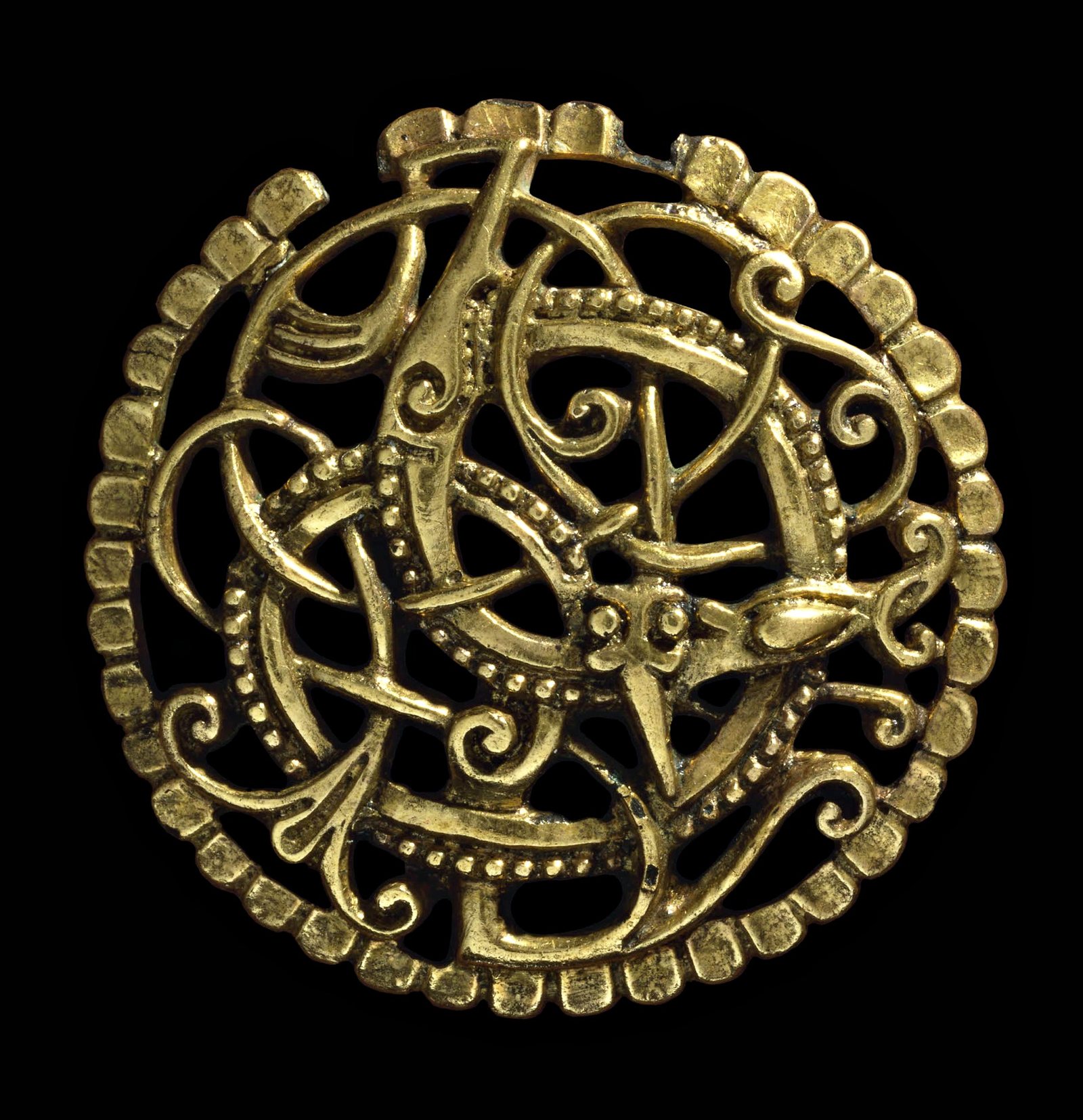
 Interlaced animals, gripping beasts, endless tendrils: the Viking Age had no single style but a whole sequence of them. We walk through the six classic animal styles in order — from Oseberg to Urnes — with their key finds. And we say honestly where the scheme is clean and where it is art-historical construction.
"The Viking style" is a handy phrase, but it doesn't exist. What we call Viking art is a chain of overlapping animal styles across some three hundred years. The basic idea stays the same — stylised animals, plaited, interlaced, dissolved into ribbons and tendrils — yet posture, anatomy and ornament shift from one generation to the next. Since the Swedish archaeologist Bernhard Salin (1904) and his successors, scholarship sorts this into six main styles: Oseberg, Borre, Jelling, Mammen, Ringerike and Urnes.
Salin himself had divided the older Germanic animal ornament into three phases (Style I to III); the sixfold series of the Viking Age proper is the result of later research building on him. This scheme is a useful framework, not a law of nature. The styles do not replace one another cleanly but interlock; a craftsman could mix old and new, a region could lag behind the fashion, a motif could live on across two styles. Anyone who wants to engrave the genuine motifs of the Viking Age — which is exactly what we do — should know this sequence but treat the sharp dividing lines with care.
It is just as important to say what this art is NOT: it hardly ever tells stories and almost never carries a "secret meaning" in the esoteric sense. It is about rhythm, symmetry and the gap-free filling of the surface — a beast twists, a band interlocks, a tendril lashes out. The art adorns ships, weapons, jewellery and runestones; it is craft and display, not a picture book. That is exactly what makes it so appealing to us: clear, load-bearing forms that can be translated onto slate, wood or glass without inventing something that was never there.
It begins with the Oseberg style, named after the famous Norwegian ship burial. Its hallmark is the "gripping beast": a squat creature with a muscular body and paws that grab everything around it — its own body, the frame, the neighbouring animals. This gripping motif is the great innovation of the early period; it gives the surface a nervous, hooked tension. Alongside it stand long, winding animal bodies with small heads in profile and bulging eyes. Closely related is the Broa group (after mounts from Broa on Gotland), often named in the same breath.
The key find is the Oseberg ship itself with its intricately carved stems, sledges, animal-head posts and the famous cart — a whole workshop in wood, laid in the mound around 834. Here the programme of the whole era already shows: surface and border are filled without a gap with living form, not a centimetre left empty. Anyone who wants to understand how Norse art "thinks" begins with Oseberg.
The Borre style, named after gilded mounts from a burial mound at Borre in Norway, was the most widespread of all. Its signature is the symmetrical "ring-chain" — a plaited band of interlocking rings, often with a knot in the middle — together with a single gripping beast with a triangular, cat-like head and contorted body. Borre adorned brooches, strap-ends and silver jewellery from Scandinavia to the Viking settlements of the British Isles, Iceland and the Rus in the east.
Precisely because Borre was so serviceable, popular and long-lived, it appears in vast numbers on jewellery — and overlaps strongly in time with the following Jelling style. The two ran alongside each other for a good while, and many pieces carry traits of both. For engraving the ring-chain is rewarding: clear, rhythmic, repeatable — a genuine Norse ornament that has nothing to do with Celtic interlace, even if it looks similar at first glance.
The Jelling style slims the animal into a ribbon-like, S-curved body with the head in profile, often double-contoured and filled with beaded rows. Two such animals like to intertwine into a symmetrical, interwoven pattern. It takes its name from the Danish royal estate of Jelling, whose great stone setting Harald Bluetooth expanded — on the large Jelling stone stands the dynasty's famous self-testimony:
King Harald bade this monument be made in memory of Gorm his father and Thyra his mother — that Harald who won for himself all Denmark and Norway and made the Danes Christian.Runic inscription on the large Jelling stone (DR 42), around 965 (public domain)
Beside the inscription the stone bears a great beast entwined by a serpent and — on a further face — the oldest native depiction of the crucified Christ in the North. It is thus a hinge twice over: between paganism and Christianity, and between the Jelling style and the more forceful Mammen style that follows it.
The Mammen style is named after an ornate axe from a rich Danish grave near Mammen, whose burial chamber was dendrochronologically dated to the winter of 970/971. The slender ribbon beast now becomes a large, powerful single animal with spiral-shaped shoulders and hips, often asymmetrical and dynamic — and for the first time plant tendrils clearly join in. The technique is characteristic: on the Mammen axe the motifs are inlaid in silver, hammered into the iron as fine metal threads; an animal on one side, a tendril or tree motif on the other.
Besides the axe, the large Jelling stone and carved ivory and antler works count among the key pieces. Mammen is the link between the strict animal world of the early period and the swinging tendrils of the late — here Norse art turns properly "botanical" for the first time. Anyone after a motif with force and movement is well served by Mammen.
The Ringerike style, named after a type of stone from the Norwegian region of Ringerike, pushes the plant-work to its peak. At its centre stands a large, usually four-legged "lion-beast" in a dynamic pose, played around by long, symmetrically tapering tendrils and lashing shoots that run out into fine points. The style was especially popular in England and Ireland and appears on runestones (such as the Vang stone), on the famous grave slab from St Paul's in London and on gilded ship weathervanes.
Ringerike feels more elegant and fluid than Mammen; the movement now runs in great, far-reaching arcs, and the tendril-work orders itself into bundles and axes. It is the direct forerunner of the last and finest style — you can almost watch the sturdy Mammen beast growing slimmer and more supple.
The Urnes style is the end point and, to many, the most beautiful. It is named after the carved north portal of the Urnes stave church in Norway (today a UNESCO World Heritage Site). Here the animals have become extremely slender, elegantly curved bodies that interpenetrate in open loops with thin, thread-like snakes and shoots — the Scandinavian "drakslingor", dragon-loops. Everything is asymmetrical, airy, dissolved into soft figure-of-eight and loop forms; the thick gripping beast of the early period has become a fine line.
Urnes already falls into the early Christian period and was especially influential in Ireland, where it combined with native traditions into a variant of its own. With it the independent animal-style tradition of the Viking Age runs out and passes into the Romanesque art of the European Middle Ages. The last great arc of Norse art closes here — with a linework of almost musical lightness.
The six styles hang on concrete key finds: Oseberg on the ship burial of the same name (around 834), Borre on the mounts from the Borre mound, Jelling and Mammen on the large Jelling stone and the Mammen axe (burial chamber 970/971), Ringerike on runestones and ship weathervanes, Urnes on the portal of the Urnes stave church. The rough time spans (Oseberg around 800 to Urnes around 1125) are well anchored through the dating of graves, coins and dendrochronology. The names each come from the find-spot, not from the Vikings themselves — they are modern labels for a real development.
Anyone who wants a "Viking" ornament today can gain a lot by knowing which style their motif comes from: a gripping Borre beast reads differently from an airy Urnes loop, a hefty Mammen creature differently from a fine Ringerike tendril. That is exactly why we work with the documented styles rather than arbitrary fantasy tendrils — these are the genuine forms the Vikings carved, hammered and incised, and each carries a character of its own.
In practice this means: a Borre-style motif suits a strict, symmetrical piece, a Ringerike or Urnes motif a lively, swinging design. The early styles (Oseberg, Borre) are surface-filling and gripping, the late ones (Ringerike, Urnes) linear and flowing — between them, Jelling and Mammen mark the shift from ribbon to great beast and tendril. Keep that in mind and you don't pick "some Viking pattern" but an ornament with a real pedigree. And that is exactly what we care about.
There is no "single Viking style" — there are several, overlapping styles whose transitions are fluid. The neat sixfold scheme is an art-historical construction (after Salin and later scholarship); the craftsmen of the Viking Age did not think in these boxes and gave their styles no names. And a stubborn error: "Celtic knots" are not the same as Viking art. Celtic interlace (as in the Book of Kells) and the Norse animal styles are related but distinct traditions — they look alike but do not belong in the same pot.
The Urnes portal – the last animal style · The Oseberg ship & the two women · The picture stones of Gotland · Norse symbols: real or invented? · The Mästermyr tool chest.
Slender animals and serpents winding around one another in endless, elegant loops, as fine as if drawn with a pen: this …
Read more →Three interlocking triangles, an eight-armed magical stave, a “wayfinder” – few areas are as full of beautiful …
Read more →