The triquetra is an interlaced knot of three pointed arcs, and its honest meaning is this: it is an ancient, widespread ornament, but no source anywhere records a pagan meaning for it. In the North you find it on a runestone from Funbo now standing in Uppsala and on the coins of Harald Hardrada; in Ireland and England it fills the art of the monasteries. The Trinity reading is a Christian interpretation, while the Norns, the Triple Goddess and the “Power of Three” are modern. Here are the finds, a clean line between triquetra, triskele and valknut, and how we engrave the motif.
Pick up a pencil and try it without lifting your hand: a pointed loop upwards, one down to the left, one down to the right, and you arrive exactly where you began. Three loops, one line, no start and no finish. That is a triquetra. It is one of those shapes that feel as if they have always existed. And it really is old. Just not in the way that pendants and tattoo flash like to claim.
The name is Latin. Triquetrus means “three-cornered”, and its feminine form triquetra became the modern technical term for the figure. In English it is also called the trinity knot or, more loosely, a Celtic knot. Geometrically the classic triquetra is made of three equal, overlapping circular arcs, three pointed ovals of the kind art historians call a vesica piscis, a “fish bladder”. A circle is often drawn around it or woven through the loops.
Draw it as true interlace, with each strand passing over and under, and mathematicians will tell you that you have made a trefoil knot, the simplest knot that cannot be undone. That is more than a party trick. Being one closed strand is exactly what made the shape so useful to interlace artists: it slots seamlessly into bands, frames and the bodies of animals.
For this article we went back over our earlier, much shorter version. Some of it held up, some of it did not. Where we correct ourselves, we say so plainly.
Before we look at the finds, some tidying up. Online, three different signs are mixed up constantly, and that corrupts every claim about “how old the triquetra is”.
Archaeologists do not always draw these lines sharply. In English-language scholarship “triquetra” is sometimes used very broadly, for any three-arc figure, even for pinwheel-like whirls. We keep it narrow: for us a triquetra is the three-leaved figure of arcs. Once you separate the shapes like that, you quickly notice that several famous “triquetras” are really something else.
The number three as a visual form is as old as ornament itself. Inside the Irish passage tomb of Newgrange, some five thousand years old, a triple spiral is pecked into the stone, and today it is often sold as a “Celtic” symbol. It is older than anything Celtic by a good two millennia, and it is a triskele-type spiral, not a triquetra.
In the Mediterranean world, rotating three-part figures become common from about the 4th century BC on pottery from Anatolia and Persia, and on early coins of Lycia in south-western Asia Minor. Sicily’s three legs, the Trinacria, belong to the same family. All of this shows that the love of three is not a Northern peculiarity. It is a basic European, indeed Eurasian, form.
The interlaced triquetra in the narrow sense, on the other hand, is a child of interlace art. And interlace is a technique that spread across Europe in late antiquity and the early Middle Ages from Italy and southern Gaul. Anyone looking for the roots of the triquetra therefore ends up not in a pagan grove but in workshops where stonemasons, goldsmiths and scribes swapped patterns.
Our old version said the triquetra already appears on Germanic gold bracteates. We need to qualify that. Bracteates are thin gold pendants stamped on one side, made in the 5th to 7th centuries and modelled on Roman imperial medallions, found mostly in Denmark, southern Sweden and Norway. Around a thousand are known, catalogued above all by Karl Hauck, Morten Axboe and Klaus Düwel in the Ikonographischer Katalog.
These bracteates do carry three-part figures: whirl signs, and animal bodies twisting into an animal triskele, especially on the late pieces of the Vendel Period. A clearly interlaced triquetra in the sense of the later knot, however, is not, as far as we could check, a typical bracteate motif. The more honest version: on bracteates, threes spin; they hardly ever knot.
This is not pedantry. Whoever claims the triquetra has been “Germanic since the Migration Period” is taking a whirl and calling it a knot. The visual language is related; the form is different.
The picture stones of Gotland tell a similar story. The earliest of these limestone slabs, from roughly AD 400 to 600, bear large circular whirl and spiral discs together with ships, people and animals. The whirls rotate; they look more like triskeles or sun wheels than like interlace knots.
Things get interesting on the tall stones of the 8th century. On Stenkyrka Lillbjärs III a valknut appears above a rider, next to three interlocking drinking horns. On Lärbro Stora Hammars I and Lärbro Tängelgårda I valknut figures also turn up, right in the middle of scenes of combat, death and sacrifice. Scholars debate whether they point to Odin, depict a heart or mark a particular story. None of these readings is secure.
A triquetra in the narrow sense is not the leading motif on these famous stones. What you see on Gotland are valknuts, horns and whirls. That is exactly why they are worth a look: they show how rich the North’s repertoire of threes already was before the Viking Age, and how little it can be reduced to a single sign. For a wider survey of the genuine signs, see our article on Viking symbols and their meaning.
Perhaps the best-known candidate for a “Viking Age triquetra” stands in the National Museum of Denmark in Copenhagen: the Snoldelev stone from Zealand, Rundata number DR 248, from the 9th century. Farmers found it in the late 18th century. Its inscription in the Younger Futhark says, in essence: “Gunnvaldr’s stone, son of Hróaldr, the þulr at Salhaugar.” A þulr was a speaker or reciter, perhaps a keeper of law, lore or poetry. We do not know exactly what the office involved.
Above the inscription, three drinking horns are interlocked so that they form a triangle, hooking into one another like incomplete Borromean rings. That is a motif of three, but it is not a triquetra: the horns have open ends and turn around a centre, which is why specialists speak of a horn triskele.
Why horns of all things? The obvious link is drinking and speaking in the hall, the gift of words. Some scholars think of the mead of poetry from myth, which Odin stole. It is an attractive idea, but it remains an idea. The inscription itself says nothing about what the horns mean.
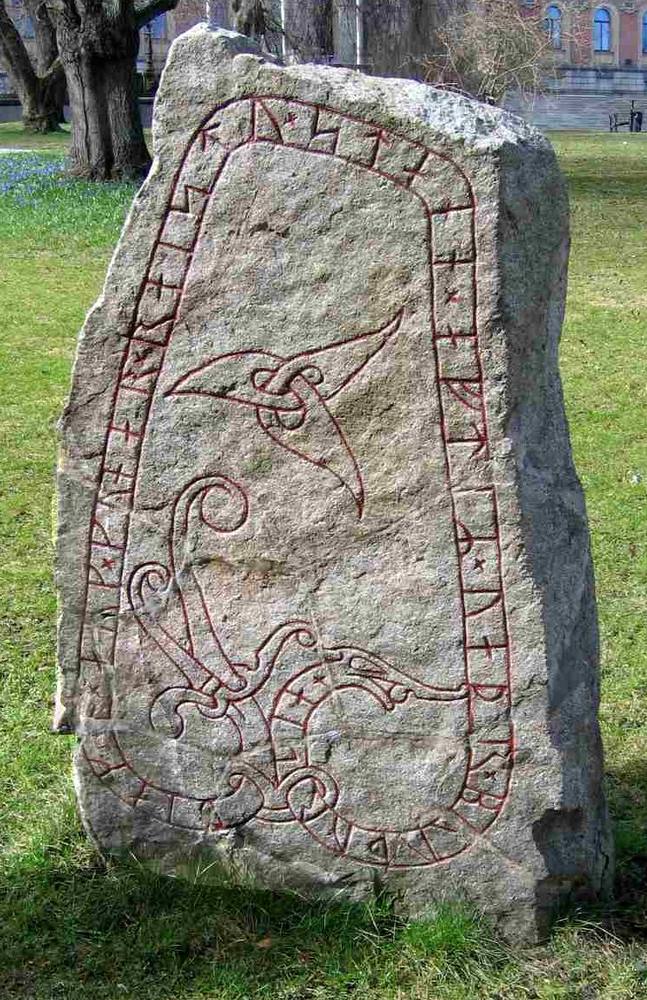
And now the stone we have been looking for. In the University Park in Uppsala, among students and bicycles, stands runestone U 937. It was found in Uppsala in 1875, built into the remains of a Franciscan friary, and belongs to a group of four stones that a single family raised in the 11th century in the parish of Funbo: the Funbo stones.
On U 937 a rune serpent coils in the elegant loops of the Urnes style, the last animal style of the Viking Age. And at its centre sits an interlaced triquetra. The inscription is simple. In essence: Þegn and Gunnarr had the stone raised for Veðr, their brother. The stone is not signed, but scholars attribute it and its twin U 991 to the runemaster Fótr, one of the great Urnes-style carvers of Uppland.
Now the crucial point. On another stone of the same family, U 990, the sons ask God to help their father’s soul, and a cross stands at the centre. This family was Christian. The best-known triquetra on a Swedish runestone therefore comes from a Christian household of the 11th century, carved in the artistic idiom of the late Viking Age. Turning it into a “pagan Viking symbol” means reading the stone against its own context.
To see how Urnes serpents work, read our articles on the Urnes portal and the art styles of the Viking Age. Our earlier version also named the Mammen style as a home of the triquetra. We could not find a solid example, so we have dropped the claim.
The triquetra’s grand entrance happens not in Scandinavia but in the British Isles. In so-called Insular art, the Irish and Anglo-Saxon art of the 7th to 9th centuries, interlace bands from the Mediterranean, spirals from older Celtic art and Germanic animal style merged into something entirely new. A 7th-century Gospel fragment in the library of Durham Cathedral is regarded as the earliest example of true knotwork in this manner.
The Lindisfarne Gospels were made, according to the British Library’s current dating, around 715 to 720 on the monastic island off Northumbria, the same place Norse seafarers raided in 793. More in Lindisfarne 793. Its carpet pages, full-page fields of ornament, are thickets of interlace, knots and twisting birds. The Book of Kells, made around 800 and now in Trinity College Dublin, takes the art to its limit. Triquetra knots, triskeles and spirals sit in its initials, frames and fillers, often so small you need a magnifying glass.
Other media join in. On Anglo-Saxon silver sceattas the triquetra is a minor but recurring motif between roughly 710 and 760. It appears on early Christian high crosses and grave slabs in Ireland, Scotland and northern England, and on the stone frith stool, the “peace chair”, of Hexham Abbey.
This matters for the question of meaning. These triquetras stand in gospel books, on crosses, in monasteries. Their setting is Christian through and through. And yet no monk, as far as we know, ever wrote down what he meant by the knot. We see the motif and we know its context, but the artists’ intention stays silent.
When the Vikings settled in Ireland and Scotland they met this visual world head-on. On the Isle of Man, in northern England and in Scotland, Scandinavian animal styles and Insular interlace then fused on stone crosses, often so closely that it is hard to say where one ends and the other begins.
The clearest proof that Scandinavian rulers liked the triquetra comes from coins. In York, the Norse Jórvík, the kings of the 940s struck a coin type with a triquetra on the obverse. One surviving penny names Ragnald Guthfrithsson as king and shows a banner with a cross on the reverse. Numismatists link this triquetra type with several rulers of that short, turbulent decade.
Better known still is the coinage of Harald Hardrada, king of Norway from 1046/1047 until his death at Stamford Bridge in 1066. Throughout his reign he struck essentially a single penny type, with a triquetra on the obverse and a cross on the reverse. These coins are also notorious because Harald steadily cut their silver content from around 90 per cent to an average of just over 30. In 2022 a metal detectorist even found one in southern Hungary, near Várdomb, a long way from Trondheim where it was minted.
What did the triquetra mean to Harald? The coin does not say. Press reports naturally called it a symbol of the Holy Trinity. That is plausible, since Harald was a Christian king and the cross sits right on the other side. In the strict sense it is not documented. The only certainty is that an 11th-century Viking king put the triquetra on his money within a clearly Christian design.
Today, in churches, parish newsletters and Irish jewellery, the triquetra is the “Trinity knot”, an image of Father, Son and Holy Spirit. It fits beautifully: three equal arcs, inseparable, drawn from one line. But when was this reading actually put into words?
The answer is surprisingly recent. The Irish antiquarian George Petrie, in his 1845 work on the early church architecture of Ireland, is cited as one of the earliest explicit references to the triquetra as a Trinity symbol. The reading spread widely with the Celtic Revival, the romantic rediscovery of Celtic art in the 19th century. There were sceptics even then: the British archaeologist J. Romilly Allen, a pioneer of interlace studies, doubted in the early 20th century that the knots carried any Trinitarian symbolism.
How does that square with the Christian find spots? Quite simply: a motif can sit in a Christian context without carrying a fixed doctrinal meaning there. Monks decorated their books with birds, dogs and serpents without every animal being a message. It is entirely possible that some artists thought of the Trinity when they drew three interlaced arcs. For the early Middle Ages it cannot be proven. Gothic tracery has a related three-lobed ornament, the trefoil in church windows, where a Trinitarian reading is natural, but that too is a form of its own.
For us that means the Christian reading is an old, serious and living interpretation. It is not, however, “the original meaning” you can simply slip over a find from AD 800. How the North became Christian in the first place is told in our article on the Christianisation of the Germanic peoples.
Now the question most searchers are actually asking: what did the triquetra mean to the pagan Germanic peoples and the Vikings? The honest answer: we do not know, and there is no sign that it had a fixed meaning at all.
No runic inscription mentions the knot. No poem of the Edda, no saga, no skaldic verse describes a sign made of three arcs. The only runestone triquetra we know for certain belongs to a Christian family. What circulates online are later attributions: the triquetra as the three Norns, as past, present and future, as earth, sea and sky, or as “the three worlds”.
That does not mean Viking Age people felt nothing when they looked at a triquetra. Threes matter a great deal in Norse tradition, from the three roots of Yggdrasil to the three horns on the Snoldelev stone. But between “three was important” and “this sign meant X” lies a gap that no source bridges. Our article which Norse symbols are genuine draws that line for many more signs.
The triquetra’s popularity today has three modern sources, and none of them lies in the Viking Age.
The first is the 19th-century Celtic Revival and its Irish jewellery. The “Trinity knot” became a badge of Irish identity and still is, often paired with the Claddagh ring.
The second is Wicca, the modern witchcraft religion that emerged in England from the mid-20th century. There the triquetra became the sign of the Triple Goddess as maiden, mother and crone. That idea of the goddess owes a great deal to the poet Robert Graves and his 1948 book The White Goddess. It is a poetic construction of the 20th century, not a transmitted Germanic or Celtic religion. Celtic reconstructionists and New Age groups also use the triquetra as a protective sign.
The third is television. From 1998 to 2006 the triquetra adorned the Book of Shadows of the three Halliwell sisters in the US series Charmed, as the sign of the “Power of Three”. For a whole generation it became the witch symbol par excellence. Later it showed up on Thor’s hammer in Marvel’s Thor of 2011 and in the Netflix series Dark from 2017 as an image of three intertwined timelines.
There is nothing wrong with any of this. Modern meanings are real meanings; they just are not old. The problem starts when a pendant is labelled “ancient Viking protection symbol of the Norns”. That is a television and esoteric story being sold as archaeology.
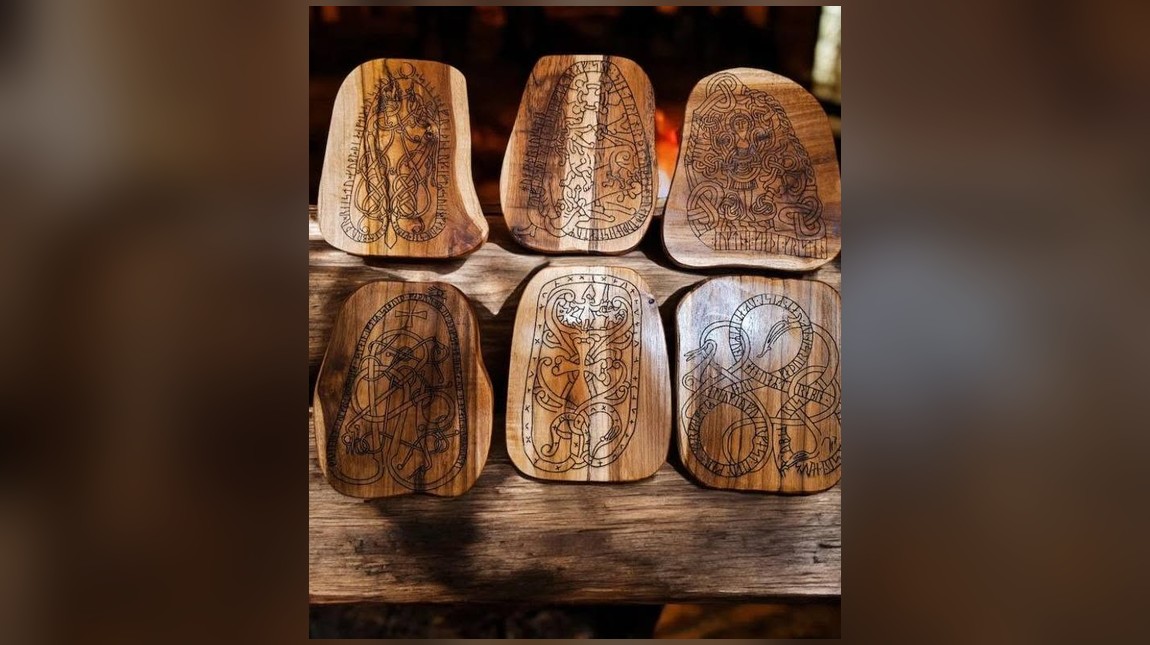
We enjoy engraving the triquetra on slate, wood and glass. It is one of the most rewarding motifs there is: clean lines, strong symmetry, legible at any size. On natural slate in particular, where the laser breaks the dark surface open to a pale grey, the interlace looks almost as if it had been cut into stone. How that works technically is explained in how laser engraving on natural slate works.
What we will not tell you is that the triquetra is a secret Viking sign with built-in magic. What we can tell you is more honest and, we think, more beautiful:
For a particularly fitting design we like to work from real models: a triquetra inside the ring of an Urnes serpent as on U 937, or a strict Insular interlace band. Triquetras are popular as a family sign for three people or as a gift for weddings and christenings; you will find ideas among our Norse gifts for weddings, christenings and naming days. If you want to add runes, treat the script as carefully as the ornament. And if you are torn between several signs, our guide to genuine Viking motifs for engraving and tattoos will help.
One tip from the workshop: the smaller the engraving, the more the gaps between the bands matter. A finely interlaced triquetra with over-and-under crossings needs a little space on slate, or the crossings blur. On glass, by contrast, the simple outline form often looks the most elegant.
What does the triquetra mean? No meaning has come down to us from the Viking Age; it was above all an ornament. Since the 19th century it has been widely read as a Christian symbol of the Trinity, and today also as a sign of family, connection or the Triple Goddess.
Is the triquetra a Viking symbol? It does occur in the late Viking Age, for example on runestone U 937 in Uppsala and on the coins of Harald Hardrada. But it is not exclusively Norse: its most splendid examples are in Irish and Anglo-Saxon monastic art.
What is the difference between a triquetra, a triskele and a valknut? A triquetra is three interlaced arcs, a triskele is three rotating arms or spirals, and a valknut is three interlocking triangles. The three horns on the Snoldelev stone form a triskele, not a triquetra.
Is the triquetra Celtic or Norse? Neither in an exclusive sense. The interlaced form belongs to early medieval interlace art, used in Ireland, England and Scandinavia alike.
Is the triquetra a witch symbol? Only since the 20th century. Wicca reads it as a sign of the Triple Goddess, and the series Charmed made it famous worldwide as the “Power of Three” from 1998.
Can Christians wear a triquetra? Yes. The Trinity reading is firmly established in church art today, and the triquetra appears on many early medieval crosses and in gospel books.
For courage. For remembrance. For legends that live on.
Norse symbols: real or invented? · The Valknut · The Troll Cross · The Web of Wyrd · Runes & their meaning.
Slender animals and serpents winding around one another in endless, elegant loops, as fine as if drawn with a pen: this …
Read more →Three interlocking triangles, an eight-armed magical stave, a “wayfinder” – few areas are as full of beautiful …
Read more →