
How did people in the north marry and name a child? The sources know marriage gifts in Tacitus, mundr and trousseau in Icelandic law, a hammer in the Þrymskviða, water and name in the Hávamál and a baptism decision in Iceland around 999/1000. We separate evidence, poetry and modern addition, and say which symbols suit which occasion.
Anyone looking for a Nordic gift for a wedding, christening or naming day soon runs into symbols: tree of life, Norns, runes. Less well known is what the sources say about the celebrations themselves. There is no Viking wedding liturgy. We have no text describing the course of a Viking Age marriage ceremony, and none prescribing a baptismal rite. What we have are fragments: legal texts of the Icelandic Commonwealth, Eddic poems, thirteenth-century sagas reporting on events of the tenth and eleventh centuries, and a Roman description of the Germanic peoples from the year 98.
These fragments are productive all the same. They show that both celebrations joined three things: a legal side (who gives what to whom, who is obligated), a ritual side (water, hammer, ring) and a social side (feast, guests, gifts). This article goes through the three levels and asks at the end which modern symbols the sources can support and which they cannot. That doubles as orientation for anyone designing a gift with names, a date and a sign. Background on the kin group as the frame of these celebrations is in our piece on kin and family.
The earliest description of Germanic marriage customs is by Tacitus, who wrote the Germania around the year 98. He never visited the Germanic peoples and relies on reports, so he writes with a Roman's eye. In chapter 18 he singles out a trait that strikes him:
The wife does not bring a dowry to her husband, but receives one from him. […] Oxen, a caparisoned steed, a shield, spear, and sword.Tacitus, Germania 18, Oxford translation (Project Gutenberg no. 7524)
The woman, Tacitus continues, accepts the gifts and in turn brings some arms to her husband. This, he says, is their strongest bond, their secret rites, their marriage gods. For a Roman it is remarkable, because around the Mediterranean the woman brings the dowry. He reads the gifts as a sign that the wife is to share the man's toil and danger, in war and in peace.
Two caveats belong here. Tacitus writes with a moral purpose: he sets the simple customs of the Germanic peoples against Roman ones. And he generalises across many tribes. We do not take it on trust that oxen and swords were given everywhere. What the passage does show is that gifts at marriage were understood as a legal act and as a symbol, an idea that returns in the Norse sources. How Tacitus saw women, who in his account possess sanctity and foresight (ch. 8), is taken further in the piece on Germanic women.
The Icelandic law collection Grágás (written down in the twelfth and thirteenth centuries, with an older core) and the sagas show a marriage law with several payments. The groom pays the mundr to the bride's guardian, usually father or brother. The woman's family gives the bride the heimanfylgja, a trousseau. Added to this are gifts from the man to the woman, such as the grant later called the "morning gift", made on the morning after the wedding night. Related institutions are attested in the Frankish laws; in the Rhineland, for example, the law of the Rhine Franks, the Lex Ribuaria, gives the morning gift a role (the details are disputed in the literature).
The purpose of the payments matters. They were not purchase prices for a woman, as the older slogan of "bride purchase" suggested, but part of a contract between two kin groups. The mundr tied the kin groups together and secured the woman's property in case of divorce or widowhood. Marriages were often political: a wedding could end a feud or seal an alliance. The Old English Beowulf has a word for a woman who makes peace this way, freoðuwebbe, "peace-weaver". That women had little say in the decision is a finding of many sagas, but not the only one: there are women who insist on a voice, and negotiations that fail because the bride does not consent. Women's roles in the sagas are covered in women in the Viking Age; laws and legal custom are in the piece on Viking law.
For a modern gift this means giving at a wedding was never just a pleasant gesture. It belonged to the core of the legal act. Anyone who puts names and a date on a plaque today does something similar in a quiet form: they record that two people made a bond before witnesses.
The sagas distinguish two steps. First the betrothal (festar, "making fast"): the suitor or his representative puts the matter to the guardian, mundr and trousseau are negotiated, witnesses are named, hands are struck. The word "handfasting" goes back to this "making fast by hand". Then follows, often months later, the wedding feast, Old Norse brúðlaup, literally "bride-run". It took place in the home of the groom or of the bride, lasted several days, and the guests brought gifts. Feasting customs of the Viking Age are discussed at greater length in customs of the Vikings; for the drink that flowed at feasts see mead.
A rare look at a real feast is in the Sturlunga saga, a collection of contemporary Icelandic accounts of the twelfth and thirteenth centuries. The wedding at Reykjahólar in 1119 is regarded in research as the key piece of evidence that sagas were told at feasts: stories were recited for the entertainment of the guests. The family sagas themselves, such as Njál's saga, like to use weddings as flashpoints of conflict, a quarrel among guests, an insulting gift. That is literary sharpening. An overview of the genre is in the piece on the sagas of Icelanders; that they were written down centuries after the events they describe should stay in mind.
The only poem describing a wedding rite of the gods is the Þrymskviða, the "Lay of Thrym", in the Poetic Edda. The giant Thrym has stolen Thor's hammer and demands the goddess Freyja as his wife in return. The gods dress Thor as the bride instead, with veil and the necklace Brísingamen, and Loki goes along as bridesmaid. In the giants' hall comes the moment the poem builds toward: the hammer is fetched to consecrate the bride and laid in her lap. Thor seizes it and strikes down Thrym and the giants.
Two observations matter. First, in the poem the hammer is the means of consecration. The text mentions the hand of the goddess Vár, who hears the oaths and vows between man and woman. That is the only source for a hammer rite at weddings; Thor and his hammer appear here in the role of a consecrating god. Second, how old the poem is remains disputed. An older strand of research, following E. V. Gordon, put its origin around 900 and took the text as thoroughly heathen. Today a majority, among them Jan de Vries and Peter Hallberg, favours a date in the first half of the thirteenth century and sees a Christian-era play with the gods. Even the stanza numbering differs between editions: the hammer scene stands in stanza 30, 32, 34 or 39 depending on the editor.
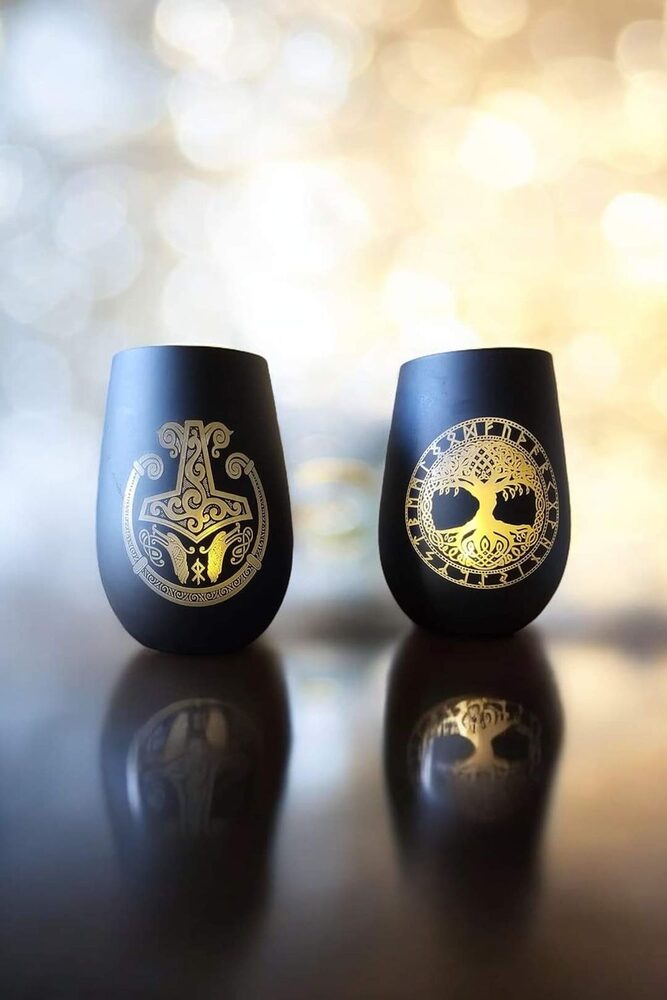
Whether Vikings actually laid a hammer in the bride's lap at weddings is therefore open. Archaeology knows small hammer rings and Thor's hammer pendants, mostly from graves and hoards; a find context linking them to wedding rites is not attested. Those interested in the pendants will find them in the piece on Thor's hammer; more on the god in Thor.
A further component of Norse legal acts is the oath ring. The Eyrbyggja saga, in its chapter on the temple at Thorsnes, describes a ring of twenty ounces lying on the altar, to be sworn on at court proceedings and in contracts. The ring is not jewellery here but evidence. Whether such oaths were sworn at weddings we do not know; it cannot be ruled out. Rings of silver and gold were in addition the usual gift of generous lords in the Viking Age. More on both contexts in the piece on oath rings and in the overview of Viking jewellery.
For the wedding this means the exchange of rings as practised today has no Viking Age model in the form of a ritual. It has a Roman-Christian history. The idea of a ring as a sign of fidelity and obligation, though, is found in the north as well. Here too the same applies: we can draw the line but not claim it is unbroken.
At birth the north knew an act that made the newborn a member of the family: sprinkling with water, ausa vatni, and the giving of a name. The sources are brief. In the Hávamál, stanza 158, Odin lists his charms. The thirteenth, he says, applies if he sprinkles a young warrior with water: that man will not fall, not even in the greatest battle, and cannot be felled by weapons. In the Rígsþula, the "Lay of Rig", in which the god Rig begets the estates of mankind, thrall, farmer and earl, the stanzas on the sons mention more than once the sprinkling with water and the naming. The custom thus appears where the child's place in society is at issue. The Edda was written down in the thirteenth century; the text is partly older but cannot be dated.
One question for research is whether the sprinkling is older than Christian baptism or shaped by it. Those favouring a heathen origin point to the age of the Eddic stanzas; sceptics to the water ritual of baptism, known before the writing down. Both sides have arguments. All that is certain is that the act is closely tied to the name in the texts, and that admission to the family did not hang on birth alone. Some scholars understand the sagas to mean that a child counted as a member of the family only with water and name; before that act, according to some texts, the family could expose it. Exposure is named explicitly by the Icelander Ari Þorgilsson when he describes the adoption of Christianity in Iceland (see below). How common it was remains unclear.
Names were no accident in the Viking Age. Children were often named after relatives, especially dead grandfathers or uncles, in the hope that something of the forebear would pass to the child. The sagas know this idea as nafnfestr, "name-fastening", and link it with a gift: the sponsor or name-giver presents the child with something to seal the name. How far this may count as a fixed custom is judged differently; the evidence comes from sagas, not from legal texts. On names and their meaning see our piece on Viking names; lists are in Nordic first names.
In Tacitus, too, relatives play a part. In chapter 20 of the Germania he writes that a sister's sons are held as dear by their maternal uncle as by their own father; some thought this tie the more sacred and closer. Research has read this as a hint of old kinship rules, giving the mother's brother a special standing. How far it held in daily life is uncertain. For a christening gift it means that a gift from a relative or sponsor has models older than any church.
Whoever looks for a model should think not of mythology but of the gifts that guests and relatives brought into house and farm: jewellery, cloth, a head of cattle, later silver. How jewellery was made and worn in the Viking Age is shown in the pieces on gifts for women and gifts for men.
With the adoption of Christianity in Iceland baptism became law. Ari Þorgilsson the Wise describes in the Íslendingabók (around 1130) the decision taken at the Althing around the year 999 or 1000: everyone still unbaptised in the country should be baptised. According to Ari, one of our best witnesses for the period, an exception was granted at the same time: the exposure of children and the eating of horse meat stayed permitted, and anyone who wished could go on sacrificing in secret; these arrangements, he says, were abolished a few years later. Baptism was thus first a political decision that prevented conflict, not a conversion of each individual. More on the Althing in Thing, on the church in the north in Christianisation of the Germanic peoples.
For children it meant that the sprinkling with water and naming turned into church baptism, with sponsor and christening robe. Many baptismal customs, such as the sponsor's gift, lived on and entered the European godparent present. Whoever gives a gift at a christening or naming today therefore stands in a tradition fed by more than one source. A straight line of descent from the Vikings would be a claim without evidence.
Anyone wanting to design a gift with a Nordic sign chooses among a few common motifs. For each one can say what is attested and what later interpretation adds.
The tree of life, Yggdrasil. The Edda describes in the Völuspá (stanza 19) and in the Grímnismál (stanzas 31 to 35) an ash whose branches reach over the world and at whose roots animals gnaw. The image of the world tree is attested; reading it as a symbol of origin and growth is a modern transfer, though one that suits the occasion. More in Yggdrasil and in the animals at the world tree.
The Norns. Urd, Verdandi and Skuld stand in the Völuspá (stanza 20) at the well beneath the tree; they carve something on wood ("skáru á skíði"), lay down laws and choose the lives of the children of men. The picture of the spun thread of fate is not in this stanza; it comes from later portrayals and from comparison with the Greek Moirai. As a motif for a wedding or birth the idea that a life's course is determined fits well enough. The Norns are not, however, blessing goddesses in the modern sense but powers of fate. More on them in Norns.
The Vegvísir. The "wayfinder" is a magical sign from the Icelandic collection known as the Huld manuscript of 1860. There is no Viking Age source for the sign. Choosing it as a modern emblem of orientation is legitimate; it should not be called a Viking symbol. Context in Vegvísir and Ægishjálmr and in genuine and invented symbols.
Runes. A name or a brief wish in runes is a route close to the sources, because runes were script. The rune Algiz, often chosen as a protective sign, bears a reconstructed name; whether it means "elk" or "protection" is disputed among scholars, and the protective meaning is first of all a modern association. How runes were read and written is explained in runes and their meaning; for a selection on the theme of union see runes for love and union.
Knots and name bonds. Interlaced bands are a basic motif of Viking art, from animal style to the picture stones (see art styles of the Viking Age). Joining two names with a knot picks up this formal heritage without claiming a meaning the sources do not carry.
A simple attitude follows from what has been said: the gift should carry what tradition supports and say honestly what is new. Names and date are the core, since they record what mattered at weddings and christenings then as now: who, when, before whom. A sign based on Edda or rune may be added. A saying is possible; it should then be cited with its source, say a stanza from the Hávamál on the worth of friendship.
For design, less is calmer. One motif, two names and a date look clearer than a full surface. The spelling of the names should be settled before engraving, since an engraving cannot be taken back. The material shapes the effect: natural slate shows a matt dark surface with light engraving, wood takes the grain into the picture, glass works with light. All three have strengths and limits; a factual comparison is in our piece slate, wood or glass, and on the laser process in laser engraving on natural slate. For personal commissions allow enough lead time, especially before the wedding season; a proof round beforehand makes sense.
Attested are the marriage gifts in Tacitus (around 98), the legal terms mundr and heimanfylgja in the Icelandic laws and sagas, the naming with water in Eddic stanzas, and the adoption of Christianity in Iceland according to Ari. Less certain are the dating of the Þrymskviða, the question of the pre-Christian origin of the sprinkling and the reach of the custom of nafnfestr. Not attested are a hammer consecration at weddings in practice, handfasting as a Viking custom, and special protective runes for children. Almost all sources are literary and date from the twelfth and thirteenth centuries; Tacitus is an outsider. The evidence leaves room for fine symbols but not for the claim that they are ancient custom. A gift bearing names and a date does not need that claim: it convinces by being exact.
How did Vikings marry? According to the sources in two steps: betrothal (festar) with negotiation of mundr and trousseau, and later the multi-day wedding feast (brúðlaup). The texts do not transmit a fixed order of ceremony.
Was there a hammer at the wedding? The Þrymskviða has Thor's hammer consecrate the bride. Whether this was a real custom is unknown; the poem's date ranges from about 900 to the thirteenth century.
How were children named? The Edda names sprinkling with water and the giving of a name. Children were often named after relatives; the sagas know a gift with the name (nafnfestr).
Were Vikings baptised? After the adoption of Christianity, in Iceland following a decision around 999/1000. Baptism was first understood as a political decision; earlier customs remained permitted for a time.
Which symbol suits a celebration? That depends on the occasion. Yggdrasil and the Norns are attested in the Edda; Vegvísir is early modern; runes suit names. The meaning remains a personal attribution.
What should be engraved? Names, date and at most one motif; check the spelling beforehand and allow enough lead time.
For courage. For remembrance. For legends that live on.
Viking gifts for men · Slate, Wood or Glass? · Yggdrasil – the world tree · The Norns · Runes & their meaning.
A word of love engraved in stone or glass outlasts any card and any bouquet. But how did „I love you" actually sound in …
Read more →Natural slate is a rewarding material: sturdy, millions of years old and genuinely low-maintenance. Still, there are a …
Read more →Are you the thinker or the protector? The trickster or the watcher? The Norse pantheon isn't a distant gallery of idols …
Read more →The Norse world is full of strong women: Freyja, who rules over love and battle alike, the Norns who weave fate, Idun …
Read more →