 Is there a „love rune"? Not in the way the internet sometimes promises. But there are old images of the gift, of joy, of growth and of trust that fit a relationship beautifully. An honest tour through Gebo, Wunjo, Berkano and Ehwaz.
„Which rune brings love?" – we hear this one often, especially before weddings and anniversaries. And again the honest answer is finer than any promise of magic: in the Viking age there was no rune used like a love spell to make two people find each other. Runes were script. When love and runes came together, it was usually because someone carved a name, a short verse or a dedication – through words, not through a single magical sign.
What does exist are runes whose recorded images fit love, harmony and partnership astonishingly well: the gift that binds two people; the joy that carries a good togetherness; the growth that needs care; the horse-and-rider that only move as one. These images come from the rune poems and from the meanings of the rune names – and that is exactly what we look at now, honestly split into „documented" and „modern interpretation".
If one rune touches love, it is Gebo, ᚷ – not by accident a sign shaped like a kiss, an X, two crossing lines. Its name simply means „gift" (Proto-Germanic *gebō). Gebo is one of the runes found only in the Elder Futhark, so it has no stanza of its own in the Old English or Norse rune poems – we know its meaning from the rune name itself and from related words.
In the Germanic world a gift was anything but casual: giving and giving-back created bonds, loyalty and obligation. A present was a visible tie between two people. That is exactly why Gebo is, for many, the rune of partnership: not possession, but the free giving and receiving that carries a relationship. As the High One says in the Hávamál:
With weapons and garments friends should gladden one another; each knows this for himself. Those who give to each other stay friends the longest – if things turn out well.Hávamál, stanza 41 (Poetic Edda); rendering based on the public-domain translation by Henry Adams Bellows, 1923
That is not a spell but life-wisdom – and a perfect image for Gebo: what we give each other keeps the bond alive.
Wunjo, ᚹ, carries the name „joy, bliss" (*wunjō). Wunjo too is a pure Elder-Futhark rune with no stanza of its own in the surviving rune poems; its meaning lives in the name and in related Old English words for happiness and well-being. Kindred in sense is the Old English Wynn stanza, which describes the same word-field: the joy of one who lives without suffering, sorrow or anxiety and has a good enough life.
For a relationship that is a warm image: not the great rush, but the quiet, sustaining happiness of a good togetherness. Wunjo stands for harmony, contentment and the feeling of being in the right place with the right people. To choose it as a symbol is to choose less the passion of a moment than the joy that remains.
Berkano, ᛒ, is the birch (*berkanan). In the north the birch is the first tree to bud after winter – a sign of spring, growth and new life. The Norwegian rune poem calls the birch twig the greenest of leaves; the Old English poem reads the same rune as the poplar/birch, which brings forth new shoots entirely without seed:
The birch bears no fruit, yet without seed it brings forth suckers, for it is generated from its own leaves. Splendid are its branches and gloriously adorned its lofty crown that reaches to the skies.Old English rune poem, Beorc (birch) stanza; translation by Bruce Dickins, 1915 (public domain)
In a relationship this is a wonderful image: growth that wants tending, care, a flourishing shared between two. Berkano is traditionally linked with the feminine, with fertility and nurture – as a symbol it stands for a new beginning as a couple, for a young love, or for a family that is growing.
Ehwaz, ᛖ, means „horse" (*ehwaz, related to Latin equus). In the Viking world the horse was a companion, a fellow traveller and a creature you had to trust. The Old English rune poem describes exactly this close bond between rider and mount:
The horse is a joy to princes in the presence of warriors, a steed proud of its hoofs; when wealthy men on horseback exchange words about it, it is ever a comfort to the restless.Old English rune poem, Eh (horse) stanza; translation by Bruce Dickins, 1915 (public domain)
Rider and horse only move forward in step, in trust, in listening to each other. That is precisely why Ehwaz is regarded as the partnership rune par excellence: two who form a team and can rely on one another. Where Gebo forges the bond, Ehwaz describes the daily working-together – loyalty, reliability, a shared road.
What is documented are the rune names and their images: Gebo as „gift", Wunjo as „joy/bliss", Berkano as the birch of new beginnings, Ehwaz as the trusted horse. It is also documented that gift and counter-gift created bonds in Germanic culture (see Hávamál 41). From these images the modern shorthand meanings „love, harmony, partnership" can be drawn. What is not documented is that any of these runes was used as a love charm in the Viking age to summon affection.
„Carve Gebo and love will come" is modern interpretation, not historical rune magic. The idea of deliberately using individual runes „for love" arose above all in the esoteric rune lore of the 20th century; the oracle mindset was popularised by Ralph Blum's New-Age book (1982). The old sources contain no love runes as magic signs. What did exist were words: Egil's Saga even tells of a young man who, meaning only well, clumsily carved runes for a sick woman – and made things worse, until Egil scraped off the wrong signs and carved the right ones. The moral is strikingly sober: it is not about a magic symbol but about knowing what you are doing. We promise no effect – but a deliberately chosen rune is a beautiful sign for two.
For love and relationship especially, the appeal lies less in „magic" than in a sign chosen together. Gebo on two rings or pendants, Ehwaz on a couple's anniversary gift, Berkano for a birth or wedding, Wunjo for a home full of joy – these are not incantations but symbols you agree on together. And because a relationship rarely fits into a single sign, the loveliest solution is often a short name or verse in runes – exactly as people really did back then.
Feel your way in playfully first, perhaps with our rune of the day, and once you have found your sign we engrave it for you cleanly and for good. Honest in meaning, clear in craft – that is our way of translating love into material.
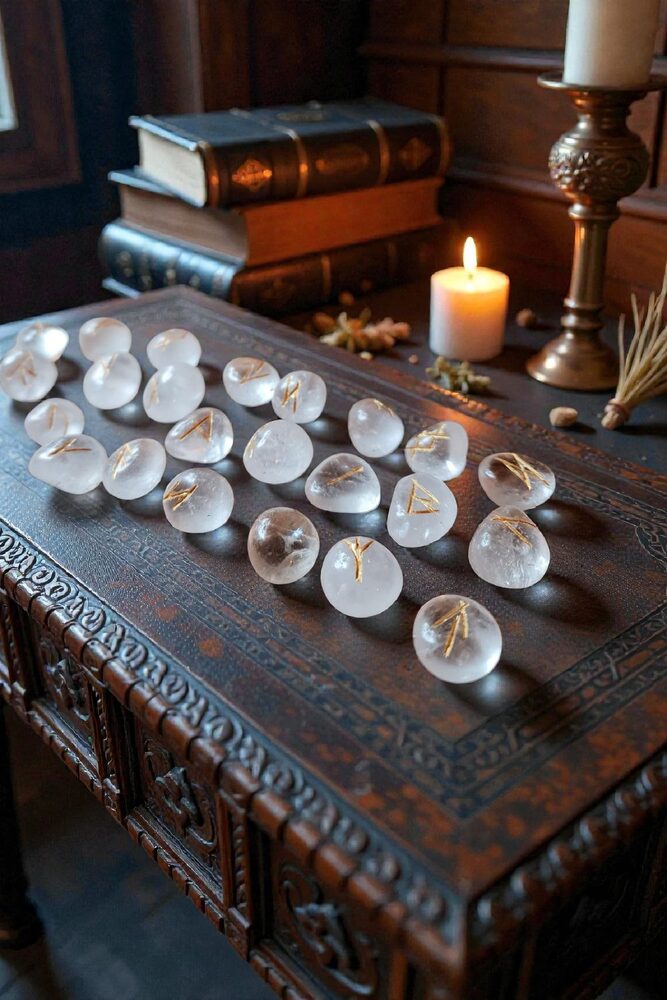
Runes for Protection & Courage · Runes & their meaning · Norse words of love · Which rune to engrave?.
All Runes & Writing articles →
Before the runes became oracle stones in a pouch, they were simply the first alphabet of the North – for names, trade …
Read more →Some runic inscriptions form no smooth sentence, but only single, recurring words: alu, laukaʀ, laþu. They stand on …
Read more →Some runestones move us across a thousand years. The Skarpåker stone in Södermanland is one: a father casts his grief …
Read more →