Old Norse has no fixed "I love you". It has verbs such as unna and elska, the noun ást, Eddic poems about women who follow the dead into the grave, sagas about love that ends badly, and a handful of runic carvings from Bergen. We go through the sources in order, keep the Viking Age apart from the age of the sagas, and say plainly which phrases suit an engraving and which circulate only online.
The unromantic part first. No sentence turns up in the sources as a standard, everyday declaration of love. Anyone who searches the Eddic poems and sagas for an Old Norse "I love you" finds verbs, nouns and deeds, but no formula that could be printed on a card. That says nothing about whether people loved. It says something about how they talked about it: through actions, loyalty and poetry rather than a confession in three words.
Two verbs come closest to modern "love". Unna means "to grant, to be fond of, to love"; the first person is ann. "Ek ann þér" therefore means, literally, "I am devoted to you, I wish you every good". The second verb is elska, "to love". It goes back to an adjective meaning "dear, beloved" (elskr) and survives in Icelandic and Faroese to this day. Modern Icelandic "Ég elska þig" is a direct descendant of "ek elska þik". Both phrases are grammatically sound. We did not find either as a set formula in the texts we checked, and we do not claim that they were one.
A second caveat belongs here. The spelling you see in books and on engravings is normalized Old Norse, a scholarly convention that brings manuscripts from different centuries onto a single standard. A stone or a manuscript from the Viking Age would have spelled the words differently, and in runes, in the Younger Futhark of the time, the phrase would have been written in a heavily shortened form. Engraving "ek ann þér" means engraving a learned reconstruction, not a copy. That is legitimate, and it is beautiful, as long as you know it.
The central noun is ást, plural ástir. Linguistically it belongs to a word family that still echoes in German gönnen and Gunst; Gothic ansts ("grace, favour") and Old High German anst sit on the same line. On this explanation ást originally meant something like "what one grants to someone", affection as goodwill. That fits with ást and unna belonging together: whoever loves, grants. In modern Icelandic ást is the everyday word for love, and "ástin mín" means "my love, my darling".
Compounds belong to the family, among them ástvinr ("love-friend", a dear and trusted person) and ástkona ("beloved woman"). As Cleasby and Vigfússon's dictionary of 1874 shows, Old Norse also uses vinr, "friend", for a close and tender companion. The line between friendship and love was thinner than it is for us. A word for "sweetheart" could also mean "female friend".
Betrothal and marriage bring the law into it. The festarmær was the formally betrothed bride, the brúðr the bride, and what mattered in practice was settled by kin and law. We described how that worked in our article on Viking Age law. For this topic it is enough to say that love and marriage did not automatically coincide. If you look for feeling, you have to look at poetry.
The evidence is unevenly spread, and that shapes every picture. From the Viking Age proper (roughly 800 to 1050) we have almost only stone, metal and runes. The long texts were written down in Iceland in the twelfth and thirteenth centuries by Christian scholars who gathered older poetry and oral tales. The Poetic Edda survives in the thirteenth-century manuscript Codex Regius. Some of the poems are clearly older, a few perhaps from the tenth century, but hardly any can be dated exactly. The sagas of Icelanders arose mostly in the thirteenth century and tell of events from the tenth and early eleventh; they are literature, not minutes.
For the question of love-words that means: what we read reflects how educated Icelanders of the thirteenth century imagined love in the past. That is not worthless, but it is not a tape recording from the year 950. The skalds of the Viking Age themselves seldom made love their subject; their business was praise of princes and accounts of battle. Some skaldic sagas are an exception, built around poets who dedicated verses to a beloved: Kormáks saga about Kormákr Ögmundarson and his love for Steingerðr, Hallfreðar saga, and Bjarnar saga Hítdælakappa. Parts of the verses may be older than the prose around them, but whether they truly stem from the tenth century is judged differently by different scholars.
Kormákr is a good example of the character of Norse love poetry. According to the saga he is betrothed to Steingerðr, arrives late for the wedding because of a curse, and she marries another man. His stanzas recall their first meeting, praise her beauty and lament. The saga, probably written in the early thirteenth century, sets the verses in a frame rather than explaining them. Tenderness and injured pride sit close together. That is the basic tone: love as a matter of honour, of insult, of fate, and rarely as a gentle expression of feeling.
Whether medieval Iceland restricted love verse is often mentioned in the literature. The collective term, mansöngr ("woman-song"), comes up regularly in skaldic studies, but the exact legal position and the penalty are cited differently depending on edition and manuscript. We do not commit ourselves here and refer to the scholarship.
The most famous love scene of the Edda stands in Helgakviða Hundingsbana II, also known as Völsungakviða in forna. In 1923 the editor Henry Adams Bellows called the poem a patchwork of several pieces that do not fit well together, yet he counted the stanzas of the mound visit among the finest in Old Norse poetry. The poem tells how Helgi, Hunding's slayer, wins the valkyrie Sigrún, how her brother Dagr kills him with a spear lent by Odin, and how Sigrún curses her brother.
Then comes the scene that has lasted. A maidservant sees Helgi ride into his burial mound with a large retinue and tells Sigrún. She goes out and finds him: his hair frosted over, his body bloody, his hands wet. Helgi explains that this comes from her tears, which fell cold and wet upon him. Sigrún makes up a bed in the mound, and the two spend a night there. Before dawn he must go back. She waits for a second night that never comes and dies of sorrow, as the prose at the end of the poem reports. A further note says the two are reborn in a later life as Kára and Helgi Haddingjaskati. That note probably comes from the compiler of the manuscript and is no proof of a heathen belief.
"A bed I have made for thee, Helgi, now, for thee who knew no sorrow, thou Ylfing's son; on thy breast I will fall asleep, hero, as I often did when thou wert alive." – Sigrún to the dead HelgiPoetic Edda, Helgakviða Hundingsbana II (own rendering after the Simrock translation of 1851, public domain)
One can read these stanzas as a love poem, and they are one. One can also take them as evidence of what was imagined to happen to a fallen warrior: he stayed in the mound, rode out with a retinue, and could receive visitors. As we have described at length in our article on Helgi and Sigrún, the special quality lies in the way the poet shows grief and closeness without pathos. The tears are cold, and the night is limited.
Not every love in the Edda comforts. In Guðrúnarkviða I Gudrún sits beside the dead Sigurð and does not weep, though her pain is overwhelming. Her sister Gollrönd uncovers the body and lays Sigurð's head on Gudrún's knees, asking her to kiss him as though he were alive. Then the tears fall on his matted hair. Gollrönd says she has never seen a greater love, and Gudrún answers that Sigurð was greater than her brothers. In Bellows's judgement the poem is among the oldest of the heroic lays and has extraordinary emotional force. Women such as Gjaflaug and Herborg come to console Gudrún by listing their own losses, and that too is a feature of Norse mourning: comfort consists in comparison with other dead.
The counterpart is Brynhildr, the valkyrie who first loves Sigurð and then, in rage and injury, brings about his death. The Edda tells her story in several poems that do not agree on every point; the fullest prose version comes only with the Völsunga saga of the late thirteenth century. The Nibelungenlied of around 1200 draws the same figures quite differently, with Kriemhild in place of Gudrún and courtly revenge as its subject. Anyone looking for "the Norse love story" therefore finds not a single version but a web of poems and prose around Sigurd. What they share is that love and duty, love and loyalty, love and honour collide, and none of the characters comes through unharmed.
Skírnismál offers the sharpest scene of longing in the Edda. The god Freyr sits on Odin's high seat Hliðskjálf, sees the giantess Gerðr in Jötunheimr and sinks into gloom. He sends his servant Skírnir with his horse and his sword to woo her. When gifts achieve nothing, Skírnir threatens violence and a long curse. Gerðr agrees to meet Freyr in the wood of Barri after nine nights. The manuscripts of the poem are from the thirteenth century (Codex Regius and AM 748 I 4to); the poem itself is sometimes placed in the early tenth century, though that is not certain.
"Lǫng er nótt, lǫng eru tvær, hvé of þreyjak þrjár? Opt mér mánaðr minni þótti en sjá half hýnótt." – Long is one night, long are two; how shall I bear three? Often a month seemed shorter to me than this half bridal night.Skírnismál, stanza 42 (own translation)
This is one of the most beautiful lines of Old Norse love poetry, and it stands in a poem that also describes coercion. Skírnir's curse contains, as Carolyne Larrington has worked out, invisibility, sexual frustration, a repulsive husband and loss of rank and autonomy. Older readings saw the union as a sacred marriage between god and earth that brings fertility; more recent work stresses the coercive character. Both readings have passages in their favour, and neither is established. For our subject it is enough to note that longing finds a great language in the Edda, but the wooing that follows is not a love story in the modern sense.
Laxdæla saga is the great story of love and jealousy in medieval Iceland. Its author is unknown; internal evidence places its composition between about 1230 and 1260, and the events it narrates run from the late ninth to the early eleventh century. At the centre are Kjartan Ólafsson, his foster-brother Bolli Þorleiksson and Guðrún Ósvífrsdóttir. Both men love Guðrún, she and Kjartan are thought a good match, but while Kjartan is abroad she marries Bolli. Kjartan later marries Hrefna, and humiliations grow into a feud that ends with Bolli killing Kjartan at the urging of Guðrún's brothers.
At the end of the saga Bolli, Guðrún's son, asks his aged mother which of her husbands she loved most. She lists four and then says what has counted since the thirteenth century as one of the best-known sentences of saga literature:
"Þeim var ek verst, er ek unna mest." – To him I was worst whom I loved most.Laxdæla saga, final chapter (own translation; English version by Muriel A. C. Press, London 1899, public domain)
Note the verb: Guðrún says unna, not elska. The saga leaves open whom she means, and scholars debate whether Kjartan or Bolli is meant. That is the point. The scene gives no answer; it lets a woman look back on her life without explaining it. Anyone who wants to engrave this sentence should know that it does not console. It laments.
A second great triangle is told in Gunnlaugs saga ormstungu, composed toward the end of the thirteenth century. The poet Gunnlaugr Serpent-Tongue and his rival, the skald Hrafn Önundarson, both love Helga the Fair, granddaughter of the skald Egill Skallagrímsson. Gunnlaugr asks for her hand, and her father Þorsteinn gives him three years. Gunnlaugr travels through the courts of Norway, England, Ireland, the Orkneys and Sweden, stays one summer too long in England, and Hrafn uses the gap: he persuades Helga's kin that the promise has lapsed, and marries her. The quarrel ends in a duel in Norway in which both men die.
The image that lasts is a piece of cloth. King Æthelred of England has given Gunnlaugr a scarlet cloak, and at the wedding Gunnlaugr gives it to Helga. Later she marries another poet, Þorkell, yet the saga closes with her looking at the cloak as she dies. Eiríkr Magnússon and William Morris translated the story in 1875 as "The Story of Gunnlaug the Worm-Tongue and Raven the Skald" (Three Northern Love Stories), and in 1775 it was the first saga of Icelanders to appear in a scholarly edition. Here again an object carries what the word does not say.
Njáls saga offers two opposite pictures of marriage. Gunnarr of Hlíðarendi and Hallgerðr langbrók are a couple in whom old injuries never quite heal. When Gunnarr is in need and asks for two locks of her hair to make a bowstring, she refuses and reminds him of a slap he once gave her. That is the other side of loyalty: love that does not forgive.
Quite different are Bergþóra and Njáll at the burning of their farm. Bergþóra, says the saga, is offered the chance to leave with the women, decides to stay and lies down in bed with Njáll. In essence she explains that she was given to Njáll young and promised him that they would share the same fate. The scene is no proof of a general feeling of the age; it shows what the Icelandic saga wanted to present as exemplary marital loyalty. In a similar way Gísla saga has Auðr, the wife of Gísli Súrsson, strike a man in the face with a purse of silver when he tries to bribe her into betraying her husband. She too shows her loyalty not in words but in an act.
The Hávamál are a collection of maxims in Odin's voice, preserved only in the thirteenth-century Codex Regius, with parts of the poem estimated to date between 900 and 1000. They are revealing for our subject because they are sober. Stanzas 44 to 46 deal with friendship: whoever has a friend he trusts should visit him often and exchange gifts with him. Whoever distrusts someone should speak kindly but still repay like with like. Friendship here is an exchange that must be kept up. The picture of affection as mutual giving fits what we saw with ást and unna.
On love between man and woman the Hávamál are less kind. Stanzas 84 to 95 contain warnings about the fickleness of women, stanza 91 claims in turn that men's hearts are changeable toward women and that fair speech often hides a false mind. After that Odin reports how he tried to win the daughter of Billing and failed. One hears a speaker who knows love as a danger and therefore handles it with care. As in the whole Norse tradition, it is never only sweet.
The most tangible everyday evidence comes from Bergen. Since 1955 archaeologists at the Bryggen wharf quarter have found about 670 medieval runic inscriptions, mostly on pine, some on bone. Many date from the fourteenth century at the earliest, and they overturned the idea that runic writing died out early in Norway. There are ownership marks ("Eysteinn á mik", "Eysteinn owns me"), business letters, Latin prayers and a few personal lines. One of them, inscription B017, reads "Ást min, kyss mik": "My love, kiss me." Alongside it is a love charm, N B257, dated to about 1335, whose content resembles a curse in Skírnismál.
The classification matters. Bryggen belongs to the High Middle Ages, not the Viking Age; the people were Christians, and next to the heathen allusions stand "Ave Maria" inscriptions. That "ást min" stands there shows that the word ást was used in daily life and that a beloved could be addressed as "my love". It is a lovely piece of evidence and an honest one: short, plain, without ornament. In the Viking Age proper the commonest runic texts are memorial inscriptions. The monument at Jelling names King Gorm, who had it raised for his wife Thyri, "Denmark's adornment" or "Denmark's salvation", depending on how one translates tanmarkar but. If you want to read more about Thyra and the Jelling stone, both have articles of their own.
Caution is in order here, because the internet is full of lists of supposed "Viking pet names", most of which cite no source. Little is attested. We know that vinr ("friend") and vina ("female friend") were used warmly, that ást min stands on wood in Bergen, and that the skalds described women in kennings, multi-part images that often contain jewellery, gold or the names of goddesses: a woman could be called "goddess of the ring". The poets' kennings are art, not spoken language. As far as we know, nobody greeted his wife at the breakfast table with "tree of gold".
What we do know is that Scandinavians bore names with expressive components. How such names were formed, and what can be shown, is covered in the articles on Nordic first names and Viking names.
For a gift three things count: the word should be attested or cleanly formed, it should be short enough for the surface, and you should be able to explain it without telling fairy tales. On that basis the candidates sort themselves out.
The two special letters belong to the words. Þ (thorn) sounds like the voiceless English "th" in "thing", ð (eth) like the voiced "th" in "the". "Þér" is said roughly "thehr", "ann" with a short a and a long n. One note that helps on an engraving as on a card: say that it is normalized Old Norse, and put the translation underneath. Then nobody takes the engraving for a copy from the tenth century, and the meaning does not get lost.
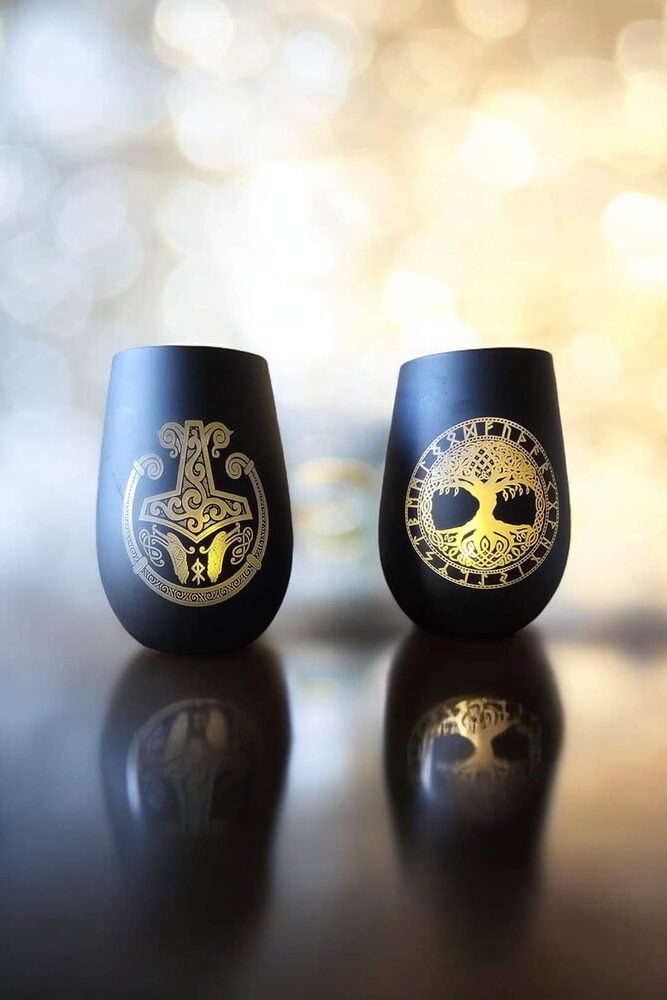
In the workshop we engrave these words, special characters included, on slate plaques, on crystal-glass tealight lanterns or on pendants. If you would like to arrange word, names and date yourself first, use the engraving configurator; for anything free-form and personal you can reach us through the page for custom engraving. How to turn names into runes without talking nonsense is explained in the article on Viking names, and if you are looking for a gift for a wedding or a birth you will find ideas under Nordic weddings, christenings and gifts.
A sober overview to close, so that it stays clear what the statements above rest on.
That is less than some websites promise, and more than one might first suspect. The sources show people who loved, grieved, felt jealous and stayed loyal, and they left behind words that are still spoken in Iceland today.
How do you say "I love you" in Old Norse? The closest are "ek ann þér" (from the verb unna, to be devoted) and "ek elska þik" (from elska, to love). Both are correctly formed, but no fixed standard formula has survived.
What does "ást" mean? Ást is the Old Norse word for love and affection, and today the everyday word for it in Icelandic. It belongs linguistically to unna and to German gönnen.
Are there real runic inscriptions with love messages? Yes, for example from Bergen "Ást min, kyss mik" (B017) and a love charm (N B257, about 1335). Both date from the Middle Ages after the Viking Age. From the Viking Age itself, memorial stones predominate.
Which love stories does the Norse tradition tell? The best known are Sigrún and Helgi in the Edda, Gudrún and Sigurð, Freyr and Gerðr in Skírnismál, and Guðrún, Kjartan and Bolli in Laxdæla saga. All were fixed in writing only in the twelfth and thirteenth centuries.
Did the Vikings have pet names? Tender forms of address such as vinr, vina or ást min are attested. The many "cute Viking pet name" lists online usually cite no source and are generally modern inventions.
Can I have an Old Norse phrase engraved? Yes. We engrave the words with special characters such as þ and ð and, on request, add the meaning and pronunciation. It helps to note that the text is normalized Old Norse.
For courage. For remembrance. For legends that live on.
Norse wedding & christening gifts · Viking names & their meaning · Viking gifts for men · Runes & their meaning.
Natural slate is a rewarding material: sturdy, millions of years old and genuinely low-maintenance. Still, there are a …
Read more →Are you the thinker or the protector? The trickster or the watcher? The Norse pantheon isn't a distant gallery of idols …
Read more →The Norse world is full of strong women: Freyja, who rules over love and battle alike, the Norns who weave fate, Idun …
Read more →A tie, another shower-gel set, one more mug with a slogan — for birthdays and Christmas, men often get exactly what …
Read more →