 A valkyrie punished by Odin with a sleep-thorn. A hero who rides through the flames. A betrayal that ends in blood. Brynhild is one of the mightiest female figures of Norse legend – and one of the most contradictory. Let us tell her story without smoothing over the fractures.
A valkyrie punished by Odin with a sleep-thorn. A hero who rides through the flames. A betrayal that ends in blood. Brynhild is one of the mightiest female figures of Norse legend – and one of the most contradictory. Let us tell her story without smoothing over the fractures.
Brynhild (Old Norse Brynhildr) stands at the centre of the Sigurd and Völsung matter, the greatest heroic legend of the North. The sources draw her with two faces: as a valkyrie – one of those shield-maidens who decide victory and fall in battle at Odin’s command – and as a mortal queen, sister of Atli (the legendary Attila) and bride of the Burgundian king Gunnar.
This double nature is not a flaw in the tradition but its core. In the “Völsunga saga,” in several lays of the Poetic Edda and – as a southern parallel – in the “Nibelungenlied,” two figures merge: the superhuman valkyrie and the courtly princess. To understand Brynhild you must allow both sides: the winged decider of fates and the woman who fights for her honour to the death.
According to the “Völsunga saga,” Brynhild is the daughter of King Budli and grows up at the court of her foster-father Heimir; her sister is Bekkhild, her brother the later King Atli. These kinship threads are no mere trimming: through Atli, the brother, Brynhild’s fate is later bound to the fall of the Burgundians – that second great catastrophe of the Nibelung matter. The legend thinks in kin-groups and vengeance, and Brynhild stands at the centre of this web of oath, honour and blood-guilt.
In the Eddic lay “Sigrdrífumál,” Sigurd finds a sleeping woman in armour on the mountain Hindarfjall. He wakes her – and she explains why she sleeps: in a battle she had let a king fall to whom Odin had promised victory. As punishment for this disobedience Odin stabbed her with a sleep-thorn (svefnþorn), took her future victories from her and decreed that she should henceforth be married off. As she wakes, she greets day and night with the famous verses:
Hail, day! Hail, sons of day!
And night and her daughter now!
Look on us here with loving eyes,
That waiting we victory win.
Sigrdrífumál (Poetic Edda), trans. H. A. Bellows 1923
She then teaches Sigurd rune-lore and good counsel. This image – the warlike woman whom Odin punishes for her own will and lays down in sleep – is the origin of the Brynhild figure as it was handed on through the centuries.
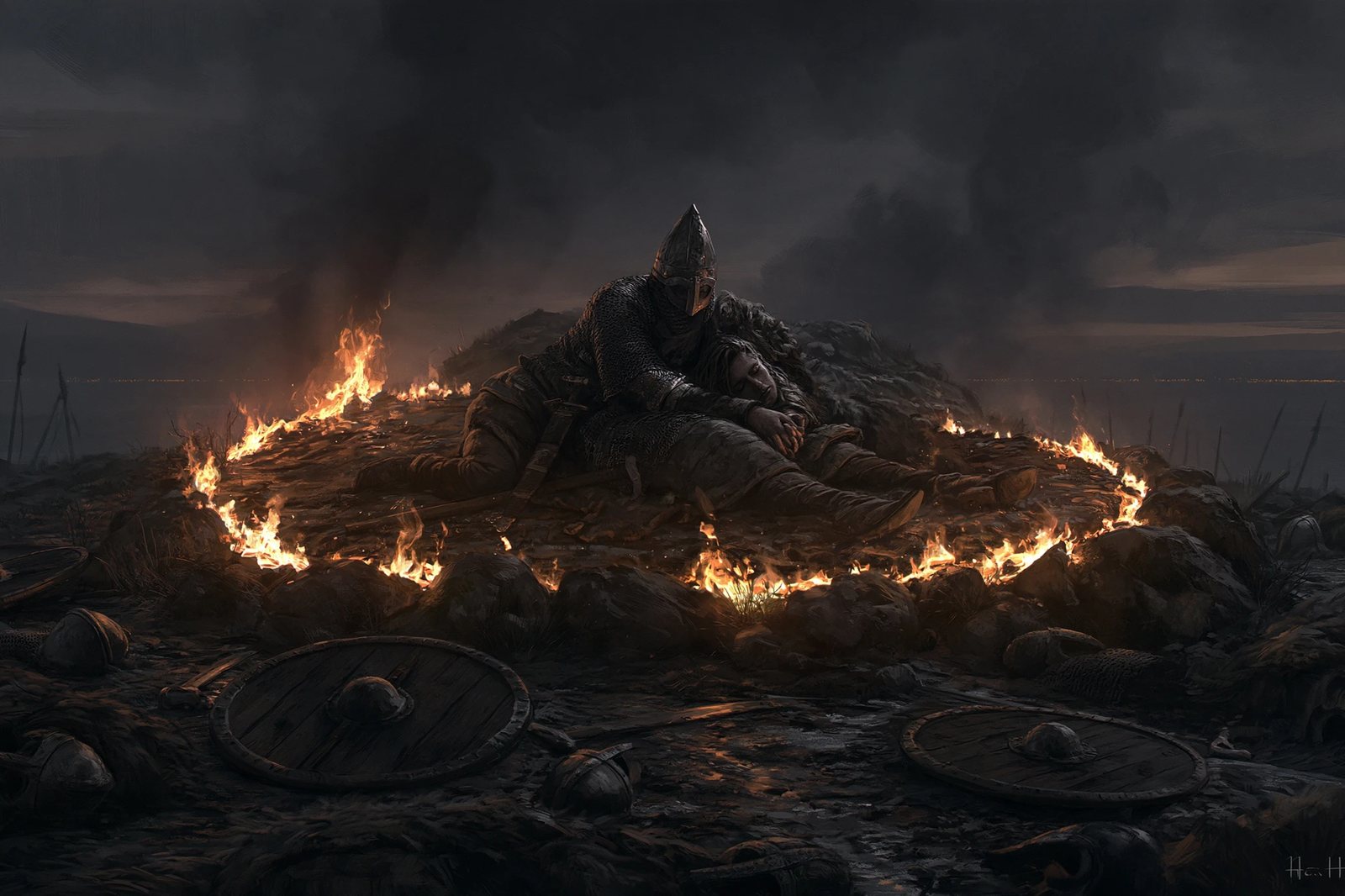
Odin did not only bind the defiant woman in sleep but behind a wall: in the more elaborate tradition Brynhild rests in a hall on the mountain, ringed by a wall of flames – some sources also speak of a rampart of shields. Only one fearless enough to ride through the fire is to win her.
The wall of flame is more than a backdrop. It is the test meant to single out the worthy hero, and at the same time the symbol of Brynhild’s unapproachability. She is not a bride to be taken but one who must be earned. On exactly this the whole later course of the legend will break: on the question of who really rode through the fire.
It is worth noting how differently the sources describe the obstacle: sometimes a blazing fire (vafrlogi, “flickering flame”), sometimes a rampart of shields, sometimes a hall ringed by flames. Such variation is typical of a legend passed on orally over generations and written down only late. The core, however, stays the same: a border of fire that only the fearless can cross.
Sigurd, the dragon-slayer, owns the only horse that dares the ride: Grani, a foal of Odin’s own Sleipnir line. With Sigurd on his back, Grani passes through the flames as if they were nothing. So the hero reaches Brynhild – and in one version the two pledge their troth to one another, exchange rings, bind themselves in love.
Here lies the seed of the tragedy. Sigurd has mastered the wall, Brynhild has promised him her heart. But the potion of forgetfulness and the politics of royal courts intervene. At the Burgundian court Sigurd is made to forget his pledge by a magic drink and marries Gudrun, sister of King Gunnar. And Gunnar in turn wants Brynhild – whom he cannot win himself.
Gunnar rides to the wall of flame, but his horse shies back from the fire. Nor can he get through on Sigurd’s horse Grani – for Grani carries only Sigurd. So the two resort to a ruse: Sigurd and Gunnar swap shapes by magic. In Gunnar’s likeness Sigurd rides through the flames a second time, passes himself off as the suitor, and spends three nights with Brynhild. Between himself and her he lays his sword – a sign that he hands her over to the true Gunnar untouched.
In doing so he takes one ring from her and gives her another: Andvaranaut, the cursed ring from the dragon’s hoard. This ring will later become the proof of the deception. Brynhild marries Gunnar in the belief that he passed the ride through the fire. Only when Gudrun, in a quarrel, shows her the ring and flings the truth in her face does Brynhild grasp that it was not Gunnar but Sigurd who came through the fire – and that she was bound to the wrong man.
The quarrel itself is one of the most famous scenes of the whole legend. As Brynhild and Gudrun wash their hair in the river, they fall out over the rank of their husbands: who is the greater hero, Gunnar or Sigurd? The war of words at the water turns bitterly serious when Gudrun draws out the ring Andvaranaut and flings the truth in Brynhild’s face. This “quarrel of the queens” is the spark from which three deaths grow – for what comes to light here Brynhild can no longer bear.
The knowledge destroys Brynhild. Her whole honour, her oath, her destiny hung on the ride through the fire – and both love and truth were taken from her by the ruse. Not grief but cold will now rules her: she demands Sigurd’s death and drives Gunnar and his brothers with reproaches and threats to kill the man she once loved.
In the Norse version Sigurd is finally slain – depending on the source, in bed at Gudrun’s side or outside, far from the court. Brynhild has reached her goal, but the triumph is none: with Sigurd’s death dies the only thing she ever cared about. The vengeance is complete, and it is empty.
Brynhild does not long outlive the dead man. In the Völsunga saga and the Eddic lays she runs herself through and has herself burned with Sigurd – on a shared pyre, the sword once more laid between them, as in the three nights at the wall of flame. Some versions let her deliver one last, clear-sighted speech and foretell the coming ruin of the Burgundians.
Her death closes the circle: the valkyrie who once decided the death of others decides, in the end, her own. The pyre is not a defeat but a final act of self-determination – the return to Sigurd on her own terms, beyond ruse and royal politics.
Anyone who thinks they know Brynhild from the “Nibelungenlied” knows a different figure. In the southern, Middle High German branch, Brünhild is a queen of superhuman strength who defeats her suitors in contests; Siegfried helps Gunther overcome her with a cloak of invisibility. Of valkyrie, sleep-thorn and rune-lore there is nothing to read there. The Norse and southern strands go back to the same ancient legendary core but have drifted far apart over the centuries.
Both versions are “genuine” – only different. The North preserves the mythic face of the sleeping valkyrie; the South the courtly one of the conquered queen. Whoever engraves or retells Brynhild should know which of the two is meant. And they should know: even within the Norse texts it is not wholly clear whether the sleeping Sigrdrífa and the queen Brynhild were originally one and the same – or only merged into a single person in the course of tradition.
Behind the whole matter lies a kernel of real history: the Burgundians were an actual Germanic people whose kingdom on the Rhine was destroyed by Hunnic forces in 436 AD. Out of that catastrophe – and out of the memory of Attila – the heroic legend grew over centuries, weaving figures like Brynhild, Sigurd and Gudrun into it. What began as the memory of a historical downfall became the greatest tragedy of Germanic storytelling.
Brynhild is widely attested: in several lays of the Poetic Edda (among them “Sigrdrífumál,” “Sigurðarkviða in skamma,” “Helreið Brynhildar,” “Grípisspá”), in the prose of the Icelandic “Völsunga saga” (13th c.) and – as an independent southern branch – in the Middle High German “Nibelungenlied.” Fixed elements are Odin’s sleep-thorn, the wall of flame, Sigurd’s ride through the fire on Grani, the shape-swap with Gunnar, the ring Andvaranaut as proof of the betrayal, the killing of Sigurd driven by Brynhild, and her death on the pyre.
“Valkyrie” and “mortal queen” merge in Brynhild – the identification of the sleeping Sigrdrífa (“Sigrdrífumál”) with Queen Brynhild is common interpretation, but not unambiguous in every source; some scholars see two originally separate figures. The Norse (Brynhild) and southern (Brünhild/Nibelungenlied) versions differ sharply and must not be mixed. The “Völsunga saga” is a high-medieval synthesis of older lays, not a Viking-Age record – the individual details vary between sources. And the shimmering, tragic figure we love today is also a work of the modern age: Wagner’s “Ring” has strongly shaped our image of Brünnhilde.
Sigurd the dragon-slayer · The Valkyries · Aslaug (Kraka) · Ragnar's sons · The Norse pantheon.
We like to imagine valkyries as noble riders escorting the fallen to Valhalla. The Darraðarljóð shows them quite …
Read more →Some sayings are older than you would guess. What may be the finest words of consolation in the Germanic world sit …
Read more →A ring from which ever new rings arise: Draupnir is Odin’s golden treasure and one of the most striking images of Norse …
Read more →A tree carries the world – but what waters the tree? Beneath the roots of Yggdrasil lie three springs, and each tells a …
Read more →