We like to imagine valkyries as noble riders escorting the fallen to Valhalla. The Darraðarljóð shows them quite otherwise: as cruel weavers of death.
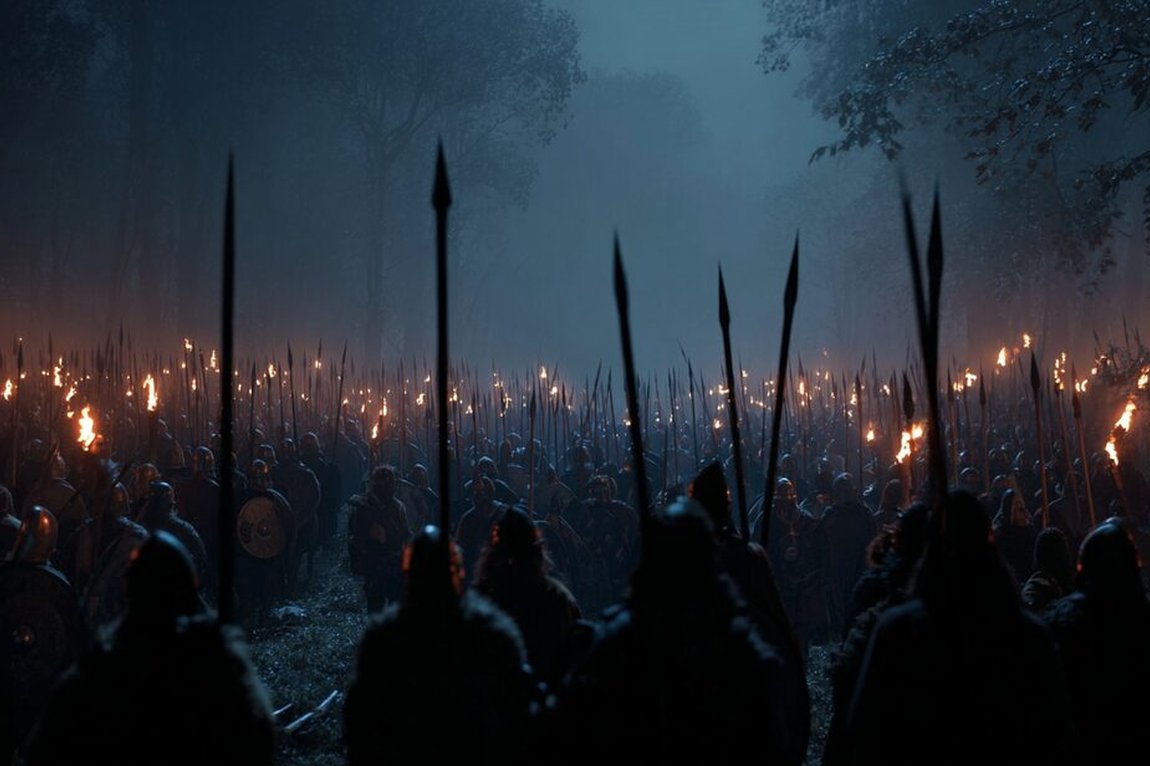
The frame-tale in Njáls saga is brief and eerie. On Good Friday of the year 1014, the morning of the Battle of Clontarf, a man named Dörruðr in Orkney sees twelve figures ride to a stone hut. He steps up and peers through a slit of a window – and inside beholds twelve valkyries at a loom. What he sees and hears the poem renders as their weaving-song: eleven stanzas in which the women of fate sing the outcome of the distant battle into their web.
This picture-within-a-picture is cunningly made: while men die in Ireland, on an island far to the north the pattern of their deaths takes shape on a frame at the very same moment. The text leaves open whether the valkyries foresee the event or themselves decree it – and it is exactly this blur that makes it so oppressive.
The heart of it is the grisly loom itself, built line by line from war-gear and human parts. The warp threads are human entrails, stretched and weighted with human heads. The loom-weights are skulls, the heddle-rods spears, the beaters that drive the weft home are real swords, and for a shuttle an arrow flies. A red cloth grows, a fabric of guts and blood that the women pull taut with bloodied hands.
Singing, they name themselves – Hildr, Hjörþrimul, Sanngríðr, Svipul and others, speaking names like „battle" and „spear-shaker". They declare that they decide who falls and who wins, and that the valkyries’ power rules the fate of kings. Hardly another text of the North shows the weaver-metaphor – weaving as the image of fate – so drastically: here the cloth is literally made of the slain.
The historical reference is the Battle of Clontarf near Dublin, where on Good Friday 1014 the Irish high king Brian Boru and a great host of Norse and Irish warriors clashed. Brian won but fell himself – an event that quickly grew legendary and echoes in Norse-Icelandic as well as Irish tradition. The Darraðarljóð reads this bloodbath not as an accident of human politics but as the work of higher, relentless powers.
At the end the valkyries tear their web apart, each keeping a shred in her hand, leap onto their horses and ride away – six to the south, six to the north. Behind them remains a man who witnessed how, over a distant battle, fate was woven and then torn asunder.
We like to imagine valkyries as noble riders who escort the fallen with honour to Valhalla. The Darraðarljóð shows the other, older side: they are also choosers of the slain – that is what their name means – who actively decide who dies. This double nature, half caring, half terrifying, lies at the core of the Norse belief in fate: destiny is woven, it is inescapable, and the hands that weave it are not always kind.
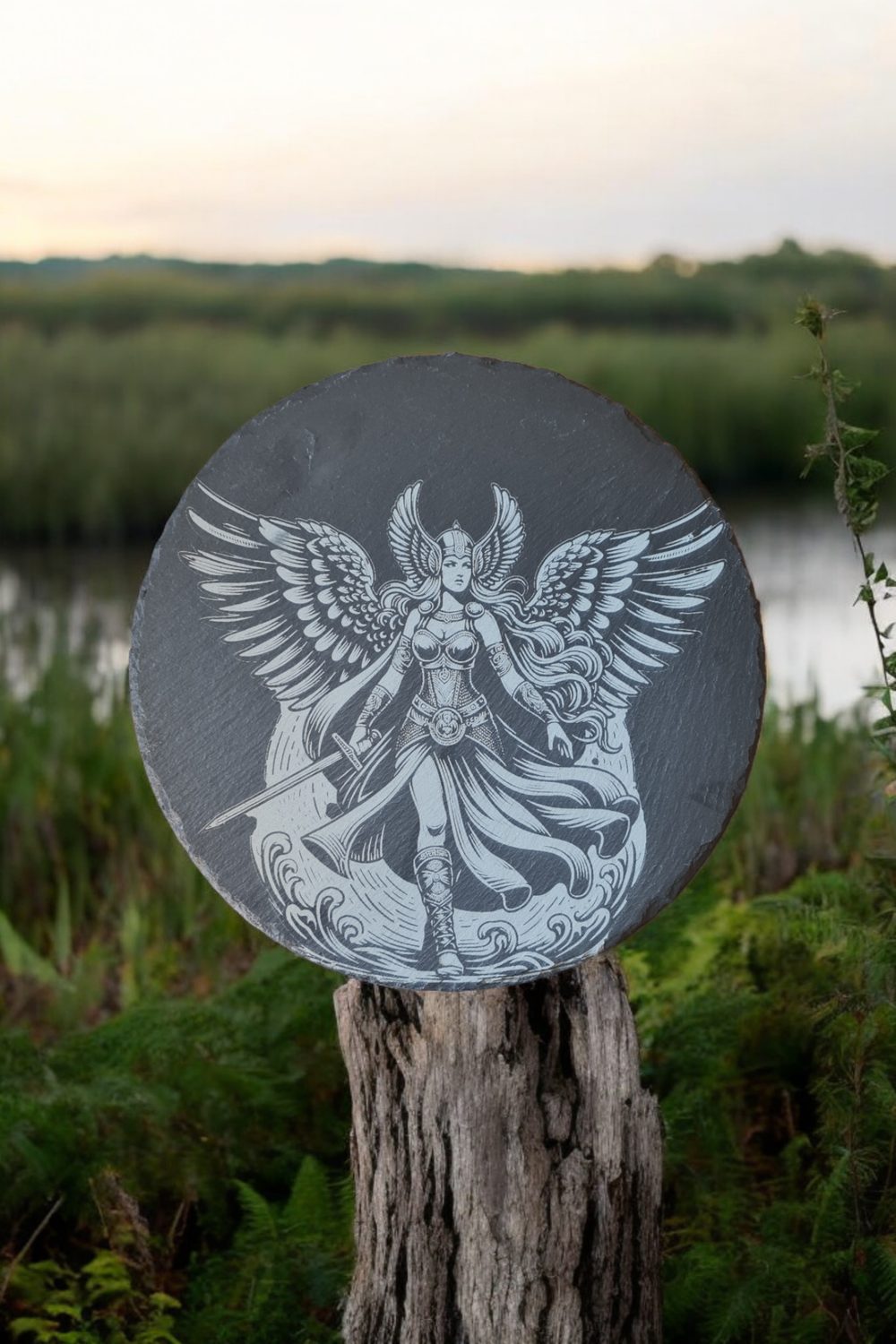
For us that is a reason not to prettify valkyries. When we bind a director of battle into slate, we carry both sides: the dignity of the guide and the hard gravity of the power of fate. It is exactly this depth that makes the old figures so striking to this day.
That a loom stands at the centre is no accident. In the Norse and the wider Germanic imagination, fate is something woven or spun. The Norns spin and braid the life-threads of humans at the roots of the world-tree; the Old English wyrd and Old Norse urðr belong linguistically to a word for „to become, to turn". Weaving was, moreover, women’s work – and so the image of the weaving woman of fate joins an everyday task to the highest, most uncanny power over life and death.
The Darraðarljóð pushes this metaphor to the limit by taking it literally: not a fine thread but entrails; not clay whorls for weights but skulls. Where the Norns work quietly at invisible threads, the valkyries weave visibly from the bodies of warriors. Both images mean the same thing – destiny is a fabric whose pattern is fixed before the fighter even draws his sword.
A linguistic riddle clings to the poem. The name of the witness, Dörruðr, likely arose from a kenning: „vefr darraðar" means „web of the spear", that is, battle. From the word darraðr („spear") the prose of Njáls saga apparently forged a personal name – the watcher is called this because the old kenning was no longer understood. Such misunderstandings are gold for scholars: they show that the poem was already old when the saga-writer embedded it in his text around 1280.
Originally the Darraðarljóð probably stood on its own, composed not long after 1014. Only later was it taken into the great Njáls saga, which tells it as a vision in Orkney. That so dark and heathen a lay survived within the frame of a thoroughly Christian saga we owe to the Icelandic instinct for preservation – without the manuscripts we would know nothing of this text at all.
„Let us wind, let us wind the web of the spear." – Darraðarljóð, after Dasent 1861
Valkyries · Helgi & Sigrún · The Norns · Ragnarök.
Njáls saga, ch. 157; George Webbe Dasent, The Story of Burnt Njal (1861). Rudolf Simek, Dictionary of Northern Mythology.
Some sayings are older than you would guess. What may be the finest words of consolation in the Germanic world sit …
Read more →A ring from which ever new rings arise: Draupnir is Odin’s golden treasure and one of the most striking images of Norse …
Read more →A tree carries the world – but what waters the tree? Beneath the roots of Yggdrasil lie three springs, and each tells a …
Read more →Almost everything we know about the Norse gods we owe to two books from medieval Iceland. A look at the sources – and …
Read more →