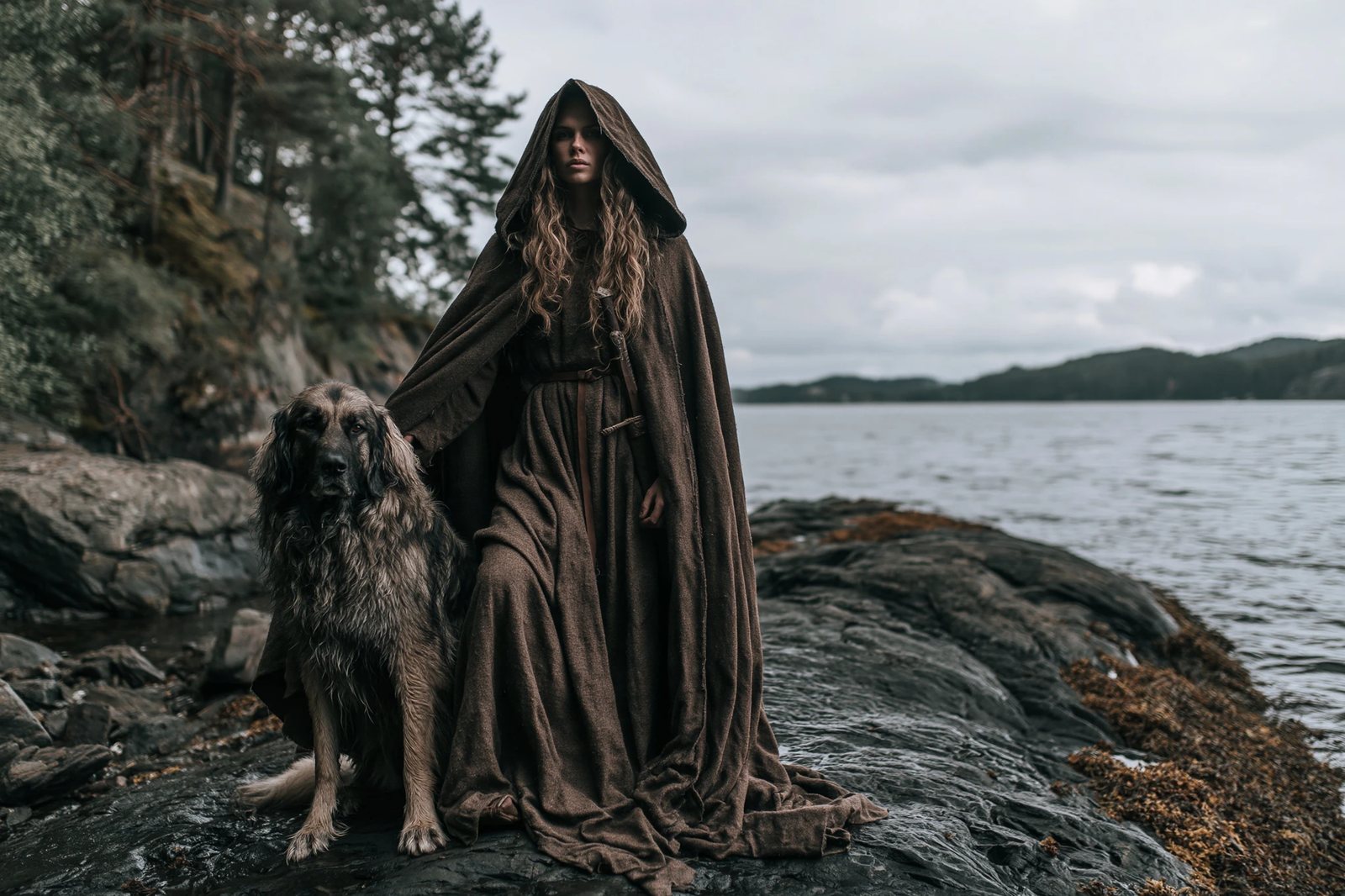
 She comes neither clothed nor naked, neither full nor hungry, neither alone nor in company – and thereby wins a king. Aslaug, also called Kráka, is one of the cleverest female figures in Old Norse legend. Supposedly the daughter of the dragon-slayer Sigurd and the valkyrie Brynhild, she becomes queen at Ragnar Lodbrok's side and the mother of an entire Viking dynasty. We tell her saga – and separate cleanly what is invention.
Aslaug's story begins with a downfall. According to the Ragnars saga loðbrókar, she is the child of the North's greatest hero, Sigurd Fáfnisbani – the dragon-slayer – and the valkyrie Brynhild. When both die, the girl is an infant. Brynhild's foster-father Heimir fears for her life, for as heir to the most famous lineage she would be a target. He builds an especially large harp, hides the child inside and travels the land as a poor, wandering harp-player. Thus he brings little Aslaug to safety – until he lodges with a farming couple named Áki and Grima. The two spot gold in the harp, kill the old man in his sleep, and instead of treasure find a little girl. Out of greed and suspicion they raise her – but not as a foster-daughter, almost as a servant.
So that no one suspects the child's noble origin, Áki and Grima give her a plain name: Kráka, "the crow". They rub the girl with tar and clothe her in rags so that her beauty will not stand out. Yet the saga leaves no doubt: Kráka grows into the wisest and most beautiful woman ever seen. This double role – outwardly a poor farm servant, inwardly a king's daughter of heroic blood – is the whole appeal of the figure. She is the hidden princess whose true greatness will show as soon as someone is clever enough to look behind the rags. That someone is Ragnar Lodbrok.
Ragnar, the famous Viking king, lands with his ships on the coast. Some of his men go ashore to bake bread and meet the ragged Kráka. They are so dazzled by her beauty that the bread burns. When Ragnar hears of it, his curiosity is roused. He wants to test this woman – not with weapons but with wit. For Ragnar is tired of meeting ordinary women; he seeks one who is his equal. So he sends her a task that seems impossible.
Ragnar sends word that Kráka should come to him – but only under three contradictory conditions. This is one of the finest motifs in all of legend: the setting of the impossible, solvable only by cunning.
She should come to him, yet neither clothed nor unclothed, neither fasting nor full-fed, and neither alone nor in company.Ragnars saga loðbrókar (public-domain 19th-century translation)
Kráka solves each condition through an ingenious middle way. She comes "neither clothed nor naked" by wrapping herself in a fishing net and spreading her long hair over it. She comes "neither full nor hungry" by biting into a leek-onion – her breath smells of food, yet she has eaten nothing. And she comes "neither alone nor in company" by leading a dog at her side. Ragnar is impressed: this woman has exactly the cleverness he was looking for. He wants to marry her at once, but Kráka insists that he first complete his voyage and return in his right mind. Only then does she consent – a woman who sets conditions even for a king.
Aslaug and Ragnar have several sons who become among the most famous figures of the Viking sagas: Ivar the Boneless, Björn Ironside, Hvitserk, Rögnvald and Sigurd Snake-in-the-Eye. The youngest bears his byname because of a mark in his eye that looks like a coiled snake – for the saga the visible proof that the blood of Sigurd the dragon-slayer flows in these children. For it is only late in the story that Kráka reveals herself as Aslaug and discloses her royal descent. Ragnar had at first taken her for a mere farmer's daughter; the son's snake-eye becomes the sign that confirms her words. Thus the saga links the sons of Ragnar to the greatest heroic cycle of the North.
Aslaug is no passive queen. Later in the saga she appears under yet another name: Randalín. When her sons go to war to avenge the death of a brother, she – so the saga tells – rides into the field herself at the head of her own troop. From the hidden farm servant Kráka has become a queen who gives counsel, drives on the vengeance and leads her own forces. The three names – Kráka, Aslaug, Randalín – mark three stages of life: the hidden child, the recognised king's daughter, the fighting mother. This many-sidedness makes her one of the richest female figures in Old Norse literature.
As gripping as Aslaug's story sounds – it is literature, not chronicle. The Ragnars saga loðbrókar was written down in Iceland in the 13th century, centuries after the supposed Viking age of its heroes. Aslaug's link to Sigurd and Brynhild is a clever narrative device: it connects Ragnar's lineage to the North's most famous heroic material, the Völsung and Nibelung cycle. This makes the sons of Ragnar heirs of the dragon-slayer – a patent of nobility from the pen of the saga-writers. Whether a historical woman named Aslaug ever existed cannot be said; as a figure she is a creature of the saga art.
Anyone who knows Aslaug today often knows her from the series "Vikings". There she is an important figure – but her portrayal is freely shaped and departs in much from the saga. The series reinvents relationships, conflicts and character traits and presses historically and legendarily separate things into a family drama. That is legitimate dramaturgy, but no source. Anyone seeking the "real" Aslaug will find her in the Ragnars saga and around the Völsunga saga: a clever, eloquent, mysterious queen who wins a king through a riddle and whose origin lies, to this day, in the realm of legend.
Aslaug/Kráka appears above all in the Ragnars saga loðbrókar (13th century), with links to the Völsunga saga. Attested there are: her descent from Sigurd and Brynhild, the hiding in Heimir's harp, her upbringing by Áki and Grima, Ragnar's riddle test (net, leek, dog), the sons (among them Ivar the Boneless, Björn Ironside, Sigurd Snake-in-the-Eye) and the name Randalín. The snake-eye serves in the tale as a sign of the Völsung descent.
Aslaug is a legendary figure, not a historically attested person. Her descent from Sigurd and Brynhild is a literary device that ties Ragnar's lineage to the Völsung material – not a transmitted genealogy. The various names (Kráka, Aslaug, Randalín) mark stages of the narrative, not documented biographical dates. And the TV series "Vikings" shapes her freely; it is no source for the medieval legend.
Ragnar Lodbrok · Ragnar's sons · Lagertha the Shield-Maiden · Sigurd the dragon-slayer · Björn Ironside.
It is the moment when laughter vanishes from Asgard. The death of the shining Balder is the most moving legend of the …
Read more →Warriors who fought in bear pelts and wolf-skins, bit their shields and feared neither fire nor iron. The berserker is …
Read more →Valhalla was only one of many realms of the dead. The ideas of the afterlife were as varied as the burial customs …
Read more →The most beautiful piece of jewellery in the world belongs to the most beautiful of the goddesses: Brísingamen, the …
Read more →