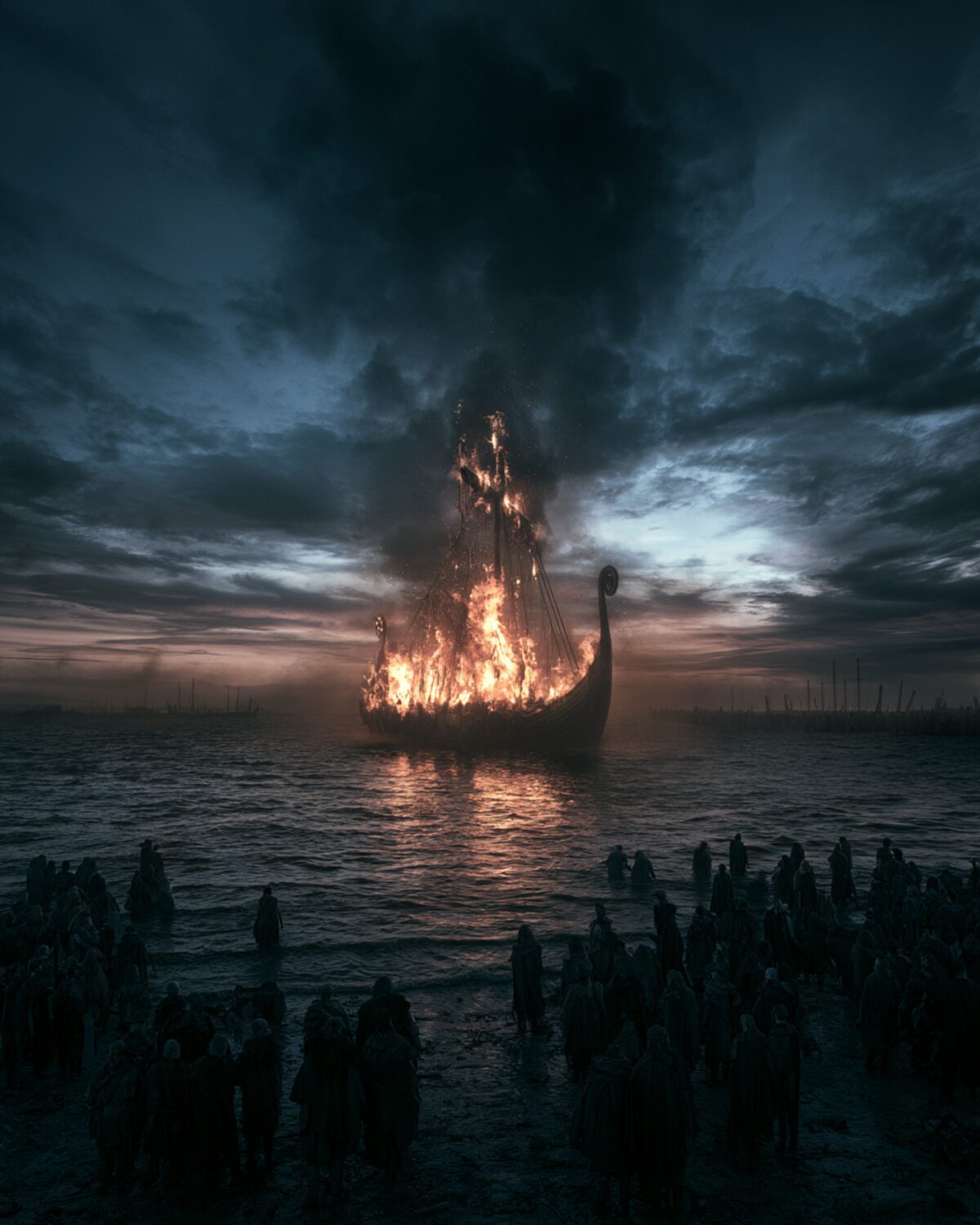
There was no single Viking burial rite: people in the Viking-Age North either cremated their dead or laid them in the ground unburnt – in plain pits, timber chambers, boats or under massive mounds – depending on region, century, family and rank. What many graves share is that the living staged them with care, using grave goods, animal offerings, stone settings and, later, rune stones. This guide walks you through every form of Viking burial and shows where the evidence ends and interpretation begins.
Picture a cemetery where one man lies in a timber chamber the size of a small room, with his sword and his horse, and ten paces away a handful of burnt bone sits in a shallow pit with nothing else at all. Both belong to the same period, perhaps even to the same family. That is what the Viking Age looks like in the ground: many-voiced, contradictory, and far more interesting than the single image almost everyone carries around – the burning longship drifting out to sea.
The two basic forms are cremation and inhumation. In a cremation, the body was burnt on a pyre, usually clothed and often with objects, animals and equipment. What remained – burnt bone fragments, ash, melted metal – was placed in an urn or a pit, or spread beneath a layer of earth or stones. In an inhumation, the body was laid unburnt in a pit, a coffin, a timber chamber or a boat.
No Scandinavia-wide law decided which rite was used. Broadly speaking, cremation was very common across much of mainland Sweden and Norway during the Viking Age (roughly 750–1050). In Denmark, inhumation becomes increasingly frequent through the ninth and tenth centuries. Gotland, too, is dominated by inhumations. And in Iceland, settled from around 870, pagan-period graves are almost exclusively inhumations; cremations have hardly been found there at all.
Often both rites appear at the same site. At Birka, the trading town in Lake Mälaren, cremations under small mounds lie next to unburnt burials in coffins and timber chambers. Who chose which rite, and when, probably depended on origin, family, status and date. Nobody has found a rule that explains it neatly.
Written sources do offer an explanation, and it is worth seeing how thin it is. In Ynglinga saga (c. 1230), Snorri Sturluson has Odin himself decree that all the dead should be burnt with their possessions on the pyre, so that each would arrive in Valhalla with that wealth. But Snorri was a Christian writing some two centuries after the pagan period, and his Odin is a deified human king. A universal law of cremation simply does not fit the countless inhumation graves in the ground.
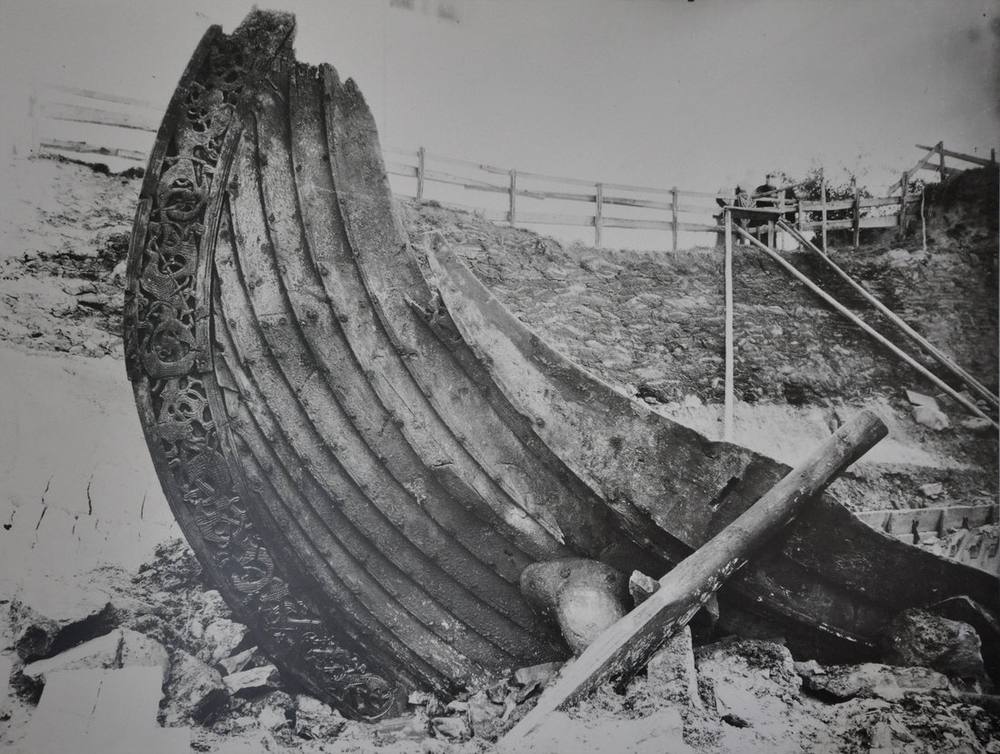
Above the burial, burnt or unburnt, very different things could stand.
Burial mounds. The heaped mound of earth, turf or stones is the most visible form, and its roots reach back into the Bronze Age. In the Viking Age the range runs from knee-high humps to true monuments: the Gokstad mound in Vestfold measures roughly 40 to 50 metres across, and the North Mound at Jelling in Denmark about 65 metres. A mound like that was both a grave and a statement of power, placed by roads and on high ground for everyone to see.
Chamber graves. Here a pit was lined with timber to create an underground room. The dead person lay inside, sometimes seated, with grave goods and occasionally a horse on a ledge at the foot end. Birka has produced a whole group of chamber graves, including the famous grave Bj 581. The most remarkable example in Germany lies at Hedeby (Haithabu).
Flat graves. Graves without a mound, perhaps once marked by a post or a low hump that has long since vanished. This is by far the most common form – and the least famous. A great many people of the Viking Age were buried like this, with a knife, a comb, a few beads, or nothing.
Stone settings and ship settings. Upright stones were arranged in circles, ovals, triangles or the outline of a ship around a grave. The ship-shaped monuments have their own article on our site: stone ships for the final voyage.
Boat and ship graves. The most spectacular and the rarest form. Oseberg, Gokstad, Ladby, Scar on Orkney – they shape our image of the period but belong to a tiny elite. You can read the full story in our articles on boat burial.
Grave goods are what make Viking graves so rich for us: weapons, jewellery, tools, cooking gear, gaming pieces, textiles, food. In ordinary graves this often means just a knife, a comb and a whetstone, or for women a pair of oval brooches that held up the strap dress and a string of beads. Wealthy graves add swords, riding equipment, bronze vessels, glass, even whole wagons.
And here lies the biggest trap. A grave is not furnished by the dead but by the living. What goes in is a statement by the mourners: about the family's rank and ambitions, about the image they wanted to project of the deceased, perhaps about an inheritance still to be settled. A sword in a grave does not prove its owner fought. A set of scales does not prove someone traded. Loom weights do not prove someone wove. The archaeologist Neil Price likes to describe Viking graves as staged narratives – the final frame of a ritual that may have lasted days, of which we see only the last picture.
The best-known test case is Birka Bj 581, a chamber grave full of weapons whose occupant turned out in 2017 to be genetically female. The genetic result is considered sound; reading the grave as a "warrior woman" remains contested – not least because weapons in a man's grave do not automatically prove a lived role either.
So why grave goods at all? The obvious answer is that the dead were thought to need them in the afterlife. That is a plausible interpretation, but it is an interpretation. The written sources offer several realms of the dead – Hel, Valhalla, Freyja's Fólkvangr, a continued existence inside the mound itself – and almost all of them were written down in Christian times. You will find an overview in our article Valhalla, Hel, Fólkvangr: where did the dead go?. More sober explanations sit alongside: property no one wanted to use after its owner's death, family prestige, an offering to gods or ancestors. Probably several reasons applied at once, and not the same ones everywhere.
Animals are among the most striking features of rich graves. At Oseberg the excavators found the remains of more than a dozen horses, plus dogs and cattle. Gokstad held twelve horses, six dogs and a peacock – an exotic prestige bird that must have come a very long way. At Ladby in Denmark, around 925, there were eleven horses and several dogs. And the Hedeby boat-chamber grave had its three horses in a pit of their own.
Simpler graves contain animals too: a dog, hens, joints of beef or mutton as food. In cremation deposits, burnt animal bones are often mixed in with the human remains, showing that animals went onto the pyre as well.
What the animals meant remains a matter of interpretation. Horse and dog were companions in life and part of any respectable household. A horse in a grave may be a mount for the journey to the other world, a status symbol, a sacrifice – or all three.
The written source. The only detailed eyewitness account comes from Ibn Fadlan (more below): at the funeral of a Rūs chieftain on the Volga in 922, an enslaved girl is killed and burnt with her master. It is a contemporary source – but a single snapshot, far from Scandinavia.
Ballateare, Isle of Man. In 1946 Gerhard Bersu excavated a mound here. At the bottom lay a man in a coffin with a sword, spears and a shield; the sword had been broken. Higher up in the mound lay the skeleton of a young woman, arms raised, her skull opened by a heavy blow. Above her came a layer of burnt animal bone. The excavators interpreted the woman as a sacrifice who followed the man into the grave. It is an obvious reading, though not the only possible one.
Flakstad, Lofoten. In double and triple graves, at least three headless individuals were found buried alongside complete bodies. Isotope analyses by Elise Naumann and colleagues (2014) showed that the headless individuals had lived mainly on fish, while the others ate considerably more meat and land-based food; DNA results argued against a maternal family link. The researchers read the headless dead as unfree people killed and buried with their masters – explicitly as a hypothesis.
Gerdrup, Zealand. Around 800, a man and a woman were buried together here. The woman had a knife, with an iron spearhead lying beside her leg. The man lay with crossed ankles that had probably been tied, and his neck was probably broken – he may have been hanged. The Viking Ship Museum in Roskilde considers that he may have been an enslaved man killed at the woman's funeral.
For more on the people who apparently lost their lives this way, see our article on slavery in the Viking Age.
Ahmad ibn Fadlan travelled in 921/922 as an envoy of the Caliph of Baghdad to the Volga Bulgars. There he watched the Rūs bury one of their leaders. For the full background, read our article on Ibn Fadlan and the Rus on the Volga.
The dead man lay in a temporary grave for ten days while his clothes were sewn. His property was divided into thirds: one for his family, one for his garments, one for the drink consumed at the ceremony. A ship was hauled ashore and propped up, and the body was seated on a couch inside it. A dog, two horses, two cows, a cockerel and a hen were killed and placed in the ship. An enslaved girl who had agreed to die with her master was killed by an old woman Ibn Fadlan calls the "Angel of Death". The dead man's closest male relative lit the pyre; over the ashes a mound was raised, topped by a post bearing his name.
The limits of the source: Ibn Fadlan did not understand the language, he wrote as a Muslim diplomat for an audience back home, and he describes one single funeral on the Volga, in a milieu shaped by Scandinavian, Slavic and Turkic influences. And yet a remarkable amount matches the excavated evidence in Scandinavia: ship, fire, animal offerings, mound, wooden post.
If you want to know what counted beyond death, one of the clearest answers comes from the Edda. The Hávamál, the "Sayings of the High One", contain two famous stanzas, usually numbered 76 and 77:
Cattle die, and kinsmen die,
And so one dies one's self;
But a noble name will never die,
If good renown one gets.Hávamál 76, transl. Henry Adams Bellows, 1923 (his stanza 77)
The second stanza opens the same way and ends with the certainty that one thing never dies: dómr um dauðan hvern – the verdict on each of the dead. What is meant is what the living say about you once you are gone.
That is strikingly unspectacular. No paradise, no hall, no pyre carrying you to another world – just the reputation that remains in the community. The Hávamál survive in a thirteenth-century manuscript, though their proverbial wisdom is probably older. They explain well why so much effort went into what stood above the grave: mounds, stones, inscriptions and feasts all kept a name alive.
The burial was not the end of it. Sagas and laws know the erfi or erfiöl, literally the "inheritance ale": a feast held in honour of the dead at which the heir also took up the inheritance. In Ynglinga saga, Snorri describes how the heir of a king or jarl first sat on a step in front of the high seat until a cup – the Bragafull – was brought in. He then made a vow, drained the horn, and only afterwards took his father's seat. The feast was not only a wake but a legal act performed in front of witnesses.
The second form of remembrance left far more physical traces: the rune stone. In the late Viking Age, especially in the tenth and eleventh centuries, several thousand such stones were raised across Scandinavia, most of them in Sweden, particularly in Uppland. The inscriptions almost always follow the same pattern: "X had this stone raised in memory of Y, his father / son / husband / brother." Often a prayer for the soul follows – many of these stones are already Christian.
A rune stone frequently stood not at the grave but by roads, bridges and assembly places where many people passed. The historian Birgit Sawyer has shown how often these inscriptions quietly record who inherited from whom: whoever raised the stone publicly documented their relationship to the dead. The most famous case is Jelling, where Gorm raised a stone for Thyra and Harald Bluetooth one for his parents – and, while he was at it, for his own glory.
The Icelandic sagas are full of revenants, the draugr. The most famous is probably Þórólfr Lame-foot in Eyrbyggja saga: a quarrelsome man who causes so much harm after his death that he is dug up and moved elsewhere. When even that does not help, his body is burnt – and a cow that licks the ashes later gives birth to an uncanny bull. In Grettis saga, Grettir wrestles the dead Glámr, cuts off his head and places it against his buttocks so that he cannot return.
These stories were written in the thirteenth and fourteenth centuries. But they describe measures that do turn up in the ground. Archaeologists speak of deviant burials: bodies laid face down, weighed down with heavy stones, with bound limbs, severed heads, or placed outside the normal cemetery. Such graves exist in the Viking Age, though they are not common.
Behind it all lies one idea: the dead were not gone but present – in the mound, on the farm. Read more in our article on Viking ideas about death.
Christianisation changes the picture in the ground, but not overnight. In Denmark after Harald Bluetooth's baptism around 965, in Norway around 1000, and in parts of Sweden only in the course of the eleventh century, the hallmarks of Christian burial take hold: unburnt bodies, west–east orientation with the head to the west, burial in churchyards, few or no grave goods. Cremation disappears.
In between lie decades of mixture. Unfurnished west–east graves sit beside richly furnished ones, cross pendants turn up in graves of the old type, and a casting mould from Trendgården in Jutland let the same craftsman cast both Thor's hammers and crosses. At Jelling, a grave containing the reburied bones of a man was found beneath the church; it is often linked to Gorm the Old – a pagan king moved into Christian ground? That is a widespread but not certain interpretation.
No image defines the Viking funeral quite like this one: a longship slides out onto dark water, archers loose flaming arrows, and the ship blazes on the horizon.
So where does the image come from? It has literary roots, and honesty means naming them. In Snorri's Edda, Baldr's body is laid on his ship Hringhorni, the pyre is lit and the ship is pushed into the water – a funeral of gods, in myth. In Ynglinga saga, the legendary king Haki, mortally wounded, has a warship loaded with fallen men and weapons, a pyre lit aboard, and the ship sent burning out to sea. And in the Old English Beowulf, King Scyld is given to the sea in a ship – but without fire.
These are stories about gods and legendary kings, written down by Christians centuries after the pagan period – not an attested burial custom. Practical sense argues against it too: a burning wooden ship on the water would probably sink long before a human body was fully cremated. In the nineteenth century painters took up the literary scenes, Frank Dicksee among them with The Funeral of a Viking (1893) – and from there the road leads straight to the cinema.
We know for certain that cremation and inhumation ran side by side, with strong regional and chronological differences. There were mounds, chambers, flat graves, stone settings and ships; only a few graves are lavish. With Christianisation, unfurnished inhumations take over.
Well founded but interpretive are: human sacrifice in individual cases, grave goods as equipment for the afterlife, and deviant burials as protection against revenants.
We do not know by what rules a family chose between fire and earth, what exactly people believed about the afterlife – different people probably believed different things – or what words were spoken at the graveside. Not attested is the burning ship at sea.
A grave is an attempt to hold on to a person – with objects, stones and words. Memorial plaques and inscriptions do exactly that to this day, which is why in our workshop we stick to forms that are genuinely attested.
How were Vikings buried? In many different ways: cremated or unburnt, in plain pits, timber chambers, under mounds or stone settings, and in rare cases in boats and ships. Region, period and family rank decided the form.
Did Vikings send their dead out to sea on burning ships? There is no archaeological evidence for it. Ship burials took place on land; the burning ship at sea comes from myth and legend (Baldr, King Haki) and became popular in the nineteenth century.
What did Vikings put in graves? Depending on status: knives, combs, jewellery, brooches, tools, weapons, vessels, gaming pieces, food and animals such as horses and dogs. Many graves contain only a few objects or none at all.
Did Viking funerals involve human sacrifice? In rare cases, yes: Ibn Fadlan describes the killing of an enslaved girl, and finds such as Ballateare, Flakstad and Gerdrup are interpreted as sacrifices. It was not a general custom.
What was a Viking funeral feast (erfi)? The Old Norse erfi was a feast in honour of the dead at which the heir formally took up the inheritance – wake and legal act in one.
When did pagan Viking burials end? With Christianisation in the tenth and eleventh centuries, at different times in different regions. Unfurnished inhumations in churchyards then became the norm, often after decades of mixed practice.
For courage. For remembrance. For legends that live on.
For courage. For remembrance. For legends that live on.
The most beautiful piece of jewellery in the world belongs to the most beautiful of the goddesses: Brísingamen, the …
Read more →We like to imagine valkyries as noble riders escorting the fallen to Valhalla. The Darraðarljóð shows them quite …
Read more →Some sayings are older than you would guess. What may be the finest words of consolation in the Germanic world sit …
Read more →A ring from which ever new rings arise: Draupnir is Odin’s golden treasure and one of the most striking images of Norse …
Read more →