A poem that opens by advising you to look around when you enter a house, to see where the enemies are sitting. It explains table manners, warns against too much beer, thinks about friendship – and then tips abruptly into a god who hangs for nine nights on a windswept tree, wounded by a spear, sacrificed by himself to himself. The Hávamál is no handbook of virtue. It is a stack of very different verses in a single manuscript, and that is exactly what makes it good.
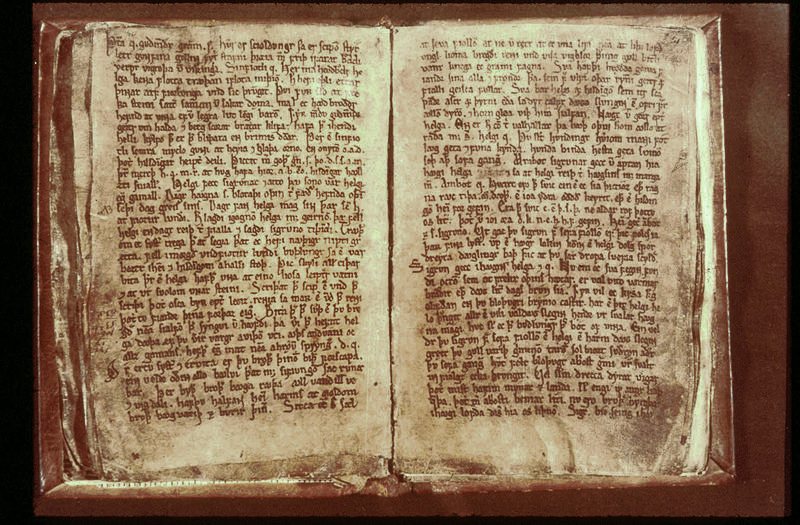
Everything we have of the Hávamál sits in a single book: the Codex Regius of the Poetic Edda, written down in Iceland in the later thirteenth century. The Sayings of the High One stand second in it, right after the Völuspá. Without that manuscript we would know almost nothing of the poem.
The title means literally "sayings of the High One". The High One, Hávi, is Odin. He does not speak throughout, but he is the voice the whole thing is attributed to – and by the end he is unmistakably speaking for himself.
How the Codex Regius came about, who wrote it and why we have a collection of old divine poems at all is set out in our piece on the Edda. Anyone who wants the complete text will find it on our Hávamál reading page.
The standard edition counts 164 stanzas. Others arrive at 165, because they divide differently at one point – a detail that matters later. Scholars usually split the text into five parts with blurred edges.
The first and longest, often called the Gestaþáttr or guest section, runs to about stanza 80 and consists of rules for living: hospitality, moderation in drink, caution, friendship, reputation. Then, to around stanza 110, come verses about women and seduction and two stories in which Odin is himself taken in, or does the deceiving – among them the theft of the mead of poetry from Gunnlöð. From stanza 111 a voice addresses a certain Loddfáfnir, always with the same opening formula; that part is therefore called Loddfáfnismál. Then comes the Rúnatal, Odin's self-sacrifice and the winning of the runes. And last the Ljóðatal, a list of eighteen magical songs.
The metre is mostly ljóðaháttr, the typical measure of gnomic verse: two long lines and a full line that drives the thought home. A few stanzas fall outside it and use other metres. That too suggests material bound together that did not begin together.
The most famous stanzas of the first part concern hospitality, and they are cheerfully unromantic. Not a word about honour. This is about a frozen human being at the door.
Elds er þörf
þeims inn er kominn
ok á kné kalinn;
matar ok váða
er manni þörf,
þeim er hefr um fjall farit.
"Fire is what he needs who has come in and is frozen to the knee. Food and clothing is what a man needs who has travelled over the mountain."Hávamál, stanza 3; English rendering our own
That is one half. The other stands in stanza 1: before entering, look over every doorway and glance around, for you never know where enemies are already sitting in the room. Hospitality and mistrust stand side by side in this poem, and nobody resolves the contradiction.
Then there is a whole run of stanzas on drinking. Beer is not as good for the sons of men as it is said to be; the more a man drinks, the less he knows of his own mind. Anyone tempted to read that as later Christian moralising should remember that this is the same collection in which Odin steals the mead of poetry.
The second great strand is friendship, and here the poem turns downright practical. Be a friend to your friend and repay gift with gift. Go and see him, often, and do not let the path grow over; where nobody walks, brushwood takes hold. Exchange thoughts, not only presents.
And in the same breath: be no friend to your enemy's friend. Trust nobody too quickly. Laugh with the man you do not trust, and speak other than you think. Anyone who reads the Hávamál as a catalogue of noble virtues has skipped half of it. This is the shrewdness of people who lived on farms far apart and had to size up every encounter before taking off their cloaks.
Some of it is hard to stomach today, especially the stanzas on women, which swing between mockery and open contempt – and which sit in the same collection as the story where Odin does exactly what he accuses others of. We see no point in leaving such passages out. They belong to the text.
At the end of the first part stand two stanzas that begin almost identically and end completely differently.
Deyr fé,
deyja frændr,
deyr sjalfr it sama;
en orðstírr
deyr aldregi
hveim er sér góðan getr.
Deyr fé,
deyja frændr,
deyr sjalfr it sama;
ek veit einn
at aldri deyr:
dómr um dauðan hvern.
"Cattle die, kinsmen die, you yourself die the same. But the name a man earns well never dies.
Cattle die, kinsmen die, you yourself die the same. One thing I know that never dies: the judgement on every dead man."Hávamál, stanzas 76 and 77; English rendering our own
The first stanza is the kind one. Orðstírr is good repute, literally something like "word-fame", and it promises that this endures. The second is harder and more honest: what endures is dómr, the judgement – on every dead man. Not only on those who deserved well of it. A bad afterlife in people's mouths is an afterlife too.
That point is exactly what drops out of most quotations. On postcards and in signatures you almost always get the first half alone, or both stirred together into one softer statement. We engrave these lines often and gladly. But we say out loud that the second stanza is not a consolation. It is a warning.
Then the poem breaks off and something entirely different begins. Odin speaks in the first person:
Veit ek at ek hekk
vindga meiði á
nætr allar níu,
geiri undaðr
ok gefinn Óðni,
sjalfr sjalfum mér,
á þeim meiði
er manngi veit
hvers af rótum renn.
"I know that I hung on a windswept tree nine whole nights, wounded by a spear and given to Odin, myself to myself, on that tree of which no one knows from what roots it grows."Hávamál, stanza 138 in Neckel/Kuhn, 139 in other editions; English rendering our own
Nine nights, no bread, no drinking horn. Then he looks down, takes up the runes, screaming, and falls back. This is the passage on which everything said about Odin as a god of knowledge rests – and it is terse, dark and wholly unexplained. The tree is not named. That it is Yggdrasil is not stated here; it follows from the rest of the tradition.
After it come the eighteen charms of the Ljóðatal: against sickness, against fire, against weapons, for love, to make a hanged man speak. The eighteenth he teaches to nobody – except, he says, the woman who holds him in her arms, or his sister. Anyone who wants to know more about what is actually being described here will find the runes and seiðr treated at length elsewhere on the site.
People have argued about that for more than a century, and nobody has settled it.
One piece of skaldic evidence speaks for age. The Hákonarmál of Eyvindr skáldaspillir, composed after the death of Hákon the Good around 961, ends with a stanza that opens the same way – Deyr fé, deyja frændr – and then goes elsewhere, to land laid waste. The usual reading is that Eyvindr quotes the Hávamál, so the poem existed in the tenth century. But the direction cannot be proved. It may be the other way round, or both may draw on an older formula that was simply in circulation.
Against that stands the work of Klaus von See, who in the 1970s pointed to contacts with Latin gnomic verse, above all the Disticha Catonis, a school collection read everywhere in the Middle Ages. If that holds, parts of the Hávamál are considerably younger and more learned than was assumed.
Probably both are right, because the question is badly put. The Hávamál is not a unity. Different metres, doublets, stanzas that appear twice, transitions that look like seams: all of that points to a collection that grew over generations and reached a book at some point in the thirteenth century. Individual stanzas may be old, others young, and the order is the scribe's. The standard edition with commentary is David A. H. Evans's; anyone who wants certainty has to go through it.
That Snorri Sturluson quotes the Hávamál in the early thirteenth century proves only that it existed then. What else we owe him is in our piece on Snorri.
And now the part that genuinely annoys us.
First, the numbers. Because there are countings with 164 and with 165 stanzas, two people saying "Hávamál 140" often mean two different verses. A reference without an edition is not a reference.
Second, the translations. Almost everything circulating in English goes back to two public-domain versions of the early twentieth century: Olive Bray's of 1908 and Henry Adams Bellows's of 1923. Those get reworked, smoothed and pushed into self-help register until an angular verse comes out as a fridge magnet. Reading a line of Old Norse and reading a translation of a translation of a paraphrase are not the same activity.
Third, lists that never existed. The "Nine Noble Virtues", regularly presented in comment threads as the content of the Hávamál, are a modern formulation: drawn up in the British Odinic Rite in 1974 and repeated in a different version in the United States in 1983, loosely after the Hávamál and the Sigrdrífumál. No medieval manuscript contains such a list.
Fourth, quotations from the cinema. The widely shared prayer beginning "Lo, there do I see my father" comes from Michael Crichton's novel Eaters of the Dead of 1976 and the film made from it. It is well written. It is simply not medieval.
And fifth, the selection. Anyone quoting the Hávamál as a moral code has picked out the friendly stanzas and left the suspicious, coarse and contradictory ones lying. That does not make the poem nicer. It makes it smaller.
Attested in manuscript is a text of 164 stanzas in the Codex Regius, written in Iceland in the later thirteenth century. That is all there is: no second manuscript, no fragment to check it against.
Touched by a contemporary is the poem in the Hákonarmál of around 961 – with the known uncertainty about who took what from whom.
Modern interpretation covers the division into five parts, the dating of individual layers, the derivation from Latin gnomic verse, and every claim about what "the Vikings" believed. The poem says what it says, and it contradicts itself regularly while doing so.
Purely modern are the lists of virtues, the smoothed maxims and the film prayers.
We prefer the original. A text that tells you to build a fire for the freezing man and still check who is sitting in the room credits its reader with more than any fridge magnet does. For courage. For memory. For legends that live on.
Odin · Snorri Sturluson · Runes & their meaning · Seiðr – the magic · Law & the Thing · Viking Symbols & their meaning – genuine or invented?.