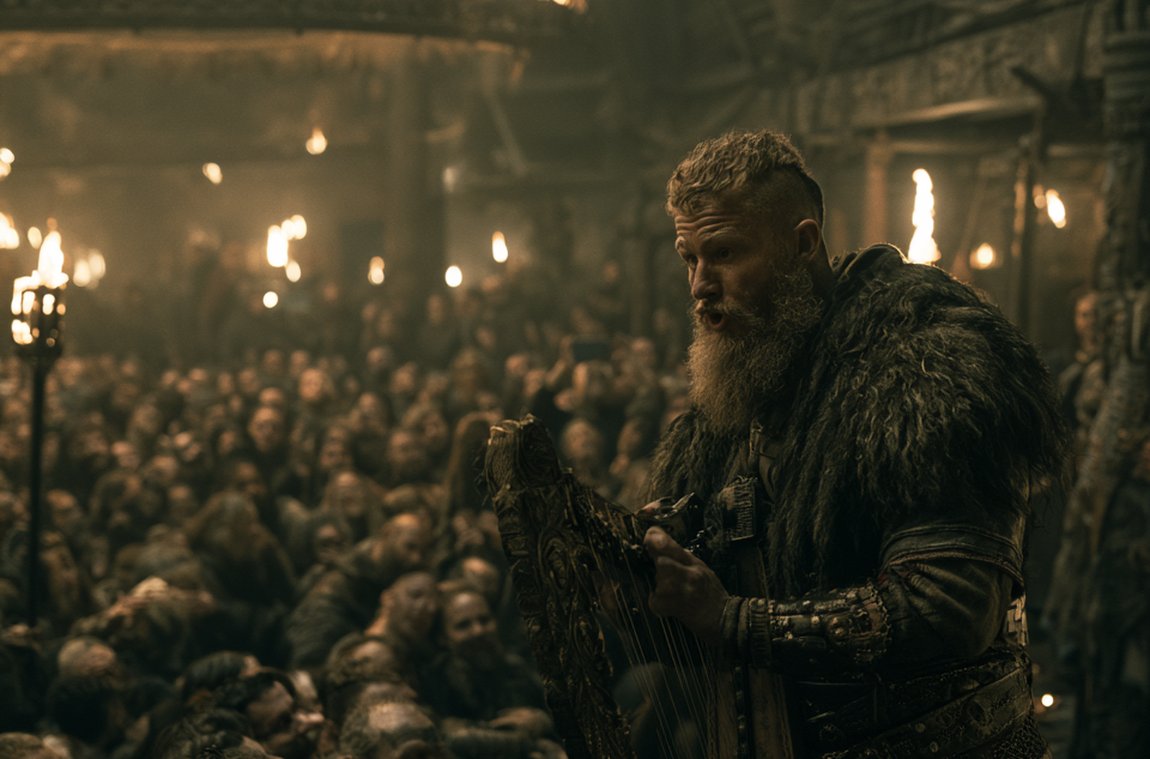
His byname sounds like a reproach: Eyvindr skáldaspillir, „the plagiarist“ (or „spoiler of poets"). It probably means he imitated older models – yet he was one of the greatest skalds of Norway, and in a sense the last of his kind.
Some Norse bynames sound like an honour, others like a reproach. Eyvindr Finnsson bore one of the most puzzling: skáldaspillir, „the spoiler of poets". It probably meant that he leaned closely on older models and, as it were, „used them up". But the mockery deceives: Eyvindr was one of the greatest skalds of Norway – and, as it would turn out, in a sense the last of his kind.
He lived in the 10th century and himself came of noble, partly royal descent. His byname has stayed ambiguous: „the one who surpasses the poets" as much as „the one who spoils the poets" or simply „plagiarist". Even in the Middle Ages people argued over whether his artful echoes of older works were imitation or brilliant reply.
Eyvindr served King Hákon the Good, a son of Harald Fairhair who had been raised a Christian but ruled a still-heathen people. When Hákon was mortally wounded in the Battle of Fitjar around 961, Eyvindr created his masterpiece, the Hákonarmál, the „lay of Hákon".
The poem is of moving ambiguity. It tells how Odin sends the valkyries Göndul and Skögul to fetch the fallen king, and how the heathen Hákon is received in Valhalla – although he died a Christian. The old gods take in the good king as if he belonged to them. Hardly any text captures the passage between two ages, the coexistence of old and new faith, so movingly.
„Cattle die, kinsmen die, the land and realm lie waste, since Hákon went to the heathen gods." — Hákonarmál, closing stanza, after the Heimskringla
With this closing stanza the lay ends – an echo of the famous Hávamál verses, but turned upon one very concrete loss. With Hákon, Eyvindr laments, not only a king passes away but a whole order. The land grows poor because the good ruler is gone.
Eyvindr’s second great work is the Háleygjatal, an artful genealogy of the jarls of Lade. It traces the line of this mighty family back through many generations – up to the gods themselves, to Odin and the giantess Skaði. Such genealogies were no mere game: they founded a family’s claim to rule by deriving it directly from the divine. Whoever descended from Odin held a right to rule above that of ordinary men.
With this Eyvindr shows the skalds’ second great task beside the praise-poem: they were also the keepers of descent, the memory-bearers of the lineages. In their verses the ancestors lived on, and with them the claim of the living.
Eyvindr is reckoned the last great skald who still composed wholly and without a break within the old, heathen imagery. After him the times changed irrevocably: Christianity prevailed, and with it came new subjects, new images, a new heaven. The kennings that alluded to the old myths gradually became mere formulas whose sense had to be explained.
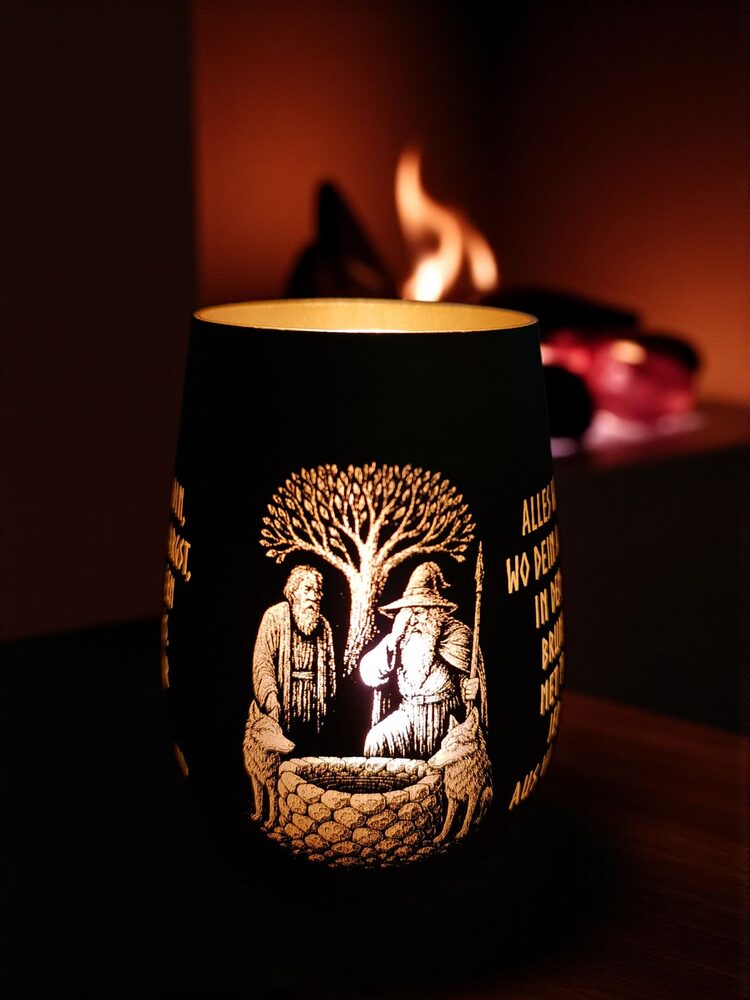
So his Hákonarmál stands like a boundary-stone at the edge of a fading world – a last, glowing song for the old gods and a good king, composed in the very moment when both began to pale. It is exactly such moments of passage that fascinate us: when we evoke the mead of poetry on a windlight, we think of men like Eyvindr, who let the old faith blaze up once more in full light before it passed into memory.
Vellekla · Óttarr svarti · Hákon’s Battles · Valhalla.
Eyvindr skáldaspillir, Hákonarmál, Háleygjatal (Snorri, Heimskringla); Skaldic Poetry of the Scandinavian Middle Ages. Rudolf Simek, Dictionary of Northern Mythology.
No being do the gods of the North fear like Fenrir, the wolf. They rear him themselves, they bind him by cunning – and …
Read more →What does the strongest god do when he has been stripped of his hammer, his belt of strength and his iron gloves? He …
Read more →In the beginning there was no word and no bang, but a void: Ginnungagap, the ‘yawning gap’. Between the fire in the …
Read more →Neither iron nor chains tamed the mightiest monster of the North, but a ribbon thin and soft as a silken thread …
Read more →