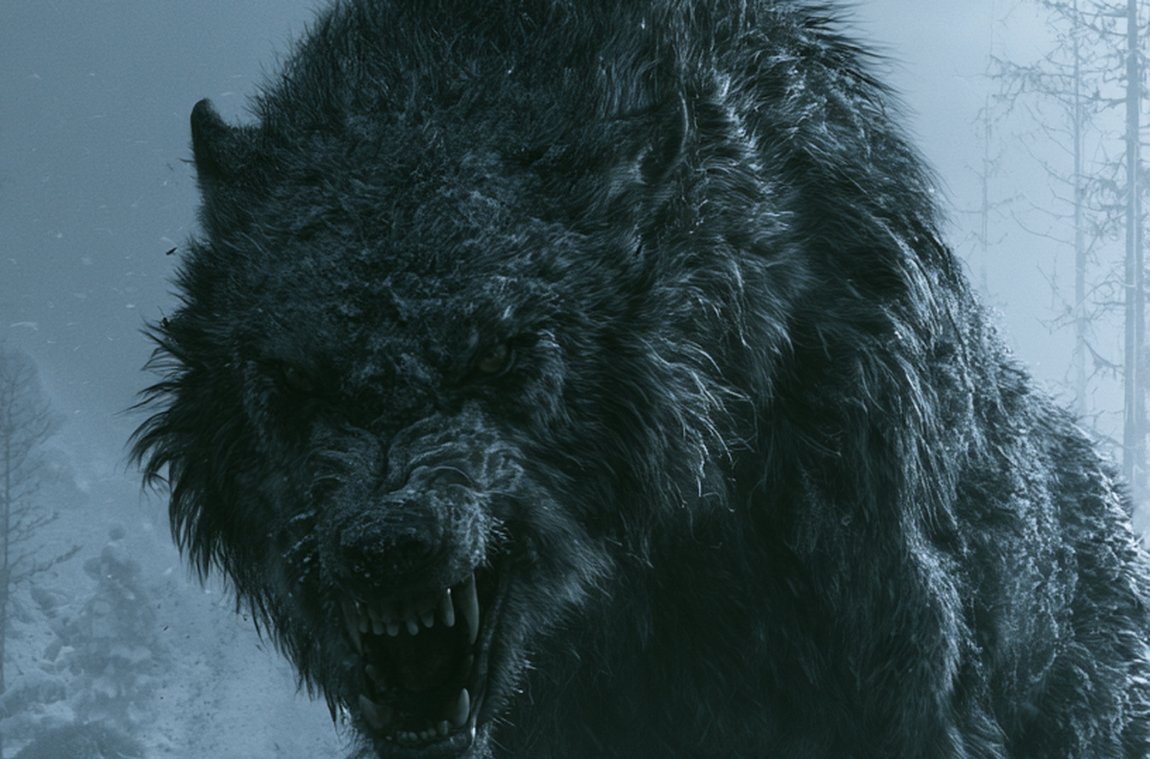
Gleipnir is the third and final fetter the gods used to bind the wolf Fenrir: a ribbon as smooth and soft as silk, made by dwarves from six things that do not exist – the sound of a cat's footfall, the beard of a woman, the roots of a mountain, the sinews of a bear, the breath of a fish and the spittle of a bird. It held where two iron chains had shattered, and it cost the god Tyr his hand. Almost everything we know comes from Snorri Sturluson in the 13th century, so let us read him closely.
Here is the problem. You need to tie up the most dangerous creature alive. You have tried the strongest iron chain your smiths could forge, and it snapped. You ordered one twice as strong, and that one lies in pieces too. Then a messenger comes back from underground and hands you something that looks like a hair ribbon.
That is exactly where the gods stand in one of the tightest stories in Norse mythology. It is told in Gylfaginning ("the beguiling of Gylfi"), the first major part of the Prose Edda, written around 1220 by the Icelandic scholar and chieftain Snorri Sturluson. In its frame story a Swedish king called Gylfi travels in disguise to the Æsir and questions three mysterious figures – High, Just-as-High and Third – about the world. Their answers are our main source for the Norse gods, and the binding of Fenrir sits in chapter 34 (numbering differs slightly between editions).
It begins with a family. Loki has three children with the giantess Angrboða: the wolf Fenrir, the Midgard Serpent Jörmungandr and Hel. Prophecies warn the gods that great harm will come to them from these siblings. Odin has the serpent thrown into the sea and sends Hel down to the underworld. The wolf, however, the Æsir keep at home and raise themselves.
Think about that for a moment: Fenrir grows up among the gods. According to Snorri, only one of them has the nerve to feed him – Tyr. The wolf grows bigger every day, and every prophecy says he is destined to destroy them. Still, they will not kill him. Snorri gives a precise reason: the gods held their sacred places and sanctuaries in such high regard that they would not stain them with the wolf's blood.
The first attempt is crude but honest. The gods have a very strong fetter made and call it Læðingr (also spelled Leyðingr or Lœðingr in some editions). They bring it to the wolf and invite him to test his strength. Fenrir looks it over, decides it is not too impressive, and lets them put it on. One heave, and Læðingr breaks.
So the gods forge a second fetter, hálfu sterkara in Snorri's words – usually understood as "twice as strong" – and name it Drómi. Once more they propose a test, once more with fame as bait: whoever breaks a chain like this will be renowned. Fenrir weighs it up. The chain is strong, but he has grown since last time, and fame, he reasons, is worth a risk. He lets himself be bound, shakes himself, dashes the fetter against the ground, strains against it, and Drómi bursts apart so violently that the pieces fly far away.
Here Snorri adds a linguistic footnote. Ever since, he says, people speak of at leysa ór Læðingi and at drepa ór Dróma – "to get loose from Læðingr", "to strike free from Drómi" – when something is achieved with enormous effort. Whether the saying is older than the story, or whether Snorri wrapped a tale around an existing idiom, nobody can tell.
Two broken chains make one thing clear: more iron will not hold this wolf. So the All-Father sends a messenger below. It is Skírnir, the servant of the god Freyr, better known as the matchmaker of the poem Skírnismál. He travels down to Svartálfaheim, the world of the dark elves, and has dwarves make a fetter there.
Gleipnir, High tells Gylfi, was made of six things. The Old Norse list runs: af dyn kattarins ok af skeggi konunnar ok af rótum bjargsins ok af sinum bjarnarins ok af anda fisksins ok af fogls hráka. In plain English:
The construction is careful. Six members, all built the same way: a thing that belongs to a creature. Cat, woman, mountain, bear, fish, bird – domestic animal, human, landscape, predator, water, air. The list walks once through the whole world.
Gangleri, as Gylfi calls himself, is sceptical, and High answers with a line that many readers love. Even if you did not know this before, he says, you can quickly find proof that you are not being lied to:
"thou must have seen that a woman has no beard, and no sound comes from the leap of a cat, and there are no roots under a mountain; and by my troth, all that I have told thee is equally true, even if there be some things which thou canst not put to the test."Gylfaginning 34, translated by Arthur G. Brodeur (1916)
Savour the logic. The proof that the dwarves used these things is that they do not exist. It is a circular argument delivered with a straight face, and Snorri knows exactly what he is doing. High belongs to a frame story that ends with Gylfi hearing a great crash and finding himself alone on open ground: the whole hall was an illusion. Snorri lets his narrators be slightly unreliable on purpose.
Many retellings turn this into a neat punchline: the dwarves used up every cat's footfall and every woman's beard, and that is why they no longer exist. Snorri never spells it out quite like that. He sets up the conclusion and leaves it to the reader, which makes the joke better, not worse.
What the dwarves deliver does not look like a weapon. Snorri describes Gleipnir as slétt ok blautt sem silkiræma – smooth and soft as a silken ribbon. Silk was a precious import in the North; strips of silk turn up as trimming on clothing in rich Viking-age burials such as those at Birka and in the Oseberg ship. To Snorri's audience a silkiræma was something fine, delicate and expensive – the very opposite of a chain.
When the messenger returns, the gods ask whether the thing is any good. He assures them it is strong. Then they take the wolf out to test it.
For the third trial the gods choose a special place. They take Fenrir out onto the lake Ámsvartnir to an island called Lyngvi. The lake's name is usually explained as "pitch-black" or similar; Lyngvi fits nicely with Old Norse lyng, "heather" – a heather island. Both readings are plausible, neither is certain.
Rudolf Simek suggests that Snorri may have invented the lake, since it appears in no other source.
On Lyngvi the Æsir show the wolf the silken band. They pass it from hand to hand, pull with all their might, and it does not tear. But you, they tell the wolf, would surely break it. Fenrir is no fool.
Fenrir's reply is one of the sharpest speeches in the whole of Gylfaginning. In Brodeur's translation he says he "shall get no glory of it, though I snap asunder so slender a band", but if it is made with cunning and wiles, then, little as it looks, that band will never come upon his feet.
The gods press on. A wolf who has burst such great iron chains will surely manage a silk ribbon – and if he cannot, he has nothing to fear from the gods, because they will set him free. Fenrir does not believe them. He knows his hosts. If they bind him, he says, he will be waiting a long time for their help. But he does not want to look like a coward either. So he names a condition: one of you puts a hand in my mouth, as a pledge that this is done without deceit.
The Æsir look at one another. Snorri lets the moment hang: nobody wants to give up a hand. Then Tyr raises his right hand and lays it in the wolf's jaws.
The binding begins. Fenrir strains against the band as he did against Læðingr and Drómi. But the harder he struggles, the harder Gleipnir becomes and the tighter it cuts. He cannot get free. And the gods laugh – all of them except one.
"Then all laughed except Týr: he lost his hand."Gylfaginning 34, translated by Arthur G. Brodeur (1916)
Snorri returns to the scene in an earlier chapter (Gylfaginning 25), where he calls Tyr the boldest of the gods and says the place where the wolf bit off the hand has been called úlfliðr, "wolf-joint", ever since – the Old Norse word for wrist. He adds that Tyr is not called a reconciler of people. A god who guarantees an agreement with his own body while knowing it will be broken is a bitter figure indeed.
Lokasenna survives in a manuscript from around 1270; many scholars think the poem is older than Snorri's Edda, though its date is disputed. Either way it shows that the bound wolf waiting for Ragnarök and the one-handed Tyr were things a poet could assume his audience knew. In the same poem Freyr threatens Loki (st. 41): he sees a wolf lying at the river's mouth until the gods are destroyed – and Loki will soon be bound as well. Another clear nod to Fenrir's fetter.
From Gleipnir runs a cord or rope called Gelgja. The gods thread this rope through a great stone slab called Gjöll and sink the slab deep into the earth. Then they take a huge rock, Þviti, and drive it even further into the ground, using it as the anchoring peg.
The names speak, although not every interpretation is secure. Gjöll is related to a verb meaning "to resound, to yell", and it is also the name of the river at the border of the underworld, crossed by the bridge Gjallarbrú. Þviti is often explained as "the striker" or "the hammerer". For Gelgja you will find renderings such as "fetter" or "rope", but there is no secure etymology. We leave it at that.
The bound wolf gapes and snaps at the gods. So they thrust a sword into his mouth: the hilt against the lower jaw, the point against the palate. Snorri calls it his gómsparri, his "gag" or palate-prop. Ever since, the jaws have stood open.
The wolf howls horribly, and slaver runs from his mouth. It becomes a river called Ván. And there, Snorri concludes, he lies until ragnarøkkr, the twilight of the gods.
Ván (also written Vón) means "hope, expectation" in Old Norse. From this river Fenrir takes the poetic name Vánargandr, "monster of the Ván", and kennings call Loki "father of Vánargandr". A river named Hope flowing out of the propped-open jaws of the world's enemy: it is one of the strongest images in the Edda, and Snorri spends two sentences on it.
Some reference works and retellings speak of two rivers, Ván and Víl, where víl could be rendered as "misery, toil" – hope and misery pouring from the same mouth. It would make a fine pair of opposites. The standard editions of Gylfaginning we checked, however, name only Ván. We could not securely trace Víl to a manuscript reading, so we mention it as a pointer, not as evidence.
With so many telling names around it, you naturally ask: what does Gleipnir itself mean? The honest answer is that nobody knows for sure.
Rudolf Simek's dictionary gives "the open one". Andy Orchard's Dictionary of Norse Myth and Legend also offers "open one" and adds possibilities such as "the entangler". Others connect the word with forms meaning "to glide, to be smooth", which would suit a smooth silken ribbon. None of these is proven.
After the death of King Hákon the Good (around 961) the Norwegian skald Eyvindr skáldaspillir composed the memorial poem Hákonarmál. Its last stanza says, in effect, that the Fenris wolf will go unbound against the dwellings of men before a king as good as Hákon takes his place. That only works if the wolf is bound now. A few years earlier, after the death of Eric Bloodaxe (954), the poem Eiríksmál has the hero Sigmund ask Odin why he took King Eric so early, and Odin replies, roughly, that one can never know when the grey wolf will come for the seats of the gods. Gleipnir is not named, but the bound wolf waiting for his day plainly is there.
Viking-age stone carving knows the wolf who swallows Odin, and the god who tears his jaws apart. On Thorwald's Cross on the Isle of Man and the Gosforth Cross in Cumbria the events of Ragnarök are carved in stone. The binding itself is not shown there, but what it leads to is. The Eddic poem Vafþrúðnismál (st. 53) says the wolf will swallow the father of men and Víðarr will avenge him, and in Völuspá Odin's fight with the wolf is a centrepiece of the end times.
Gleipnir is often called "unbreakable". That holds only for a while. Snorri says explicitly that the wolf lies there until Ragnarök. In his account of the end of the world (Gylfaginning 51) Fenrir breaks loose. He advances with jaws agape, the upper jaw against the sky and the lower against the earth – he would open them wider if there were room. He swallows Odin. Then Odin's son Víðarr sets one foot on the wolf's lower jaw, seizes the upper jaw and tears the mouth apart.
Notice the mirror image. The gods' sword held the wolf's jaws open. In the end those jaws swallow the father of the gods, and they in turn are wrenched apart by force. Gleipnir bought the world time. Nothing more.
The power of the impossible. The list of six ingredients recalls a rhetorical figure called adynaton: a catalogue of impossibilities, common in many literatures and often used in oaths ("sooner will rivers run uphill than…"). Gleipnir turns the principle inside out: from nothing but impossibilities comes something that works. What has no mass cannot be torn. The less tangible the material, the tighter the bond. The Æsir win not by force but by stepping around the rules of the world.
Binding as magic. Binding has a magical side in Germanic tradition. In the first of the Merseburg Charms (in a 10th-century manuscript) divine women, the Idisi, fasten fetters and pick at bonds to loosen them. Sagas also know the herfjöturr, the "war-fetter", a paralysing rigidity that seizes fighters in battle. Against that background it makes sense to read Gleipnir as a spell as much as a piece of craftsmanship: it is made by beings from below the earth, out of hidden things, and it grows stronger the more you resist it. That is magic, not mechanics.
The broken oath. The most influential reading is probably that of the French scholar of religion Georges Dumézil. He saw Tyr as a god of law and contract and read the binding as the story of a false pledge: Tyr guarantees with his hand a promise he knows will be broken. Many of Dumézil's comparative theories about Indo-European gods are contested today, but the core observation stands: at the foundation of the divine order lies a deception, and one god pays for it with his body. That suits a god whom Snorri expressly declines to call a reconciler.
In our workshop in Alsdorf near Aachen we are often asked for motifs for couples, families and friendships. Gleipnir is an unusual but lovely idea for that: a bond that holds not by weight but by what you cannot see. A bond that grows tighter the harder anything pulls at it.
What is Gleipnir in Norse mythology? Gleipnir is the magic fetter the gods used to bind the wolf Fenrir. Dwarves made it from six impossible things; it was as thin as a silk ribbon and holds the wolf until Ragnarök.
What is Gleipnir made of? According to Snorri, the sound of a cat's footfall, the beard of a woman, the roots of a mountain, the sinews of a bear, the breath of a fish and the spittle of a bird.
What were Fenrir's other chains called? The first was Læðingr, the second, twice as strong, was Drómi. Fenrir broke both.
Why did Tyr lose his hand? Fenrir would only let himself be bound if a god put a hand in his mouth as a pledge. Tyr did, and when the wolf could not break free, he bit it off.
Where is Fenrir bound? On the island Lyngvi in the lake Ámsvartnir. The fetter is anchored deep in the earth through the slab Gjöll and the rock Þviti, and a sword props his jaws open.
Does Gleipnir ever break? Yes. At Ragnarök Fenrir breaks free, swallows Odin and is killed by Víðarr.
For courage. For remembrance. For legends that live on.
The Fenris-wolf · Tyr · The Dwarves · Ragnarök.
A king has gold and peace ground for him – and grants the maids who turn the mill no rest. Grottasöngr is one of the …
Read more →A boar whose bristles are gold and glow in the dark, running over sky and water faster than any horse: Gullinbursti …
Read more →Thor has his hammer, Freyr his ship – and Odin has the spear. Gungnir is the weapon of the All-Father: forged by …
Read more →The mead of poetry turns anyone who drinks it into a poet or sage. It lies deep in the mountain, guarded by the giant's …
Read more →