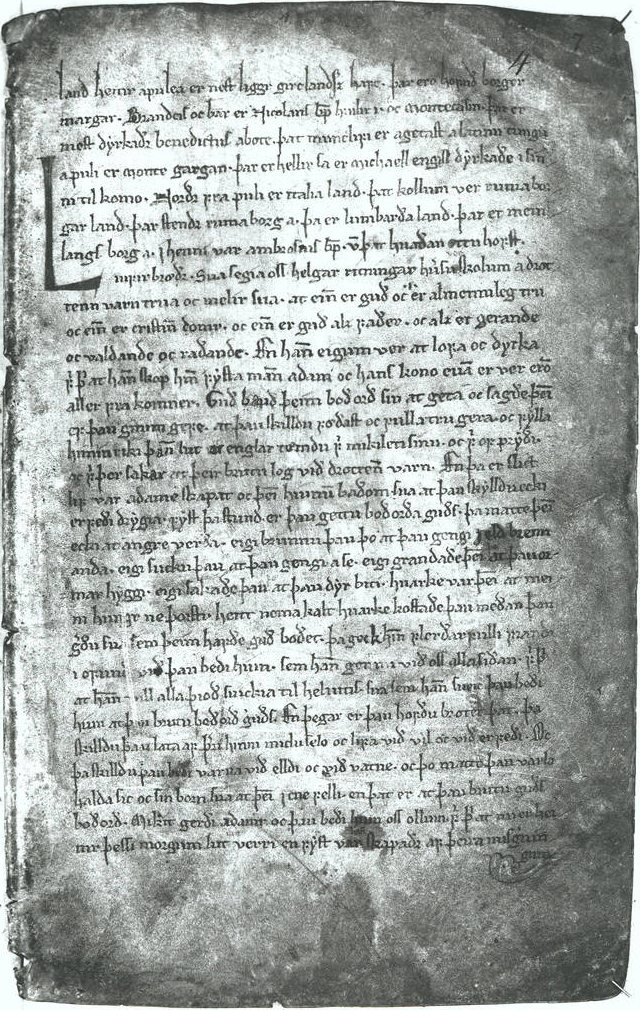
Almost everything we think we know about the Norse order of the world hangs on a single poem of some sixty stanzas. It stands first in the most important manuscript of eddic verse, and it is spoken not by a god but by a seeress whom Odin has summoned. She tells him the world from its first morning to beyond its end: creation, a golden age, the first war, the death of Baldr, the fire that takes everything, and the green earth that rises afterwards. And she does it in a tone that suggests she knows exactly how little he will enjoy the closing stanzas.
Völuspá, "the seeress's prophecy", opens the Codex Regius and is the only eddic poem that carries a single arc from beginning to end and out the other side. The poem never names its speaker. She is a völva, a seeress, and in the very first stanza she calls her audience to order.
Hljóðs bið ek allar helgar kindir,
meiri ok minni mögu Heimdallar
"I ask for a hearing from all holy kindreds, the greater and the lesser, the sons of Heimdallr."Völuspá, stanza 1 (numbering as in the standard editions); English rendering our own
"Sons of Heimdallr" means human beings. So she is not addressing Odin alone; she speaks over his head to everyone. Immediately afterwards she states her credentials: she remembers giants born before the world, and nine worlds. She is older than what she describes.
The poem is in fornyrðislag, the terse alliterative metre of narrative verse, and it works by repetition, like a song. A refrain about the hound Garmr howling before the cave Gnipahellir cuts across the flow of the stanzas again and again. This is not a chronicle. It is a spoken performance with a sense of timing.
It begins with emptiness. No earth, no sky, no grass – only Ginnungagap, the yawning void. Then the sons of Burr raise the lands, sun and moon find their places, the gods give names to the parts of the day. How the world was made from Ymir's body is not actually spelled out here; that comes from Snorri, drawing on other poems.
Then the golden age. The gods build on the field Iðavöllr, they forge, they raise halls, and they play with golden gaming pieces in the grass. They lack nothing. The age ends when three giant maidens come out of Jötunheim. What they do, the poem does not say. Only that nothing is the same afterwards.
Then the first war. A figure called Gullveig is pierced with spears in Odin's hall and burned three times – and three times comes back to life. Afterwards she is called Heiðr and travels the land as a worker of magic. Odin hurls his spear into the host, the wall of the gods' stronghold breaks, and the war between Æsir and Vanir begins. The poem calls it the first war in the world.
Next: Baldr's death. The seeress foresees the fate of the god, the mistletoe that becomes a weapon, the blind Höðr as the instrument, and the avenger who goes to battle one night old. Four or five stanzas, no more. Everything else – the mourning, the funeral, the ride to Hel – comes from other sources.
From here the poem tips over. It begins listing signs: brothers killing brothers, the cock crowing, the fetters breaking. The seeress moves from memory into prophecy.
Bræðr munu berjask ok at bönum verðask,
munu systrungar sifjum spilla;
skeggöld, skálmöld, skildir ro klofnir,
vindöld, vargöld, áðr veröld steypisk
"Brothers will fight and become each other's killers, sisters' sons will break the bonds of kinship; axe-age, sword-age, shields are split, wind-age, wolf-age, before the world topples."Völuspá, stanza 45; English rendering our own
That run of compounds – axe-age, sword-age, wind-age, wolf-age – is one of the few passages of Old Norse verse that lands without any commentary at all. Four words, and the picture is there.
We are not retelling the end of the world here; we have a separate article on Ragnarök. What matters is how Völuspá positions it: not as a catastrophe at the edge of the story but as the goal of the whole poem. And it supplies images that survive nowhere else in this form.
Sól tér sortna, sígr fold í mar,
hverfa af himni heiðar stjörnur;
geisar eimi ok aldrnari,
leikr hár hiti við himin sjalfan
"The sun begins to blacken, the land sinks into the sea, the bright stars vanish from the sky; steam rages and the life-feeder, high heat plays against heaven itself."Völuspá, stanza 57; English rendering our own. Aldrnari, "feeder of life", is a kenning for fire.
And then the poem does not stop. The seeress sees a second earth rise from the sea, green, with waterfalls falling and an eagle hunting fish above the cliffs. The surviving Æsir find in the grass the golden gaming pieces they had lost in the golden age. Baldr returns. What becomes of that new world we have treated separately: What comes after Ragnarök?
The final stanza of the Codex Regius version, however, is no redemption. It shows the dark dragon flying up from the Niðafjöll with corpses in his feathers. Then the seeress breaks off. Scholars have been arguing about that ending for more than a century.
Between the golden age and the first war sits a block of six or seven stanzas that sounds unlike anything around it: the Dvergatal, the catalogue of dwarfs. The gods take counsel about who shall shape the dwarfs; Mótsognir becomes the greatest of them, Durinn the second. Then come names. Dozens of names, recited in rows, with no action at all.
Many editors regard the block as an insertion. It interrupts the narrative, it repeats itself, and it reads like a free-standing mnemonic poem that someone dropped into Völuspá. That is not certain either – catalogues of this kind belong to eddic verse. If you want more on these beings, we have an article on the dwarfs.
One side effect of the Dvergatal is familiar to almost everyone today without their knowing it. J. R. R. Tolkien, a philologist by trade, helped himself to the list: Þorinn, Fíli, Kíli, Óinn, Glóinn, Dvalinn, Bifurr, Bafurr, Bömburr – and, three lines further on, Gandálfr. The dwarves of The Hobbit carry the names of a thirteenth-century stanza sequence.
Völuspá survives in three shapes, and none of them agrees with the others.
The Codex Regius (shelfmark GKS 2365 4to) was written in Iceland in the 1270s and has Völuspá as its opening piece, counted there as 62 stanzas. The manuscript was long thought lost; in 1643 Brynjólfur Sveinsson, bishop of Skálholt, found it, in 1662 it went to the Danish king as a gift, and only on 21 April 1971 did it return to Reykjavík. Without that one volume we would know a fraction of what we know about Norse myth.
Hauksbók (AM 544 4to), compiled by the Icelandic lawspeaker Haukr Erlendsson in the early fourteenth century, carries a markedly different version in 59 stanzas. It lacks the explicit account of Baldr's death, and the order of stanzas diverges in several places. On the other hand it has a stanza the Codex Regius does not: there inn ríki, "the mighty one", comes from above to judgement, "who rules over all". Who is meant is still being discussed.
Snorri Sturluson quotes many Völuspá stanzas in the Gylfaginning of his Prose Edda around 1220 – in readings that match neither the Codex Regius nor Hauksbók exactly. He evidently knew a third version. In at least one place that is pure luck: what happens to Thor against the Midgard serpent is fuller in his text than in the poetic manuscripts.
Modern editions assemble a text from all three, arriving since Sophus Bugge at 66 stanzas; the manuscripts count differently. That is convenient and also a problem: the text we read today is a nineteenth- and twentieth-century construction. Nobody in the Middle Ages knew it in that form. How the eddic tradition came down to us at all we have written up in our article on the Edda.
The manuscripts are Christian, Icelandic, thirteenth and fourteenth century. The poem is older – but how much older is the question.
The nineteenth century liked very early dates. In the twentieth, most scholars followed Sigurður Nordal, who placed composition around the year 1000, in the decades of Iceland's conversion, and connected the apocalyptic imagery with the mood of those years. Others push back into the tenth century. Sveinbjörn Rafnsson argued in 1999 for the twelfth. John McKinnell objects that Snorri would hardly have leaned so heavily on a poem he considered recent.
The language argues for age. The logic of transmission argues for caution: at least two and a half centuries of oral transmission lie between composition and the first writing down. What was added, lost or shifted in that time cannot be unpicked.
Ever since Sophus Bugge argued in the late nineteenth century that Norse mythology was largely built from Christian and classical material, Völuspá has been the main battlefield of that debate.
The candidates are quickly named. A seeress announcing the end of the world recalls the sibyls of the Latin tradition – Ursula Dronke and Kees Samplonius pointed to the Cantus Sibyllae. The world fire recalls the Last Judgement; in 1969 Wolfgang Butt traced the Ragnarök passages back to Old English homiletic writing, above all to Wulfstan of York – a derivation that has not carried the field. And the Hauksbók stanza about the mighty one coming from above to judgement reads to some like the Second Coming.
Against that: much of Völuspá has no Christian counterpart at all. The wolf that swallows the sun, the world tree, the norns, a first war between two families of gods – none of that is biblical material. McKinnell reckons that perhaps twenty stanzas show Christian influence and describes the poet as Christian-influenced but not Christian. That probably catches it: a poem from the turn of an age, by someone who knew both worlds.
Anyone who wants a clean answer will not get one. The honest position: Christian influence on individual images is likely, its extent is disputed, and not one single case is compelling on its own.
In 2018 a team led by Clive Oppenheimer published a study of the Eldgjá eruption in Climatic Change. Ice-core and tree-ring data date this enormous eruption in southern Iceland to the spring of 939 and at least into the autumn of 940. The authors relate it to the stanzas about the darkened sky: a memory of a real catastrophe, turned into verse a generation later and – this is the further claim – deployed in the struggle over Iceland's conversion.
It is an attractive idea, and the dating of the eruption is solid. The step from there to the poem is not. A blackened sun, falling stars and fire reaching the sky are images that occur in apocalyptic poetry across several cultures. We regard it as a well-argued suggestion, no more.
Manuscript evidence means three divergent versions: Codex Regius (1270s, 62 stanzas), Hauksbók (early fourteenth century, 59 stanzas) and the stanzas quoted in Snorri's Gylfaginning (c. 1220).
Contemporary Viking Age evidence for the poem: none. No manuscript and no runic inscription transmits it. Individual Ragnarök motifs can, however, be traced independently in stone – on the Gosforth Cross and Thorwald's Cross, for instance.
Later tradition is the prose frame the thirteenth century built around the myths, Snorri's ordering hand, and the so-called "short Völuspá" embedded in Hyndluljóð, a younger poem of similar shape.
Modern interpretation covers datings from 900 to 1150, the extent of Christian influence, the reading of the Dvergatal as an insertion, the Eldgjá thesis – and not least the composite 66-stanza text we now quote as a matter of course.
What remains is a poem in which a woman tells a god how he will end and does not spare him a syllable. The norns beneath Yggdrasil, the first war, the world fire, the green earth afterwards: much of what passes today as "Norse mythology" hangs on these sixty stanzas. For courage. For memory. For legends that live on.
Snorri Sturluson · The Norns · Yggdrasil – the world tree · Ragnarök · Hávamál – Sayings of the High One · The Dwarves.

