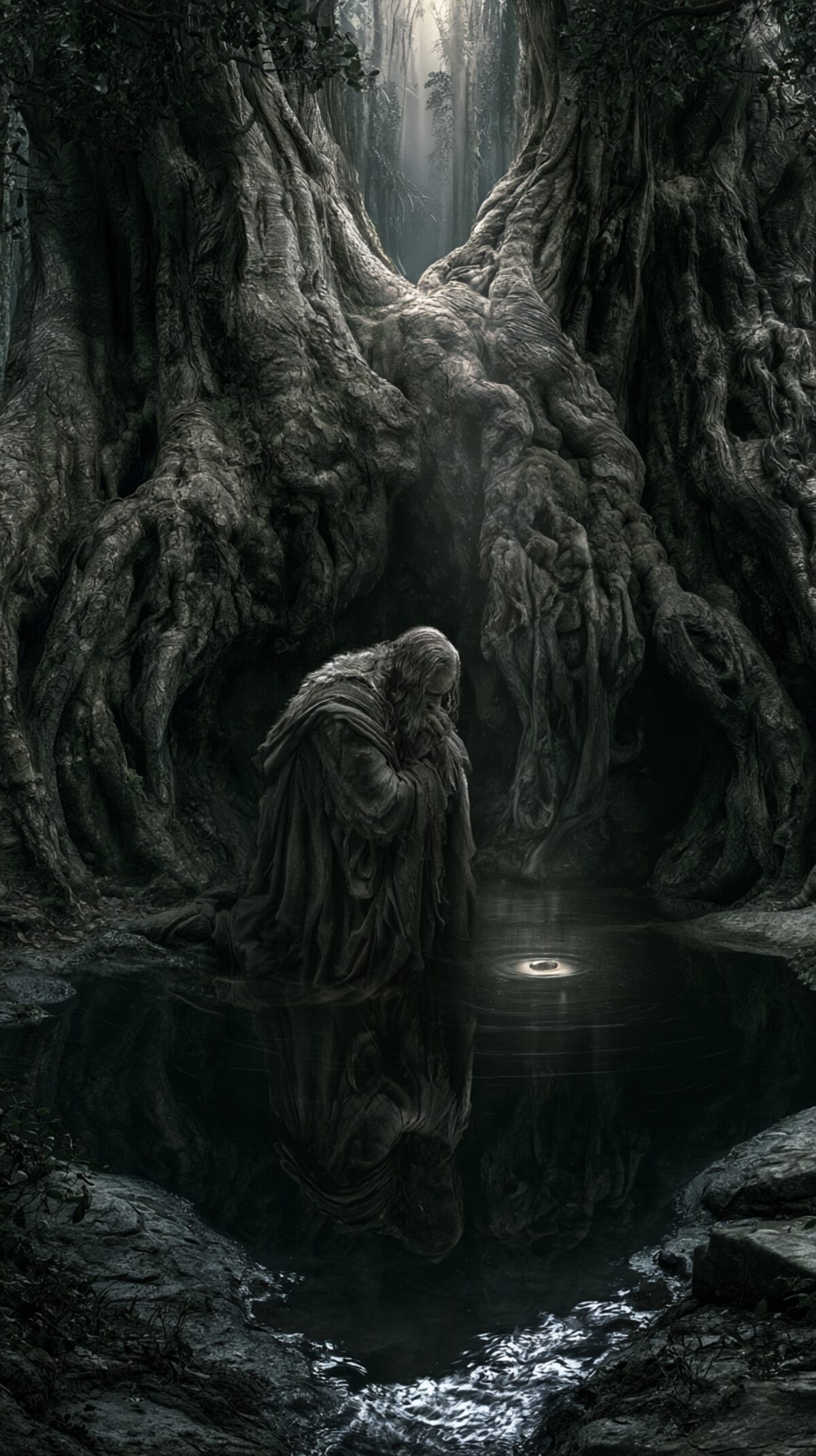
The Merseburg Charms are two Old High German magic spells written into a blank page of a church manuscript in the 10th century: a release charm in which women called the Idisi loosen fetters, and a healing charm in which the god Wodan sings a horse's dislocated leg back into place. The page is still in Merseburg Cathedral Library (Cod. 136, fol. 85r). Below you get both texts complete in the original and in our own translation, the story of their discovery, and the big open questions: who is Phol, and is Balder a god or just a "lord"?
Picture a scribe in the 10th century, bent over a priest's mass book. It is full of prayers, mass texts and a baptismal vow in which converts renounce the devil and all his works. Near the end there is some free space. And there, of all places, he writes down two short spells in which Wodan rides into the woods, Frija sings over a lame foal and ghostly women tear at a warrior's bonds. Later, another hand adds a Latin prayer underneath.
We do not know why he did it. But without that moment we would have no Old High German text at all in which pagan gods appear and act in their own story. The Merseburg Charms are not a myth retold centuries later by a learned antiquarian. They are working texts, meant to be spoken aloud, with divine names in the language of the people who called on them. Let's walk through both, line by line, and see where scholars agree and where they have been arguing for 180 years.
The charms are found in manuscript Cod. I 136 of the Domstiftsbibliothek, the cathedral chapter library of Merseburg in Saxony-Anhalt, on folio 85 recto (84r in the older pencil numbering Jacob Grimm used). The book itself is a sacramentary, a liturgical volume holding the priest's prayers for mass, and dates from the 9th century. It was most likely written at the monastery of Fulda.
The charms are a later addition. The palaeographer Bernhard Bischoff dated the entry to the first or second third of the 10th century. Because the handwriting does not match the Fulda style, scholars assume the scribe copied the spells from an older exemplar. The texts themselves may therefore be considerably older than this copy – how much older, nobody can say.
The setting has a delicious irony. On folio 16r of the very same book stands the so-called Frankish Baptismal Vow, the formula by which new Christians renounced the devil and his works. A few dozen leaves later, Wodan rides into the forest. For the wider picture of this age of conversion, see our article on the Christianisation of the Germanic peoples.
For about nine centuries nobody paid attention to those two blocks of text. In 1841 the young historian Georg Waitz was working through the Merseburg holdings while searching for medieval historical sources. He recognised that he had found something unusual and passed it on to Jacob Grimm.
Grimm, the elder of the famous brothers, had spent years assembling his "Teutonic Mythology" from scraps: place names, weekday names, church penitentials, folk customs. Now here was a text that simply named Wodan and Frija. In 1842 he published the find under the title "Über zwei entdeckte Gedichte aus der Zeit des deutschen Heidentums" ("On two discovered poems from the time of German paganism"). His readings still shape the debate, even where scholars now disagree with him. More on Grimm as a collector of myths in our piece on the Brothers Grimm.
Here is the usual normalised text. The manuscript itself runs words together and has no length marks; normalisation makes it readable but involves a little interpretation.
Eiris sâzun idisi, sâzun hêra duoder.
suma hapt heptidun, suma heri lêzidun,
suma clûbodun umbi cuoniouuidi:
insprinc haptbandun, invar vîgandun!First Merseburg Charm, Old High German, 10th century (public domain)
Once the Idisi sat, sat here and there.
Some fastened fetters, some hindered the host,
some tugged at the bonds:
Leap out of the fetters, escape from the foes!Our own translation, Glanz & Gravur
A few words need unpacking. Eiris means "once", opening the spell like "once upon a time". Idisi is the plural of a word for "woman", probably "noble woman", related to Old English ides, which Beowulf uses for queens and high-born ladies. Hapt is a fetter, heri an army or host. The hardest word is cuoniouuidi: its second part, widi, means a withy or rope; the first part is uncertain. Most editions settle for "fetters" or "bonds".
The last line is the actual command. Haptbandun ("bonds") and vîgandun ("foes") chime at the end – a compact, memorable formula, made for whispering.
The Idisi are the riddle at the heart of the first charm. The text only tells us what they do. Everything else is interpretation, and scholars offer several options.
Valkyrie-like battle women. Grimm already linked them to the Norse valkyries, the women who, according to the Edda and skaldic verse, decide victory and death in battle. The fetters, the host and the foes certainly suggest a war scene. Wolfgang Beck, author of the standard monograph on the charms (2003), rejects a straight equation, however: the valkyries come to us centuries later and from a different culture.
Dísir and mother goddesses. Others connect the Idisi with the Norse dísir, female guardian spirits, or with the Matronae, the goddesses usually shown as a trio on Roman-era altars along the Lower Rhine. Gerhard Eis even read duoder as a miswritten muoder ("mothers") and saw the three groups of "some … some … some" as three divine companies. Elegant, but not compelling. Our article on the Matronae of the Rhineland shows what we actually know about them.
Human women. A sober reading takes the Idisi simply as noble women. Linguistically that is possible, but the magical frame leads most scholars to think of supernatural beings.
What is the first charm supposed to do? The last line leaves no doubt: "leap out of the fetters, escape from the foes". A captive is to be set free. Scholars therefore call it a release charm, in German a Lösesegen.
The middle is trickier. One group of Idisi fastens fetters, the second "hinders the host" (lêzidun, from a verb meaning to hold back), the third tugs at the bonds. Only the third group frees anyone. The other two seem to work on the other side, binding enemies and paralysing an army.
This is where the Norse war-fetter enters. Old Norse has the word herfjǫturr, literally "army-fetter", a sudden paralysis that grips a warrior in battle. In the list of valkyrie names in the Eddic poem Grímnismál (stanza 36), Herfjǫturr even appears as a valkyrie's name. Some scholars therefore read the Merseburg charm as evidence for a shared Germanic belief in battle women who could fetter or free fighters by magic. Others find the link too thin: one valkyrie name recorded in 13th-century Iceland does not automatically explain a spell from 10th-century Francia.
Grimm also pointed to a story from England. Bede tells in his Ecclesiastical History (book IV, chapter 22) of a young warrior named Imma, taken prisoner after a battle in 679. His fetters kept falling off – because, says Bede, his brother, an abbot, was saying masses for him. The puzzled captor asked whether Imma carried litteras solutorias, "loosening letters", about him; the Old English version of Bede speaks of a "loosening rune". The idea that words could break bonds was clearly familiar in the early medieval West – and the Church told it with its own spin.
The second charm is the famous one. Here is the normalised text:
Phol ende Uuodan uuorun zi holza.
dû uuart demo balderes uolon sîn uuoz birenkit.
thû biguolen Sinthgunt, Sunna era suister;
thû biguolen Frîia, Uolla era suister;
thû biguolen Uuodan, sô hê uuola conda:
sôse bênrenki, sôse bluotrenki,
sôse lidirenki:
bên zi bêna, bluot zi bluoda,
lid zi geliden, sôse gelîmida sîn.Second Merseburg Charm, Old High German, 10th century (public domain)
Phol and Wodan rode to the wood.
Then Balder's foal sprained its foot.
Then Sinthgunt sang over it, Sunna her sister;
then Frija sang over it, Volla her sister;
then Wodan sang over it, as well he knew how:
be it sprain of bone, be it sprain of blood,
be it sprain of limb:
bone to bone, blood to blood,
limb to limbs, as if they were glued.Our own translation, Glanz & Gravur
The verb biguolen deserves a closer look. It comes from Old High German galan, "to sing, to chant a spell" – the same root as Old Norse galdr, a magic song, and the "-gale" in English "nightingale", the night-singer. The gods do not splint the leg or apply herbs; they sing it whole. Healing happens through the right words in the right voice. The same idea lies behind the spell-songs Odin lists in the Hávamál, which we have gathered in our article on the Rúnatal. And Old High German bên means "bone", as in the English cognate.
What makes the second charm unique is its cast. Six names appear in nine lines, more than in any other Old High German text.
Wodan is certain: the West Germanic name of the god the North knew as Odin. That he of all gods masters the healing spell, "as well he knew how", fits his Norse image as lord of spell-songs, runes and hidden knowledge. More in our articles on Odin and, for the continental form, Wodan, Donar & Ziu.
Frija is equally secure. She corresponds to Norse Frigg, Odin's wife, and to Frea among the Lombards. The Merseburg charm is one of the oldest sources showing her as an active goddess. Her full portrait is in our articles on Frigg and Frija.
Volla (manuscript uolla) is called "her sister". In 13th-century Iceland, Snorri Sturluson describes a Fulla who attends Frigg as servant and confidante, wears her hair loose under a golden band and carries Frigg's casket. The name probably means "fullness". That southern Volla and northern Fulla are the same figure is very likely; what changed is that the "sister" became a handmaid.
Sunna is the sun – as a goddess. The Eddic poem Alvíssmál says the sun is called sól among men but sunna among the gods. The Merseburg charm is a key witness that the sun was also honoured as a female deity on the continent. The whole trail, from the Bronze Age to the Edda, is in our article on Sunna and Sól.
Sinthgunt (manuscript sinhtgunt) appears nowhere else. The name can be split into sinth, "path, journey", and gund, "battle". Because she is named beside the sun, some have seen in her a moon or star deity, "she who fights her way" across the sky. That remains speculation. The text is also ambiguous: "Sunna era suister" can mean Sunna is Sinthgunt's sister – or the other way round.
That leaves the two names that have caused the fiercest arguments since Grimm. The first line begins with Phol. In the manuscript there is a capital P followed by ol, with an h squeezed in above the line. Even the scribe, it seems, was not entirely sure.
None of these solutions has won the field. The honest answer to "who is Phol?" is: we don't know.
The second line is just as slippery: demo balderes uolon, "to Balder's foal". Read Balder as a name, and here is the god the Edda calls Baldr – Odin's shining son, whose death shakes the world of the gods. It would be the only evidence for Balder as a god on the continent. His Norse story is in our article on Balder.
The problem: no god Balder is attested anywhere else in the West Germanic languages. There is, however, a word that can mean "lord, prince" – Old English bealdor is used that way, and in Old Norse poetry baldr can also simply mean "lord". Then the line would read "to the lord's foal", and the lord would be Phol or Wodan himself.
Both readings carry weight. One gains a precious early witness to Balder outside Iceland; the other avoids a one-off with no parallel. Many editions therefore deliberately print it lower-case: balderes.
Both charms follow the same blueprint, and for the study of magic it matters as much as the divine names. First comes a narrative part, a little episode from mythic time: the Idisi sit and act; Phol and Wodan ride, the foal is hurt, the gods sing. Specialists call this a historiola, a "little story". Then comes the actual formula, which transfers the ancient case onto the present one: "leap out of the fetters" – "bone to bone".
The logic is simple and strong: what happened among the gods back then shall happen again now. The speaker does not heal by his own power; he invokes the precedent. Notice also the escalation in the second charm: two pairs of goddesses try, and only the third attempt, by Wodan, succeeds. Threefold patterns and escalation are hallmarks of oral poetry, easy to remember and recite.
How long this blueprint lived on is shown by a Christian relative from the same period. The so-called Trier horse blessing, also Old High German and usually dated to the 10th century, follows the identical pattern: Christ and Saint Stephen come to a town, Stephen's horse falls ill, Christ heals it – and just so, the text says in essence, may this horse be healed with Christ's help. A Lord's Prayer follows.
Two travellers, a sick horse, a divine cure, then the transfer to the case at hand. Only the cast has changed: where Wodan stood, Christ now stands, and a saint replaces Phol. Grimm suspected as early as 1842 that Christian blessings recast older pagan models. Whether Merseburg was the model or both drew on a shared tradition cannot be decided.
The recasting runs into modern times. Folklorists in Scandinavia recorded many horse charms against sprains: in a Norwegian text of 1787, Jesus heals a foal's broken leg with words like "marrow to marrow, bone to bone"; a Swedish spell of 1672 has "our Lord and Saint Peter" riding out, with "blood to blood, joint to joint". In some later Norwegian versions, Saint Olaf takes the rider's place. The rider changes; the formula stays. For an English cousin, see our article on the Canterbury charm, where Thor is called on against a wound.
An even older parallel was made famous by the 19th-century philologist Adalbert Kuhn. The Atharvaveda, an ancient Indian collection of spells and blessings, contains a healing hymn (book IV, hymn 12) for broken limbs. It invokes a healing plant, and in William Dwight Whitney's public-domain translation of 1905 it says:
Let marrow be put together with marrow, and joint together with joint; together let what of thy flesh has fallen apart, together let thy bone grow over.Atharvaveda IV, 12, trans. W. D. Whitney, 1905 (public domain)
The likeness to "bone to bone, blood to blood, limb to limbs" is obvious. Kuhn concluded that both go back to a shared Indo-European inheritance, a healing formula handed down for thousands of years in India and in Germania alike. Many scholars accept that. There are serious dissenters, though: the Indologist Klaus Mylius considered the similarities accidental. Anyone trying to heal a broken leg will almost inevitably talk about bones, blood and limbs – the formula lies in the task itself.
The truth probably lies in between. The comparison does not prove a common ancestral poem, but it does place the Merseburg charm in a widespread family of healing formulas, attested across Europe and Asia, down to Irish, Finnish and Baltic charms. How healing, herbs and spoken magic intertwined in the North is the subject of our article on Viking medicine.
Their value is hard to overstate, which is exactly why it should be stated precisely. The continent does have other witnesses to the old gods. The Nordendorf brooch from the 6th or 7th century carries a runic inscription naming Wodan and Wigiþonar (probably Donar); the Old Saxon baptismal vow makes the convert renounce Thunaer, Woden and Saxnot. Add weekday names, place names and reports by Roman and Christian writers.
But those are lists of names, brief dedications or texts written by opponents. The Merseburg Charms are the only texts in Old High German in which pre-Christian gods act within a story of their own – Wodan rides and sings, Frija and Sunna chant over a horse. No missionary is speaking about the heathens here; the users speak for themselves. Compare that with the North, where nearly everything we know about the gods comes from the Edda and Snorri, from Christian Iceland in the 13th century. The Merseburg Charms are roughly three hundred years older and come from a different world. How the Norse sources came about is explained in our article on the Edda.
That makes them a test case. When Frija as Wodan's consort, Volla/Fulla as her companion and Sunna as a goddess turn up both in Merseburg and in Iceland, it is a strong argument that Snorri did not invent these figures. The charms are a cross-check for Norse mythology.
Since Grimm, the charms have belonged in every introduction to Old High German literature; generations of German studies students have learnt "Phol ende Uuodan" by heart. Walter Benjamin took up the second charm in his short prose piece "Erzählung und Heilung" ("Storytelling and Healing"), as an example of narration itself as a cure.
Musicians have set them several times, among them the folk group Ougenweide in the 1970s and the German band In Extremo, whose track "Merseburger Zaubersprüche" came out in 1999. For an honest look at what survives of early medieval music itself, read our piece on music in the Viking Age.
The manuscript is getting fresh attention, too. In 2021 the United Cathedral Chapters of Merseburg and Naumburg and the Collegiate Chapter of Zeitz applied to have the Merseburg Charms inscribed in UNESCO's Memory of the World register. The German Commission for UNESCO backed the nomination; as far as we know, a decision is still pending.
At Glanz & Gravur we engrave many motifs from the North – runes, Odin, Yggdrasil. The Merseburg Charms are special to us because they come from the history of our own language. Read "bên zi bêna, bluot zi bluoda" aloud and you hear German as it was spoken more than a thousand years ago. And the horse in that world was far more than a beast of burden, as our article on sacred horses shows.
The Merseburg scribe was a Christian writing in a mass book, and still he chose to preserve these two old spells. Out of curiosity, practical use or respect – without him, a whole world would have fallen silent.
What are the Merseburg Charms? Two short Old High German spells from the 10th century: a release charm for captives and a healing charm for a horse's sprained leg. They are the only Old High German texts in which pagan gods act in their own story.
Where are the Merseburg Charms kept? In the cathedral chapter library of Merseburg in Saxony-Anhalt, Germany, in manuscript Cod. I 136, folio 85r. The host manuscript is a 9th-century sacramentary.
Who discovered the Merseburg Charms? The historian Georg Waitz found them in 1841. Jacob Grimm published them for the first time in 1842.
What does "Phol ende Wodan vuorun zi holza" mean? "Phol and Wodan rode to the wood." Who Phol is remains unknown: an otherwise unattested god, a male counterpart to Volla, a learned name like Apollo or Paul, or simply the foal.
Is Balder in the Merseburg Charms? Possibly. The word balderes can be read as the name of the god Balder or as "of the lord". Scholars still disagree.
Who were the Idisi? Supernatural women who, in the first charm, fasten fetters, hinder an army and loosen bonds. They are compared to valkyries, dísir or the Matronae, but no identification is certain.
For courage. For remembrance. For legends that live on.
Wodan, Donar & Ziu · Frija – Goddess of the Week · Germanic Religion · Donar · Rune magic – alu, laukaʀ and the formula words.
