Most people know the Brothers Grimm as the two kindly gentlemen behind Little Red Riding Hood and Cinderella. But that is only half the truth. Jacob and Wilhelm Grimm were two of the most important scholars of the 19th century – and their fairy tales are a window into a far older world. Do our children’s stories secretly carry the legacy of the old gods?
Jacob (1785–1863) and Wilhelm (1786–1859) Grimm published the first edition of the Children’s and Household Tales in 1812. But that was only part of their work. With his German Grammar (from 1819) Jacob Grimm founded comparative linguistics – the First Germanic Sound Shift is named after him, „Grimm’s Law", which explains why Latin pater became German Vater and English father. Together the brothers began the monumental German Dictionary (from 1838) – a work not completed until 1961, more than a century later.
They were also men of principle: as professors at Göttingen they were among the „Göttingen Seven" in 1837 who protested the king of Hanover’s breach of the constitution – and lost their posts for it. Anyone who thinks of the Grimms as mere fairy-tale uncles greatly underestimates them.
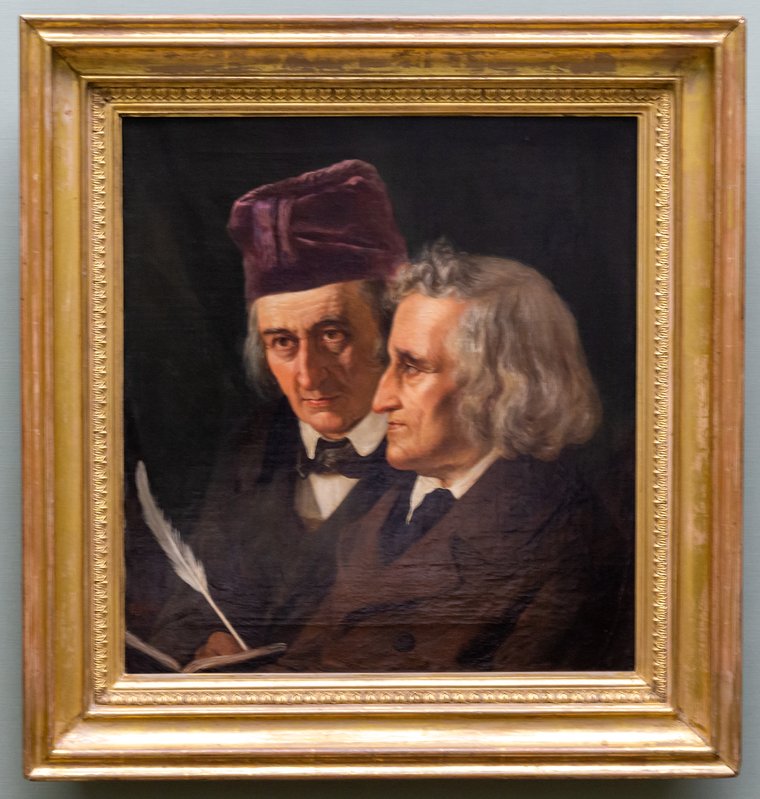
Jacob Grimm’s greatest research project was the search for the buried faith of the heathen Germanic peoples. In his Deutsche Mythologie (Teutonic Mythology, 1835) he gathered everything he could grasp: fairy tales, customs, place-names, legal formulas, „superstition". His guiding idea: after Christianisation the old gods did not vanish without a trace – they sank down into folk tale, rural custom and turn of phrase. What was once a god lives on as a fairy, a witch, a „wise woman". This „myth school" shaped folklore studies for generations.
And indeed, astonishing traces can be found in the tales:
Frau Holle is the clearest case: behind the fairy-tale granny who makes it snow by shaking her beds stands the goddess Holda/Holle, whose worship was branded superstition by the Church as early as around the year 1000. More on this in our article Frau Holle, the Elder Tree and the Old Goddess.
Sleeping Beauty, the princess asleep behind a hedge of thorns, is the tamed sister of the valkyrie Brynhild, who – bound by Odin’s sleep-thorn – sleeps behind a wall of fire until a fearless hero wakes her. The Grimms knew this parallel and even used it as an argument to include Sleeping Beauty as a „genuinely German" tale. We tell the whole saga in Sigurd, Brynhild & the Nibelungs.
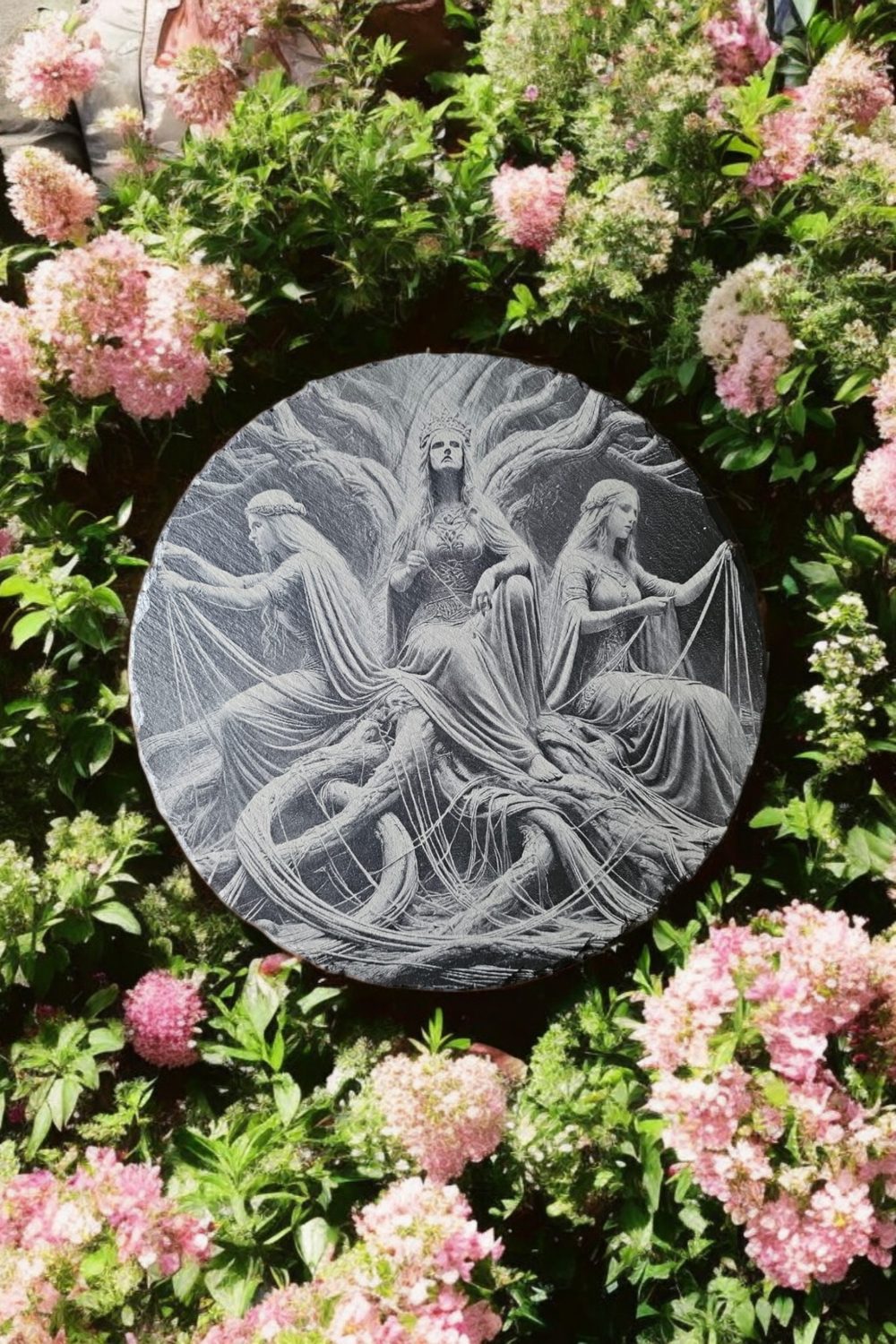
Add to this the spinning women (Frau Holle, Rumpelstiltskin, the Norns at the thread of fate), the mysterious wanderers and old men in whom some see a faded Wodan, and the Wild Hunt that haunts legend and custom.
The honest answer is: partly yes. Anyone who heard Frau Holle, Sleeping Beauty or the spinning king’s daughter as a child unknowingly absorbed ancient motifs whose roots reach into pre-Christian times. The Germanic faith was never simply „deleted" – it disguised itself in images and figures that survived all the way into our nurseries. That is exactly what gives the tales their depth: beneath the harmless surface shimmers a far older layer.
Even so, one must not overstate it, and today’s scholarship is far more cautious than Jacob Grimm. Two points matter:
First, Grimm’s thesis that all fairy tales are „faded Germanic myths" went too far. Many tales are international: the same story types occur from India to Ireland, they travelled across language borders, and some material entered late or from literary sources (such as the Frenchman Perrault). Not every fairy is a fallen goddess.
Second, the Grimms were not pure recorders. Wilhelm in particular reworked the texts heavily across seven editions: he smoothed the style, removed coarse and sexual content, added Christian-moral tones and shaped the collection into a deliberately „German" national work of Romanticism. The Children’s and Household Tales are therefore not an untouched folk document but also a crafted work of art with a political message.
Frau Holle & the goddess Holda · The Sleep Thorn · Sigurd, Brynhild & the Nibelungs · The Merseburg Charms · Nerthus.
Jacob Grimm, Deutsche Mythologie (1835, public domain) & Deutsche Grammatik; Brothers Grimm, Children’s and Household Tales (public domain); scholarship on tale types (Aarne-Thompson-Uther) and the editorial history of the KHM; Rudolf Simek, Dictionary of Northern Mythology. Image: Elisabeth Jerichau-Baumann (1855), public domain (Wikimedia Commons).
She enters Odin's hall, is pierced with spears and cast three times into the fire – and rises three times again …
Read more →The god Freyr stood for fertility, harvest and peace. Two very different sources show what his cult could look like in …
Read more →Two curved horns, a fierce beard, a mead horn in the fist – that is the Viking of nearly every film, every carnival …
Read more →A heavy grey slab covered in a long line of runes, dug out from under the roots of an aspen tree in Minnesota. The …
Read more →