Two short stanzas, scribbled onto a blank page of a church book – and yet the most precious record we have of the heathen Germanic faith in the German language. The Merseburg Charms are a window into a world the Church thought it had long erased.
They are unique: the only surviving texts in Old High German in which the old gods are still named and still act – Wodan, Balder, Frija. No other German text of the age does this.
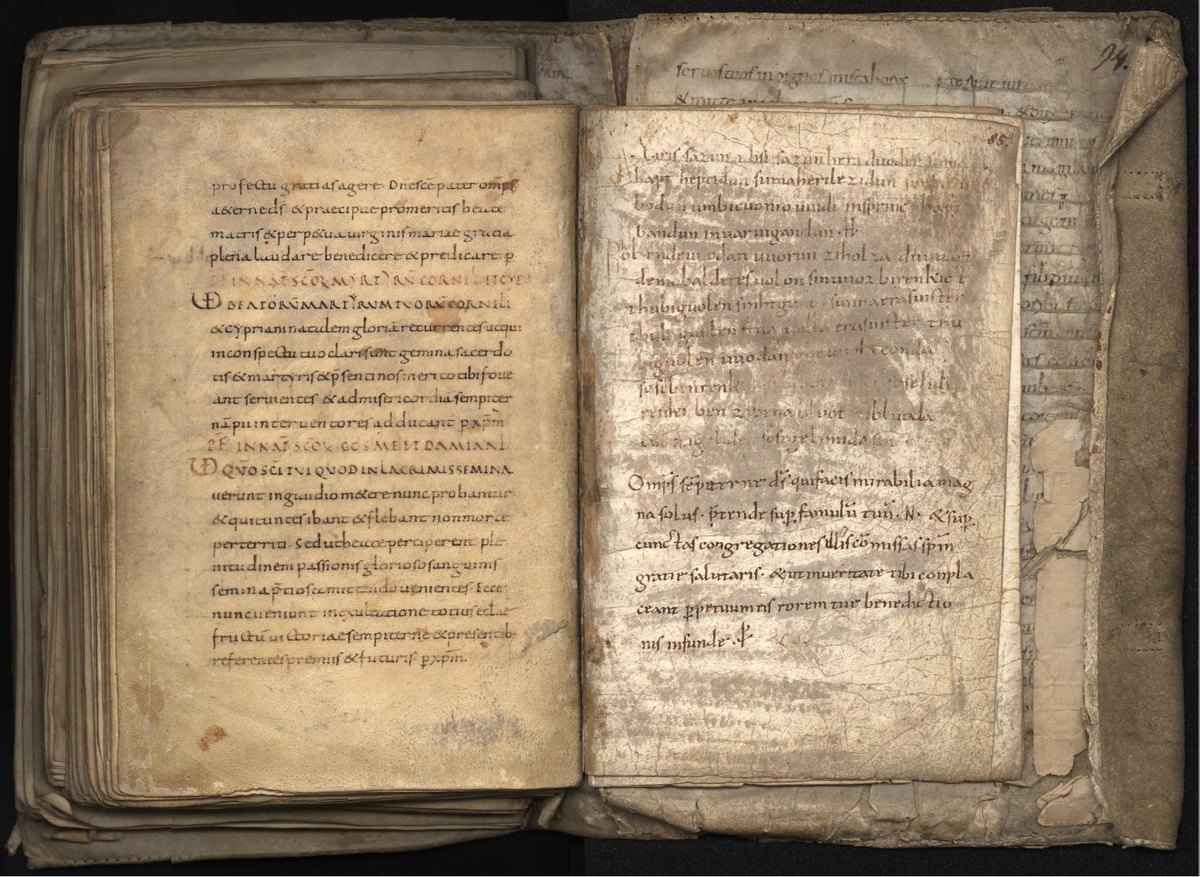
In 1841 the historian Georg Waitz came upon an unremarkable theological manuscript, Codex 136, in the library of the Merseburg cathedral chapter. On a blank page (fol. 85r) he found two stanzas in a language no one would have expected there: Old High German, in alliterative verse, full of heathen god-names. Waitz passed the find to Jacob Grimm, who published it in 1842 as „two poems from the age of German paganism". The sensation was complete.
The manuscript itself was written around the early 10th century, probably at the monastery of Fulda – but the charms are older and long circulated only by word of mouth. A Christian monk later wrote them from memory onto the empty page. As so often: what gets written down is usually already fading.
Both charms follow the same ancient design. First a little god-story is told – a mythic precedent scholars call the historiola: „back then the gods managed it, so it works now too." Then comes the actual spell-formula that applies this precedent to the case at hand. First the tale, then the command. This exact pattern turns up in charms from India to Ireland.
The first charm is a loosening spell – meant to free a prisoner from his bonds. Its historiola tells of the mysterious Idisi: supernatural women who settle on the battlefield. Some bind the enemy with fetters, some hinder the advancing host, some loose the chains of their own warriors.
Eiris sazun idisi, sazun hera duoder.
suma hapt heptidun, suma heri lezidun,
suma clubodun umbi cuoniouuidi:
insprinc haptbandun, inuar uigandun.
Once the Idisi sat, settled here and there.
Some fastened fetters, some hindered the host,
some picked at the bonds:
Escape the fetters, flee the foes!
These Idisi appear nowhere else – and yet they feel familiar. The word idis (Old Saxon), itis (Old High German), ides (Anglo-Saxon) means a „venerable woman", kin to the Norse dísir and the Rhineland matronae. Rudolf Simek sees in them „obviously a kind of valkyrie" – and indeed one Norse valkyrie bears the name Herfjötur, „army-fetter". The women who bind and loose chains are very old.
The second charm is a healing spell against a sprain – literally for a horse, figuratively for man and beast. The gods ride into the wood, a horse wrenches its foot, and a whole row of deities attempts the cure – until Wodan himself, the mightiest of magicians, speaks the right formula.
Phol ende Uuodan uuorun zi holza.
du uuart demo balderes uolon sin uuoz birenkit.
thu biguol en Sinthgunt, Sunna era suister;
thu biguol en Friia, Uolla era suister;
thu biguol en Uuodan, so he uuola conda:
sose benrenki, sose bluotrenki, sose lidirenki:
ben zi bena, bluot zi bluoda,
lid zi geliden, sose gelimida sin.
Phol and Wodan rode into the wood.
Then Balder’s foal wrenched its foot.
Then Sinthgunt charmed it, and Sunna, her sister;
then Frija charmed it, and Volla, her sister;
then Wodan charmed it, as well he could:
as bone-wrench, so blood-wrench, so limb-wrench:
bone to bone, blood to blood,
limb to limbs, as though they were glued.
Half a pantheon suddenly stands together here: Wodan (the Norse Odin), Balder, whose foal is hurt, plus the goddesses Sinthgunt (obscure, perhaps linked to the heavenly bodies), her sister Sunna (the sun), Frija (= Frigg, lady of Friday) and her sister Volla (the Norse Fulla). Phol at the very start is disputed to this day – probably a byname of Balder or a god in his own right. The heart of the spell is the healing formula „bone to bone, blood to blood, limb to limbs" – the injury is to knit back together as though glued.
And now it gets truly big. This very „bone-to-bone" formula appears almost word for word thousands of years earlier – in the Indian Atharvaveda (hymn IV, 12), where marrow is joined to marrow, flesh to flesh and bone to bone. Similar healing charms are known in Gaelic, Latvian and Finnish. As early as the 19th century the philologist Adalbert Kuhn recognised in this a shared Indo-European inheritance: a magic formula descended from a common ancestral language, passed down across millennia and half of Eurasia. The Merseburg charm is thus not only older than its manuscript – it may be older than the very Germanic gods who speak it.
Perhaps the finest irony: these deeply heathen lines survive only because a Christian monk wrote them down – onto the blank page of a Latin liturgical book, among prayers and blessings. Whether out of curiosity, nostalgia, or a wish to keep them „under control", we do not know. What is clear: the formulas were still alive enough in daily life to be remembered. Christianity did not sweep away the old faith at a stroke – it overlaid it, and in the cracks of that overlay fragments endured. The Merseburg Charms are one such fragment – and a priceless one.
Odin / Wodan · Frigg & Friday · Sunna – the Sun · Valkyries · Nerthus & the matronae · Rune lexicon.
Merseburg Charms, Codex 136 (Merseburg Cathedral Chapter Library); first edition Jacob Grimm (1842); Old High German text and public-domain renderings (Grimm/Simrock). Rudolf Simek, Dictionary of Northern Mythology. Adalbert Kuhn on the Indo-European origin of the healing formula (Atharvaveda IV,12). Image: Wikimedia Commons (public domain).
The market is full of "Norse" symbols: on pendants, T-shirts, tattoos and wall art. Many are sold as ancient and …
Read more →Every Easter she makes the rounds again: „Ostara, the Germanic spring goddess". Only – she is largely an invention of …
Read more →It is one of the most stubborn images of the „wild Viking“: the bearded warrior sipping his mead from the hollowed-out …
Read more →The sun wheel is one of humanity's oldest signs – around the world, since the Stone Age. Precisely for that reason …
Read more →