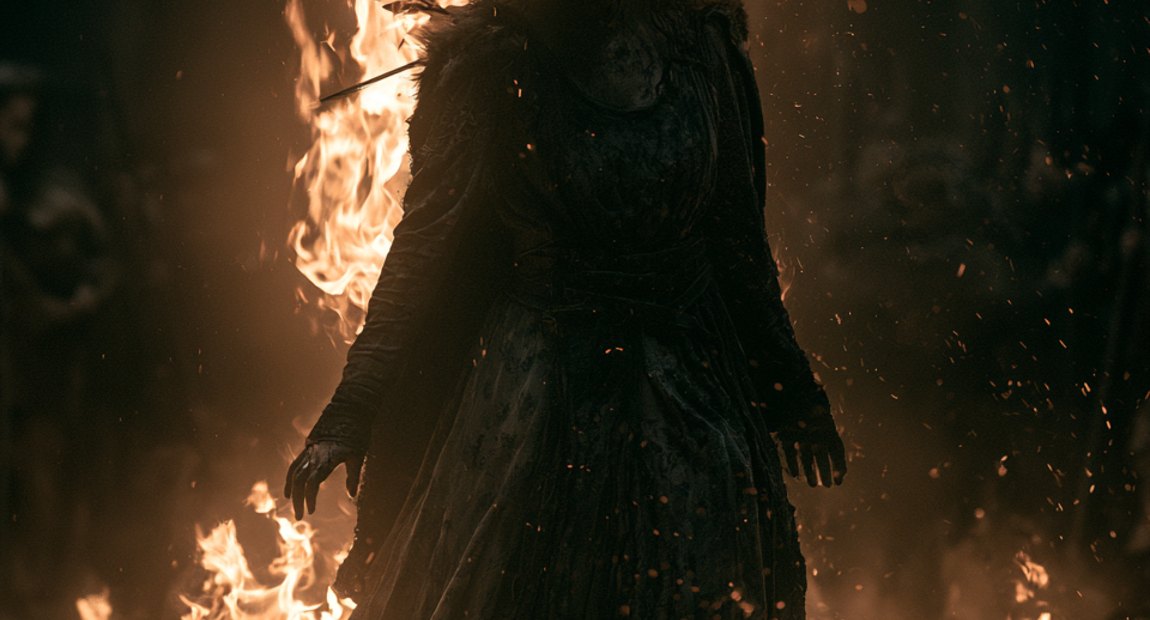
She enters Odin's hall, is pierced with spears and cast three times into the fire – and rises three times again. Gullveig is one of the darkest and most disputed figures in all of Norse tradition. What lies behind the woman with the name of gold, and why do some scholars link her to the very first war of the world?
The name Gullveig contains the Old Norse word for gold, gull. What the second part means exactly is disputed – it is read as "power", "might", "intoxication" or "draught". Translations therefore waver between "gold-might" and "gold-lust". Both fit: in the figure, gold resonates as something at once seductive and dangerous, as greed entering the world.
Gullveig appears in a single text only, in the Völuspá, the great seeress-poem of the Poetic Edda. There, in a few dense stanzas, a scene is described that still occupies scholars today. No second text names Gullveig; we have nothing but this handful of lines. Everything beyond them is interpretation.
The Völuspá tells how Gullveig comes to Odin's hall. The gods pierce her with spears and throw her into the hall's fire. They burn her – and she rises again. They do it a second time, a third time; three times she is killed and three times she lives anew. She cannot be destroyed. Whatever she is, she belongs to those beings over whom death holds no lasting power.
They pierced Gullveig with spears and burned her in Odin's hall; thrice burned, thrice born, still she lives on.Bellows 1923 (Völuspá, public domain)
This indestructibility is the heart of the scene. In a mythology where even the gods are mortal and moving toward their doom, here stands a figure whom you throw into the fire three times and who three times rises from the ashes. That is no marginal motif, it is a signal: something is stepping onto the stage that the old order cannot cope with.
Immediately after the burning scene the Völuspá speaks of a woman named Heiðr, a wise seeress. She travels through the lands, is skilled in seiðr, that mysterious craft of prophecy and influence, and is welcome everywhere such skill is valued – among "wicked women", as the text says, those who meddle with magic. Heiðr means something like "the shining" or "the bright one".
Because these stanzas follow one another directly, it is natural to read Gullveig and Heiðr as the same figure: the burned one who lives on as a sorceress and brings her craft among people. This is not compelling – the text does not say it outright – but it is the most widespread reading. Anyone interested in that craft itself finds more in our piece on Seiðr.
Shortly after the Gullveig scene the Völuspá reports the first war of the world: Aesir against Vanir, those two divine races who wage war at the beginning of time before making peace and mingling. Many readers have understood the mistreatment of Gullveig as the trigger of this war – an outrage that enrages the Vanir so far that battle breaks out. If Gullveig is a Vanir, then the Aesir crossed a line with her torture that could not go unavenged.
This reading is elegant, for it links two adjacent events into a chain of cause and effect. It is not certain. The Völuspá sets the scenes side by side without explicitly saying that one triggers the other. Anyone wanting to understand the war itself more closely finds the connections in our piece on the War of the Aesir and Vanir.
Gullveig is among the most disputed figures of Norse mythology. Some see in her an embodiment of gold-greed that carries discord into the world of the gods. Others read the triple burning as an image for the refining of gold in fire. Still others equate her with known goddesses. For all of this there are arguments – and for all of it the final proof is missing, because the source is so brief.
Perhaps that is exactly what makes her compelling. Gullveig is a riddle the Edda poses to us and does not resolve: a woman of gold, killed three times and risen three times, whose appearance plunges the world into its first great war. Honestly, we do not know who she was. But we know the poets ascribed to her a power that no spear and no fire could conquer.
The Völuspá describes in a few stanzas that a figure called Gullveig is pierced with spears in Odin's hall and burned three times and rises three times. Immediately afterwards the seeress Heiðr, skilled in seiðr, is mentioned, as is the first war between Aesir and Vanir. Gullveig appears in this one text alone.
The equation Gullveig = Heiðr = Freyja is a widespread interpretation but does not stand thus in the text. That the mistreatment of Gullveig triggers the Vanir war is likewise a reading of the sequence, not an explicit statement. Gullveig is one of the most open and most discussed figures in Edda scholarship – any single clear-cut explanation should be treated with caution.
The war of the Aesir and Vanir · The Vanir · Seiðr – the magic · Freyja · The Norse pantheon.
The god Freyr stood for fertility, harvest and peace. Two very different sources show what his cult could look like in …
Read more →Two curved horns, a fierce beard, a mead horn in the fist – that is the Viking of nearly every film, every carnival …
Read more →A heavy grey slab covered in a long line of runes, dug out from under the roots of an aspen tree in Minnesota. The …
Read more →Two short stanzas, scribbled onto a blank page of a church book – and yet the most precious record we have of the …
Read more →