An Arab traveller heard singing at Hedeby and thought it hideous. A canon of Bremen wrote that the songs of Uppsala were too indecent to repeat. Two men, two dislikes – and both tell us the same thing: people in the North sang, loudly and often. What nobody tells us is how it sounded. From three centuries of the Viking Age not one melody survives. What we have is fragments out of the ground, a few sharp remarks by foreigners, and a poetry whose form we know and whose sound we have lost.
Start with the uncomfortable part. There is no Viking Age notation. No tablature, no neumes, no song with pitches. The oldest written-down secular melody from the North appears roughly two hundred and fifty years after the Viking Age ends, and it is two lines long. More on that below.
What remains falls into three kinds of trace. Instrument parts from settlements, harbours, rubbish pits and graves. Remarks by people who visited or described the North – almost always from outside, almost always dismissive. And a highly developed poetry that was certainly performed, but whose manner of performance the sources never explain.
That sounds thin. It is still enough to say a great deal. Just not the one thing everyone wants to know: how it sounded.
Wind instruments are the commonest find because bone survives. From Hedeby come bone flutes, mostly from the long bones of cattle, sheep or birds, with cut finger holes. From Anglo-Scandinavian Jórvík, Viking York, come bone whistles and one object that appears in every exhibition: a small boxwood panpipe, a flat plate of wood with five surviving bores, tenth century, from the Coppergate excavations. One side is broken off, so there may originally have been more.
These are not concert instruments. They are small, loud and quickly made. A shepherd's whistle, a child's toy, a signalling device – that is the likely use, and the categories blur. A neatly turned recorder of sheep shin bone exists too, from Århus, but it belongs to the early thirteenth century.
The Oseberg ship burial produced two wooden whistles without finger holes and a cone-shaped wooden wind instrument about a metre long, its hollowed core bound with bands of willow; it is usually called a lur. The Oseberg chamber is dated by tree rings to 834. An instrument of that kind makes signals, not melodies: assemble, move out, take warning. The sagas simply assume horn signals in warfare – but the sagas are three hundred years later.
The stringed instrument of the Germanic North was not the harp as we picture it today but the lyre: a flat body, two arms, a crossbar yoke, six or seven strings, plucked or struck with a plectrum.
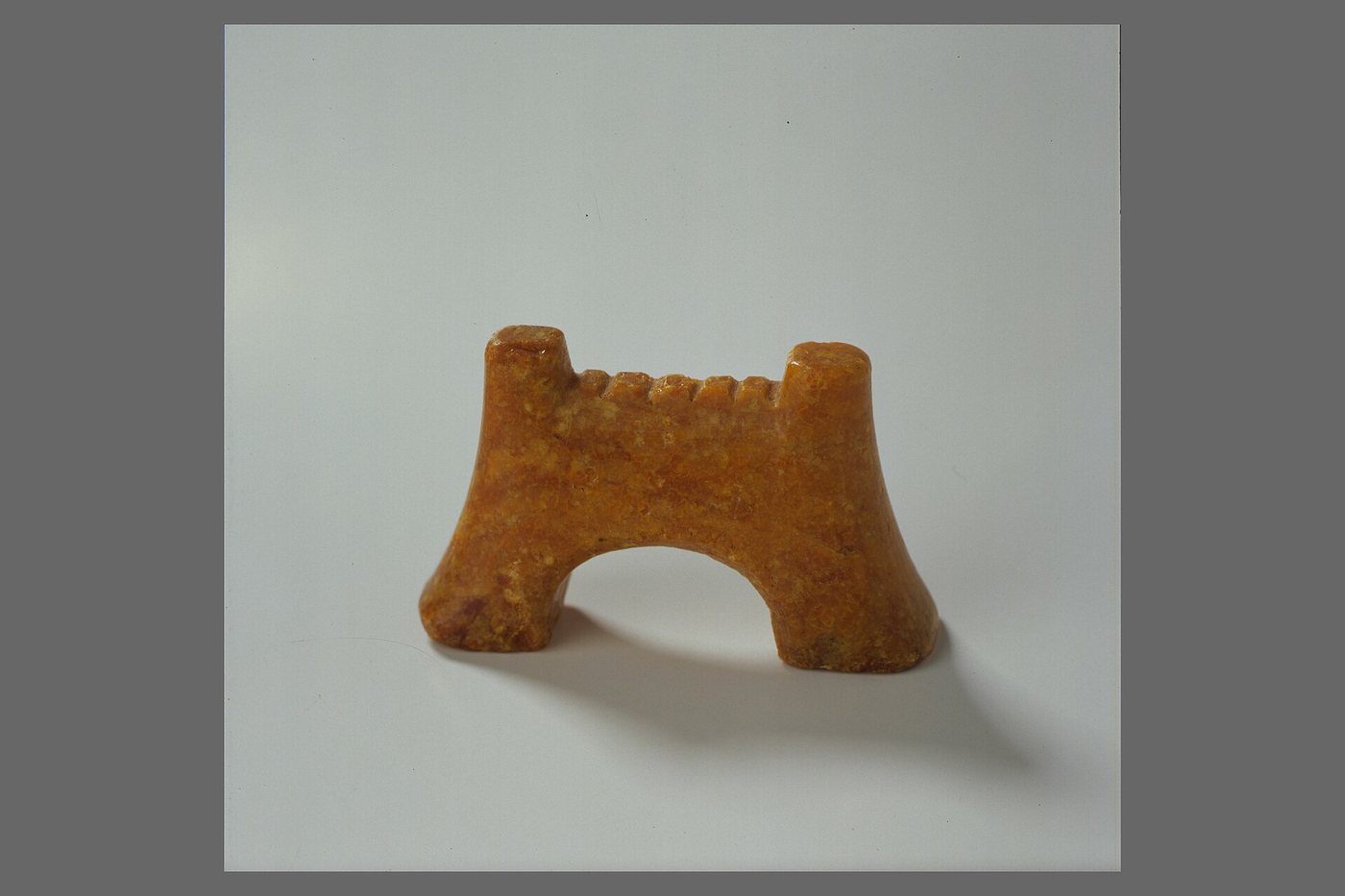
Not one complete example survives from Scandinavia itself. What survives are the small hard parts. From Broa in Halla parish on Gotland comes an amber lyre bridge, out of a man's grave of the eighth or ninth century, buried with horse and sword. The Black Earth at Birka produced an antler bridge notched for five to seven strings. At Hedeby a rubbish pit of the tenth or eleventh century held a yoke fragment of yew, 15.5 centimetres long, with six peg holes. York has yielded a wooden bridge with six string notches, Elisenhof on the Eider two amber bridges of the eighth century, Dorestad in the Netherlands two more. From Sigtuna comes a tuning key of elk antler with a runic inscription, around 1100.
What the whole instrument looked like we nevertheless know quite well – from neighbouring cultures, where the soil was kinder. The lyre from grave 58 at Trossingen, found in 2001, is dated by tree rings to about 578–580: 80.3 centimetres long, body, arms and yoke cut from a single piece of maple, six pegs, a bridge of willow, both faces carved, two groups of warriors on the front and a knotwork of snakes on the back. Add the Anglo-Saxon pieces from Sutton Hoo, Taplow and Prittlewell. These are Germanic lyres, a few generations older and a few hundred kilometres further south. The Scandinavian bridges fit exactly this type.
A picture of a player comes only with the High Middle Ages. On the portal of Hylestad stave church, carved in the second half of the twelfth century, Gunnar sits in the snake pit playing the harp with his toes – the last scene in a sequence telling the story of Sigurd and Fáfnir. A musician in art, yes. But Christian times, not the Viking Age.
During work on a stream dam a 43-centimetre piece of alder wood came to light at Hedeby, interpreted as the rounded, pear-shaped base of a sound box with a flat neck attached, dated to the tenth or eleventh century. If the reading is right, it is the oldest archaeological evidence for a bowed instrument in Europe. The reading is not undisputed, and the object looks unfinished. Old Norse has a word for such a thing: gígja. From Dublin comes a bow of the mid-eleventh century, decorated with an animal head in Norse style.
There certainty ends. The tagelharpa or talharpa, which fills every Viking festival today, is a bowed lyre from the Swedish-speaking coast of Estonia. The oldest surviving instrument comes from Nuckö in north-western Estonia and is dated to the mid-eighteenth century; detailed descriptions begin only in the nineteenth. Pictorial evidence for bowed lyres at all starts in the eleventh century, on the Continent. Viking Age art shows none.
The jew's harp is a similar case. Many take it for a typical Viking instrument. The finds say otherwise: well-dated European jew's harps begin in the thirteenth and fourteenth centuries, and even there dating is delicate, because the vibrating tongue is usually missing and many pieces are surface finds without stratigraphy. No securely Viking Age example is known. That does not prove the instrument did not exist then – it means we cannot show that it did. The difference matters to us.
The written testimony is scarce, short and almost uniformly unfriendly. The Andalusian traveller Ibrāhīm ibn Yaʿqūb al-Ṭarṭūshī visited Schleswig, that is Hedeby, in the tenth century. His account survives only in the reworking of later Arab geographers, al-Bakrī and al-Qazwīnī. The best-known passage runs:
"Never did I hear worse singing than that of the people of Schleswig: a droning that comes out of their throats, like the barking of dogs, only more bestial still."Al-Ṭarṭūshī on Schleswig, transmitted by al-Qazwīnī; English rendering our own
You can laugh at that. But read what it actually says: throat singing, low, pressed, sustained. Anyone who has heard Nordic kulning or Faroese chain-dance singing can see why a man from the Andalusian music world took it for barking.
The Arab envoy Ibn Fadlan described the funeral of a Rus leader on the Volga in 922. Two details belong here. A stringed instrument was laid in the grave along with intoxicating drink and fruit. And when the slave girl was killed, the men beat their shields with sticks so that her cries could not be heard – noise with a function, not music.
Adam of Bremen wrote about the sacrifices at Uppsala around 1075 and broke off at the decisive point:
Ceterum neniae, quae in eiusmodi ritu libationis fieri solent, multiplices et inhonestae, ideoque melius reticendae.
"As for the songs customary at such a rite of libation, they are many and indecent, and therefore better passed over in silence."Adam of Bremen, Gesta Hammaburgensis ecclesiae pontificum IV,27; English rendering our own
Adam was never there. He wrote at second hand and with intent. Even so there is information in the sentence: songs belonged to the sacrifice, there were several kinds, and a Christian found them offensive. That is all it yields, and it should not be squeezed for more.
The most artful utterance of the Viking Age was not a song but a stanza. Dróttkvætt, the court metre, demands six syllables to the line, alliteration across line pairs, and internal rhymes in a fixed pattern. A man who mastered it could praise a lord, destroy an enemy or make a battle durable in eight lines. As with Eyvindr skáldaspillir or in the Vellekla.
Whether such stanzas were sung we do not know. The language gives a hint: in Old Norse verses are kveðit – said, spoken, chanted – not sungit. That does not rule out a kind of melodic speech; quite the opposite. But it suggests skaldic verse stood closer to declamation than to song, and that its musical scaffolding lay in the metre rather than in a tune. Anyone hearing a skaldic stanza sung to a lyre today is hearing a modern decision, not a transmitted one.
The same holds for the eddic poems. Their metres are freer, their age is disputed, and the manuscripts of the Edda are books of the thirteenth century. None of them contains notation.
There is one point where the silence stops, and it lands pleasingly off-centre. The Codex Runicus, a manuscript of the Scanian Law from around 1300, is written entirely in runes. Right at the end, after the legal text, stand two lines of a song – and above them two simple staves in an early notation. The text begins Drømde mik en drøm i nat, I dreamt a dream last night. It is the oldest surviving secular melody in Scandinavia.
It is two hundred and fifty years younger than the Viking Age, it is two lines long, and even its rhythm is argued over, because the notation gives pitches but no clear durations. Which is exactly why it is instructive: it shows how thin the record becomes as soon as sound is involved – and how late it starts.
So to the music most people were actually searching for when they found this article. Wardruna was founded in Norway in 2003 by Einar Selvik and works with deer-hide frame drums, flutes, goat horn, lur, kravik lyre and jew's harp. Heilung formed in Copenhagen in 2014 and calls its own work "amplified history": the lyrics draw heavily on genuine runic inscriptions, charms and older language stages, from Old Norse through Old High German to Gothic.
Both are carefully made, both are well researched, and both are new music. The instruments are partly reconstructions, partly borrowings from younger folk traditions. The texts are old; the melodies are not and cannot be, because none survives. Selvik says so himself when asked.
We think that is an honest way to handle it. An attempt at reconstruction is not a forgery as long as it admits what it is: an answer to a gap. Only the claim that this is "the music of the Vikings" passes the answer off as the source. We engrave along the same lines: a motif after a find from Hedeby is a motif after a find – not a time machine.
Archaeological evidence: bone and wooden whistles from Hedeby, York and Oseberg; the boxwood panpipe from Coppergate, tenth century; lyre bridges from Broa, Birka, Elisenhof, Dorestad and York; a yew yoke with six peg holes from Hedeby; a tuning key from Sigtuna around 1100; a bow from Dublin, mid-eleventh century. Complete lyres only outside Scandinavia: Trossingen, Oberflacht, Sutton Hoo, Taplow.
Contemporary written sources: al-Ṭarṭūshī on the singing at Schleswig, tenth century, transmitted by later Arab authors; Ibn Fadlan in 922 on a stringed instrument in the grave and on shield noise; Adam of Bremen around 1075 on the songs of Uppsala. All three from outside, all three judgemental.
Later tradition: sagas and eddic manuscripts of the thirteenth century that mention instruments and performance without describing them; the Hylestad portal of the twelfth century with Gunnar in the snake pit; the Codex Runicus of around 1300 with the oldest melody.
Modern interpretation: everything said about scales, tunings, polyphony and rhythm in the Viking Age. Likewise every modern "Viking music", however well made. What we do know for certain: they sang, they plucked, they blew, and they seriously upset at least one Andalusian. For courage. For memory. For legends that live on.
Hedeby · The Norse of Jórvík · Ibn Fadlan & the Rus · Adam of Bremen · Eyvindr skáldaspillir – the Last Court Skald · The Gotlanders.

.jpg)