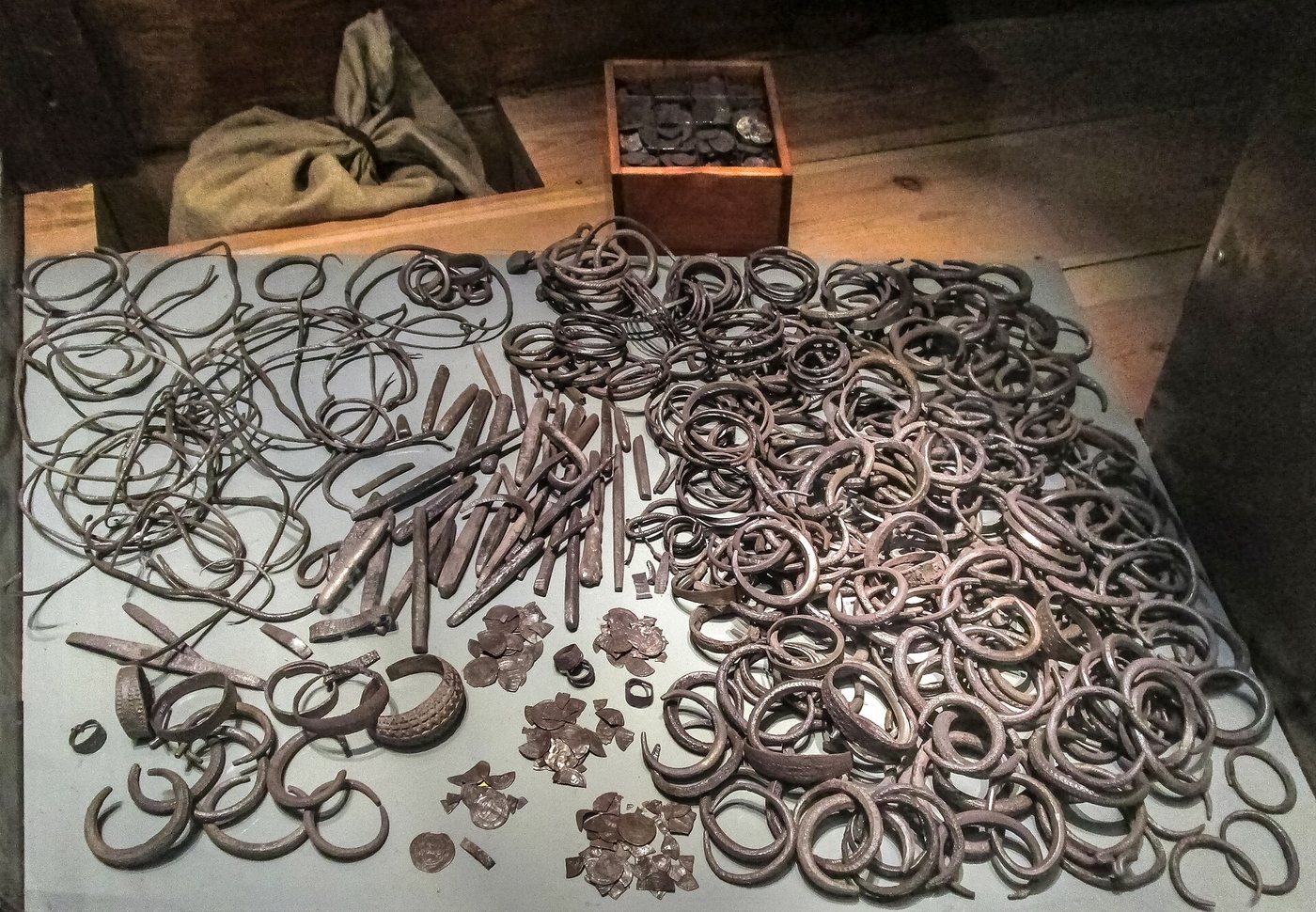
In July 1999 a metal detector on a farm near Othem gave a signal, then flashed "overload", then switched itself off. Beneath it lay some 67 kilograms of silver. The Spillings hoard is the largest known silver treasure of the Viking Age, and it comes from an island about the size of an English county. Gotland has yielded more Viking-Age silver than any other part of Scandinavia. Who were the people who buried it? Their own story begins with an island that sank beneath the sea by day.
The Gotlanders wrote down their origins themselves. Guta saga, the "history of the Gutar", is a short text in Old Gutnish, the island's own dialect. It survives in a single manuscript from the middle of the fourteenth century, now in the National Library of Sweden in Stockholm, as an appendix to Gutalag, the island's law. When it was composed cannot be said exactly; its editor Christine Peel places it in the thirteenth or perhaps the fourteenth century. It begins:
Gutland hitti fyrsti maþr þann sum Þieluar hit. Þa war Gutland so eluist, at þet daghum sank ok natum war uppi.
"The first man to find Gotland was one called Thjelvar. Gotland was then so bewitched that it sank by day and was up by night."Guta saga, opening; our translation
Thjelvar is the first to bring fire ashore, and from then on the island never sinks again. One can read this as an old motif: whoever makes fire takes possession of the land. One can also read it as a memory of an island rising from the sea – and Gotland did indeed rise after the Ice Age. Neither reading can be proved. It is an origin legend and does not pretend to be anything else.
Thjelvar's son Hafthi marries Hvitastjerna, "White Star". On their first night she dreams that three snakes lie coiled in her lap. Hafthi reads the dream: they will have three sons. Guti, Graipr and Gunfjaun later divide the island into three, Graipr taking the north, Guti the middle, Gunfjaun the south. The division is not pure fairy tale. Medieval Gotland really was organised in thirds, and the saga explains an order its readers knew.
Then the island becomes too small. The people multiply until the land can no longer feed them. By lot, every third person must leave, taking everything except the land. The emigrants go first to the hillfort of Torsburgen, then to Fårö, then to Dagö off the Estonian coast, and finally up the Dvina through Russia to "Greece" – the Byzantine Empire. There, says the saga, they still live and keep something of the Gutnish tongue.
How much memory lies in this migration nobody knows. The route reads like the eastern roads that Viking-Age Gotlanders actually travelled. Whether a thirteenth-century author wrote down an old tradition or projected the routes of his own day back into the distant past cannot be decided.
The Gotlanders called themselves Gutar. The name sounds like "Goths", and that is no accident of pronunciation: linguists trace the names of the Gutar, of the Götar of Västergötland and Östergötland, and of the Goths to a common Germanic root. It does not follow that the Goths came from Gotland.
Around 551 the Gothic historian Jordanes wrote that his ancestors had once come with three ships from Scandza. Which part of Scandinavia he meant, and whether there is any real memory behind it, has long been disputed. Some have read the emigration in Guta saga as an echo of that Gothic migration. That is a hypothesis, and not one that can be proved. We side with cautious scholarship: same root, open history. The ancient Goths have an article of their own.
The second great theme of Guta saga is the island's freedom. Many kings, it says, made war on Gotland, but the Gutar always won. Then they sent Awair Strabain of Alva parish to the king of the Svear, and he made the first peace:
So gingu Gutar sielfs wiliandi undir Swia kunung, þy at þair mattin frir ok frelsir sykia Swiariki i hwerium staþ, utan tull ok allar utgiptir.
"So the Gutar went of their own free will under the king of the Svear, so that they might travel free and unhindered to every place in the realm of the Svear, without toll or any dues."Guta saga, chapter on Awair Strabain; our translation
In return, according to the saga, the Gutar paid sixty marks of silver a year, forty to the king and twenty to the jarl, and the king owed them protection and help. The tone is unmistakable: nobody submits here; partners make a contract.
The saga does not say when Awair lived, and Christine Peel points out that the terms probably reflect thirteenth-century conditions more than those of a distant past. There is, however, one contemporary hint. Around 890 the seafarer Wulfstan described his voyage to Truso at the court of King Alfred. Listing the islands on his port side, Gotland among them, he added: þas land hyrað to Sweon – "these lands belong to the Svear". How close that belonging was, the sentence does not say. More on that report under Ohthere of Hålogaland.
The Swedish History Museum in Stockholm counts over 700 Viking-Age silver hoards on Gotland, more than in any other Swedish province. A figure of around 180,000 coins from the island is often quoted, far more than from the whole Swedish mainland; totals like this are extrapolated from many separate finds and not exact to the coin. The largest share are Arabic dirhams from the Caliphate and its successor states; later come German and English pennies.
The Spillings hoard is the largest single find. It was discovered in 1999 near Othem in the north of the island and consisted of two silver deposits totalling some 67 kilograms, plus a deposit of over 20 kilograms of bronze. Among the silver were 14,295 coins, almost all dirhams, and 486 arm rings or fragments of them. The latest coins date from 870/71, so the hoard was buried some time after that. Today it is in the Gotland Museum in Visby.
Why so much silver stayed in the ground is the real question. In the late 1980s Majvor Östergren showed that many hoards were not hidden out in the landscape but lay in or beside dwellings. That points to a kind of house bank rather than loot hidden in a hurry. Others stress belief, family and status: silver that was owned rather than spent. The two explanations do not exclude each other. What is beyond dispute is that Gotlanders sat as traders and middlemen on the routes east – across the Baltic, along the rivers of Russia and the Varangian route.
The island's second legacy stands upright. More than four hundred picture stones are known from Gotland, made between about 400 and 1100. The early ones carry whirl patterns and sun discs; the late ones, some over three metres tall, show ships with chequered sails, fights, riders and a woman offering a drinking horn to a new arrival. How far these scenes depict myths we know from the Edda has been debated since Sune Lindqvist's great survey of 1941–42. What is certain is that many stones were memorials set up along roads, not on graves.
Gotland has fewer runestones than Uppland, but some speak plainly. The Pilgårds stone from Boge parish, of the later tenth century, names brothers who raised stones for a man called Hrafn and mentions Aifur – one of the dangerous Dnieper rapids, which the Byzantine emperor Constantine Porphyrogenitus describes under almost the same name. The obvious reading is that Hrafn died on that journey, far in the east.
Medieval Gotland had no nobility of its own and no king on the island. Guta saga names the Gutnalþing, the assembly of all the Gutar, which also collected the payment to the king. Gutalag, probably written down in the thirteenth century, regulated the lives of farmers with no lord in between. Below the thirds there were smaller districts with their own assemblies. Of the paganism that preceded this order, the saga says people believed in groves and burial mounds, in sanctuaries and heathen gods – written by a Christian who knew what he thought of that.
Swedish historical writing commonly uses the term bonderepublik, peasant republic, for these conditions. It is a modern interpretation, not a medieval self-description. It captures something true: the island largely ran its own affairs and paid the king a fixed sum. But it hides the fact that these farmers were not equals either. The hoards show great differences in wealth, and whether a layer of rich farms dominated the assembly is still argued over.
With the rise of Visby in the twelfth and thirteenth centuries the weight shifted to the town and its German merchants. In 1361 the Danish king Valdemar Atterdag conquered the island. But that is another story.
Archaeological evidence is the more than 700 silver hoards, the Spillings hoard and its figures, the picture stones and runestones such as Pilgårds. They show a wealthy farming population with far-reaching links to the east.
Contemporary written evidence is above all Wulfstan's late ninth-century remark that Gotland belonged to the Svear.
Later tradition is Guta saga of the thirteenth or fourteenth century: Thjelvar and the fire, Hvitastjerna's dream, the three sons, the emigration to Greece, Awair Strabain and the sixty marks. The fire and the snakes are legend. The treaty terms are more likely thirteenth-century law than memory.
Modern interpretation covers the link to the Goths, the reasons for burying the hoards and the idea of a peasant republic.
What remains is an island that told its own story – and whose soil keeps a second, more precise version. For courage. For memory. For legends that live on.
The picture stones of Gotland · Birka – the trading hub · The Suiones · The Geats · The Ingvar Expedition · Danes, Swedes, Norwegians · The Varangian route.

