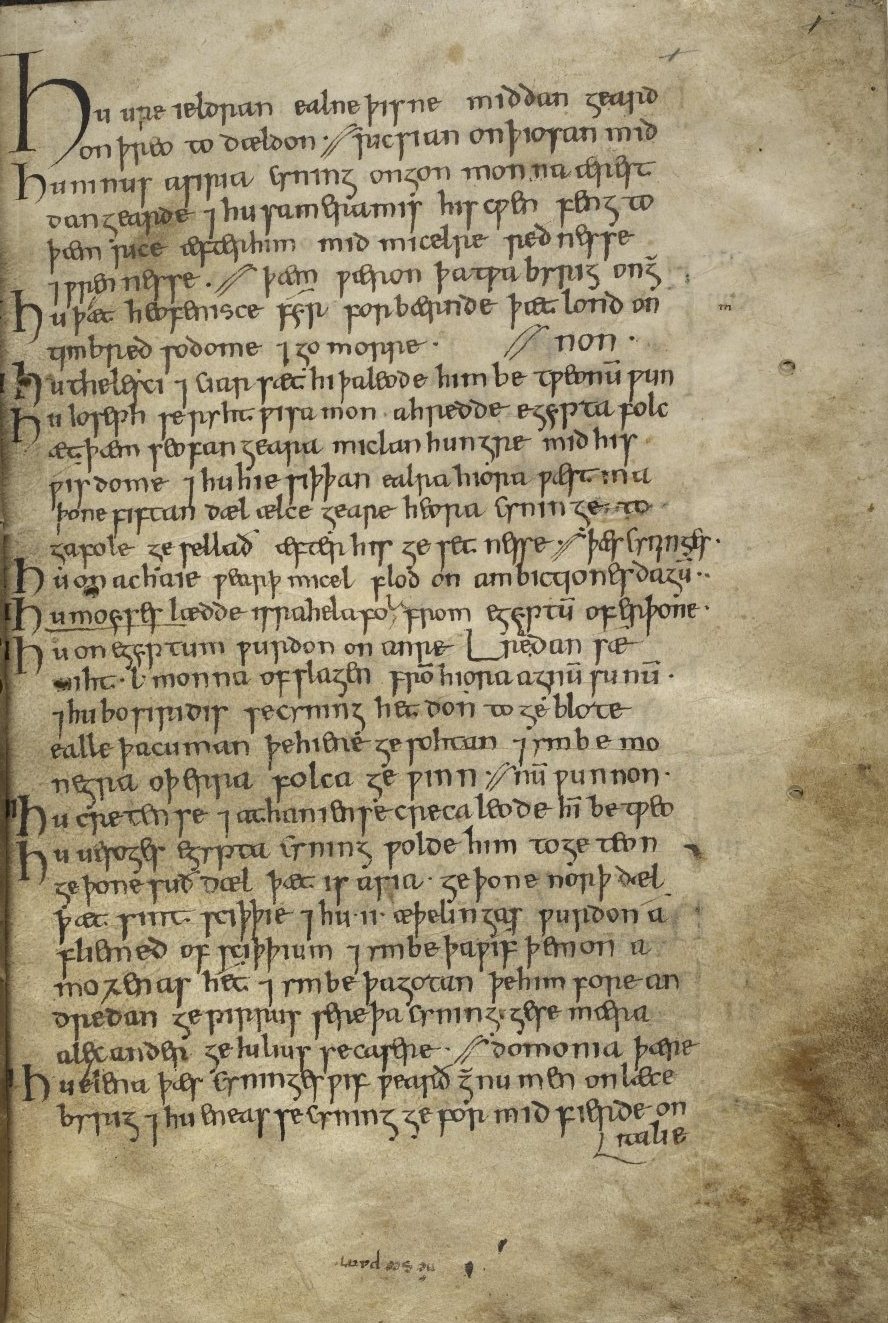
Most people of the Viking Age are known to us only through the eyes of others. Ohthere is an exception. At some point around 890 a man from the far north of Norway stood before King Alfred of Wessex, gave him walrus tusks and talked. About his six hundred reindeer and his twenty cows. About a voyage into the unknown that took him as far as the White Sea. About trading places in the south. A scribe wrote it down in Old English. So the oldest description of Norway was not written in Norway but in England – from the mouth of a Northman.
The account sits where no one would look for it: in the Old English Orosius. This is a free adaptation of the world history written by the late antique churchman Paulus Orosius in the early fifth century. It was rendered into Old English in Wessex around 900; for a long time Alfred himself was thought to be the translator, which is now strongly doubted. Into the geography at the beginning the adapter inserted two travel reports that are not in Orosius: that of the Norwegian Ohthere – probably Óttarr in Old Norse – and that of a man called Wulfstan. The oldest manuscript, now in the British Library, dates from the early tenth century.
The text begins without preamble:
Ohthere sæde his hlaforde, Ælfrede cyninge, þæt he ealra Norðmonna norþmest bude.
"Ohthere told his lord, King Alfred, that he lived furthest north of all the Northmen."Old English Orosius, Book I; our translation
Two things stand out. First, this is not a diary but a conversation, recorded by a scribe in the third person. We hear Ohthere through an Englishman. Second, the text calls Alfred Ohthere's hlaford, his lord. Whether Ohthere had entered Alfred's service or whether this is merely courtesy, we do not know. The year of the visit is given nowhere. "Around 890" is an estimate derived from Alfred's reign (871–899) and the date of the text. More on the king under Alfred the Great.
Ohthere lived, the text says, in a region called Hålogaland, Halgoland, on the coast of the "West Sea". The land was very long and very narrow. Whatever could be grazed or ploughed lay by the sea, and even that was rocky in places. To the east ran wild mountains, and there lived the Finnas. These are not the Finns but the Sámi, the indigenous people of the north. They have an article of their own: The Sámi in the Norse sources.
Where exactly Ohthere's farm lay the account does not reveal. It is usually sought somewhere between Lofoten, Senja and the area around Tromsø. What a chieftain's seat in this world could look like is shown by Borg in Lofoten, where a longhouse over eighty metres long was excavated. That was not Ohthere's farm, or at least nobody can say it was. But it shows that Hålogaland had power and wealth.
Ohthere listed his property for Alfred, and the list is remarkably honest. When he came to the king he still had six hundred tame reindeer, tamra deora unbebohtra syx hund. The word unbebohtra literally means "unbought"; whether it means he had not sold them or that he had not bought them in but bred them himself is disputed. Among them were six stælhranas, decoy reindeer used to catch wild ones, which were very valuable among the Finnas.
Then comes the sentence that puts things in proportion: Ohthere was among the first men of the land, yet he had no more than twenty cattle, twenty sheep and twenty pigs, and the little he ploughed he ploughed with horses. A big West Saxon landholder would have smiled. Ohthere's wealth lay elsewhere: Ac hyra ar is mæst on þæm gafole þe ða Finnas him gyldað – "But their income consists mostly of the tribute that the Finnas pay them."
The account describes this payment more precisely than any later source:
Þæt gafol bið on deora fellum, and on fugela feðerum, and hwales bane, and on þæm sciprapum þe beoð of hwæles hyde geworht, and of seoles.
"That tribute is paid in animal skins, in birds' feathers and whalebone, and in the ship's ropes made from the hide of whales and of seals."Old English Orosius, Book I; our translation
Each paid according to his rank. The highest-ranking had to give fifteen marten skins, five reindeer (skins, presumably – the text only says "five of reindeer"), one bearskin, ten ambra of feathers, a measure whose size we do not know, a coat of bear or otter skin and two ship's ropes, each sixty ells long, one of whale hide and the other of seal hide.
What to call this relationship depends on one's standpoint. For Ohthere it was gafol, tribute. Was it tribute under compulsion, protection money, an exchange in which the Sámi received iron, cloth or grain in return? The text does not say. The fact that the most valuable animals in Ohthere's herd were prized "among the Finnas" has led some scholars to suggest that Sámi herded his reindeer. That too is interpretation. Only this is certain: the prosperity of the northern Norwegians rested on goods from Sámi hands.
The largest part of the account is a voyage Ohthere undertook out of curiosity. He wanted to find out hu longe þæt land norþryhte læge oþþe hwæðer ænig mon be norðan þæm westenne bude – how far the land extended northwards and whether anyone lived north of the wilderness.
He sailed north for three days, as far as the whale hunters go furthest, then three days more. There the land turned east, "or the sea into the land, he did not know which". He waited for a west wind and sailed east for four days, waited for a north wind and sailed south for five days, until a great river led into the land. This is the rounding of the North Cape and the Kola Peninsula into the White Sea. Which river is meant is debated; the Northern Dvina is often suggested.
Along the way lived only fishers, fowlers and hunters, all of them Finnas. At the river, though, began a well-settled land, that of the Beormas. Ohthere did not dare to go in. The Beormas told him much about their own country and the lands around it, and then comes a sentence every chronicler should have framed above his desk:
Ac he nyste hwæt þæs soþes wæs, for þæm he hit self ne geseah.
"But he did not know how much of it was true, because he had not seen it himself."Old English Orosius, Book I; our translation
It seemed to him that the Finnas and the Beormas spoke almost the same language. Above all, though, besides his curiosity, he went for the horshwælas, the walruses: their teeth were very fine bone – he brought some to the king – and their hide made very good ship's ropes. He also claimed that at home he and five companions had killed sixty whales in two days, the largest fifty ells long. How that figure should be understood is disputed among scholars.
The account also gives Ohthere's routes south. In the south of the land lay a trading place called Sciringes heal. One could not sail there in a month if one camped ashore at night and had a fair wind every day – a month's voyage at least, and all the way Norðweg lay to port. It is one of the oldest records of the name Norway: "the way north".
Sciringes heal is Skiringssal in Vestfold, and its trading place is Kaupang near Larvik. Excavations, most recently under Dagfinn Skre from 2000, have shown that Kaupang was founded around 800 and was a place of craft and long-distance trade in the ninth century.
From there, Ohthere said, he sailed in five days to the port called æt Hæþum. It lay between the Wends, the Saxons and the Angles and belonged to the Danes. That is Hedeby on the Schlei. On this voyage Ohthere had Denamearc to port and open sea to starboard for three days – one of the earliest mentions of Denmark anywhere.
Straight after Ohthere the same text has a second report. A man called Wulfstan said he had sailed from Hedeby to Truso in seven days and nights, under sail the whole way. Whether Wulfstan was English, as his name suggests, is an open question.
He describes which lands lay on which side and to whom they belonged: to starboard the land of the Wends; to port Langeland, Lolland, Falster and Scania, which belonged to Denmark; then Bornholm with its own king; then Blekinge, Möre, Öland and Gotland, which belonged to the Svear. Truso lay on a lake near the mouth of the Vistula. It is now identified with the site of Janów Pomorski near Elbląg.
Wulfstan's view of the Este, the people east of the Vistula, is that of an outsider who looks closely: many strongholds, each with a king; plenty of honey and fish; mare's milk for the rich, mead for the poor and the unfree, no ale. The dead stayed unburnt in the house for a month or more; then their property was shared out in a horse race. More on this people under the Aesti.
Contemporary written evidence is the account itself, written down in Wessex shortly before 900. It is one of very few sources in which a Viking-Age Scandinavian speaks about himself – even if through an English scribe and in his language.
Archaeological evidence is Kaupang, Hedeby and Truso as trading places, the wealth of Hålogaland, for instance at Borg, and the trade in walrus ivory.
Later tradition plays hardly any part here. The Bjarmaland of the sagas, where eleventh-century Vikings plunder sanctuaries, is a literary echo of the Beormas, not evidence for Ohthere's time.
Modern interpretation covers the location of Ohthere's farm, the question of who herded his reindeer, the nature of the Sámi payments and the river where he turned back.
What remains is a man who wanted to know how far the world reached, and who admitted it when he had not seen something himself. For courage. For memory. For legends that live on.
Hedeby · The Sámi in Norse Sources · Alfred the Great · Danes, Swedes, Norwegians · Birka – the trading hub · The longships.

_-_folio_2r_-_list_of_chapter_headings.jpg)