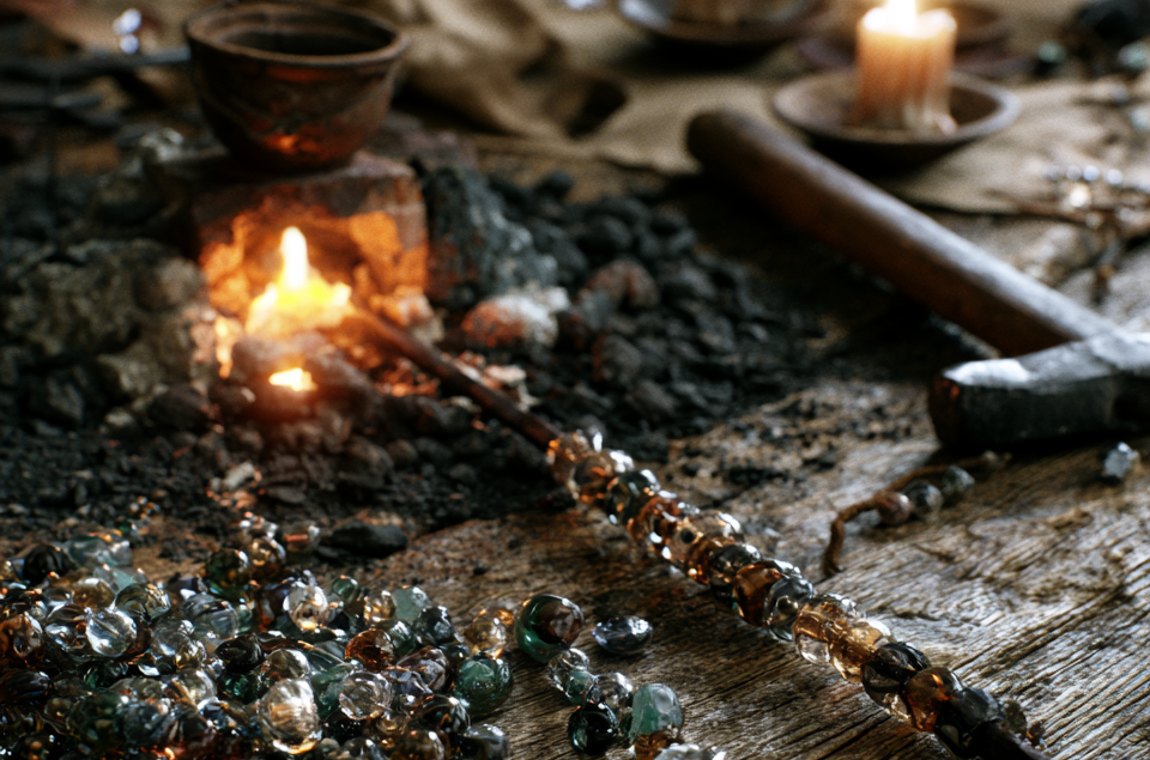
Few stones shaped early-medieval prestige craft the way deep-red garnet did. Sliced wafer-thin and set into golden cells, it glowed on brooches, sword hilts and royal regalia from Scandinavia to the Frankish realm. Let us look closely: what the stone really is, where it came from, why it was at its most magnificent BEFORE the Viking Age – and what modern "warrior-stone" legends have to do with it (namely nothing).
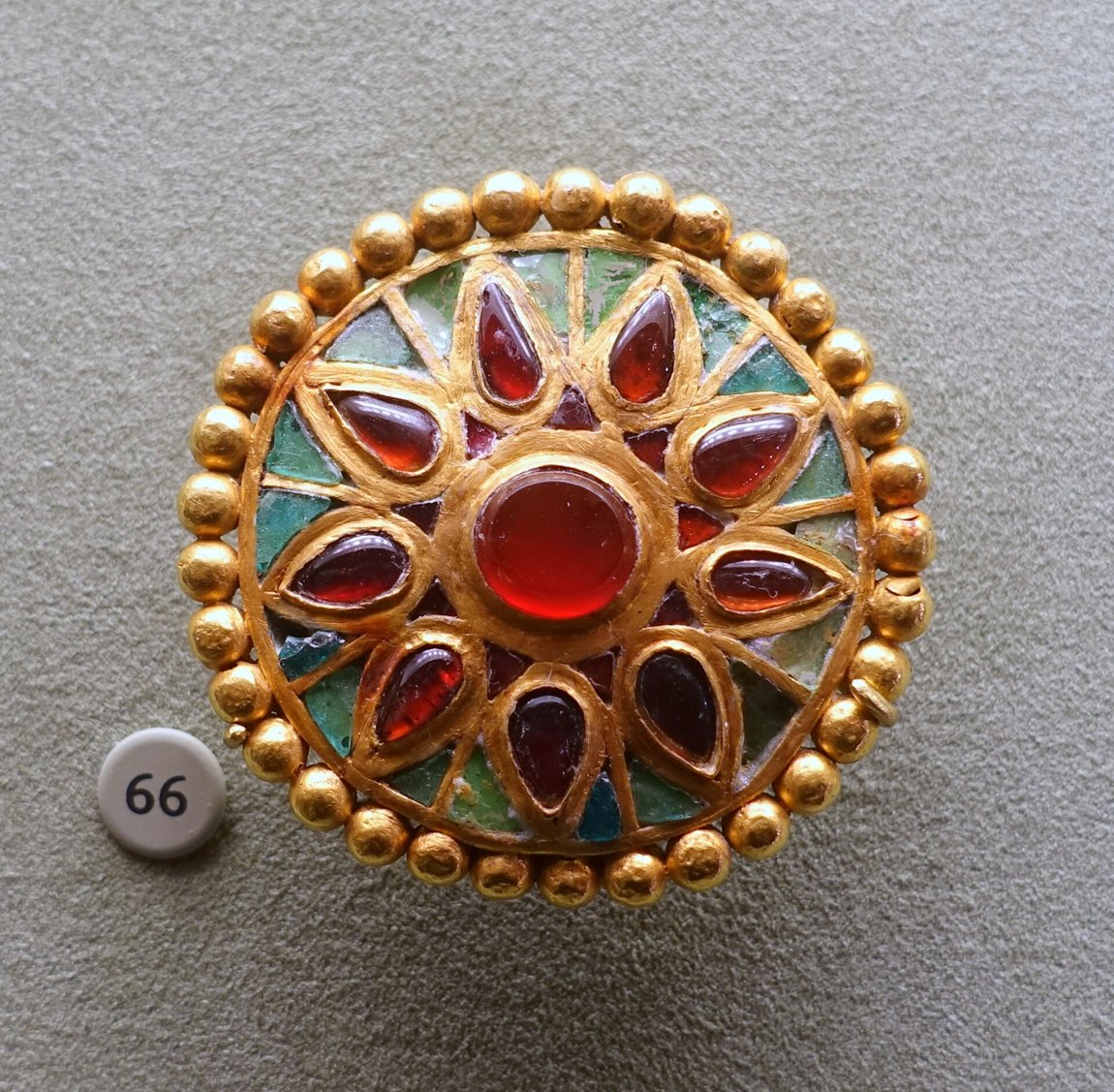
"Garnet" is not a single mineral but a whole group of related silicates sharing a common crystal structure, with the general formula X₃Y₂(SiO₄)₃. Depending on which metals occupy the X and Y positions, different end-members form: pyrope (magnesium-rich, fiery red), almandine (iron-rich, deep brownish to violet-red), spessartine (manganese-rich, orange), grossular and andradite (more yellow, green, brown). Most natural garnets are mixed crystals lying between these end-members.
For early-medieval jewellery one end-member matters above all: almandine, the iron-rich red garnet. It has a Mohs hardness of about 7 to 7.5 – harder than quartz and remarkably tough – and a glassy lustre. Garnet crystallises in the cubic system, often as characteristic rhombic dodecahedra, and has no marked cleavage. That is exactly what made it so valuable to craftsmen: it could be sawn and ground into thin plates without shattering uncontrollably.
The deep red of almandine comes from the iron built into its structure, which absorbs certain wavelengths of light and lets the warm red remainder through. Ground very thin, a garnet becomes semi-translucent and positively glows once light passes through it. Early-medieval goldsmiths exploited this optical behaviour masterfully – more on that shortly.
An honest framing matters here: the stone was prized because it was rare, hard, expensive in long-distance trade and visually overwhelming. Red was the colour of blood, fire and rank – a pure signal of status and beauty. Not a single contemporary northern source speaks of any "effect" of the stone.
Garnet's great moment falls in the Migration period and the early Middle Ages, roughly the 5th to 7th centuries. The technique is called cloisonné, or cell-work: onto a gold base plate the craftsmen soldered wafer-thin gold walls (the "cloisons"), creating a honeycomb of cells. Into each individual cell a precisely ground red garnet plate was fitted.
The most ingenious part often lies hidden beneath: into many cells the craftsmen laid a fine stamped gold foil bearing a tiny waffle or lozenge pattern under the stone. This foil backing reflects the light entering through the thin garnet back out again – the stone then seems to glow from within, even by candlelight in a dim hall. What looks from a distance like a solid red surface reveals itself, up close, as a mosaic of dozens, sometimes hundreds of tiny, individually cut stones.
This was precision craft of the highest order. Every plate had to be sawn, ground to shape and polished so that it sat exactly in its cell. A single prestige object could take weeks and was reserved for the highest ranks of society.
Garnet cloisonné appears right across the Germanic world: on great bow and disc brooches, on belt buckles and strap-ends, on sword and sax hilts, on sword pommels and the small pyramid-shaped strap fittings ("sword pyramids"). It adorned Gothic, Lombard, Frankish and Anglo-Saxon elites alike.
Famous Frankish and Merovingian princely graves show the wealth of this fashion; the grave of the Frankish king Childeric (died 481/482) contained garnet-set regalia and golden bees. The most spectacular find, however, is the Anglo-Saxon ship burial of Sutton Hoo in England (early 7th century): the celebrated shoulder clasps, the lid of the belt purse and the sword fittings are set with thousands of accurately cut garnets over foil backing. The Staffordshire Hoard, discovered in England in 2009, likewise contained kilograms of garnet-set weapon parts. These objects rank among the peaks of goldsmithing across the entire first millennium.
Perhaps the most astonishing point: the red garnets of Germanic prestige craft almost never grew in Europe. Scientific provenance studies – among others at the Louvre and other institutes using non-destructive methods such as PIXE analysis – have determined the chemical "fingerprints" of hundreds of garnets from early-medieval jewellery. The result: a large share of the almandines came from South and Southeast Asia, above all from India (such as Rajasthan) and Sri Lanka, with a further share from Bohemia and from regions at the edge of the ancient world.
That means red stones reached the North along trade routes running through the late-antique and Byzantine networks all the way to the Indian Ocean, where Germanic goldsmiths worked them. The glowing garnet on a Frankish brooch or Anglo-Saxon royal ornament is thus solid evidence of a far-flung long-distance trade network. Researchers also found that the garnet sources in use shifted over time: the mass-imported far-eastern stones grew scarcer from around the middle of the 7th century, and craftsmen relied more on nearer, often smaller deposits. At roughly the same time the great cloisonné fashion faded out.
An honest framing is needed here, because it is often skipped: garnet's truly great era lies before the Viking Age proper. Dense, sheet-like garnet cloisonné is a phenomenon of the Migration, Merovingian and Vendel periods (roughly 5th to early 8th centuries). By the time the Viking Age begins in the late 8th century, this technique is already in retreat.
The Viking Age has its own unmistakable aesthetic – and it is largely an aesthetic of silver and interlaced animal ornament (Borre, Jelling, Mammen, Ringerike, Urnes). Instead of red stone mosaics, cast and filigree-decorated silver brooches, plaited neck rings, hacksilver as currency, and imported beads of glass and semi-precious stone dominate. Coloured stones do appear – for example red carnelian beads from long-distance trade along the Volga route – but the elaborate garnet cell-work of the royal graves is not the guiding image of the Viking Age.
So anyone looking for a "genuine Viking garnet piece" should know the timeframe: magnificent garnet belongs more to the Germanic ancestors of the Vikings than to the Vikings themselves. That makes it no less fascinating – it simply places it correctly.
Across all these centuries one thing stays constant: red was expensive, rare and noble. A garnet-set sword or a prestige brooch signalled at a glance lordship, wealth and access to far-reaching trade connections. The value lay in the material, the craftsmanship and the sheer visibility of rank – not in any ascribed magical power.
The red gemstones of antiquity – garnet, but also other fiery stones – ran under the collective Roman name carbunculus, "little coal", because they looked like glowing pieces of charcoal. Pliny the Elder describes them at length in Book 37 of his Natural History, classing them by origin and fire:
The first rank among the fiery-red stones is held by the carbuncles, so called because they resemble fire, though they themselves are not affected by fire; for which reason some call them "unquenchable". Pliny the Elder, Naturalis historia 37, after the translation by Bostock & Riley 1855 (public domain)
Pliny distinguishes Indian from other carbuncles and describes precisely how to tell a genuine stone from a coloured glass imitation – ancient proof that red stones were coveted and costly enough to be faked. He says nothing in this context about any healing effect on "blood" or "energy"; his interest is origin, hardness, fire and authenticity.
A common error: red in a find does not automatically mean garnet. In early-medieval objects, cells often hold red glass alongside almandine – sometimes deliberately as a cheaper substitute, sometimes mixed with genuine stones in the same piece. Carnelian (a red chalcedony) also occurs, especially as beads. Only a mineralogical examination (under loupe, microscope or with non-destructive analysis) reliably shows what is really set. Claims like "all garnets" should be treated with caution without such testing.
You need not attribute any magic to almandine to admire it. A single ornament like the Sutton Hoo shoulder clasps contains thousands of hand-cut stone plates, each set over a stamped gold foil so that it glows in the light. That is precision, trade across continents and aesthetic mastery in their purest form – a red fire set in gold that still shines after a millennium and a half. We prefer to tell that story honestly rather than overload it with invented stone powers.
Gemstones in the North · Amethyst · Carnelian – the Vikings' red beads · Celtic Princely Graves · Rock Crystal.
All History & Finds articles →
In 865 an army landed in England that did not want to raid and sail home, but to stay: the „Great Heathen Army". Two …
Read more →The name says it all: Gudme means „home of the gods". On the Danish island of Funen lay one of the richest cult and …
Read more →They are so small and so thin that you can barely hold one without creasing it: the guldgubber, “gold men,” tiny …
Read more →In 1891 peat-cutters in a bog near Gundestrup in Jutland struck something metallic: a dismantled cauldron of pure …
Read more →