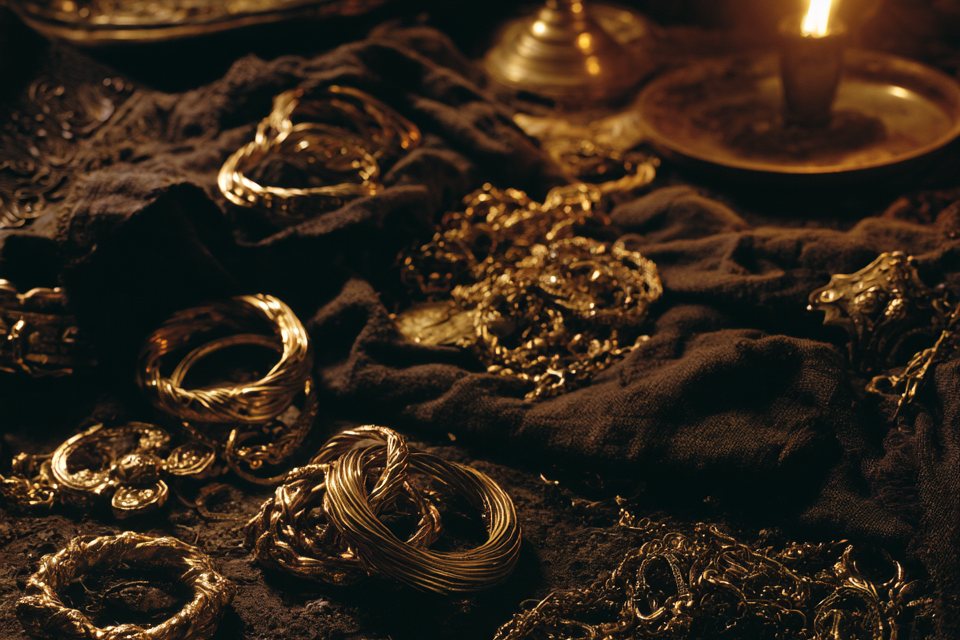
Gudme, on the Danish island of Funen, was one of the richest centres of power and cult in Scandinavia from the 3rd to the 6th century AD, and its name is usually read as “home of the gods”. A hall 47 metres long stood here; the fields have produced the Broholm hoard of more than 4.5 kilograms of gold, over a thousand Roman coins and many gold bracteates; and on the nearby coast lay its harbour, Lundeborg. Here is what counts as hard evidence, what is interpretation – and why Gudme became the blueprint for later royal seats.
In 1833 a plough working a field near Lundeborg, on the east coast of Funen, turned up something that had lain there for roughly three centuries: neck rings, arm rings, sword fittings, gold bars, a brooch, bracteates. More than four and a half kilograms of gold. The find took its name from the nearby Broholm estate and is still among the largest gold treasures from Denmark's prehistory.
Nobody suspected at the time that it was only the tip of something much bigger. A century and a half later, when archaeologists and metal detectorists began to comb the fields around the village of Gudme, it became clear that an entire landscape of precious metal, workshops and halls lay beneath the plough soil. And the village name itself might explain why. Gudme, on the usual reading, means “home of the gods”.
Gudme is not a Viking site. It flourished between roughly AD 200 and 600, in the late Roman Iron Age and the Migration Period. But if you want to understand where the royal halls of Lejre, the power centres on the Schlei or the mounds of Uppsala came from, this is where the story starts.
Gudme lies in south-east Funen, a few kilometres inland from the Great Belt, the strait between Funen and Zealand. Today it belongs to Svendborg municipality. Drive through and you see gentle hills, fields, patches of woodland and a small lake, Gudme Sø, east of the village. Nothing at first sight says “seat of princes”.
Archaeologists call places like this central places. The term describes a site where things that are normally scattered come together in unusual density: wealth, specialised crafts, long-distance trade, political power and cult. A central place is not a town in the medieval sense. There are no walls, no streets, no charter. But it performs functions that towns would later take over. Gudme is the classic South Scandinavian example, and much of the central-place debate of the 1980s and 1990s was worked out on this very site.
At its height the settlement spread across about one square kilometre. According to the Danish national encyclopaedia (lex.dk), up to 50 smaller farmsteads sat on the driest knolls; the National Museum of Denmark estimates a population of around 500. Some farms were rebuilt on the same spot as many as nine times between the 3rd and 6th centuries. That is continuity over many generations, not a brief flare of glory.
The name is what grabs most visitors first. In Danish scholarship, “home of the gods” is the standard interpretation. The first element is linked to Old Danish guþ, “god”, here in the sense of the pagan gods in the plural; the second to -hēm, “home, dwelling, settlement”. A reconstructed early form would be something like *Guðheimr. That form is reconstructed, though, not recorded in any Old Norse text. Our earlier version of this article called it “Old Norse Guðheim”, which overstated the case.
Gudme is not unique. Lex.dk counts eleven places of this name type in Scandinavia – among them Gudhem in Västergötland, Sweden. Gudme on Funen is regarded as the earliest, richest and largest. In 1985 the Danish place-name scholar John Kousgård Sørensen examined the Gudhem names as a group and interpreted them as denoting a place where the gods dwell.
It is not quite that tidy. The Swedish toponymist Stefan Brink later argued that we are probably dealing not with an original proper name but with a common noun, *gudhem, which became a name in several places. What exactly that word meant – a settlement, a farm, a district, a cult site – cannot be determined with confidence, in Brink's view; he calls the name “very elusive”. He does not, however, doubt that Gudme's name has a cultic background.
How divine names work in the landscape, and how to tell solid cases from wishful thinking, is something we cover in detail in Gods in Place Names.
Around Gudme sit other names that make you look twice. Across Gudme Sø lies Gudbjerg, “gods' hill”. Then there are two rises called Albjerg and Galdbjerg (also spelt Gjaldbjerg). The National Museum translates Albjerg as “the sacred hill” and Galdbjerg as “the sacrificial hill”. For Albjerg an old word for “sanctuary” is usually assumed, related to Gothic alhs, “temple”. Galdbjerg is linked by some to sacrifice and by others to galdr, “incantation”.
Put together, the picture is seductive: a home of the gods at the centre, framed by a gods' hill, a sacred hill and a sacrificial hill, with a lake in between. That is why many accounts speak of a sacred landscape.
This is where you need to keep things apart. It is certain that these names exist and that Gudme and Gudbjerg contain a “gods” element. The readings of Albjerg and Galdbjerg are much less secure, because the names are recorded late and allow more than one explanation. And the idea that all four names belong together as a deliberately designed ensemble is a modern hypothesis – plausible and stimulating, but not provable. Whether the lake itself had a ritual role, as lex.dk cautiously suggests, we simply do not know.
Gudme is Denmark's most important region for precious-metal hoards of the 4th to 6th centuries. Of the roughly 50 Late Iron Age gold hoards the National Museum lists for Denmark, a large share comes from this area.
The most famous is the Broholm hoard. Ploughed up in 1833 on a field called Enemærket near Lundeborg, it weighs more than 4.5 kilograms. Lex.dk dates its deposition to around AD 500. The National Museum thinks it probably consists of two hoards: one of “male” objects such as neck and arm rings, sword parts and gold bars, and one of “female” objects such as a gold brooch, bracteates and finger rings.
Smaller but telling is the so-called Gudme hoard, dated by the National Museum to around 500–550: nine gold bracteates, a small sword stud set with garnets in cloisonné (stones fitted into tiny gold cells), a finger ring, two round pendants and a worn Roman silver denarius. It lay beside a post of an Iron Age house. On another farm two deposits were found at the house posts: a large group of bracteates on one side, a bundle of gold neck rings with a gold spiral on the other.
Add to that what metal detectors have brought up from the fields since the 1980s: more than a thousand Roman coins, almost 600 brooches, silver bars, hacked-up Roman silver dishes, fragments of life-size Roman bronze statues, crucibles, moulds and casting waste. In 2010 a decorated gold ring weighing 140 grams joined the list. Gudme played a major part in shaping Danish detector archaeology – the close cooperation between museums and private detectorists that is now routine in Denmark was tested and refined here.
For a comparison with the later, mainly silver treasures of the Viking Age, see our piece on the great Viking silver hoards. At Gudme, gold still rules – gold that ultimately came from the Roman world as pay, tribute, trade profit or plunder.
Bracteates are thin gold discs stamped on one side and fitted with a loop, worn as pendants. They appeared in the 5th and early 6th centuries, inspired by Roman imperial medallions, and show heads, riders, animals and mythological scenes. Some carry runic inscriptions. At Gudme bracteates were not only found; judging by the workshop debris, they were probably made here too.
Reading their images is a field of its own. The scholar Karl Hauck interpreted many bracteate motifs as scenes of the gods – Odin healing a horse, for example, or the death of Baldr – and a bracteate from the Gudme area has been read in this way too. Such readings are stimulating, but they link 5th-century images to 13th-century texts. Seven hundred years lie in between. How much weight that bridge can bear is disputed.
How close bracteates can actually bring us to the gods is shown by the Vindelev find in Jutland, where one bracteate carries the oldest securely read mention of Odin's name. More on that in The Vindelev Gold Hoard.
Then there are guldgubber, gold foil figures: wafer-thin sheets of gold stamped with human figures, often no bigger than a fingernail. On the beach at Lundeborg alone, according to the Danish heritage agency, 102 were found near the mouth of the Tange Å. They date rather to around AD 600 and are usually interpreted as cultic – offerings, perhaps, or part of rituals in halls. Their purpose is not established.
Small male figurines and masks also stand out. The National Museum notes that depictions of men are common in the area. The hall excavations produced a small silver man's mask, probably made at Gudme itself.
The heart of Gudme lay east of today's village, near Gudme Sø, about five kilometres from the coast. In 1993 and 1994 archaeologists uncovered a sequence of monumental buildings on a rise here. The excavation was led by Palle Østergaard Sørensen, who in 2022 published the full analysis together with Mads Dengsø Jessen and Mads Lou Bendtsen.
The largest hall was 47 metres long and 10 metres wide – so our earlier figure of 48 metres was a touch generous. The roof rested on two rows of eight internal posts each, up to 70–80 centimetres in diameter. The walls were made of broad planks, and the main entrance was as wide as a gateway. In the middle lay a large open room, with no workshops and no byre. That is the crucial point: this was not a farmhouse but a place for feasts, assemblies, gift-giving and ceremony.
It was built in the late 3rd century, around AD 300. The National Museum speaks of about a hundred years of use; the Danish heritage agency of a lifespan into the early 5th century. Before it, the site held two much smaller buildings of about 12 by 5 metres; when they were pulled down, Roman glass, jewellery and weapon parts were deposited.
Next to the great hall stood a smaller but very solidly built structure, a little over 20 metres long, that was demolished and rebuilt on the same spot several times between the 3rd and 6th centuries. It is interpreted as a cult building. The excavators stress that the large entrances of the two buildings faced each other. This pairing – big hall, small cult house beside it – would shape aristocratic sites across Scandinavia for some 800 years.
And then the finds from the hall area: 115 Roman silver coins and many fragments of gold jewellery, some in postholes and pits. Part of the jewellery came from south-eastern Europe and may have been made in an Ostrogothic milieu in the 4th century. Two deposits of gold and silver lay against the roof-bearing posts of one of the buildings. A bundle of treasure placed against the post that holds up the roof is not a panic stash. It is very probably a deliberate offering at the building's construction or demolition.
In the 6th century the halls disappear from this spot; afterwards only an ordinary farm stood there. Whether a new hall was built elsewhere in Gudme is unknown.
Gudme is not on the coast. That was probably deliberate: a power centre set back from the sea is safer from seaborne raids. Access to the sea came through Lundeborg, about five kilometres to the east, where the small Tange Å river runs into the Great Belt.
Here, from the late 1980s, Svendborg Museum investigated a trading and craft site that lex.dk calls the oldest known in Denmark. The occupation layer runs about 900 metres along the beach and is almost a metre thick in places. It was evidently seasonal: in summer there were huts and tents, in winter the beach lay empty.
The list of activities reads like the directory of an early industrial estate: smiths working iron, gold and silver, bronze casters, comb makers, glass-bead makers, amber workers. Shipwrights left tools and thousands of ship rivets from repairs. Iron bars arrived from western Jutland, Norway and Sweden; Roman glass and bronze vessels from the south. Payment was made in pieces of gold and Roman silver denarii – by weight and metal value, not face value.
The division of roles is striking: Gudme inland as the seat of power and cult, Lundeborg on the coast for trade and craft, the cemetery in between. A lord who protected the market could also tax it. That the ruler of Gudme did just that is a common and plausible assumption put forward by the National Museum – there are no written sources for it.
Between Gudme and Lundeborg lies Møllegårdsmarken, with more than 2,000 graves one of the largest Iron Age cemeteries in Denmark. Most burials date from around 200 to 500. Graves were already being opened there in the 19th century, and their finds are one reason why Gudme was recognised early on as exceptional.
We know so much about Gudme today thanks to a remarkable pooling of effort. In the 1980s detectorists and archaeologists began surveying the fields systematically. Out of that grew a long-term collaboration between the National Museum, Svendborg Museum, other museums on Funen and the University of Copenhagen. Svendborg Museum dug mainly at Lundeborg; work on the halls in the centre of Gudme followed in 1993/94.
A milestone was the volume The Archaeology of Gudme and Lundeborg, edited by Poul Otto Nielsen, Klavs Randsborg and Henrik Thrane and published in Copenhagen in 1994. It drew together a decade of intensive work. Almost three decades later, in 2022, Gudme: Iron Age Settlement and Central Halls presented the excavations in the centre in full.
The history of research also shows how interpretations shift. Early on, the sheer wealth took centre stage. Later, the halls and questions of cult and ideology moved to the fore.
The boldest interpretation comes from the Danish archaeologist Lotte Hedeager. In her essay “Asgard reconstructed? Gudme – a ‘central place’ in the North” (2001), she asked whether Gudme was laid out as an earthly mirror of the divine world: a home of the gods with its hall, surrounded by sacred hills, with a place for trade and craft on the periphery – much as, in the later tradition, Asgard stands at the centre with the worlds of humans and giants around it.
The hypothesis is an invitation to think, not a finding. It has strengths: it takes the place-names seriously and explains why cult and power fused so closely here. It also has weaknesses. Our images of Asgard come mainly from 13th-century tradition, written down by Christian Icelanders. Whether the people of Gudme around AD 400 carried a similar world order in their heads cannot be tested. Conversely, it is quite conceivable that later ideas of the gods' halls were modelled on real halls like the one at Gudme.
Gudme is not the only central place of its kind. Its closest relative lies in Scania, now southern Sweden: Uppåkra near Lund. There, too, a large settlement with extraordinary finds; there, too, precious metal, long-distance trade and a small, very solidly built structure interpreted as a cult house and renewed on the same spot over centuries. Lex.dk names Uppåkra, along with Sorte Muld on Bornholm, as a direct comparison.
The main difference is longevity. Gudme's brilliance fades from the 6th century: finds become rarer, farms fewer and smaller, and parts of the landscape revert to woodland, even though individual finds run into the Viking Age. Uppåkra, by contrast, stayed important well into the Viking Age and was only superseded around the year 1000 by newly founded Lund.
What both share is the pattern: a rich inland centre, a cult building, a hall, and trade links reaching the Roman Empire. Put Gudme and Uppåkra side by side and it becomes clear that this was not one eccentric prince building on a whim, but a shared form of lordship taking shape across southern Scandinavia.
Gudme's decline in the 6th century falls in a time of deep upheaval. The Western Roman Empire had gone, and the flow of gold from the south dried up. In the mid-6th century came a climate crisis, with cold years after major volcanic eruptions, which left traces in Scandinavian settlement and offering practice. Whether it hit Gudme directly is not proven.
The model, however, lived on. Gudme's excavators emphasise that the pairing of big hall and small cult building shaped Scandinavia's aristocratic seats for some 800 years. You find it at Lejre on Zealand, where great halls stood from the 6th century and where the tiny silver figure on the high seat was found. You find it at Tissø, also on Zealand, with a hall and a fenced cult area. And you find the idea of royal power, cult and assembly in one place at Gamla Uppsala and later at Jelling.
The road to the town starts here too. Lundeborg is a seasonal beach market under the protection of a lord in the hinterland. Centuries later come places like Ribe and Hedeby, where trade, craft and royal protection come together permanently. The line is not straight, and Gudme is not literally the “ancestor” of these places. But the building blocks are the same.
So Gudme can fairly be read as a forerunner of the Viking Age power centres – with one caveat. Gudme is not an “early Hedeby” and not a “Viking Asgard”. It is a power centre in its own right, from an age still in direct contact with Rome.
Travel to south-east Funen and you can still trace this story in the landscape. The site of the great hall is signposted as a destination under the name Gudmekongens Hal, “the Gudme king's hall”. The countryside around Gudme Sø, with Gudbjerg on the far side, is easy to explore on foot or by bike, and Lundeborg is today a quiet little harbour. The great treasures themselves are in the National Museum in Copenhagen, in its prehistory galleries. For more ideas for a trip north, see Experience the Vikings: Museums and Sites.
For us at Glanz & Gravur, Gudme is a favourite reminder of a simple truth: gold glitters, but the real story lies in postholes, in names on the map and in the gifts someone placed against a hall post sixteen hundred years ago. When we engrave a bracteate motif or a line of runes in slate, this is the world of images we are drawing on.
What does the name Gudme mean? The usual interpretation is “home of the gods”, from a word for the (pagan) gods plus “-home”. The reference to gods is considered certain; what exactly “home” denoted is still debated by place-name scholars.
How big was the hall at Gudme? The largest hall was about 47 metres long and 10 metres wide and was built around AD 300. It is among the largest known buildings of Danish prehistory.
What is the Broholm treasure? A gold hoard of more than 4.5 kilograms found near Lundeborg in 1833 and buried around AD 500. It probably comprises two hoards containing rings, sword parts, bars, a brooch and bracteates.
Was Gudme a Viking site? No. Gudme flourished between about AD 200 and 600, before the Viking Age. It is, however, seen as a forerunner of later power centres such as Lejre and Tissø.
Where can I see the Gudme finds? The most important treasures are on display at the National Museum of Denmark in Copenhagen. On site, the hall location is signposted as Gudmekongens Hal.
How is Gudme related to Uppåkra? Both are rich central places in southern Scandinavia with a hall and a cult building. Uppåkra in Scania, however, remained important much longer, into the Viking Age.
For courage. For remembrance. For legends that live on.
Tissø · Gamla Uppsala · Hedeby · The Norse pantheon.
All History & Finds articles →
They are so small and so thin that you can barely hold one without creasing it: the guldgubber, “gold men,” tiny …
Read more →In 1891 peat-cutters in a bog near Gundestrup in Jutland struck something metallic: a dismantled cauldron of pure …
Read more →Here silver from Baghdad, furs from the North and glass from the Rhineland came together. Hedeby was the pulsing …
Read more →Long before the Vikings, a Roman writer describes a Germanic tribe that defeats its enemies not by number or strength …
Read more →