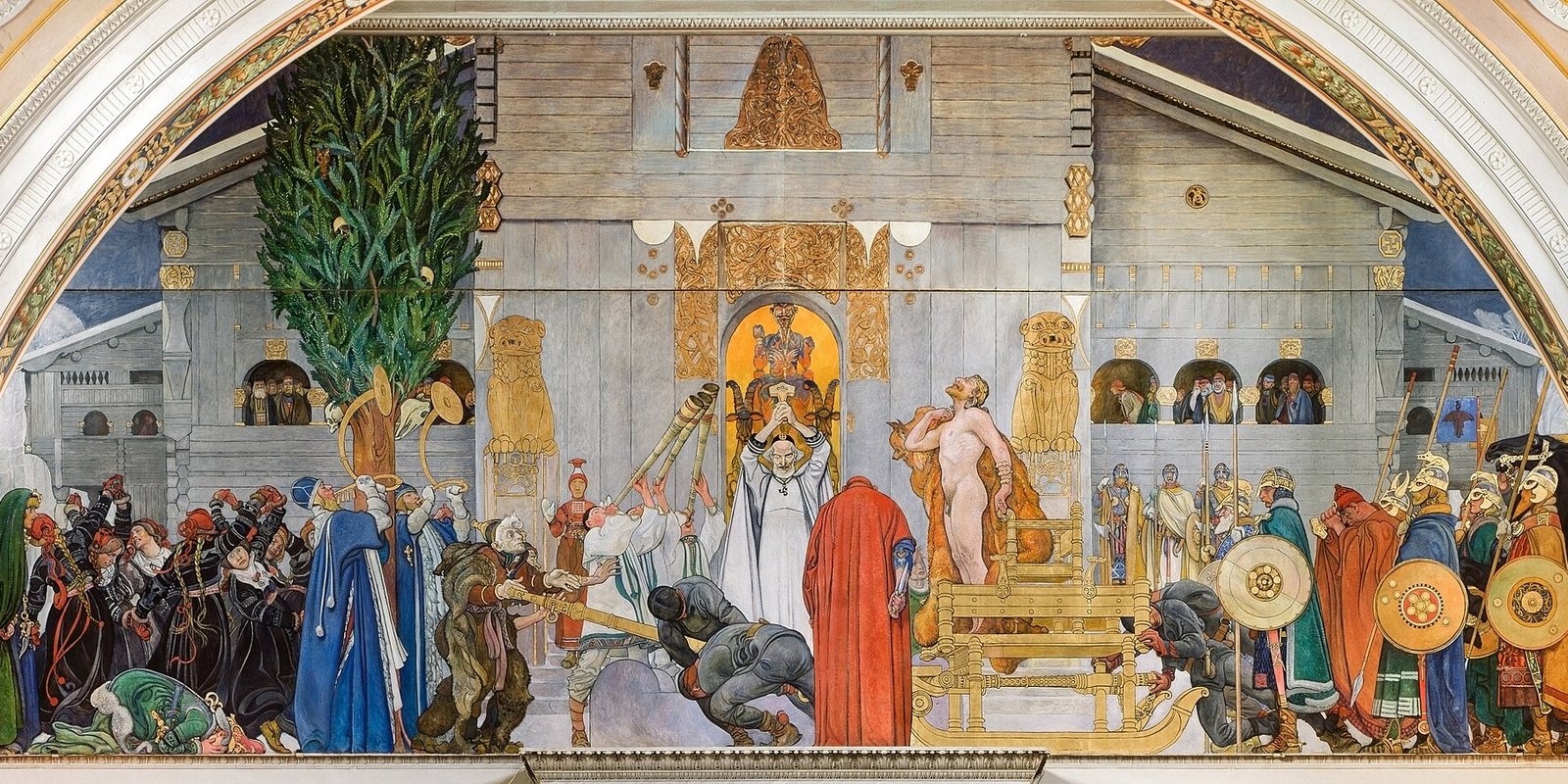
The Norse had no holy book, no pope and no fixed liturgy. Their faith lived in action: in the sacrificial feast at the turning point of the year, in the drinking horn passing through the hall, in the naming of a newborn and in the oath sworn upon a ring. This overview gathers what we know about their rituals – and carefully separates what sources and finds actually prove from what modern heathenry has reconstructed.
Anyone wanting to understand Viking Age ritual must first set aside one expectation: there was no unified religion with dogmas, a priestly caste and an order of service. The pre-Christian cult of the North was local, family-based and pragmatic. People celebrated where they lived – on the farm, in the leader's hall, at sacred places in the landscape. Whoever hosted the feast was usually the same person who held worldly power: the head of the household, the chieftain, the goði, the king. Cult and community could not be separated.
This also shapes what we can know. Part of the evidence is archaeological – animal bones at cult sites, amulets, memorial stones, grave goods. Another part sits in texts written down centuries later, mostly by Christians. Snorri Sturluson described the old sacrificial customs around 1230, a good two hundred years after Iceland's conversion. Such accounts are valuable, but they are literature and hindsight, not first-hand minutes. Honest ritual lore therefore always means distinguishing what is secure from what remains interpretation.
The most important ritual was the blót. The word is linked to the verb blóta, "to sacrifice, to worship", and is related to the word for "blood". A blót was sacrifice and communal feast in one: animals were slaughtered, the blessing of the offering was shared with the gods, and afterwards people ate together. It was not about grim mysticism but about harvest, peace and cohesion – til árs ok friðar, "for a good year and peace", is the recurring formula.
In Heimskringla, Snorri describes how such a feast supposedly proceeded: farmers brought livestock and ale, the blood of the slaughtered animals – called hlaut – was caught in bowls, and with sacrificial twigs the altars, the walls of the temple and the assembled people were sprinkled. The meat was boiled in cauldrons and eaten together while the drink went round.
Fires were to be in the middle of the temple floor, with cauldrons over them. The full cup was to be carried around the fire. He who gave the feast and was chief was to bless the cup and all the sacrificial food. First Odin's cup was to be drunk – emptied for victory and the power of the king – and then Njörd's cup and Frey's cup for a good year and peace.Snorri Sturluson, Hákonar saga góða (Heimskringla), ch. 14; rendered from the public-domain text
Such feasts were tied to fixed points in the year – the start of winter, midwinter and the start of summer. Where sacrifice happened is shown by archaeological cult sites with striking concentrations of animal bones and deposits; we treat these in our piece on blót sites and cult places, and the seasonal dates are set out in our comparison of the wheel of feasts.
Alongside the blót stood the sumbel (Old Norse sumbl), the ritual drinking gathering. It was no mere binge but an ordered act in the hall. The drinking horn passed from hand to hand, and three things recur in the sources in connection with the drink: the full, the toasting cup dedicated to a god or to rulership; the minni, the memorial draught to deceased kin and ancestors; and the heitstrenging, the solemn vow with which a man pledged a promise over the cup – often a bold deed for the coming year.
The spoken word over the horn carried weight. A vow made at the sumbel was public and binding; keeping it was a matter of honour. So the sumbel wove together memory, community and personal obligation. Anyone who today sits with friends by the fire, raising the horn in turn and speaking words, senses something of the power of this old rite – even if the precise choreography often re-enacted today is not attested that way (more on this below).
The drink of choice was usually ale or mead, the drink of the hall. The sagas tell of lords who bound their followers to them through lavish winter feasts – generosity was a ruler's virtue, and the full cup a tool of politics. At the same time drinking held the danger of excess; the Hávamál, the Sayings of the High One, warn expressly against the drunkenness that robs a person of wits and honour. Ritual and warning thus stood close together: the sumbel was celebration and test in one.
Rituals accompanied a person from cradle to grave. After birth came the naming: the child was formally received into the family, sprinkled with water (ausa vatni) and named. Only through this act did it count legally as a full member of the kin. It matters that this water-consecration is attested as pre-Christian and must not be confused with Christian baptism – it is a distinct Norse custom.
Marriage was less a religious act than a legal contract between two families, sealed by a handclasp (handsal), bride-price and dowry, and celebrated with a great feast. Death, finally, was the most ritual-rich event of all: burial by cremation or inhumation, often with rich grave goods, sometimes in a ship or under a mound. We treat the various forms of these life transitions in detail in our pieces on heathen life ceremonies and on boat burial.
The Norse wanted to know what was coming. Several techniques served this. The best known and best attested is seiðr, a form of magic and prophecy practised above all by women, the völur (seeresses). A famous description in the Saga of Erik the Red shows such a seeress predicting the coming year from a raised seat after a special song was sung. We devote a separate article to the subject of seiðr.
Alongside this there were casting-lot oracles and sign-reading. The Roman author Tacitus already describes, for the early Germanic peoples, how marked wooden slips were thrown and read as omens. Caution is needed, though: older translations like to turn these into "runes", yet Tacitus only writes of "certain signs". The now popular rune oracle, with a fixed card-like meaning per symbol, is a construction of the 20th century, not a Viking Age fact.
The oath was one of the most serious ritual acts of all, for it joined religion and law. Whoever swore often did so upon a sacred ring, kept in the temple or at the cult place and moistened with sacrificial blood. Such a ring-oath counted as binding before men and gods; to break it was sacrilege. Consecration formulae belong here too: several runestones carry the plea "Þórr vígi" – "may Thor hallow" or "may Thor protect" – placing a monument or grave under the god's protection.
This link of cult and law shows how deeply ritual permeated daily life. A contract, a court verdict, an alliance – all gained their binding force through the ritual invocation of higher powers. The oath was the glue of a society without police and without an enforcing state apparatus.
The great feasts followed the course of the year and the farming rhythm. Winter Nights in autumn, Jól at high winter and a feast at the start of summer formed the corner points. It matters here to grasp that the Norse year was not divided into eight even "sun feasts", as the modern eightfold wheel of the year suggests. What is attested above all are the three great blót dates and individual regional feasts; much else is later synthesis. The overview is provided by our article on the wheel of feasts.
Rituals needed a place. Unlike Christianity, the North long knew no purpose-built temples as the rule. Worship happened in nature and in the life of the farm: at sacred groves, at springs, stones and trees regarded as the seat of higher powers. The term vé denoted a consecrated, protected precinct in which armed force and bloodshed were forbidden – a space of peace. The hörgr was originally a stone altar or cairn in the open, the hof more of a hall that also served the cult. The idea of a splendid heathen "temple" with god-statues, as Christian chroniclers describe for Uppsala, should be taken with caution; what is archaeologically tangible is more often cult halls and deposition places than monumental sacred buildings.
This tie to place explains much: whoever sacrificed did so where the community gathered anyway, and where the landscape itself was held sacred. Place-names preserve this geography to this day – names with the elements -vé, -hörg, -hof or god-names such as Odin, Thor and Frey mark former cult sites. Where sacrifice and celebration actually took place, and what the excavations show, is deepened in our article on the blót sites.
Not every ritual was a great feast. Far more frequent, and archaeologically most tangible, are gifts and deposits: objects deliberately laid down or sunk to win the favour of higher powers or to give thanks for what had been received. In bogs, lakes and springs, weapons, jewellery, tools and food remains have been found – some of it plainly made unusable, bent or broken, so that it was lost "to this world" and handed over to the gods.
On the personal level people wore amulets. The best known is Thor's hammer (Mjölnir) as a pendant, especially widespread in the late Viking Age – often a confident avowal of the old faith just as Christianity was advancing. Alongside it are small pendants in the shape of a firesteel, a chair or a weapon, and iron amulet-rings with attached miniatures. Such objects are mute but reliable witnesses: they show that cult lived not only in the festal calendar but was worn on the body and in daily life.
There was no full-time priesthood of a Norse stamp. Cultic and worldly leadership lay in the same hands. In Iceland the local authorities were called goðar (singular goði); the word already carries it: it is linked to "god" and denotes someone who was at once legal representative and cult leader. On the individual farm the head of the household led the sacrifice, and women held important ritual roles – in prophecy, in serving the toasting cup in the hall, and at the Álfablót, a more private, domestic offering that one famous source reports strangers were not welcome to attend.
Here a sober look pays off. Much that circulates online today as "this is how the Vikings did it" is in truth modern assemblage. That does not make it worthless – living heathenry (Ásatrú) has shaped a practice worth celebrating out of the fragments. But honesty demands separating the one from the other.
Secure or well attested: the blót as a sacrificial feast with animal slaughter, blood-sprinkling (hlaut) and communal meal; the drinking formulae full and minni; the consecration formula "Þórr vígi" on real runestones (such as Glavendrup and Virring); the water-consecration ausa vatni as a pre-Christian naming custom; seiðr as a divinatory practice; the oath upon the sacred ring. These elements rest on sagas, skaldic poetry, runic inscriptions and archaeological finds.
Reconstruction or myth: the exact choreography of the sumbel with a fixed "three rounds" (gods – ancestors – boasting vow) is a sensible but modern ordering of the 20th century, not a transmitted procedure. Ritual cries such as "Hail Odin!" are not attested in that form. And the drastic human-sacrifice reports, above all Adam of Bremen's account of nine men sacrificed per animal species at the temple of Uppsala, are hostile Christian outside-view at second hand, whose figures are moreover shaped by number symbolism (the sacred nine) – as factual reportage they do not hold.
Anyone taking up the old customs today need not pretend to have travelled back to the Viking Age. A blót can be celebrated as a communal feast of gift and thanks, a sumbel as a dignified round with horn, memory and good resolutions. How living heathenry practises these forms, and where it honestly distinguishes evidence from its own shaping, is shown in our article How do heathens celebrate today? Blót and Sumbel explained.
For us in the workshop these rituals are more than folklore: they explain why people to this day want to fix a name, a date, a toast or a protective sign in stone and wood. An engraved drinking-horn motif, a consecration formula, a keepsake – at heart it is the same impulse that led the Norse to hallow the cup and set the stone: to give the word and the moment lasting form.
Blot Sites: Horgr, Hof & Cult Hall · Seiðr – the magic · Heathen life-feasts · How do heathens celebrate today?.
All Festivals & Belief articles →
Emperor Barbarossa sits in the Kyffhäuser, his head propped on the table, his beard grown through the stone slab …
Read more →The summer solstice is the longest day of the year – and was one of the great feasts of pagan Europe. Germanic peoples …
Read more →