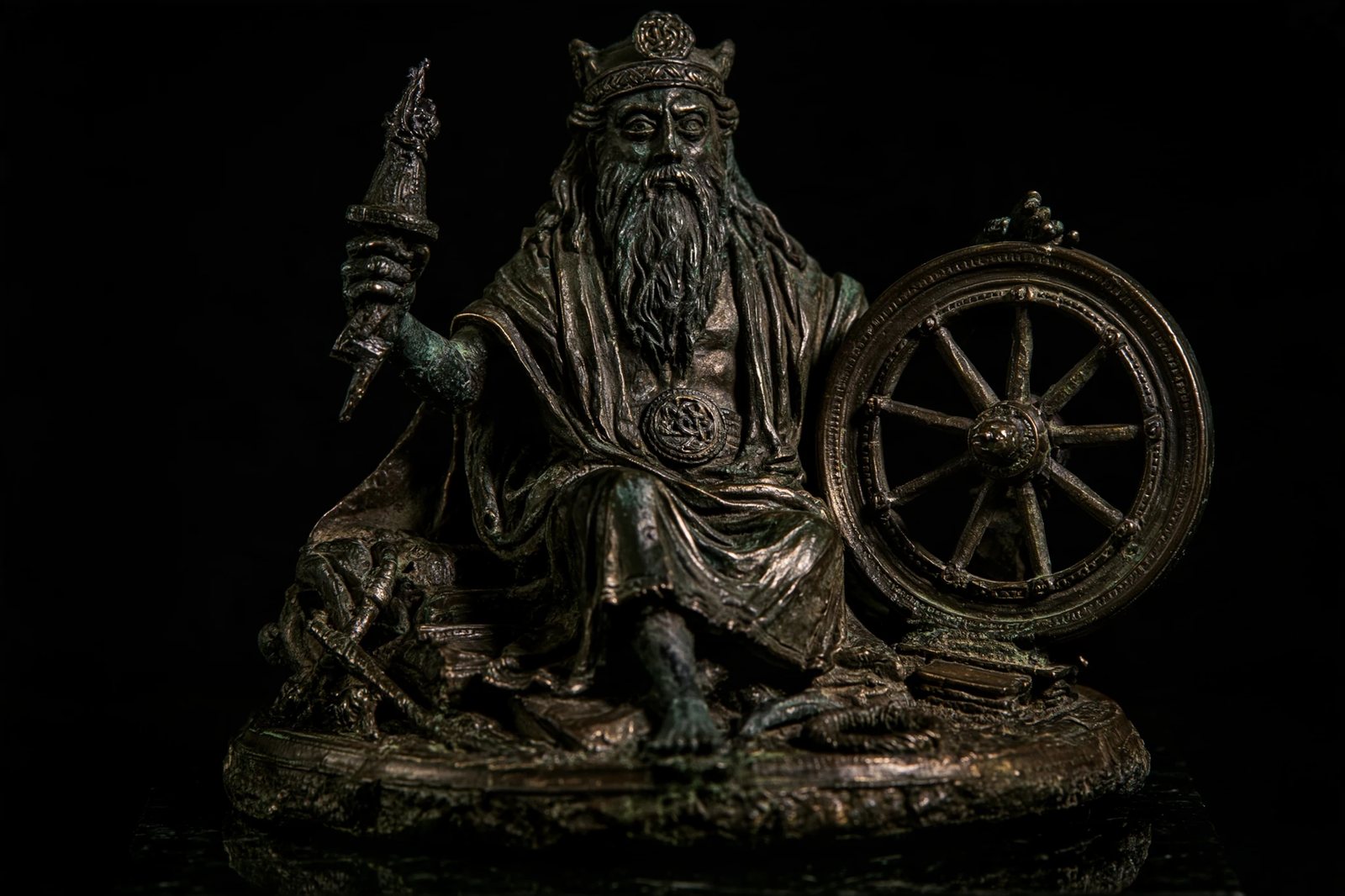
Taranis is the Celtic god of thunder – his name is related to the Celtic word for "thunder" (cf. Welsh taran). The Roman poet Lucan names him in one breath with Teutates and Esus as one of the great Gaulish deities. Taranis is the lord of the sky and the storm.
His emblem is the wheel. Numerous images show a bearded sky god with a spoked wheel in his hand – interpreted as a sun, sky or thunder wheel. Small bronze wheel pendants were worn as amulets; the wheel was the Celtic thunder and sky sign par excellence.
Taranis belongs to a large Indo-European family of weather gods. The parallel to the Germanic Donar and the Norse Thor is obvious: a strong, bearded lord of the sky who protects people with thunder and a weapon/sign. Where Donar swings the hammer, Taranis holds the wheel – the same role, a different visual language. The Rhine separated two related worlds of belief, not utterly foreign ones.
"Wits must he have who wanders wide, but all is easy at home."Hávamál 5, after Henry A. Bellows 1923 (public domain)
Taranis was the thunder god of the Celtic world – his name contains the Celtic word for "thunder" (taran). As lord over sky, storm and lightning he was among the most powerful deities of the Celts.
His most important symbol was the wheel. Small bronze wheel-pendants were worn as amulets; the wheel probably stood for sun, sky and thunder. Thus Taranis is well recognisable on votive stones and images.
The Roman poet Lucan names Taranis in a triad with Esus and Teutates as one of the great Gaulish gods. Later commentators connected him with sacrificial customs – reports that must be read critically.
The thunder god with his symbol is a prime example of shared Indo-European ideas: where the Celt worshipped Taranis with the wheel, the Germanus knew Donar and the Norseman Thor with the hammer. Related gods, separated by the Rhine.
Taranis is the Celtic brother of Donar and Thor: the thunder god whose sign was not the hammer but the wheel. More in the overview Celtic Religion.

Celtic Religion · Lugh · Teutates · Wodan, Donar & Ziu · Cernunnos.
All Festivals & Belief articles →
The Vikings had no capitals, but they had places of power: sites where law was spoken, sacrifice made and the ancestors …
Read more →In the middle of January, when the wind scours Iceland and the days have only just begun to lengthen again, Icelanders …
Read more →Through the long winters of Iceland's farmsteads ran a fear that had nothing to do with trolls or giants and everything …
Read more →