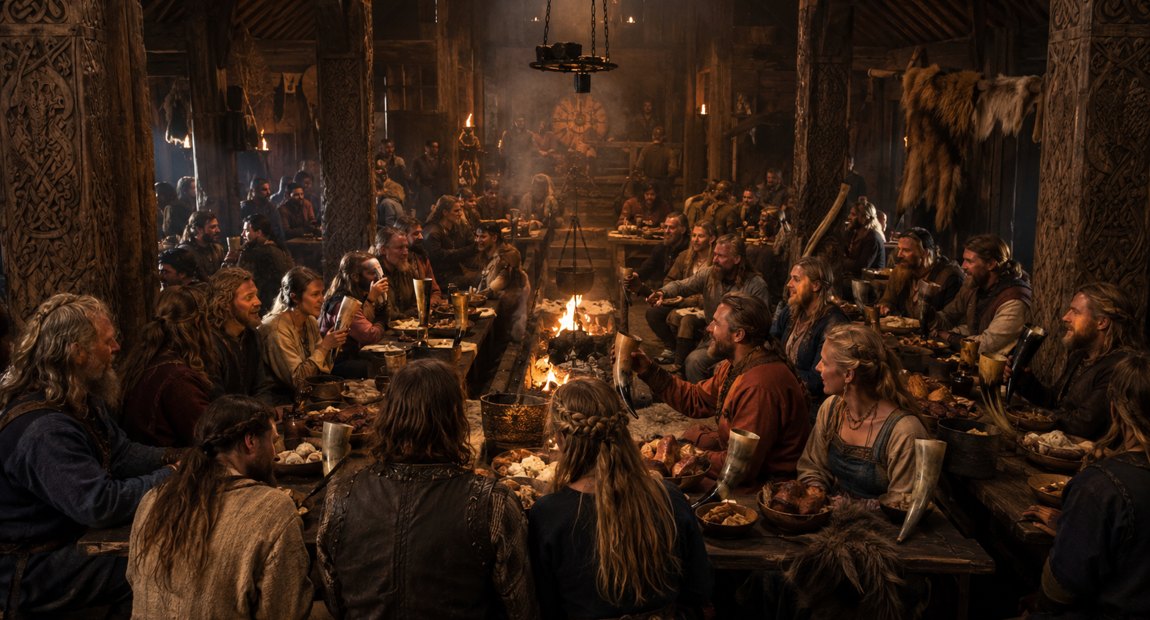
In the middle of January, when the wind scours Iceland and the days have only just begun to lengthen again, Icelanders set a table with soured ram's testicles, fermented shark and blood sausage. They call it Þorrablót, the feast of the month of Þorri, and it sounds like grey Viking antiquity. The truth is both prettier and more honest: the month is ancient, the feast is young, and the food is very nearly post-war. Let us pull up a chair and sort belief from myth.
Þorri is the fourth winter month of the Old Icelandic misseri calendar, that idiosyncratic system which divided the year not into four seasons but into two great ones: summer and winter, six months each. Þorri falls roughly from mid-January to mid-February, the depth of winter, when stores run low and spring is still far off. It always begins on Bóndadagur, the „Farmer's Day", which falls on the Friday between the 19th and 25th of January, and it ends the day before Konudagur, the „Woman's Day", which opens the following month, Gói.
This is not romantic back-projection but well-documented calendar routine. The name of the month appears in medieval Icelandic sources, and the rule that it begins on Bóndadagur has proved so tenacious that it still stands in every Icelandic calendar today. So anyone who speaks of an „old Þorri" is right. But one must add at once: the month is the old part; the feast is something else entirely.
Where does the name come from? Two closely related texts tell the same story. One is Hversu Noregr byggðist, „How Norway Was Settled", preserved in the fourteenth-century Flateyjarbók; the other is the opening chapter of the thirteenth-century Orkneyinga saga. Both trace the month's name to a King Þorri, a descendant of the primeval giant Fornjótr and son of Snær, whose name simply means „Snow". To this king, they say, the Kvens made a midwinter sacrifice so that it might snow and the skis run well.
„Thorri was a noble king; he ruled over Gothland, Kvenland, and Finland. To him the Kvens sacrificed that it might be snowy, and that there might be good going on snow-shoon. That was their harvest."Hversu Noregr byggðist, trans. George W. Dasent, 1894 (public domain)
A sacrifice for good snow, so that the snowshoes would carry: for a people of the far North this was no whimsy but harvest in the literal sense. „Þat er ár þeira", says the Old Icelandic text, „that is their harvest-blessing". The tale goes on that Þorri's daughter Gói vanished one winter; her father made his sacrifice a month later than usual to find her again, and so the next month bears her name. A neat, self-consistent naming story, with only one snag: taking it for straight history.
The commonest error lies in the sound itself. Þorri looks like a relative of Þórr, the thunder god with the hammer, and sure enough Þorrablót is often sold as „Thor's feast". This is folk etymology. The two names are simply not the same word, and the saga itself explicitly derives the month from King Þorri, not from the god. So anyone who wants to swing the hammer at the next winter feast does so for the joy of it, not out of philological necessity. Skål all the same.
The genealogy, too, should be taken with a grain of salt. Þorri as „king of Finland and Kvenland", son of Snow, grandson of the primeval giant: that is learned medieval construction, not a cult report from heathen times. Icelandic scholars assembled such pedigrees backwards, to furnish royal houses with a venerable origin. The name of the month already existed, and a founding father was invented to go with it, the way an old house is fitted with a suitable story.
And here lies the real gap. Between the saga note of the twelfth to fourteenth century and the present day, there is no continuous chain of celebrated Þorrablóts. The literary claim of a midwinter sacrifice stands in the manuscript, but an actually observed feast cannot be traced for the intervening centuries.
Þorrablót as Iceland knows it today is a nineteenth-century invention. The first known celebration was organised in 1873 by the Society of Icelandic Students in Copenhagen, carried by the wave of national enthusiasm that a year later flowed into Iceland's first constitution. It was a deliberately staged reach into the supposed distant past, a romantic-national act of self-assurance. One might compare it to the Scottish Burns Night, or to many another „ancient" custom of Europe that, on closer inspection, turns out to be a child of the Romantic era. A people striving for its independence gave itself a feast that tasted of roots.
Younger still than the feast is its most famous hallmark, the þorramatur. Whoever thinks of Þorrablót today sees the wooden trough before them, filled with cured and fermented country fare: hákarl, the Greenland shark buried for months; boiled and pressed sheep's head; blood pudding and liver sausage in sour whey; soured ram's testicles. Foods from a time when preservation decided over life and death and nothing was thrown away.
These foods are old; their staging as a festival platter is not. In 1958 the Reykjavík restaurant Naustið assembled a selection of nearly forgotten country dishes, arranged them in a wooden trough modelled on examples from the Þjóðminjasafn, Iceland's National Museum, and marketed the whole thing as „þorramatur". A marketing idea that caught fire. Within a few years a post-war restaurant notion became the national winter meal that people now take for pure Viking heritage. The shark is genuinely old; the trough on the table is younger than rock and roll.
The month-name Þorri is attested in the Middle Ages, as are the misseri calendar and its start on Bóndadagur between the 19th and 25th of January. The sagas Hversu Noregr byggðist and Orkneyinga saga tell of King Þorri and a midwinter blót for good snow. Securely dated, too, is the modern part: the first celebrated Þorrablót in 1873 by Icelandic students in Copenhagen, and the þorramatur trough in 1958 from the restaurant Naustið.
Despite the echo, Þorri has nothing to do with the god Þórr; the „Thor's feast" derivation is folk etymology. The saga genealogy is learned medieval construction, not a heathen cult report. Above all: between the saga note and 1873 lies a gap in the record with no attested feast. The notion of an „unbroken tradition since the Vikings" is therefore false. This does not lessen its charm.
One could now be disappointed and dismiss Þorrablót as a costume party. That would be petty. Invented traditions are no less real for our knowing their date of birth. A feast celebrated every January for more than a hundred and fifty years, gathering families and carrying a whole nation through the darkest part of the year, is a living tradition, whether its origin lies in the ninth century or the nineteenth. Icelanders know this best of all, and celebrate anyway, or precisely for that reason.
What we like about this story is that it allows both: the honest examination and the joy of the custom. Deep winter was always, for the people of the North, the time to draw close, share the store and drink toward the spring. Whether one invokes a legendary king or simply lifts the cup, the feast remains the same: a light against the dark. In that spirit, when Bóndadagur comes and the trough stands on the table: Skål.
Jól – the Yule feast · The Germanic feasts · Mead – the drink of gods · The solstice festivals · Runes & their meaning.
All Festivals & Belief articles →
Through the long winters of Iceland's farmsteads ran a fear that had nothing to do with trolls or giants and everything …
Read more →When the nights are longest and the fire in the house is warmest, the departed draw nearer. Yule, the midwinter feast …
Read more →For our ancestors the year was no sheet on the wall but hard, beautiful work: to sow, to tend, to harvest, to store …
Read more →The old faith of our ancestors has not died out – it is being lived again. “Ásatrú”, literally “true to the Æsir”, is …
Read more →