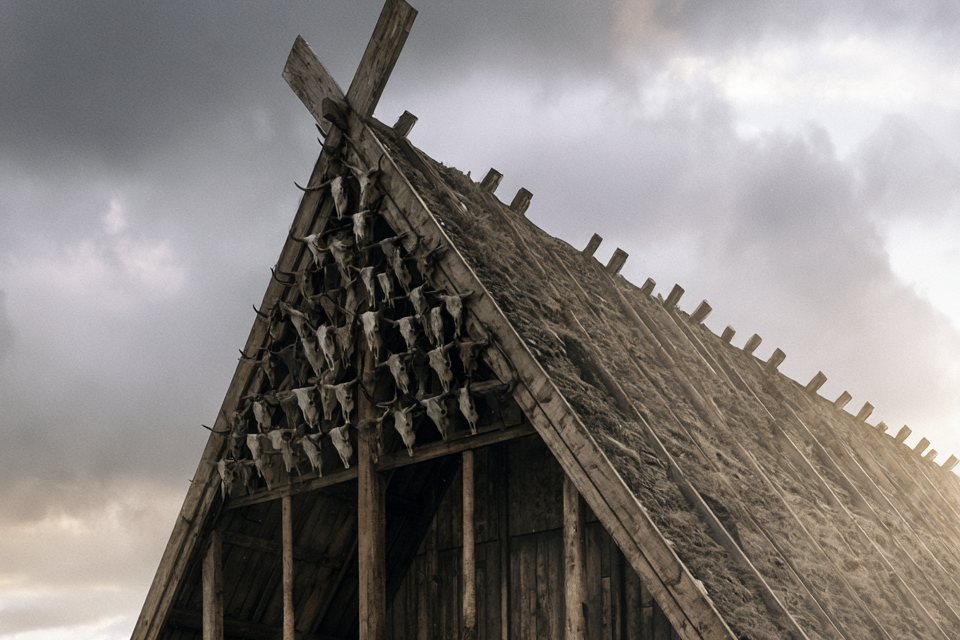
The Germanic festivals we can actually prove fit on one hand: a sacrifice at the start of winter, Yule at midwinter and a victory sacrifice at the start of summer. That is how Snorri lays it out in Ynglinga saga. Add the Dísablót, the Winter Nights, Bede's Anglo-Saxon "Mothers' Night" and the great nine-yearly gatherings at Lejre and Uppsala. What is missing is an ancient eight-spoked wheel with Ostara, Litha and Mabon. That wheel was built in the twentieth century. Here is the honest festival calendar, source by source.
Search for "Viking festivals" or "pagan holidays" and you will be handed a tidy wheel with eight spokes: Yule, Imbolc, Ostara, Beltane, Litha, Lughnasadh, Mabon, Samhain. Neatly drawn, evenly spaced, decorated with candles and herbs. The trouble is that no Viking and no Saxon would have recognised it. The real sources are rougher, patchier and far more interesting. They tell of blood in cauldrons, of farmers forcing their Christian king to eat horse liver, of a poet who had door after door shut in his face, and of a year that only had two seasons.
The Germanic-speaking peoples did not write down their own festival calendar. What we know comes from three layers of evidence that need to be kept apart.
The first layer is outside observers writing during the pagan period or shortly afterwards: the Roman historian Tacitus around AD 98, the Anglo-Saxon monk Bede in 725, the Saxon bishop Thietmar of Merseburg between 1012 and 1018, and Adam, a canon of Bremen, around 1075. They are close in time, but Christian and often reliant on hearsay.
The second layer is skaldic poetry: verses composed at Viking Age courts and later quoted inside the sagas.
The third and richest layer is the Icelandic sagas and Snorri Sturluson in the thirteenth century. Snorri wrote more than two hundred years after Iceland's conversion. He was well informed but systematised where reality was probably messier; see our portrait of Snorri Sturluson.
Archaeology adds halls, cult sites and animal bones. It proves that people feasted and sacrificed, but it rarely tells us on which day. For the places themselves, see our piece on blót sites: hörgr, hof and cult hall.
Before we look at individual festivals we need to rethink the year itself. In the North it consisted of two halves, Old Norse misseri: summer and winter. Spring and autumn were not separate seasons. Age was counted in winters, and in the Icelandic sagas a boy is "twelve winters old".
This was not a purely Scandinavian habit. Bede writes in The Reckoning of Time (De temporum ratione, chapter 15) that the pagan English originally divided the year into two seasons, summer and winter: the six months in which days were longer than nights were summer, the other six winter. Tacitus noticed centuries earlier, in Germania chapter 11, that the Germanic peoples counted nights rather than days. English still remembers this in the word fortnight, "fourteen nights".
Months were lunar, which meant they constantly drifted against the solar year. Bede explains the Anglo-Saxon fix: in some years they added a thirteenth month to the summer. Festivals were therefore tied to moon phases and seasons rather than to fixed calendar dates. How the Icelanders later turned this into a fixed week-based system is shown in our Old Norse calendar.
The Old Norse word blót means "sacrifice", but it always meant the feast as well. There was no sermon and no holy book. Religion was something people did together: an animal was slaughtered, its blood collected, its meat boiled and shared, and drinking horns went round.
The most detailed description comes from Snorri's Hákonar saga góða, the saga of Hákon the Good in Heimskringla, in its passage on sacrificial customs (chapters 14 to 16, depending on the edition). In paraphrase: at a blót all the farmers came to the temple and brought what they needed for the feast, above all ale. Cattle and horses were slaughtered. The blood was called hlaut, the bowls that held it hlautbollar, and with twigs called hlautteinar it was sprinkled on the altars, the temple walls and the people. The meat was boiled in cauldrons over fires in the middle of the floor.
Then came the toasts. The host blessed the cup. First people drank Óðins full for victory and the power of the king, then Njarðar full and Freys full "til árs ok friðar", for a good year and peace. Many then drank the bragafull, and finally the minni, the memorial toast for kinsmen lying in their mounds. At Hlaðir near Trondheim, Snorri adds, Earl Sigurðr paid for the great sacrificial feasts.
For a broader look at rituals from sacrifice to burial, read Viking customs and rituals.
The single most important sentence about the Norse festival year sits in chapter 8 of Ynglinga saga. Snorri has Odin himself lay down the laws for his people, including this one:
Þá skyldi blóta í móti vetri til árs, en at miðjum vetri blóta til gróðrar, it þriðja at sumri, þat var sigrblót.Snorri Sturluson, Ynglinga saga, ch. 8. Our own translation: "Sacrifice should be made towards winter for a good year, at midwinter for growth, and the third time towards summer; that was the victory sacrifice."
Three dates, then. First "í móti vetri", facing the winter, at the start of winter in October, for ár: a good harvest, a good year. Second "at miðjum vetri", at midwinter, for gróðr, the growth of next season's crops. Third "at sumri", at the start of summer in April, the sigrblót, the victory sacrifice for the season of voyages and war.
Notice what is not there: no solstices, no equinoxes, no high-summer festival. The framework follows the two halves of the year and the work they brought. Slaughter time, the darkest time, the time the ships set out.
One caveat remains. Snorri is writing an origin story in which Odin appears as an immigrant king, and the threefold scheme is his attempt at order. Scholars treat it as a useful core, because individual festivals from other sources fit it well, but not as a law that applied everywhere.
The Winter Nights, Old Norse vetrnætr, marked the start of the winter half-year. In the Icelandic calendar they still fall on the days before fyrsti vetrardagur, the first day of winter, a Saturday in the second half of October. This was after the harvest, when the animals that could not be fed through the winter were slaughtered. Meat and ale were plentiful.
Several sagas link sacrifices to this moment. In Gísla saga, Þorgrímr plans an autumn feast at the Winter Nights to welcome winter and sacrifice to the god Freyr. In Víga-Glúms saga, Glúmr's grandfather Vigfúss holds a Dísablót in Norway at the Winter Nights. And Snorri's most famous sacrificial scene, the autumn feast at Hlaðir, is also set "at vetrnóttum".
Bede offers an English echo. He calls October Winterfilleth, "winter full moon", because winter began at the full moon of that month. November he calls Blodmonath, "month of sacrifices", because the cattle destined for slaughter were then dedicated to the gods.
One of the loveliest pieces of evidence comes from an eyewitness. Around 1019 the Icelandic skald Sigvatr Þórðarson travelled to Sweden on behalf of the Norwegian king Óláfr Haraldsson. In his Austrfararvísur, the "Verses on an Eastern Journey", he complains that he was turned away from a farm in Götaland because the household was holding an álfablót, a sacrifice to the elves. A woman barred the door; they feared the wrath of Odin, she said. At other farms he fared no better.
The verses give no exact date, though they point to autumn. What matters is what they reveal: alongside great public sacrifices there were private household rites from which strangers were firmly excluded. Who the elves were and why people sacrificed to them is explained in our article on the Álfar (elves).
No source shows the politics of a tenth-century blót as vividly as the saga of Hákon the Good. Hákon had been raised as a Christian at the English court and wanted to bring Christianity to Norway. The farmers of Trøndelag would have none of it and insisted that their king take part in the old sacrifices.
In autumn, at the Winter Nights, a great sacrificial feast was held at Hlaðir and the king attended. When he was handed the first cup, dedicated to Odin, he made the sign of the cross over it. Earl Sigurðr saved the moment with quick thinking: the king, he told the hall, had made the sign of Thor's hammer, as anyone does who trusts in his own strength.
At the next feast, Yule at Mære, the farmers would not be soothed. Hákon had to drink every toast and eat a few bites of horse liver without making the cross. The episode shows that the autumn feast and Yule were separate occasions and that the ruler was expected to attend.
The best-known Germanic festival is also the best attested. Around 900 the poet Þorbjǫrn hornklofi says in Haraldskvæði that King Haraldr Fairhair wants to "drink Yule" out at sea. To drink Yule simply means to celebrate it. The word is therefore secure for the Viking Age, long before Snorri.
The key dating passage is again in Hákon's saga. Hákon, Snorri tells us, passed a law that Yule should begin at the same time as the Christian Christmas. Everyone was to brew a set measure of ale and keep the feast for as long as the ale lasted. Before that, however, Yule had begun on hǫkunótt, "midwinter night", and was kept for three nights.
Exactly what hǫkunótt was remains unresolved; even the word itself is obscure. What is clear is that Yule did not automatically coincide with the winter solstice, and that it was moved onto the Christian Christmas date only by Hákon's law. In a widely discussed 2006 study, the Swedish historian of religion Andreas Nordberg proposed that Yule fell at the full moon of the first lunar month after the winter solstice, which places it somewhere between early January and early February. Well argued, but a reconstruction.
What actually happened at Yule the sources sketch only in outline: ale, sacrifice, toasts, remembrance of the dead. Much of what is sold as "ancient Yule custom", from the Yule goat to the Yule log, is only visible in early modern folk culture. How the dead were drawn into the midwinter season is the subject of our article on ancestor veneration at Yule, and the festival itself gets the full treatment in Yule – the feast of the long nights.
For the English and Continental Germanic peoples, Bede is the star witness. In 725 the monk of Jarrow explained the old month names of his people in chapter 15 of De temporum ratione. He was interested in timekeeping, not paganism.
The pagan English year, he writes, began on 25 December, "when we now celebrate the birth of the Lord". The night before they called Modranecht, "the night of the mothers", because of the ceremonies they performed that night. Which ceremonies, Bede does not say. Links to the Matronae or the Norse dísir are plausible, but interpretation, not evidence. More in our article on the Twelve Nights and Mothers' Night.
Bede's list of months is a small treasure. December and January are both Giuli, the Yule months. February is Solmonath, "month of cakes", because cakes were offered to the gods. March is Hrethmonath after a goddess Hretha, April Eosturmonath after a goddess Eostre, to whom sacrifices were made in those months. September is Halegmonath, "month of holy rites", and November the blood month already mentioned.
Hretha and Eostre are known only from this single passage. From Eostre, Jacob Grimm in 1835 inferred an Old High German goddess "Ostara", who appears in no source at all; she is a reconstruction. What that means for Easter is explored in Ostara, Várblót and Sigrblót.
The dísir were female guardian powers, often tied to family, fate and birth. Their sacrifice, the dísablót, appears in several sagas, but at different times of year. In Norway it belongs to the Winter Nights, as in Víga-Glúms saga and in Egils saga, where Egill narrowly escapes a poisoned drink at a dísablót on the farm of Atley.
In Sweden it fell in late winter. In his saga of St Óláfr, Snorri reports that it was an old custom in Sweden for the chief sacrifice to be held at Uppsala in the month of Gói, for peace and for the king's victory. People came from all over Sweden; there was an assembly of all the Swedes and a market that lasted a week. Snorri knew Sweden first-hand: he had been there in 1219.
That gathering survives as the Disting, a market whose name is traced back to Dísaþing, "the dísir assembly". After the conversion the market moved to Candlemas on 2 February. It was officially abolished in 1895, carried on regardless, and is still held in Uppsala in early February.
Ynglinga saga already mentions a dísarsalr, a hall of the dísir, at Uppsala: King Aðils is said to have died at a dísablót when his horse stumbled while he rode around it. That is legendary history. More on the place in our article on Old Uppsala.
Two Christian writers independently describe huge festivals held only every nine years. Both are closer in time than Snorri; both write at second hand.
Thietmar of Merseburg writes in his chronicle (book I, chapter 17) that the chief place of the Danish realm was a site called Lederun on Zealand, today's Lejre. There, every nine years in January, after the season when Christians celebrate Epiphany, everyone gathered and sacrificed ninety-nine people to their gods, along with as many horses, dogs and cockerels, the cockerels standing in for hawks. Thietmar presents this as a custom of the past.
Adam of Bremen, writing around 1075 in book four of his history of the archbishops of Hamburg, describes the temple at Uppsala with statues of Thor, Wodan and Fricco. Every nine years, says Adam, a common festival of all the Swedish provinces was held there. Nine males of every kind of living creature were sacrificed and their bodies hung in the grove beside the temple: men, horses, dogs. A Christian told him he had seen the bodies himself. A marginal note adds that the feast lasted nine days and fell around the spring equinox.
How much of it is true? Archaeology confirms that Lejre and Uppsala were centres of power with large halls; at Lejre halls of fifty metres and more have been excavated, and Lejre is also where the little silver figure of Lejre was found. Mass graves with ninety-nine victims, on the other hand, have not been found. The numbers built around the sacred nine look stylised, and Adam was writing for the mission. Many scholars accept the core, great sacrificial festivals at royal sites held at long intervals, while regarding the details as exaggerated. How Adam worked is examined in Adam of Bremen.
The third sacrifice in Ynglinga saga, the sigrblót at the start of summer, is the thinnest on the ground. Beyond Snorri's sentence there is little that describes it concretely. The logic is plain enough: summer opened the season of voyages, trade and raiding,.
What is striking is how stubbornly the start of summer has survived as a date. In Iceland sumardagurinn fyrsti, the first day of summer, is still a public holiday, falling on a Thursday between 19 and 25 April, a remnant of the old two-season rhythm.
The Icelandic calendar, the misseristal, counted in weeks and twelve months of thirty days plus extra days. It is only recorded in the Christian Middle Ages, but it preserves old names. Two matter for festivals. Þorri begins on a Friday between 19 and 25 January, Góa on a Sunday between 18 and 24 February. Snorri's Uppsala sacrifice "at gói" therefore falls in this late-winter stretch.
The Þorrablót, so popular in Iceland today with its fermented shark and soured rams' testicles, looks ancient. Medieval texts do mention a legendary king Þorri to whom sacrifices were made at midwinter. The modern feast, however, was revived by Icelandic students in the nineteenth century and became a popular celebration in the twentieth. The whole story is in Þorri and Þorrablót, and the month names with conversion tables are in our Old Norse calendar.
This is where it gets uncomfortable. Midsummer bonfires, maypoles, St John's fires: all richly attested across northern and central Europe since the Middle Ages, mostly around the Christian feast of St John on 24 June. But neither Snorri nor Bede nor Adam names a pagan midsummer sacrifice. Bede's month Litha for June and July he explains as "gentle" or "navigable", without mentioning any festival.
That does not mean nobody celebrated the brightest time of the year. It only means we do not know.
Which brings us back to the wheel with eight spokes. It combines the four solar stations, the solstices and equinoxes, with four Irish seasonal festivals: Imbolc, Beltane, Lughnasadh and Samhain. That combination arose in the mid-twentieth century in British Wicca around Gerald Gardner, and the phrase "Wheel of the Year" was in use by the 1960s.
The names Ostara, Litha and Mabon came later still. They go back to the American pagan Aidan Kelly, who assigned them in the early 1970s. Ostara comes from Grimm's reconstruction, Litha from Bede's month list, and Mabon from Welsh legend, where Mabon is a hero, not an autumn festival.
If you love the wheel, celebrate it. Just don't call it ancient Germanic. What is genuinely known about Samhain, Beltane and the rest is unpacked in The four Celtic festivals.
For the Continental Germanic peoples the evidence is thinner still. The oldest festival description of all comes from Tacitus, Germania chapter 40: the procession of the goddess Nerthus. Her veiled wagon was drawn through the land by cows, and while the goddess travelled, weapons were laid aside. Afterwards wagon and image were washed in a hidden lake, and the slaves who helped were drowned. Tacitus gives no date.
From the missionary period come lists of prohibitions such as the eighth-century Indiculus superstitionum et paganiarum. It mentions "de spurcalibus in Februario", unclean practices in February, without explaining them. A complete Continental festival calendar cannot be rebuilt from such lists.
So what remains for anyone who wants to celebrate today? The Winter Nights in October, Yule at midwinter, a sacrificial feast and market in late winter, the start of summer in April, and the remembrance of ancestors in the minni toast: a coherent rhythm resting on real sources.
We built our blót calendar for exactly this purpose: it separates the attested dates from modern reinterpretation and shows where moon phases come into play. We can engrave almost anything. We just won't invent it.
Which Germanic festivals are actually historically attested? The safest are Yule at midwinter, a sacrifice at the start of winter (the Winter Nights) and a victory sacrifice at the start of summer, as listed in Ynglinga saga chapter 8. Add the Dísablót, Álfablót, Bede's Modranecht and the nine-yearly festivals at Lejre and Uppsala.
When was Yule originally celebrated? According to Hákon's saga, Yule began on hǫkunótt, midwinter night, and lasted three nights. No fixed date survives; Andreas Nordberg places it at the full moon after the winter solstice, between early January and early February.
Is Ostara a real Germanic holiday? There is no evidence for it. Bede names only a month, Eosturmonath, and a goddess Eostre. "Ostara" is Jacob Grimm's reconstruction, and the Ostara of the Wheel of the Year is a name given in the 1970s.
Where does the Wheel of the Year come from? From modern Wicca. It took shape in the mid-twentieth century, and Aidan Kelly coined the names Ostara, Litha and Mabon in the early 1970s. It has nothing to do with ancient Germanic religion.
What were the Winter Nights? The vetrnætr marked the start of the winter half-year in the second half of October. The sagas link them with autumn feasts, sacrifices to Freyr and the Dísablót.
For courage. For remembrance. For legends that live on.
Ostara, Várblót & Sigrblót · The solstice festivals · Sunna / Sól · The Norse pantheon.
All Festivals & Belief articles →
January, February, March – these names are Roman, and late arrivals at that. Only between the 16th and 18th centuries …
Read more →While elsewhere a round man with a reindeer sleigh rolls in, in Iceland thirteen troll boys come down from the …
Read more →A fire in the open, a drinking horn passed from hand to hand, a few words to gods and ancestors, and at the end a …
Read more →A life has its great thresholds: the arrival of a child, the coming-together of two people, the farewell to a loved …
Read more →