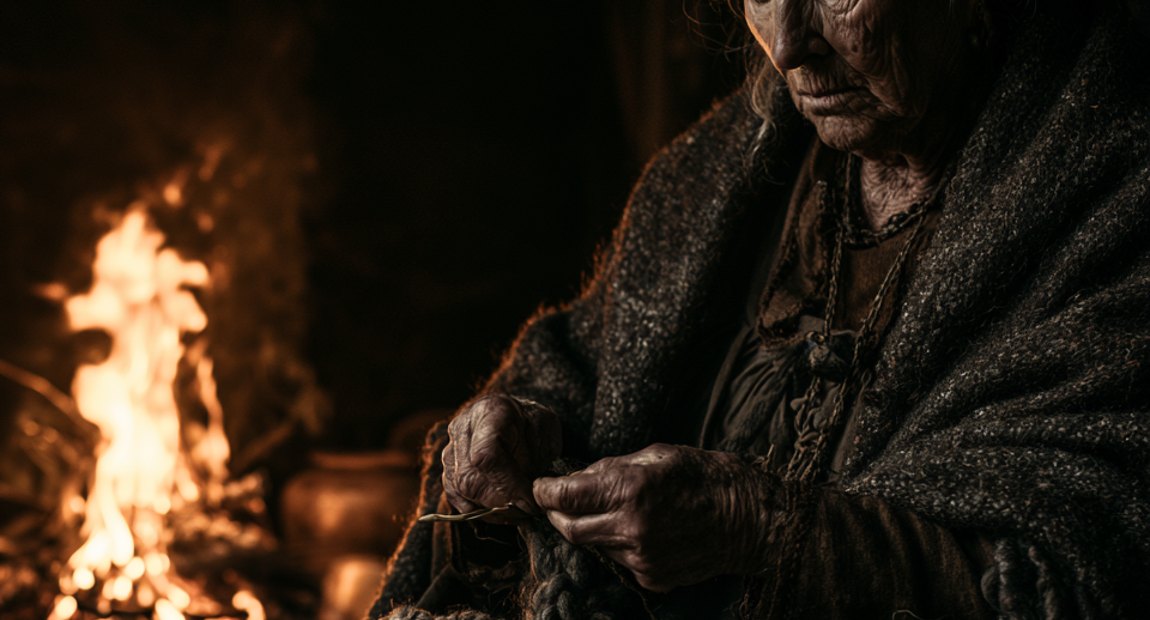
Between the years lies a time that ticks differently: the Rauhnächte, the Twelve Nights around the winter solstice. The world holds its breath, the borders between this world and the other are held to be porous, and an ancient name surfaces – Mother's Night, Modranecht. What lies behind the twelve nights, what is attested, and what does the Rhineland have to do with it?
The Rauhnächte are the twelve nights lying roughly between the winter solstice or the Yule feast and 6 January. A common reading explains them from the calendar itself: the lunar year of twelve moons is about eleven days shorter than the solar year. These “extra” days – the difference between the lunar and solar year – count as a time outside the normal order. Time that does not quite belong easily becomes the time of the spirits.
Customs cluster around it accordingly: smoke-cleansing house and yard; hanging out no laundry, so that no one is caught in it; looking into the future. And over it all, in many regions, the Wild Hunt sweeps through the night sky.
The most solid old evidence for a feast in this dark time stands in Bede. Around 725 the Anglo-Saxon scholar reports that his heathen ancestors called the night before 25 December modraniht – “night of the mothers”. It was the opening of their year. Who these “mothers” were, Bede does not say; a connection to female guardian powers is likely – the Dísir of the North and the Matronae of the Continent.
“The night we hold sacred they called by the word modranecht, that is, night of the mothers.” after Bede, De temporum ratione, ch. 15 (public domain)
Here a fine arc closes into our own region: in the Rhineland – around Cologne, Bonn and Aachen – hundreds of Roman-era votive stones to the “Matronae” survive, motherly goddesses usually shown as a group of three. The veneration of motherly guardian powers was thus at home right here, on our own doorstep.
As atmospheric as the Rauhnächte are – one should not take them for an unchanged Viking ritual. The fixed count of twelve, the notion that “each night stands for a coming month”, the smoke ritual in its present form: much of this is early-modern and especially Alpine folk custom. Certainly old is the core – Mother's Night in Bede, the dark time around the solstice, the idea of porous borders. To pin down the solstice itself to the minute, by the way, our Germanic lunar calendar will help you.
Mother's Night (modraniht) is attested by Bede, De temporum ratione (ch. 15), for the night before 25 December, as the opening of the Anglo-Saxon year. The Matronae cult in the Rhineland is secured by hundreds of Roman-era votive stones (regional link Cologne/Bonn/Aachen). The Twelve Nights as a balancing time between lunar and solar year are a common, plausible interpretation. The Wild Hunt is a widespread, well-documented folk belief.
The elaborate Rauhnächte system – twelve nights, each an oracle for one month, fixed smoking and conduct rules – is largely younger, often Alpine folk custom and cannot be shown as a closed Viking-age ritual. The word “Rauhnächte”, too, is late. What is attested and old is above all Mother's Night in Bede and the general significance of the dark time around the solstice. Whoever keeps the Rauhnächte tends genuine, grown custom – just not, in every detail, a Viking inheritance.
The Wild Hunt · Frau Holle & the old goddess · How do heathens celebrate today? · The Germanic feasts · Þorrablót – the winter feast.
All Festivals & Belief articles →
Emperor Barbarossa sits in the Kyffhäuser, his head propped on the table, his beard grown through the stone slab …
Read more →The summer solstice is the longest day of the year – and was one of the great feasts of pagan Europe. Germanic peoples …
Read more →The Vikings had no capitals, but they had places of power: sites where law was spoken, sacrifice made and the ancestors …
Read more →In the middle of January, when the wind scours Iceland and the days have only just begun to lengthen again, Icelanders …
Read more →