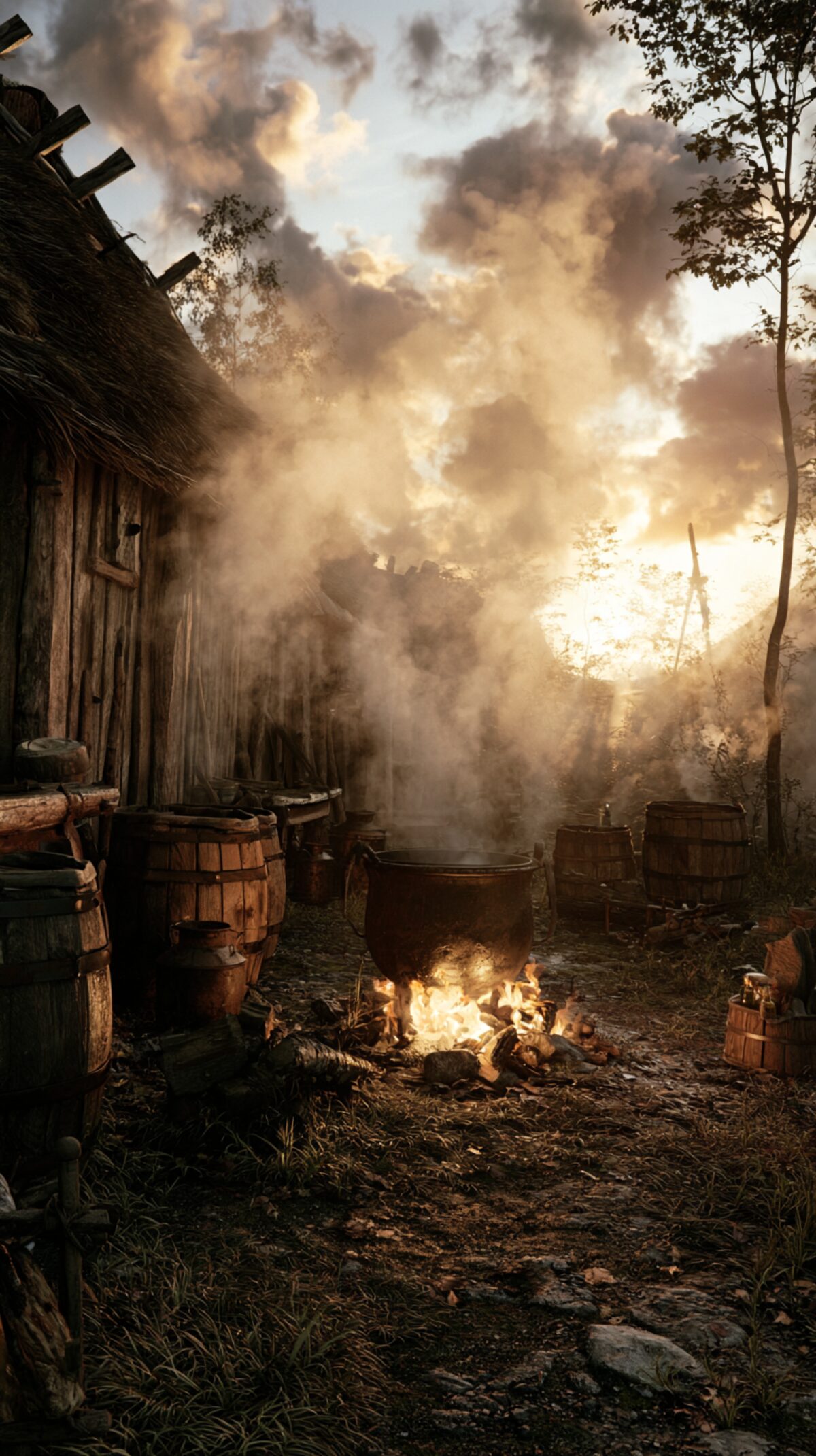
Mead is fermented honey wine – honey, water and yeast, nothing more – and one of the oldest intoxicating drinks in Europe. In the Viking Age, though, it was no everyday tipple: it was a precious drink for feasts, chieftains and gods, while the farmer's cup usually held ale. Here is what archaeology actually knows about mead, why skalds called poetry itself "mead", how Odin stole the Mead of Poetry – and how you can start a simple, historically grounded batch of your own today.
Picture a hall in midwinter. Smoke drifts under the ridge beam, shields gleam along the walls, and the master of the house rises with a horn in his hand. What is inside that horn decides what kind of evening this will be. Ordinary ale could be brewed on any farm. Mead, though, means someone here had honey to spare – and in the North honey was a small treasure. That is exactly why mead in the Eddic poems stands for more than alcohol: for generosity, honour, wisdom and, in the end, for poetry itself.
In this article we keep things carefully apart: what grave finds actually prove, what contemporary travellers reported, what Icelandic writers of the thirteenth century told, and what modern Viking romance has quietly added to the brew.
Mead (Old Norse mjǫðr, Old English medu, Old High German metu) is a drink whose fermentable sugar comes mainly from honey. Dilute honey with water and yeasts will turn its sugar into alcohol and carbon dioxide. Depending on the ratio of honey to water you get a light, almost sparkling drink or a heavy, sweet dessert wine. Modern meads usually land somewhere around 8 to 14 per cent alcohol.
The distinction is simpler than many market stalls suggest. Beer takes its sugar from grain: barley or wheat is malted – allowed to sprout so that enzymes break starch down into fermentable sugar. Wine in the strict sense comes from grapes, whose juice is naturally sweet enough to ferment. Mead needs neither malting nor vineyard, only honey. That is why it is often called one of the oldest alcoholic drinks of all, even though a "first mead" can obviously never be pinned down archaeologically.
The word itself is ancient. It goes back to a Proto-Indo-European *médʰu, which could mean both "honey" and "sweet intoxicating drink". Its relatives include Sanskrit mádhu (honey, sweetness), Greek méthy (wine, strong drink) and Lithuanian medùs (honey).
Drinks evaporate, wooden cups rot, horns crumble. Sometimes all that survives is a dried crust at the bottom of a container. Pollen analysis and chemical residue analysis can read a surprising amount from it: lime-tree pollen points to honey, cereal remains to beer, tartaric acid to grapes. Three sites matter most for the history of mead – and none of them dates to the Viking Age. We say that up front, because the internet loves to blur it.
So the Egtved drink is neither pure mead nor pure beer but a blend of grain, honey and berries. The burial has been dated by tree rings in the coffin wood to the Nordic Bronze Age – roughly two thousand years before the first Viking raids. If you ever read about "Viking mead from Egtved", you are holding a lovely story with the wrong label on it.
A wider picture came in 2013 from biomolecular archaeologist Patrick McGovern and his team in the Danish Journal of Archaeology. They analysed residues from four sites in Denmark and on Gotland, spanning roughly 1500 BC to the first century AD. They called the result "Nordic grog": a mixed drink of honey, bog cranberry, lingonberry, bog myrtle, yarrow, juniper, birch resin and cereals such as wheat, barley or rye. Some vessels belonging to imported Roman wine sets also showed signs of grape wine. The northern elite, in other words, was drinking exotic and mixing freely long before the Vikings.
Hochdorf is Celtic, not Germanic, and lies a good thousand years before the Viking Age. But it shows a pattern we meet again in the North: the lord of the hall supplies his following with strong drink, and the horn is the sign of his hospitality. Nine horns for one dead man is not thirst, it is stagecraft.
And the Viking Age itself, roughly 793 to 1066? Here the record thins out. Drinking horns, horn mounts, Rhineland glass beakers and wooden vessels have been found in numbers, for instance in the graves at Birka. A Viking-age mead securely identified by residue analysis, however, is not known to us. That does not mean nobody drank mead. It means that for this period we depend mostly on texts.
Why was mead special in the North? The answer lies in the raw material. Until beet sugar spread in the nineteenth century, honey was Europe's main sweetener – and in cool Scandinavia with its short summers it was never abundant. Wild colonies in hollow trees, later forest beekeeping (tending wild bees in tree cavities) and skep beekeeping supplied limited amounts. A large cauldron of mead swallowed honey that could otherwise have sweetened food, dressed wounds or yielded wax for candles.
Iceland makes the point even more sharply. There was no honeybee keeping there in the Middle Ages; honey had to be imported. The medievalist Megan Arnott has pointed out that in the Sagas of Icelanders, Icelanders at home nearly always drink ale (ǫl), while mead turns up mainly in myths, poems and at royal courts abroad. Egils saga mentions "wheat and honey" (hveiti ok hunang) several times as imported goods for making drinks. The very island where the Edda was written down knew mead chiefly as a luxury and a metaphor.
Things looked quite different further south-east. Around 890 the seafarer Wulfstan, whose account was included in the Old English translation of Orosius made under King Alfred, described the land of the Este – Baltic peoples near the mouth of the Vistula, not the modern Estonians in the narrow sense. There, he says, the king and the richest men drink mare's milk, "and the poor and the slaves drink mead". No ale is brewed among them at all, "but there is mead enough". In the honey-rich forests of the Baltic, mead was the drink of ordinary people. That is a wonderful counterexample to any simple rule: whether mead counted as luxury depended on how much honey the landscape gave.
In everyday Viking-age life the main drink was ale – ǫl in Old Norse, a direct relative of English ale. It was brewed on the farm, often by the women of the household, from barley, and flavoured with herbs such as bog myrtle. Hops only gradually won out over the course of the Middle Ages. People also drank water, whey and milk products; the saga world knows soured whey, sýra, as a thirst-quencher. For more on what was on the table, see our article on Viking food and drink; brewing itself is covered in beer and brewing in the Viking Age.
A third word makes things interesting: bjórr. It looks like "beer" but may have meant something else. In 1975 the English philologist Christine Fell examined its Old English counterpart bēor and concluded that it was not simply a synonym for ealu (ale). In glosses, bēor translates Latin words for honey wine and spiced wine; Ælfric lists it separately from both wine and ale; and a medical text warns pregnant women not to drink too much of it. Fell suggested a strong, sweet drink, possibly made from fruit or honey. The Irish loan phrase beóir Lochlannach, "beer of the Norsemen", also shows that the Irish picked the word up from the Vikings.
Whether Norse bjórr was fruit wine, a honey drink or simply an especially strong beer is still debated. The Eddic poem Alvíssmál captures the blur nicely: the dwarf Alvíss explains that the drink is called ǫl among men, bjórr among the gods and mjǫðr among those who dwell with Hel. That is poetic vocabulary built on synonyms, not a drinks menu. The one safe conclusion: poets distinguished several noble drinks, and mead sat at the top of the scale.
Now for the most famous mead in the world – one that has never turned up in any vessel. The fullest version is in Skáldskaparmál, the handbook of poetic language in the Edda of Snorri Sturluson (around 1220). Snorri has the god Bragi tell the story at a feast hosted by the sea giant Ægir.
It begins with a peace treaty. After the war between the Æsir and the Vanir, both tribes of gods spit into a vat, and from this token of peace the gods shape a man: Kvasir, so wise that no one can ask him a question he cannot answer. Kvasir travels the world teaching. Two dwarves, Fjalarr and Galarr, invite him in, kill him and let his blood run into three vessels: the kettle Óðrerir and the vats Són and Boðn. They mix the blood with honey, and the result is a mead that turns anyone who drinks it into a skald or a scholar. For more on him, read Kvasir and the Mead of Poetry.
The dwarves keep killing: they drown the giant Gillingr and drop a millstone on his grieving wife. Gillingr's son Suttungr then strands them on a skerry that the tide will cover. To save their lives they hand over the mead as compensation. Suttungr hides it inside the mountain Hnitbjǫrg and sets his daughter Gunnlǫð to guard it.
Enter Odin. He meets nine thralls mowing hay, sharpens their scythes with a whetstone and tosses the stone into the air – in the scramble the thralls cut each other's throats. Then, under the name Bǫlverkr ("evil-doer"), he hires himself out to Suttungr's brother Baugi and does the work of the nine dead men. His price is one drink of the mead. Suttungr refuses every drop, so Baugi drills into the mountain with the auger Rati. Odin slips through the hole as a serpent, spends three nights with Gunnlǫð and is granted three draughts – and empties a whole vessel with each one.
He flies off as an eagle, with Suttungr in eagle shape behind him. The Æsir set out vessels in the courtyard of Asgard, and Odin spits the mead into them. But in the chase some of it escapes from the other end and falls out into the world. Snorri calls it the "poetasters' share" (skáldfífla hlutr) – the stuff bad rhymesters help themselves to. The good mead Odin gives to the Æsir and to those among men who can compose. We tell the full Gunnlǫð episode in Gunnlöd and the theft of the Mead of Poetry.
The myth is more than a heist story. It explains why skalds described their own art in kennings – elaborate poetic circumlocutions – that all point back to the mead. Snorri lists them right after the tale: poetry is "Kvasir's blood", "the dwarves' drink", "Suttungr's mead", "Odin's catch" or "Odin's gift", "the drink of the Æsir". A skald reciting a poem was, in the image, pouring out Odin's mead.
This imagery is not Snorri's invention. Tenth-century skalds already use it. The Icelander Egill Skallagrímsson opens his lament Sonatorrek by complaining how hard it is to move his tongue and lift "Odin's stolen goods" out of his mind. For Egill, composing was literally giving back a divine drink. So the core idea of the Mead of Poetry is older than Snorri's prose, even if the details – spittle, dwarves, auger – only appear in this form with him.
A second, older trace lies in the Poetic Edda itself, in the Hávamál, the "Sayings of the High One". In the middle of advice about drinking, Odin suddenly talks about himself – and admits that he once went thoroughly overboard. In Henry Adams Bellows' public-domain translation:
"Over beer the bird of forgetfulness broods, / And steals the minds of men; / With the heron's feathers fettered I lay / And in Gunnloth's house was held."Hávamál 13, tr. Henry Adams Bellows (1923)
"Drunk I was, I was dead-drunk, / When with Fjalar wise I was; / 'Tis the best of drinking if back one brings / His wisdom with him home."Hávamál 14, tr. Henry Adams Bellows (1923)
These stanzas show the god not as a hero but as a cautionary tale. The "Fjalar" here, incidentally, is probably not Snorri's dwarf but another name for Suttungr or some giant; scholars disagree. The lesson matters more: mead brings wisdom, but too much of it takes wisdom away again. Elsewhere the Hávamál put it plainly:
"Shun not the mead, but drink in measure; / Speak to the point or be still."Hávamál 19, tr. Henry Adams Bellows (1923)
Later, in stanzas 104 to 110, Odin retells the theft from his own point of view: how he gnawed his way through the rock with the auger Rati, how Gunnlǫð on her golden seat gave him a drink of the precious mead, and how poorly he repaid her. He even regrets the broken ring-oath. The father of the gods rarely sounds so human. If you would like to read the stanzas side by side with the original, try our bilingual Hávamál.
Mead makes a second appearance among the gods, and a much more peaceful one. On the roof of Valhalla stands the goat Heiðrún, browsing the branches of the tree Læraðr. Mead flows from her udder – so much that a great vessel is filled with it every day. That is how the Eddic poem Grímnismál (stanza 25) describes her, and Snorri adds in Gylfaginning that the mead is enough for all the einherjar, the fallen warriors, to drink their fill.
In this world mead was scarce and expensive. In the warriors' afterlife it flows without end, from a goat that never needs milking. It is the mirror image of reality: Valhalla is the place where the host never has to be stingy. You can read more about Heiðrún and her rooftop neighbour in Heidrun and Eikthyrnir. And the gods' feast at Ægir's, where Thor has to fetch a gigantic brewing cauldron, revolves around the same question of who can serve enough to drink – see Ægir's feast.
People drank from horns, wooden cups, stave-built bowls and – the richest of them – imported glass. The drinking horn had a practical catch that doubled as a social advantage: you cannot put it down. Hand someone a full horn and they drink it or pass it on. Gotland picture stones of the eighth and ninth centuries show women holding out a horn to a rider, and from Birka and other sites we know small silver pendants of female figures carrying drinking horns. Whether these show Valkyries welcoming the dead to Valhalla or the lady of the house offering the welcome cup is interpretation; both are possible.
The most ceremonial drinking is described in the kings' sagas. In Hákonar saga góða in Heimskringla (ch. 14 in Icelandic editions, ch. 16 in Samuel Laing's English translation), Snorri describes a sacrificial feast at Hlaðir near Trondheim: first Odin's cup (Óðins full) was emptied for victory and power for the king, then the cups for Njörðr and Freyr "for good seasons and peace". After that many drank the bragafull, the cup over which vows were made. Finally the guests drank the minni – the memorial toast to departed kinsmen.
The bragafull also appears at inheritance feasts: an heir only took up his inheritance after rising at the bragafull, speaking a vow and draining the cup – so Snorri tells it of the Swedish king Ingjaldr in Ynglinga saga. Whether braga- refers to the god Bragi or to the word bragr ("the best", "poetry") is disputed. The core is clear: a drink shared in company made a word binding. The modern ritual inspired by this is called sumbel; how it is celebrated today is described in How do heathens celebrate today? Blót and sumbel explained.
One caveat belongs here. Snorri wrote in the thirteenth century, as a Christian, about a heathen feast some two hundred and fifty years earlier. His order of cups is a reconstruction from tradition and his own learning, not minutes of a meeting. That such feasts involved drinking, vows and remembrance of the dead is well founded. Whether the drink was always mead, Snorri does not say – he simply talks about the ale drunk at the sacrifice.
If all this has made you want to start a batch yourself, good news: it is refreshingly simple. One thing first – the recipe below is modern. No original Viking-age recipe survives. What is grounded in evidence is only the principle: honey, water, yeast and, if you like, herbs or berries, as the Egtved find and the "Nordic grog" analyses suggest.
For about 4 litres (roughly a gallon): 1.2 to 1.5 kilograms of honey (a mild blossom or lime-tree honey), water to just under 4 litres in total, a sachet of wine yeast and a little yeast nutrient from a home-brew shop. Dissolve the honey in lukewarm water (do not boil it, or the aromas fly off), pour it into a thoroughly cleaned glass demijohn, add the yeast and fit an airlock. At 18 to 22 °C the mead will ferment for several weeks. When hardly any bubbles rise, siphon it carefully off the settled yeast and let it mature for several months. Mead forgives a lot, but not impatience: young mead often tastes harsh and yeasty; after half a year it rounds out.
For a more historical touch, add a handful of dried lingonberries or a few bog myrtle leaves. Bog myrtle was the North's flavouring herb for thousands of years, but it is not harmless in larger amounts, so go easy.
On the legal side, just briefly: in Germany, making honey wine for your own use is permitted, and still fruit wines and mead carry no separate excise duty – unlike home-brewed beer, which must be registered with customs above a certain volume. Selling is another matter, and distilling without a licence is prohibited. Other countries have other rules, so check local law before you tap your first cask.
And then? Then you fill a horn or a glass, raise it among your people and remember those who are no longer there. That is exactly why we engrave drinking horns, glasses and slate plaques with runes and motifs from the Edda in our workshop in Alsdorf. A line from the Hávamál on the glass works, by the way, even if there is only apple juice inside.
What exactly is mead? Mead is fermented honey wine: honey is diluted with water and fermented by yeast. Unlike beer it needs no grain, and unlike wine no grapes.
Did Vikings really drink mead? Yes, but not often. Because honey was scarce, mead was a festive drink of the well-off; everyday drinks were mainly ale, milk, whey and water.
What is the Mead of Poetry? A mythical mead made from the blood of the wise Kvasir mixed with honey, which turns anyone who drinks it into a poet. Odin stole it from the giant Suttungr under the name Bǫlverkr, as Snorri tells in Skáldskaparmál.
How old is mead? Honey-based drinks in the North can be traced archaeologically back to the Bronze Age, for example in the Egtved grave of c. 1370 BC. That drink, however, was a blend of grain, honey and berries.
How strong is mead? Modern mead usually ranges from about 8 to 14 per cent alcohol. How strong historical drinks were cannot be determined precisely.
Is it legal to make mead at home? In Germany, making it for personal use is allowed. Selling and distilling are strictly regulated, and in other countries you should check local laws.
For courage. For remembrance. For legends that live on.
All Everyday Life & Craft articles →
Again and again, peat-cutters in Ireland, Scotland and Scandinavia find the same riddle: a lump of waxy, ancient …
Read more →There are tools that become legend. Among the Vikings it was a sword – or rather: a whole group of swords, all bearing …
Read more →The Viking ship was not merely a tool – it was a status symbol. And at its top there often gleamed a masterpiece of …
Read more →Matted hair, unwashed for years, reeking across the meadhall – that is the Viking of cliché. The finds tell another …
Read more →