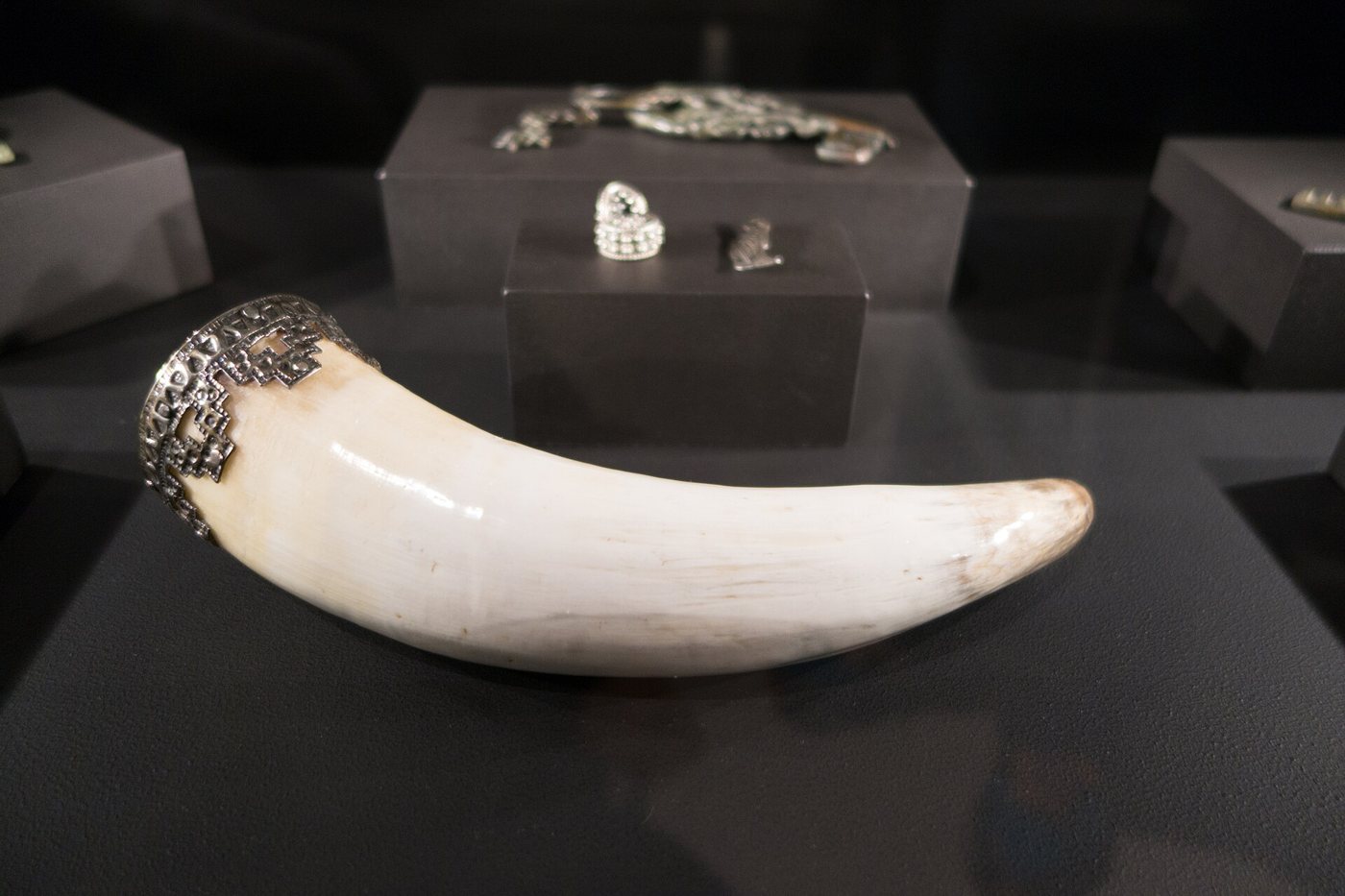
Skål literally means “bowl”. The Old Norse word skál was a drinking bowl, and because you drank to someone from it, the word became the Scandinavian toast. It has nothing to do with skulls. The famous story that Vikings drank from the heads of their enemies goes back to a misread poetic phrase and a Latin translation printed in 1636. Here is where the word comes from, how to say it, what Vikings really drank from, and why we at Glanz & Gravur sign off every message with “Skål”.
If you have ever written to us, you know: our replies end not with “Kind regards” but with “Skål”. Somewhere between slate dust and laser goggles in our workshop in Alsdorf, near Aachen, it simply stuck. It sounds like raised glasses, good company and the North our motifs come from.
People often ask what it means, usually adding: “It comes from skull, right?” No. The real story is better. It runs from a split seashell through Snorri’s sacrificial feasts to a Danish scholar who, in 1636, took a poetic metaphor far too literally. And it ends in an American football stadium in Minneapolis.
The Old Norse word skál, pronounced roughly “skahl” with a long a, simply means “bowl” or “drinking bowl”: a shallow, rounded vessel you drink from or put things in. When you drank to someone, you drank from the skál, and so the name of the vessel slid over to the act itself. English did something similar with “toast”, which originally was a piece of toasted bread floating in a cup of wine.
The word is common Germanic and is traced to the Indo-European root *skel-, “to cut, to split”. Picture a split seashell, each half a scoop or a balance pan. The same root gives Old Norse skel, “shell”, and English shell itself.
The family resemblance is still easy to see:
The word is not related to skull. English skull is usually derived from Old Norse skalli, “bald head”, while the Old Norse word for the bony head is hauss. The link to skull is folk etymology: both start with “sk” and both are hollow.
The word lives on in all the North Germanic languages, in both senses. In Sweden, Norway and Denmark a skål is still the bowl you serve salad or cereal in. As a toast you say:
Finland makes a good contrast. Finnish is not a Germanic language at all, and Finns usually say kippis when they clink glasses. You will still be understood saying “skål” in Helsinki, since Swedish is an official language there.
Old Norse had no letter å. Its long á later shifted towards an o-sound on the Scandinavian mainland. Sweden wrote it å from the 16th century, while Norway and Denmark used aa until their reforms of 1917 and 1948. That is why older Danish texts read Skaal, the form through which the word reached English. For more on how these languages grew apart, see our overview of the Germanic languages.
Before the skulls, the finds. Archaeology tells us fairly precisely what people in the Viking North drank from, and none of it is human bone.
Drinking horns are the classic image, and rightly so. The horn itself, usually from cattle, almost always rots away. What survives are the bronze or silver fittings: rim mounts, terminals shaped like animal heads, suspension loops. For Norway alone, the archaeologist Jan Petersen listed about two dozen horn finds from the Late Iron Age in 1951. On the Tjängvide picture stone from Gotland a woman offers a horn to a rider on an eight-legged horse, usually read as a valkyrie welcoming a newcomer to Valhalla.
Glass was a luxury, imported mostly from the Frankish Rhineland and from England. Typical are the funnel beakers: slim, cone-shaped glasses without a foot that you cannot put down without tipping them over. Fragments and whole vessels, some decorated with trailed glass threads, come from the graves at Birka and from Kaupang. See our article on the trading town of Birka.
Wooden cups and bowls were everyday tableware. Wood survives mainly in waterlogged soil and ship burials. The Oseberg grave held at least eight lathe-turned cups or their remains, Gokstad had round wooden cups and handled cups, and Hedeby produced fourteen turned cups. These plain round bowls are the true ancestors of the word “skål”.
And then there is a showpiece that breaks every cliché: the Jelling cup. Found in 1820 in the burial chamber of the North Mound at Jelling, it is made of almost pure silver, gilded inside and decorated with niello. It holds only about three centilitres, and whether it served strong drink, ointment or Christian wine is still debated. The finest cup from the Danish royal burials was silver, not bone.
And what was in them? The sources name öl (ale in a broad sense), mjöðr (mead), vín (expensive imported wine) and the puzzling bjórr, whose exact meaning is disputed. More in our articles on Viking beer and brewing and mead.
In the North, drinking was never just about thirst. At feasts, cups went round in a fixed order and each one was dedicated to someone. The Old Norse word for such a ritual drinking feast is sumbl, Old English symbel. In Beowulf, Queen Wealhtheow carries the cup first to the king and then to his retainers: the order of the cup expressed rank and loyalty.
The fullest description comes from Snorri Sturluson. In the saga of Hákon the Good, part of his Heimskringla written around 1230, he describes a sacrificial feast in Trøndelag under Earl Sigurd of Hlaðir, in the mid-10th century. Farmers bring ale, animals are slaughtered, and the filled cups are passed over the hearth fire and blessed by the host. According to Snorri there was a fixed sequence:
One detail for readers of Samuel Laing’s 1844 English translation: Laing names Freyja in the second toast, but the Old Norse text has Freys full, Freyr’s cup. Read more about the two in our article on Freyr and the Vanir.
A little later comes the famous scene in which King Hákon, raised a Christian in England, takes the cup at the feast and makes the sign of the cross over it. When the farmers grumble, Earl Sigurd claims it was the sign of Thor’s hammer. Nobody was happy.
The formulas even outlived the conversion. The Norwegian Gulathing law required farmers to brew ale together and bless it to Christ and the Virgin Mary, once again til árs ok friðar. In medieval Germany people drank the “Minne” of saints, such as St John’s minne at a farewell.
The bragafull or bragarfull was the cup over which vows were made. The name is linked either to bragr, “the best, the chieftain”, or to the god of poetry, Bragi. Both views have their supporters.
In Ynglinga saga, Snorri explains how at the funeral ale of a dead king the heir stepped up before the high seat, took the bragarfull, made a vow, drained the cup and only then took his father’s place. Young Ingjald vows to enlarge his realm by half in every direction, or die. The Jomsvikings famously drink themselves into similar vows at a funeral feast, regret them when sober, and still sail against Norway.
The Edda knows the custom too. In the prose of the Lay of Helgi Hjörvarðsson, Heðinn makes a vow over the bragarfull on Yule eve: he will have Sváva, the beloved of his brother. He regrets it at once, but a vow over the cup cannot be taken back. How modern heathens revive these forms is the subject of our article on blót and sumbel today.
Eddic poetry is full of cups and horns. In Odin’s hall the einherjar drink mead from the goat Heiðrún, and Hávamál offers some sober advice:
“Less good there lies than most believe / In ale for mortal men”Hávamál 12, trans. H. A. Bellows (1923)
One scene even delivers a punchline about skulls. In the Lay of Hymir, Thor is challenged to break the giant Hymir’s cup. Struck against a stone pillar, it survives. Only when Thor, on the advice of Hymir’s wife, smashes it against the giant’s skull, which is harder still, does the cup shatter. Here the skull is not the drinking vessel but the anvil the drinking vessel breaks on.
Still, there are two Eddic skull cups, both in horror scenes.
In the Lay of Völund, the captive smith takes revenge on King Níðuðr. He kills the king’s sons, sets their skulls in silver and sends them to their father. The Old Norse reads En þær skálar, er und skörum váru, sveip hann útan silfri, roughly “but the bowls that were under the hair he covered with silver”. So the word skál does appear here, but as a poetic word for the skull-cap, not the other way round.
In the Greenlandic Lay of Atli, Atlamál, Guðrún tells her husband Atli that he has drunk from the skulls of his own sons, which she served him as cups. Bellows translates: “The skulls of thy boys / thou as beer-cups didst have”.
When a skull appears as a cup in this poetry, it is an atrocity meant to make listeners shudder, never a custom of the hall.
So where does the picture of Vikings drinking from their enemies’ skulls come from? The trail leads to a poem: Krákumál, the death song of the legendary Ragnar Lodbrok. In 29 stanzas Ragnar, dying in a snake pit, recalls his battles and laughs at death. The poem is not from the Viking Age. Scholars date it to the 12th century and place it, most likely, in the Scottish isles.
In stanza 25 Ragnar looks forward to the feast in Odin’s hall and says: drekkum bjór af bragði ór bjúgviðum hausa. Literally: “we shall soon drink beer from the curved trees of the skulls.” That sounds grisly, but it is a kenning, a typical poetic circumlocution. Skalds avoided plain names: a ship was a “horse of the sea”. The “curved trees” or “bent branches of the skull” are whatever grows curved out of an animal’s head: its horns. The line simply means: we shall drink beer from drinking horns. Our glossary of Old Norse terms has more of this imagery.
The Danish physician and antiquarian Ole Worm, Latinised as Olaus Wormius, printed Krákumál in his Runir seu Danica literatura antiquissima, first published in Copenhagen in 1636, with a second edition in 1651. He added a Latin translation, and at this point he wrote: Bibemus cerevisiam brevi ex concavis crateribus craniorum, “we shall soon drink beer from the hollow bowls of skulls”. In his commentary he went further: the heroes hoped to drink in Odin’s hall from the skulls of those they had slain.
To be fair, Worm was a pioneer of runic studies, and the kenning system was barely understood in his day. He read the image literally, and because it fitted so nicely with the wild Northmen everyone imagined, nobody questioned it for a long time.
The breakthrough came in the 18th century, when Europe fell for “Northern poetry”. In 1763 the English clergyman Thomas Percy published Five Pieces of Runic Poetry, including “The Dying Ode of Regner Lodbrog”. Percy worked largely from Worm’s Latin rather than the Old Norse, and his version reads: “we shall drink BEER out of the sculls of our enemies”, with beer in capitals.
Ragnar’s death song was re-translated and imitated many times, and Worm’s Latin was even printed as an appendix in editions of Macpherson’s Ossian poems, the supposed ancient Scottish epics that thrilled Europe at the time. Scholars have long criticised the error, but as one reviewer of a modern edition of Percy’s translations dryly noted, the image proved ineradicable. We have written the full fact check in a separate article: Did Vikings really drink from skulls? The short version: the Vikings did not, but others did.
Skull cups are not pure invention, they just are not Viking. The most famous case leads to the Lombards. King Alboin killed the Gepid king Cunimund in 567 and had a drinking cup made from his head. Paul the Deacon, writing the history of the Lombards around 790, adds a remarkable sentence: Quod genus poculi apud eos “scala” dicitur, “this kind of cup is called scala among them”. The Germanic bowl word is the Lombard name for the vessel, which here happened to be a head. Around 572, at a banquet in Verona, Alboin forced his wife Rosamund, Cunimund’s daughter, to drink from it. Soon afterwards he was dead.
The Bulgar khan Krum is likewise said to have lined the skull of the Byzantine emperor Nikephoros I with silver after defeating him in 811. Such cups were rare trophies of one hated enemy, never tableware, and for the Vikings there is no evidence at all.
If you are a guest in Sweden, Norway or Denmark, a few customs help. The most important is eye contact: raise your glass, look the other person in the eye, say “skål”, nod and drink. At formal Swedish dinners the rule of thumb is to raise your glass to about the height of your third shirt button. The host usually opens with a welcome toast, and nobody drinks before that. Sipping early is a small faux pas.
Swedish celebrations come with snapsvisor, short drinking songs sung before each shot of aquavit. The tradition took shape mainly in late 19th-century middle-class and student circles. The most famous is Helan går. Helan, “the whole one”, is the first shot in a series, halvan, “the half”, the second. The point of the song: if you do not drink the whole, you will not get the half. The tune can be traced to an operetta of 1843, though its exact origin is unclear. Stockholm’s Spritmuseum holds more than 12,000 such songs.
The phrases are simple: skål för dig or skål på dig means “here’s to you”, and skåla is the verb “to toast”. Some rhyming “ancient Swedish toast” formulas circulate online, but we could not trace them to a reliable source, so we leave them out.
The word reached English around 1600 as skoal or skol. It is first recorded in Scottish English, and the Oxford English Dictionary suggests it may have been introduced or popularised through James VI of Scotland’s visit to Denmark in 1589, when he went to fetch his bride, Anne of Denmark.
In the United States “Skol” became a battle cry. The Minnesota Vikings, founded in 1961 in a state with many Scandinavian immigrants, have had the fight song “Skol, Vikings” from the beginning. Since 2016 the team has also had the “Skol chant”, the slow overhead clap that fans borrowed from Iceland’s supporters at the 2016 European Championship.
In Germany, where we work, you hear “Skål” mostly at Viking markets, in reenactment camps and from people back from a Scandinavian holiday. Next to the German “Prost”, from Latin prosit, “may it benefit”, it sounds like an invitation to the North.
The correct spelling depends on which language you mean:
Plain “skal” is a poor choice. In Swedish skal means shell or peel, and in Danish and Norwegian skal is the verb “shall”. If your keyboard has no å, write skaal. On Windows you can type å with Alt+0229, on a Mac with Option+a.
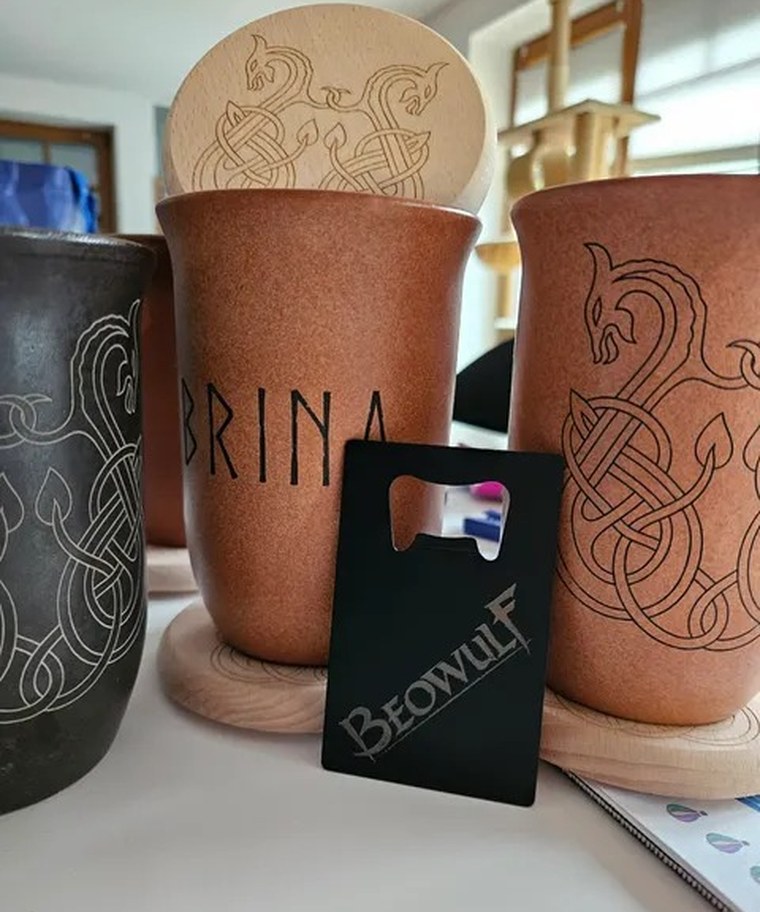
At Glanz & Gravur we engrave Norse motifs into slate, wood and glass. We would rather drop a good cliché than spread nonsense, which is exactly why “skål” suits us. It is a genuine word, more than a thousand years old, still heard at every table between Copenhagen and Reykjavík. And it is full of history without anybody having to lose their head.
If you would like to raise a glass of your own, with runes, a toast or your name on it, our glass engraving page has ideas. A horn, by the way, is much harder to put down than a glass.
What does skål mean in English? Literally “bowl” or “drinking bowl”. As a toast it means “cheers”.
Does skål come from skull? No. Skål goes back to Old Norse skál, “drinking bowl”, and is related to English scale and German Schale. The skull connection is folk etymology built on a mistranslation printed in 1636.
Did Vikings drink from skulls? There is no evidence that they did. Archaeology shows drinking horns, glass beakers and wooden bowls, and the skull idea came from Ole Worm’s literal translation of a kenning for drinking horns.
How do you pronounce skål? In Swedish and Norwegian roughly “skohl” with a long o, in Danish similar with a short glottal catch, and in Icelandic (skál) roughly “skowl”.
What do Finns say instead of skål? Finns usually say “kippis”. Finnish is not a Germanic language, so skål is not part of its native vocabulary.
For courage. For remembrance. For legends that live on.
The skull-cup myth · Mead – the drink of gods · Beer & Brewing · How do heathens celebrate today? · Ægir's feast & the Lokasenna · Viking Customs & Rituals – Blót, Sumbel, Feasts & Burial.
All Everyday Life & Craft articles →
At Søften, ten kilometres north of Aarhus, Moesgaard Museum excavated a Viking-Age production site between August 2025 …
Read more →There are tools that become legend. Among the Vikings it was a sword – or rather: a whole group of swords, all bearing …
Read more →No longship would ever have sailed, no warrior survived the winter, without perhaps the most important and most …
Read more →The Viking ship was not merely a tool – it was a status symbol. And at its top there often gleamed a masterpiece of …
Read more →
.jpg)