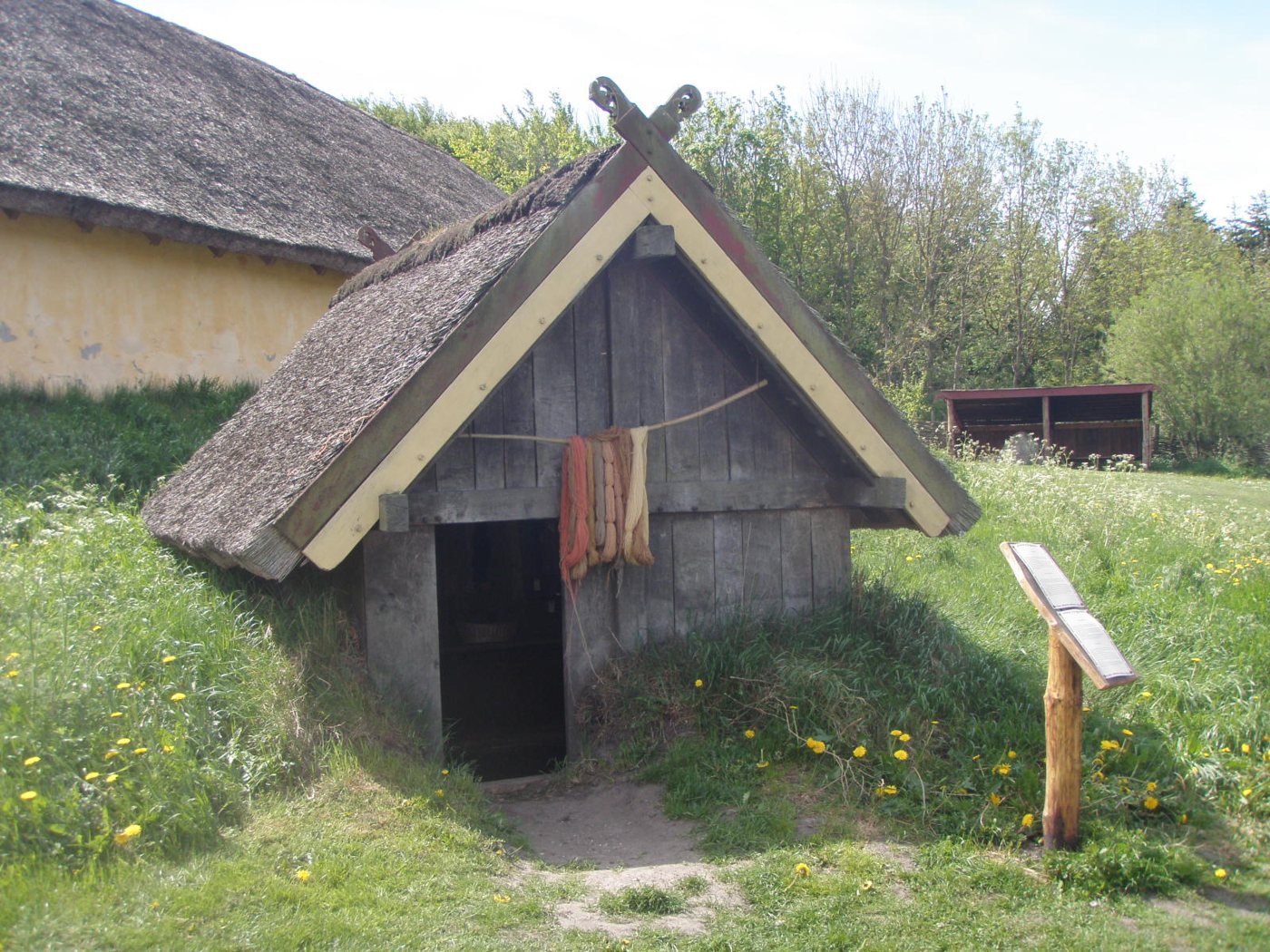
At Søften, ten kilometres north of Aarhus, Moesgaard Museum excavated a Viking-Age production site between August 2025 and June 2026: 82 pit houses, flax-processing areas, loom weights, spindle whorls and just one dwelling house. Not a village, then, but an enterprise where cloth was evidently made on a large scale. Here is what is established, what is still open, and how much work went into a single Viking sail.
Say "Vikings" and people picture longships and axes, not looms. Yet every sail, cloak and blanket on board represented a staggering amount of labour, and at Søften archaeologists have found a place where that labour was gathered together.
Søften is a small town in Favrskov Municipality, about ten kilometres north of central Aarhus and roughly four kilometres from the site of Lisbjerg. From August 2025 to the end of June 2026, Moesgaard Museum excavated just over 60,000 square metres there. The archaeologists estimate the whole settlement at no less than 100,000 square metres, roughly fourteen football pitches. The dig took place ahead of a new business park.
In total, 82 pit houses are now known from the site. 48 came to light in the current excavation, 34 in earlier investigations in 2008 and 2013 a little further south. In addition there are areas where flax was processed and a stone-paved path leading across wet ground.
The finds are above all loom weights and spindle whorls, plus hacksilver, coins and glass beads. In one pit house an X-ray revealed a knife, a pair of shears and a key. Beads were jewellery in the Viking Age, but also a means of exchange, much like the chopped-up silver that was paid out by weight; see our article on hacksilver. The museum has not published which coins were found, so we do not name any coin types either.
The truly exciting thing about Søften is not a single object but the pattern. The archaeologists found separate zones for production and craft, but only one dwelling house. "We are not seeing the traces of an ordinary village," says excavation leader Liv Stidsing Reher-Langberg of Moesgaard Museum. She describes a production area that was specialised and organised on a large scale, and a layout suggesting that the work was directed by a central actor with control over resources and production.
In an ordinary Viking-Age settlement there was of course spinning and weaving too, in almost every household, for its own needs. We have gathered what is known about this in our article on weaving in the Viking Age. At Søften, by contrast, many people evidently worked in one place, in quantities far beyond local needs. The Moesgaard team describes specialised production running from fibre to finished cloth.
The picture is not entirely new. As early as 2013, Moesgaard archaeologist Jakob Westermann wrote in the museum's excavation blog about "Viking workshops in Søften". The 2008 dig had uncovered 14 pit houses with signs of workshop production, and pollen from their floors pointed to plants that could be used for dyeing textiles and for tanning. The site sits on a gravel spur above a wetland. Westermann noted similar pit-house sites along river systems in Himmerland and near Skjern, and suggested that their location reflected both their function and the power structures behind them. The 2025–26 excavation has confirmed that early hunch on a whole new scale.
One detail from 2013 is especially tempting. Near the wetland lay a dense band of fire-cracked stones and burnt material. Westermann offered two explanations. Either ship timber was steam-bent here, as has been suggested for Stavnsager on Djursland, or water was heated for fulling cloth, that is, for felting and compacting the woven fabric, which experiments at the Viking Ship Museum in Roskilde suggested helps in making sailcloth. Both are interpretations, not findings. But both point towards ships.
To understand what went on at Søften, it helps to follow the whole chain from animal to cloth. Viking-Age sheep had little in common with a modern Merino. They were small, hardy animals related to today's Northern European short-tailed breeds. Their fleece had two layers: a soft, fine undercoat and long, smooth, coarse outer hair. The fine undercoat made soft clothing, the long hair tough, water-shedding cloth.
After sorting, the wool was combed and then spun. Spinning was done with a hand spindle: a wooden shaft with a flywheel weight, the spindle whorl. That humble ring of clay, stone or bone reveals a surprising amount.
For a long time, spindle whorls and loom weights were treated as dull bulk finds. That has changed, largely thanks to work at the Centre for Textile Research (CTR) at the University of Copenhagen. Textile archaeologist Eva Andersson Strand and her colleagues tested experimentally which yarns and fabrics particular tools produce. The basic rule is simple: a light whorl spins fast and makes a thin thread; a heavy whorl makes a thicker one.
The same logic applies at the loom. Every warp thread needs a certain tension, and the loom weights supply it. In the CTR experiments, wool yarn spun with a 4-gram whorl needed about 13 grams of pull per thread, yarn from an 8-gram whorl about 19 grams. In a 2007 weaving test the weights were about 275 grams each, with 14 warp threads hanging from each at roughly 20 grams of tension apiece. The thickness of the weights, in turn, decides how closely they can hang side by side, and so how many threads per centimetre the finished cloth will have.
Weigh and measure the loom weights from a site, and you can estimate which fabrics could have been woven there, even if not a single thread survives. Andersson Strand did exactly that for Hedeby and Birka. From Hedeby she had 939 spindle whorls, 514 complete loom weights and 3,480 fragments; from Birka 429 whorls, 69 complete weights and 1,406 fragments. Most of the Hedeby loom weights suit yarns needing 15 to 45 grams of tension, in other words medium-fine fabrics. Her conclusion: a large share of the textiles at both sites could have been made locally, above all simple twills. That challenged the long-held assumption that Birka imported most of its cloth.
No such measurements have yet been published for Søften. With dozens of pit houses and plenty of loom weights, the site offers a dataset that may one day tell us whether fine linen for clothing, dense woollen cloth or heavy sailcloth was woven here.
At Søften the archaeologists found dedicated areas where flax was processed. That matters, because linen almost never survives in Danish soil, unlike wool. So the importance of flax in the Viking Age is often known only indirectly, through seeds, pollen and tools.
The road from field to thread is long. After harvest, when the plants are pulled up roots and all, comes retting. The stalks are left in water or on damp grass until bacteria and fungi break down the pectin that glues the fibres to the woody core. Then the flax is dried and broken so the brittle core shatters. Scutching knocks out the woody bits, and hackling draws the fibres through combs with sharp teeth until only long, glossy strands remain. Only then is it spun.
A site combining flax areas, pit houses and plenty of wet ground fits that sequence remarkably well. Whether water retting actually took place at Søften, however, the archaeologists have not said. Reher-Langberg hopes that radiocarbon dates and pollen analysis will show what kind of textiles were made here. How linen and wool worked together in a Viking wardrobe is covered in our article on Viking clothing, and how undyed yarn became bright cloth in our piece on Viking dyeing.
One idea suggests itself at Søften, and we will say straight away that it is our own reflection, not a result of the excavation. The Viking Age had an enormous appetite for cloth, not only for clothing but for sails. Just how enormous was calculated by archaeologist Lise Bender Jørgensen of the Norwegian University of Science and Technology (NTNU) in Trondheim in a paper published in 2012.
Her starting point is the Skuldelev ships from Roskilde Fjord. For a cargo ship of the knarr type like Skuldelev 1, with a sail of about 90 square metres, she estimates around 90 kilograms of wool and some 8,000 working hours for the sail alone, which comes to almost five working years if you take a modern working year of 1,680 hours. Add blankets and clothing for a crew of six to eight, and she arrives at 220 to 263 kilograms of wool and about ten years of work.
For a large warship like Skuldelev 2, with 65 to 70 men and a sail of roughly 112 square metres, her figures are about 200 kilograms of wool and around nine working years for the sail. Include blankets and clothing for the crew and she reaches 1.6 to 1.7 tonnes of wool and 54 to 59 years of labour. In return, a well-maintained woollen sail might last 40 to 50 years by her estimate. These are model calculations, not measurements, but they show the order of magnitude: behind every longship stood more work at the loom than at the shipyard.
Through years of experimental archaeology, the Viking Ship Museum in Roskilde has shown that such woollen sails work. For its reconstruction of Skuldelev 2, the Sea Stallion from Glendalough, the museum gives a sail area of about 120 square metres. How Viking ships were built and rigged is told in our article on Viking shipbuilding.
Anyone wanting to equip a fleet, then, needed places like Søften. Whether sailcloth was actually woven here, we do not know. In 2011 Andersson Strand suggested that sailcloth was more likely produced in many households on commission, a putting-out system, rather than in dedicated workshops. She wrote explicitly that there was no archaeological evidence for real textile workshops at Birka and Hedeby. Whether Søften is precisely such evidence is for the analysis to show.
Pit houses are nothing unusual in themselves. They turn up at trading places like Ribe, where a market with workshop plots developed around 700, at Hedeby, and at great estates like Tissø on Zealand, where crafts and seasonal markets revolved around a royal or aristocratic residence. They are especially well known from Aarhus itself. The most famous is "Hikuin's house", named after the name carved on a comb found there. It burned down in the mid-10th century, was about 3.5 metres long and 2 metres wide, and was dug some 1.25 metres into the ground. Inside lay wooden bowls, clay pots, 25 glass beads and five whetstones.
According to the Danish reference work Trap Danmark, the first pit houses in Aarhus were built between about 750 and 800. In the early 9th century they were partly replaced by longhouses. At Søften, by contrast, the workshops seem to have stayed workshops.
That fits Lisbjerg, only four kilometres away. From 1989 onwards Moesgaard excavated a large manor there, enclosed by a palisade surrounding almost two hectares, with a gate to the south. Lisbjerg too had pit houses with traces of spinning and weaving, along with smithing, bronze casting and glassworking, pottery from the southern Baltic coast and a fragment of an Arabic silver coin. In June 2025 the museum announced 30 graves near the manor, probably from the second half of the 10th century. Among them was a small casket containing beads, gold thread and a pair of scissors, which probably belonged to an important woman. The graves differ greatly in size and contents; the archaeologists consider it possible that the manor's leading family and their enslaved people were buried here.
The key to Søften probably lies in Aros, today's Aarhus. The name is usually interpreted as "river mouth", and that is exactly where the town stood, on a low sandy island at the mouth of the Århus Å. According to Moesgaard Museum, the oldest settlement traces go back to the last decades of the 8th century, with a trading place emerging in the 770s. At first the town was protected only by a ditch. Around 934 a ring rampart was built, perhaps under Gorm the Old, and around 980 Harald Bluetooth had the defences significantly strengthened. Aarhus first appears in writing in 948, when a synod at Ingelheim named a Bishop Reginbrand for the town.
Moesgaard historian Kasper H. Andersen puts it simply: the towns of the Viking Age did not arise on their own. During the Viking Age Aarhus grew into one of the kingdom's most important trading centres under the king, and it lived on what the surrounding countryside supplied, goods that could be sold there, shipped out or exchanged for silver and glass from far away. Cloth was one of those goods. Søften looks like a place where that cloth was made. More in our article on Viking trade.
That silver circulated in the area is shown by more than the pit-house finds. For some thirty years, detectorists had been picking up silver coins in the fields around Søften. And in 2024, 22-year-old archaeology student Gustav Bruunsgaard found a silver hoard with his metal detector at Elsted, about five kilometres away: seven arm rings, together weighing over half a kilogram, dated to around 800. One ring belongs to a type that originated in Russia or Ukraine; three stamped rings are South Scandinavian and were imitated in Ireland. The rings were adjusted to a shared weight standard, which made them wearable money. The hoard is now on display at Moesgaard Museum.
Here we enter the territory of hypotheses. No find from Søften tells us who worked in the pit houses. What other sources tell us is that textile work in the Viking Age was overwhelmingly women's work. Spindle whorls and weaving swords lie almost exclusively in women's graves, and in Old Norse poetry weaving even becomes an image of fate itself, as with the Norns or the grim poem Darraðarljóð, in which Valkyries weave a battle. More on these women's lives in our article on women in the Viking Age.
But who was it at Søften? A powerful family or a lord who controlled land, raw materials and labour is the obvious guess, perhaps connected with the manor at Lisbjerg. Whether free women, dependent farming households or the unfree worked in the pit houses, we do not know. Many scholars assume that the unfree played an important role in textile work, and the possible graves of enslaved people at Lisbjerg make the idea far from far-fetched. For Søften, however, it is a possibility, not a finding. And the many small pit houses alongside a single dwelling raise a question nobody has yet answered: where did the people who worked here sleep?
Here we have to keep things separate. What was produced at Søften, fine linen, coarse wool or both, is for further analysis to determine.
The dating calls for caution too. Moesgaard Museum simply speaks of the Viking Age. The AP news agency report gave roughly AD 600 to 950, from the Late Iron Age into the early Viking Age. That is entirely possible, since some pit houses may be older than others. Until the radiocarbon dates are in, though, it remains a range rather than a date. The museum has published no new results since its press release of 24 June 2026, and we found nothing new from DR, TV2 Østjylland or the Danish heritage agency up to early October 2026 either.
Søften brings to light a side of the Viking Age that practically never appears on screen: the economy behind it. No ship sailed without a sail, no warrior went without a cloak, no trader without goods. "The Vikings were not just simple, uncivilised, barbaric hordes," Kasper H. Andersen told the AP.
It also shows that weaving could be an organised, planned and probably hierarchically directed activity. Hedeby and Birka had loom weights in great numbers, but embedded in urban life. What is new is the scale in the countryside, in an enterprise without a village around it, a few kilometres from a manor and a growing royal town.
It is not yet known when the finds will go on display. Meanwhile, Aarhus offers Moesgaard Museum's large Viking-Age exhibition, including the Elsted hoard, and the small Viking Museum in central Aarhus on the site of the old town. More destinations are collected in our guide to Viking museums and sites.
Where is the Søften Viking textile site? In Søften, Favrskov Municipality, about ten kilometres north of central Aarhus in East Jutland, Denmark, and some four kilometres from the Lisbjerg manor.
How many pit houses were found at Søften? 82 in total: 48 in the 2025–26 excavation and 34 in earlier digs in 2008 and 2013, plus flax-processing areas and a single dwelling house.
How old is the Søften site? Moesgaard Museum dates it to the Viking Age. News agency reports gave roughly AD 600 to 950. Radiocarbon results, which should narrow this down, have not yet been published.
Were Viking sails made at Søften? That is not proven. It is a reasonable thought, because sails consumed huge amounts of cloth, but what exactly was woven here is for the analysis to show.
How long did it take to make a Viking sail? According to Lise Bender Jørgensen's model calculations, a sail of about 90 square metres needed around 90 kilograms of wool and some 8,000 working hours, almost five working years.
Can I see the Søften finds? Not yet; no exhibition date has been announced. Moesgaard Museum near Aarhus does display the nearby Elsted silver hoard found in 2024.
For courage. For remembrance. For legends that live on.
Viking Weaving · Viking women · Viking clothing & fashion · Dyeing – the colours of the Vikings · Viking Shipbuilding · Viking Trade.
All Everyday Life & Craft articles →
There are tools that become legend. Among the Vikings it was a sword – or rather: a whole group of swords, all bearing …
Read more →No longship would ever have sailed, no warrior survived the winter, without perhaps the most important and most …
Read more →The Viking ship was not merely a tool – it was a status symbol. And at its top there often gleamed a masterpiece of …
Read more →Vikings were on average a little shorter than people today, often but by no means always blond, better groomed than …
Read more →
