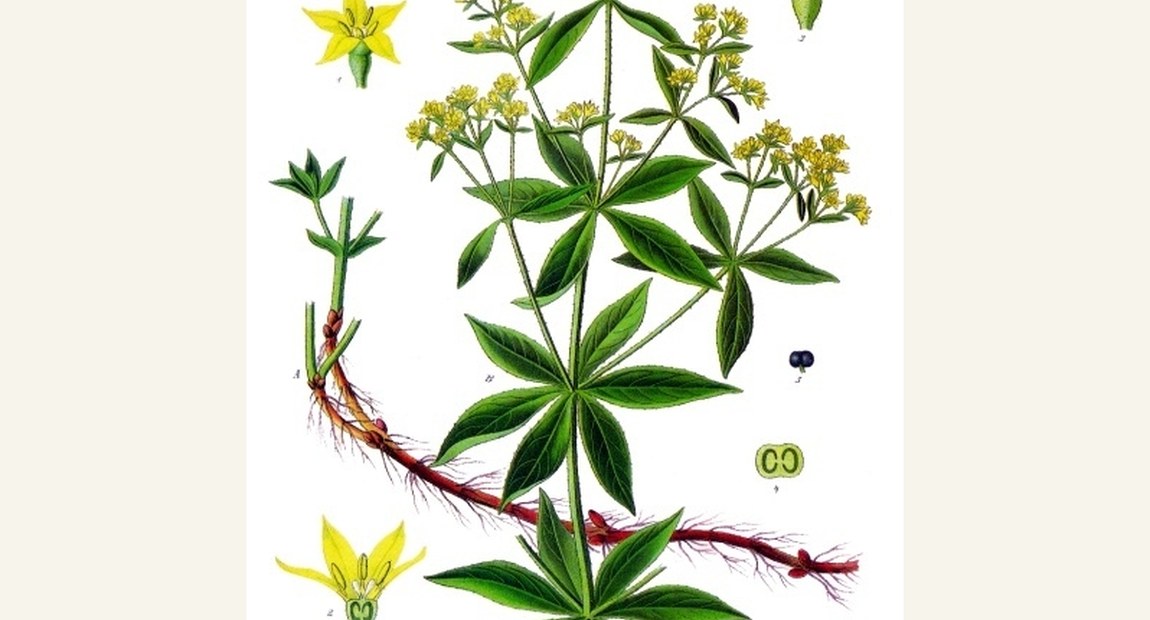
No longship would ever have sailed, no warrior survived the winter, without perhaps the most important and most underrated skill of the Viking Age: textile craft. Wool, flax and the patient rhythm of spindle and loom carried an entire culture - and lay almost entirely in the hands of women.
When we picture the Vikings, we see swords, shields and dragon ships. Yet none of it would have worked without textiles. A longship's sail, the warm woollen tunic, the cloak, the leg wraps, the bedding, the sacks for provisions, the mooring ropes - all of it was spun and woven. Textile production was not a side note but one of the most labour-intensive and valuable activities of the age. It devoured more working hours than almost any other craft, and it decided whether a family survived the northern winter or a fleet could put to sea.
Because organic material rarely survives, we know this craft chiefly from two sources: the imperishable tools - spindle whorls, loom weights, tablets, needles - and the few surviving fabric fragments from graves and waterlogged harbour layers. Together they paint the picture of a highly developed, specialised production.
Everything began with spinning. Wool was shorn or plucked from the sheep, washed, sorted and prepared with wool combs or cards. Then the spinner drew fibre after fibre into an even thread on the hand spindle - a stick weighted by a spindle whorl. That whorl, usually of clay, stone, bone or lead, is one of the most common finds of all: on its own it proves that spinning went on in almost every household.
Spinning was a constant companion task. People spun while herding, walking, talking. The reason is simple: a single larger fabric required kilometres of yarn. The direction of the twist - clockwise (Z) or counter-clockwise (S) - can still be read in surviving cloth today; in the Nordic world the combination of a Z-spun warp with an S-spun weft is especially typical.
The Nordic landrace sheep carried a double fleece, and the weavers exploited this deliberately. The long, glossy, water-repellent outer hairs (Old Norse tog) and the short, soft, insulating undercoat (þel) were spun sometimes separately, sometimes mixed. The coarse, strong tog made tough, weatherproof yarns for sails, cloaks and outer textiles; the fine þel made soft cloth for shirts and garments worn against the skin. This single choice of raw material - which fibre for which purpose - was already half a science of materials. It explains why Viking-age textiles could vary so widely in quality and function.
Alongside wool stood linen made from flax. Its production was even more laborious: the flax had to be retted (broken down in water or dew), broken, scutched and heckled before the smooth bast fibres could be spun. Linen was cool, absorbent and could be bleached corpse-white - ideal for garments worn next to the body, caps, undergarments and fine bands. Because flax demanded particular soils and much labour, fine linen tended to be more valuable and rarer than coarse wool. Finds of pleated linen shifts from wealthy women's graves show that linen could also be a status fabric.
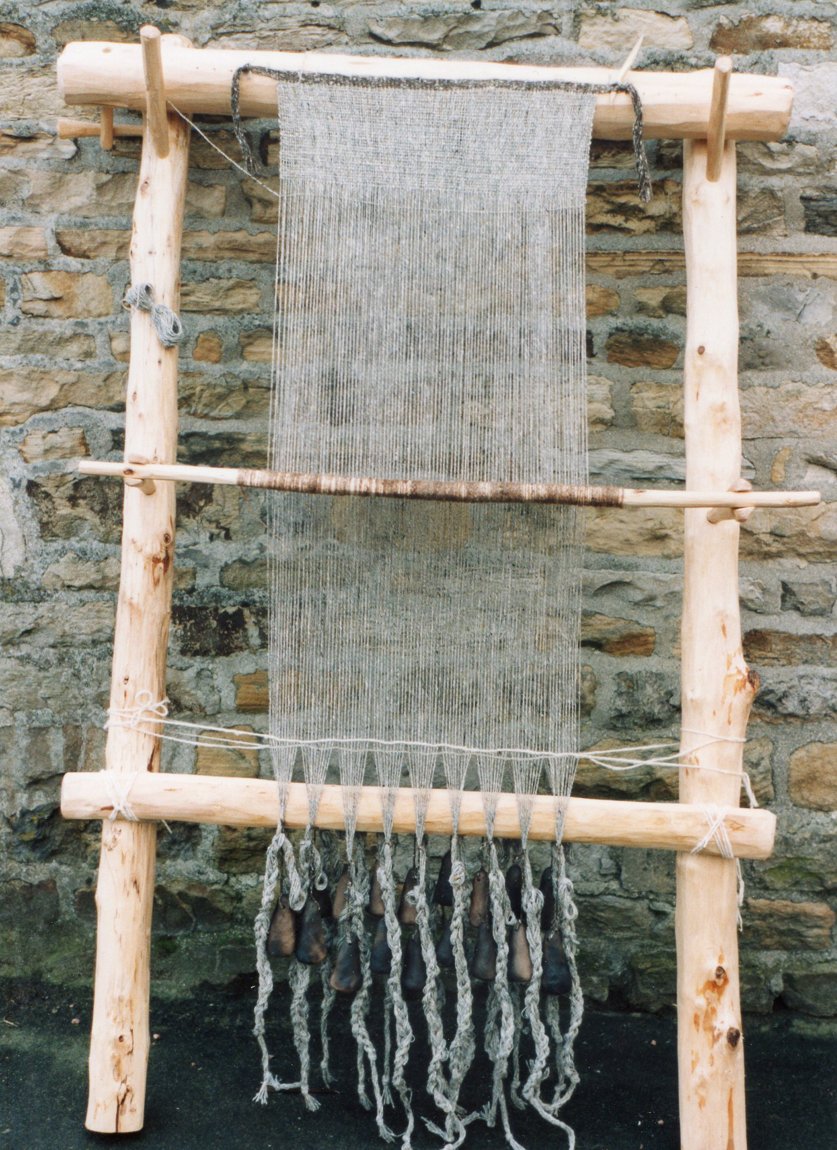
Weaving was done on the upright warp-weighted loom. It leaned at an angle against the wall of the longhouse: a tall frame over which the warp threads ran at the top, held taut below in bundles by clay or stone loom weights. These loom weights are precisely the key archaeological find - discovered in rows, they still mark the place of a loom in a house plan a thousand years later. The weft was beaten upward, not down; the weaver worked standing and moved along the fabric.
This loom was surprisingly capable: it produced not only plain cloth but also complex patterns and metre-wide widths. It remained in use in the North beyond the Viking Age - in Iceland into the early modern period - which makes reconstructing the process much easier for us.
The way warp and weft cross is called the weave. The simplest is tabby (plain weave): one thread over, one under - dense, robust, uncomplicated. More sophisticated, and widespread in the Viking Age, was twill, especially 2/2 twill (the weft runs over two and under two warp threads, shifting row by row to create the characteristic diagonal ridge). Twill fabrics drape more softly, are more elastic and warmer - ideal for clothing. From diagonal twill skilled weavers developed the prestigious diamond twill (herringbone), attested in several elite graves. The weave was therefore not merely technique but also an expression of skill and rank.
For narrow, firm, often patterned bands the weavers used tablet weaving. The warp threads run through holes in small square tablets - of wood, bone or antler; turning the tablets twists the threads into a very stable band into which complex geometric patterns, animal motifs and even sumptuous designs worked with metal thread could be woven. Such braids edged collars, sleeves and cloaks, served as belts and carrying straps, and belonged among the visible status markers of dress. The starting borders (selvedges) of broad fabrics could also be worked with tablets on the loom - technique and ornament in one.
One particular product was vaðmál, a firm, smooth woollen cloth of largely standardised width and quality. It was the everyday fabric par excellence: clothing, blankets, sacks and sails were made from it. Because it was produced in even quality and in large quantities, it could be counted, measured and traded - vaðmál became a tradeable commodity and finally a unit of account in which values were expressed.
Myth-check: The common claim that „vaðmál was the Vikings' currency“ should be handled with care. The use of standardised woollen cloth as a fixed means of payment and reckoning is securely attested above all for the HIGH MIDDLE AGES (for example Iceland in the 12th-14th centuries, regulated in law codes) - that is, AFTER the Viking Age proper. That cloth was already traded and bartered in the Viking Age is plausible; but a fixed, legally standardised cloth-money is easily projected backwards. We say it honestly: valuable trade good, yes; state-standardised „currency“ only later.
No Viking-age textile had greater consequences than the sail. Only the square sail turned a rowing boat into a long-distance trading and war ship. A ship's sail was a huge piece of firm woollen cloth, often from the resilient tog, densely beaten and impregnated with grease or tar so that it held the wind and shed water. It was reinforced with woven-in or sewn-on bands.
The labour involved was enormous. One had to shear, wash and comb the wool of many sheep, spin it into kilometres of yarn, and then weave and sew the great expanse. Here, precisely, caution is needed: the frequently quoted figures - that a single sail consumed several years of women's work or the wool of hundreds of sheep - are ESTIMATES from experimental reconstructions and calculation models, not figures from any source. The core still holds true: a sail was immensely expensive, and it was women who created that wealth with spindle and loom. Anyone who wanted to fit out a fleet needed not only carpenters and smiths but, above all, years of textile groundwork.
Because fabric rarely survives, a few sites are all the more precious. In the graves of Birka (Sweden), contact with metal jewellery preserved numerous textile fragments - among them fine twills, remnants of imported silk and tablet-woven braids decorated with metal thread, marking the wealth of the deceased. In the harbour mud of Haithabu (Hedeby) large quantities of woollen textiles were found; the researcher Inga Hägg reconstructed the clothing from them. An often overlooked detail matters here: many Haithabu fragments had been reused as sealing and caulking material in the harbour - so they show not the Sunday best but the whole spectrum down to worn-out everyday cloth. Finally, the ship burial of Oseberg (Norway), thanks to its clay packing, preserved weaving tools, wool remnants, silk fragments and precious tablet-woven braids as well as figured tapestries - the richest surviving glimpse into the textile world of an elite.
The grey, undyed Viking of the television series is a cliché. Chemical analyses of fragments from Birka, Haithabu and Oseberg prove genuine dyeing: blue from woad, red from madder or imported scale insects, yellow from weld and other plants. Bright colours were status markers, and the elaborate, multi-stage dyer's craft was part of textile work. Those who could afford it wore colour - and colour cost labour, knowledge and expensive dyestuffs.
Textile work lay overwhelmingly in women's hands, and it was far more than a duty: it was one of the most important sources of standing, value and power in the household. Whoever could spin, weave and run the whole operation held a farm together. Spindle and weaving sword were given to women in the grave, just as weapons were to men.
This importance is mirrored in mythology. Frigg, the foremost goddess, is associated with spinning; the spinning of the thread of fate and the weaving at the loom are a recurring image for the powers of destiny. It appears at its darkest in the war song of the Valkyries from Njáls saga, in which the women of fate literally weave the outcome of a battle - with human heads as loom weights and blood as dye:
See! warp is stretched for warriors' fall, lo! weft in loom 'tis wet with blood; now fight foreboding, 'neath friends' swift fingers, our grey woof waxeth with war's alarms, our warp bloodred, our weft corseblue.Darraðarljóð, Njáls saga ch. 157; trans. G. W. Dasent, 1861 (public domain)
It could hardly be stated more clearly what rank weaving held in this culture: even the fate of life and death was imagined as a work at the loom.
Attested: The warp-weighted loom with clay loom weights, the hand spindle with whorl, twill and tabby weaves, tablet weaving with surviving tablets, dyed textiles and imported silk - all of this is secured by tool and fabric finds (Birka, Haithabu, Oseberg and others). Nålbinding, a looping technique for socks, mittens and caps, is also attested.
Myth-check: The Vikings did NOT knit. Knitting with two needles reached Europe only considerably later. What sometimes appears in museums as „Viking knitting“ is in truth nålbinding - a quite different, older technique using only a single blunt needle. Handle with equal care: the „vaðmál currency“ (more likely high-medieval) and the dramatic sail-hour figures (reconstruction estimates, not sources).
The core remains: textile craft was the quiet backbone of the Viking Age. Without wool, flax, spindle and loom there was no sail, no voyage, no winter survived - and without the women who bore this craft, no Vikings as we know them.
Colours of the Viking Age · Dyeing – the colours of the Vikings · Viking clothing & fashion · Viking women · Everyday Viking life.
All Everyday Life & Craft articles →
The Viking ship was not merely a tool – it was a status symbol. And at its top there often gleamed a masterpiece of …
Read more →Matted hair, unwashed for years, reeking across the meadhall – that is the Viking of cliché. The finds tell another …
Read more →Coarse brown sacking, a shaggy fur collar, and of course the obligatory horned helmet – that is the Viking of film and …
Read more →