Viking hairstyles were more varied and far better groomed than the cliché suggests: the best evidence shows men with a closely cropped nape, a long fringe or centre parting, and a trimmed or braided beard, while women tied their long hair into a knot at the back of the head with a tail hanging down. We work through the sources one by one – carved heads, silver figurines, picture stones, an indignant English abbot, an envoy from Baghdad and a Byzantine chronicler – and finish with a guide to recreating a historically grounded Viking hairstyle yourself.
A man, three centimetres tall, carved from walrus ivory. He is smiling. His hair is parted in the middle and swept into a wave at the side, leaving the ear free, with a small curl above it. At the back, the hair is short. Below sit a heavy moustache, sideburns and a long, tapering, braided chin beard. That is the figure the National Museum of Denmark presented to the public in 2025 – in the words of curator Peter Pentz, the closest thing to a portrait from the Viking Age.
No matted tangle, no shaved skull with a single braid on top. This is a man who has been to the barber, so to speak. The little figure sums up what this article is about: the Vikings took their hair seriously. Working out exactly what they did with it means assembling remarkably scattered fragments – and keeping a firm line between what an object shows, what a contemporary wrote, and what a thirteenth-century saga or a television series later made of it.
Hair decays. Real hair survives only very rarely in Scandinavian graves, and even when it does, a few strands tell us little about how someone wore it. So we rely on three kinds of evidence. First, images: carvings, metal figurines, picture stones, textiles. They come from the people themselves, but they are stylised and often tiny. Second, contemporary written sources – almost always by outsiders describing something foreign, often with an agenda. Third, the Icelandic sagas, written down two or three centuries after the Viking Age, which reveal more about how later generations saw themselves than about fashion around the year 900.
There is a fourth, indirect witness: the tools. Combs, tweezers and shears turn up in large numbers in settlements and graves. They do not tell us the hairstyle, but they do tell us how much effort went into it. If you are curious about what Viking-Age people looked like more broadly – height, hair colour, genetics – read our article What did Vikings look like?. Here we stay with the head.
Let us begin with the most famous find complex of the Viking Age, the Oseberg burial in Norway, raised in 834. The richly carved wagon from the grave carries narrative scenes: on the front, a bearded man struggles among snakes; on another side, a woman with long hair and a large necklace holds back a man's raised arm. The supports of the wagon body end in carved human heads. A counterpoint comes from the same grave: on the remains of the Oseberg tapestry, as Oslo textile specialist Marianne Vedeler points out, none of the men wears a visible beard. Beards, it seems, were not compulsory.
The second key piece is the ivory figure described above. It was probably found in 1796 in a burial mound on the farm of Fløgstad in Sørum, north-east of Oslo, ended up in Copenhagen and lay unnoticed in storage for over two hundred years. It is dated to the tenth century. Pentz believes it is a gaming piece, perhaps the king in hnefatafl (a strategy game in which a king and his defenders face a larger attacking force). Vedeler notes that the figure is probably one or two centuries younger than Oseberg – fashions change, even in the North.
Third, the celebrated bronze figure from Rällinge in Södermanland, Sweden, found in 1904, just under seven centimetres tall, dated to around 1000 and now in the Swedish History Museum in Stockholm. The little man sits cross-legged, wears a pointed cap or conical helmet, and grips his long, pointed beard with his right hand. Above it sits a large moustache with upturned ends. He is usually identified as the god Freyr, though that is not certain. For our question it hardly matters: whoever he is, his beard has been carefully shaped.
Similar "beard-gripping" figures are known from several sites, including the small bronze from Eyrarland in Iceland, often interpreted as Thor, who clasps a forked beard. And from the trading town of Sigtuna in central Sweden comes a man's head carved from elk antler, with a pointed helmet, moustache and beard – one of the few late Viking-Age images of a warrior that is not cast in metal. Taken together these images form a clear pattern: where men wear beards, they are trimmed, pointed, forked or braided. Unkempt growth does not appear.
For women the images are even more numerous, because dozens of small pendants and figurines survive from the Viking Age showing women in profile or from the front. Scholars often call them "valkyrie figurines", since some offer a drinking horn or carry a shield and sword. Whether they really are valkyries is an open question – it makes no difference to the hairstyle.
The finest example is the silver figure from Hårby on Funen, Denmark, found by a metal detectorist in a field at the end of December 2012: about three and a half centimetres tall, gilded, inlaid with black niello, carrying sword and shield, dated to around 800. Her long hair is tied into a knot at the back of the head, from which a tail falls down her back. The same style recurs on many pendants and on the Gotland picture stones, for instance the Tjängvide stone (Alskog), where a woman offers a horn to a rider. Whether braided hair, a ponytail or a scarf is meant cannot always be decided from those coarse carvings.
Among re-enactors the style is often called the "Irish ribbon knot". The name is modern; no Viking-Age term for it survives, and it has nothing to do with Ireland. A plainer label is more accurate: a knot with a tail. As for whether married women had to cover their hair, that is often claimed but hard to pin down archaeologically. Many women's graves at Birka from the ninth and tenth centuries show no trace of a head covering, although caps of perishable material might simply not have survived. For more on women's lives, see our article Women in the Viking Age.
Now to the single most important text. Around the year 1000, the Anglo-Saxon abbot Ælfric of Eynsham, one of the most prolific prose writers of early England, wrote a letter to a "Brother Edward". In it he complains about English people abandoning the customs of their fathers for foreign, "heathen" habits: they eat blood, they even eat and drink in the privy, and they dress themselves up – and then comes the famous phrase. In Old English it reads: on Denisc, ableredum hneccan and ablendum eagum.
… when you adorn yourselves in the Danish manner, with bared necks and blinded eyes.Ælfric of Eynsham, Letter to Brother Edward, c. 1000 – our own translation
What does it mean? "Bared necks" is fairly clear: the hair at the back of the head was cut short or shaved, leaving the neck exposed. "Blinded eyes" is harder. The usual reading is a long fringe falling so low over the forehead that it half covered the eyes – which is why people jokingly call it a "reverse mullet": business in the front, party at the back turned inside out. A second, far less secure reading thinks of eye make-up, usually backed by an Arab traveller said to have seen eye cosmetics in tenth-century Hedeby (see Ibrāhīm ibn Yaʿqūb). That reading is a modern guess; Ælfric explains nothing.
One crucial detail: Ælfric is not describing Vikings but Englishmen styling themselves like Danes. That makes the passage even better. Around 1000, Danish fashion was evidently desirable enough that a churchman felt obliged to write against it. Two centuries earlier, after the raid on Lindisfarne in 793, the scholar Alcuin had already scolded the Northumbrian king that the nobility imitated the dress and hair of the heathens – without telling us what that looked like. It fits a detail of the eleventh-century Bayeux Tapestry: the Normans, descendants of Scandinavian settlers in France, are shown with conspicuously shaved backs of the head.
And it fits the Fløgstad figure, with its short-cropped back and side-swept top, surprisingly well. Two entirely independent witnesses – an ivory king from Norway and a grumpy abbot from Oxfordshire – point in the same direction. In Viking studies, that counts as a pretty solid result.
In 921–922 the Arab envoy Ibn Fadlan travelled from Baghdad to the Volga on behalf of the caliph and met the Rus, traders of Scandinavian background. His report, the Risala, is one of the most vivid sources of the period. About hairstyles in the narrow sense he says little; about hair care, a great deal. Every morning, he writes, a slave girl brings her master a large basin of water. He washes his face, hands and hair in it and combs out his hair with a comb in the water, then blows his nose and spits into it. Then the basin is passed on to the next man.
Ibn Fadlan found this disgusting and called the Rus the filthiest of God's creatures. His yardstick was Islamic purity law, which requires running water. For our question, though, the essential point is this: the Rus combed their hair every day, so naturally that it was part of the morning routine. We cover washing days and bathhouses in our article on Viking hygiene and grooming.
The most detailed personal description of a ruler from a Scandinavian-rooted dynasty comes from a Byzantine. In Book 9, chapter 11 of his History, Leo the Deacon describes the meeting between Emperor John Tzimiskes and Prince Sviatoslav of Kyiv on the Danube in 971. Sviatoslav – a great-grandson of the Varangian Rurik according to the Russian Primary Chronicle – arrived by boat, pulled an oar himself and stood out from his men only by his clean clothing.
Leo describes him as of medium height, with blue eyes and a flat nose. His head was shaved except for a lock of hair hanging down on one side – a mark of noble descent, according to Leo. He also had a thick moustache; translations disagree on the chin beard, some reading it as shaved, others as sparse. In one ear he wore a gold ring set with a ruby between two pearls. With the Sviatoslav of the mid-tenth century we are, however, firmly among the Rus, whose elite had long merged with its Slavic surroundings. Whether the lock owed more to Scandinavian, Slavic or steppe fashion is open. Its later association with the Cossack forelock (oseledets) is a modern one.
No object says more about the Vikings' relationship with their hair than the comb. Antler combs are among the most frequent finds at settlements such as Hedeby, Birka, Ribe and York, and they were placed in graves remarkably often – for men and women alike. Most consist of several plates of red deer or reindeer antler riveted between two side bars. York archaeologist Steve Ashby has shown that reindeer antler can even trace trade routes: there were no reindeer in Britain, so the raw material came from Norway.
There were single-sided combs, often kept in a decorated case, and double-sided ones with a coarse and a fine row of teeth. The fine side smoothed the hair and, as scholars such as Arthur MacGregor suggest, dealt with lice and nits. If you want to meet the craftsmen behind them, read our piece on comb makers and antler workers. Sometimes the combs even speak: a tenth-century comb case found in Lincoln, now in the British Museum, carries a runic inscription meaning "Thorfast made a good comb". Advertising, a thousand years old.
The lice, by the way, are not a rumour but a finding. In the occupation layers at Coppergate in York – Viking-Age Jorvik – archaeoentomologists have identified the remains of human lice among a great deal of other vermin. It is precisely why the daily comb mattered: it was cosmetics and pest control in one.
That the beard was tied to manhood in the North is clearest in the later sagas. The sharpest case is Njáls saga, written down in the late thirteenth century: wise Njáll is wealthy and handsome, but he cannot grow a beard. His enemy Hallgerðr exploits this mercilessly, calling him the "beardless old man" and his sons "dung-beardlings", implying that manure would have to be smeared on their chins to make anything grow. In the saga world that was a grave insult, and blood followed.
Nicknames tell the same story. The Danish king Sweyn bore the byname tjúguskegg, "Forkbeard" – more on him in our article on Sweyn Forkbeard. According to Eyrbyggja saga, the Norwegian settler Þórólfr was called "Mostrarskegg", "the beard from the island of Mostr", because of his great beard. That such names arose at all shows that a beard could be striking enough to become a trademark.
The images add more: upturned moustaches (Rällinge), forked beards (Eyrarland), braided pointed beards (Fløgstad), and beardless men alongside them (Oseberg tapestry). There was no single "Viking beard" ideal. If you want to wear your beard in Norse style today, you have plenty of room – just not for neglect.
The most famous hair story of the North belongs to Harald Fairhair. According to Snorri Sturluson's Heimskringla (c. 1230), the proud Gyða rejected the young king until he ruled all of Norway. Harald then swore an oath, rendered by Samuel Laing in 1844 as "that never shall I clip or comb my hair until I have subdued the whole of Norway" (chapter 4). For ten years he went about like that and was therefore called Lúfa, "Shock-head". Only after his victory did Earl Rögnvaldr cut his hair, and Shock-head became hárfagri, Fairhair (chapter 23).
Whether this is history is doubtful – Snorri wrote some three hundred years after Harald, and the tale conveniently explains a nickname. But it shows something important: uncut, uncombed hair was a state of exception, a visible sacrifice. The same motif appears in the Poetic Edda. Völuspá says of Váli, who is to avenge Baldr's death, that he never washed his hands nor combed his head until he had brought Baldr's slayer to the pyre (our paraphrase). Not combing here means mourning and a vow of vengeance.
Conversely, groomed hair was the norm. In Hávamál, the gnomic poem of the Edda, stanza 61 advises riding to the assembly washed and fed, even if one's clothes are not the best. And the finest hair scene in all saga literature again belongs to Hallgerðr in Njáls saga: her hair is said to have been so long that it reached her belt. When her husband Gunnarr, in mortal danger, asks her for two locks to make a new bowstring, she refuses – because of a slap he once gave her. Gunnarr dies. A story as sharp as a razor.
Hardly any claim about Viking hair is repeated as often as this one: men bleached their hair and beards with a strongly alkaline soap or lye to look blonder. Direct evidence from the Viking Age itself: none. To our knowledge, neither a written source nor hair from a Scandinavian grave demonstrates deliberate bleaching.
So where does the idea come from? Mainly from a much older source. In the first century AD, the Roman scholar Pliny the Elder mentions in his Natural History (book 28, 191) a soap made from tallow and ash, invented by the Gauls, used to redden the hair; among the Germans, he says, men use it more than women. Between Pliny and the Vikings, however, lie some seven hundred years. That wood-ash lye can lighten hair is chemically plausible – that the Vikings did it on purpose is an inference, not a finding. We consider it possible, but unproven.
As for natural hair colour, ancient DNA has moved us forward: the large genetic studies of recent years show a mix of light and dark hair among people from Viking-Age graves, with regional differences. Blond was common but far from universal. The details are in our article What did Vikings look like?.
Since the television series "Vikings" (2013–2020), one image has stuck: shaved sides, a long tight braid on top, ideally with tattoos on the scalp. That hairstyle is a creation of the make-up and costume departments. No find, no picture stone and no written source shows it. What else we checked in the show is in our "Vikings" fact check, and we look at the historical core of its hero in Ragnar Lodbrok.
Finally, the practical part. Everything below is reconstruction: an approximation of what images and texts show, not an original set of instructions. No Viking-Age barber's manual exists.
1. The "Danish cut" after Ælfric (men): Grow the top and front long so that a heavy fringe falls over the brows. Cut the nape short, clearly shorter than the sides. The result: neck bare, forehead covered. For a more polished version, sweep the top slightly to one side.
2. The Fløgstad cut (men): Centre parting, the hair laid in a soft wave on either side, ears free, short at the back. Add a strong moustache, sideburns and a long chin beard braided into a single plait and tapered to a point. This is the best-attested male look of the Viking Age that we know of.
3. The Sviatoslav cut (for the bold): Head cropped or shaved, one long lock left on one side, plus a full moustache. Historically this is the look of Rus princes in the late tenth century, not a general Viking style.
4. Knot with a tail (women): Comb long hair back, loop it into a loose knot at the back of the head and let the rest hang down the back as a tail – as on the Hårby figure and the Gotland picture stones. Braiding is possible, but rarely unambiguous in the images.
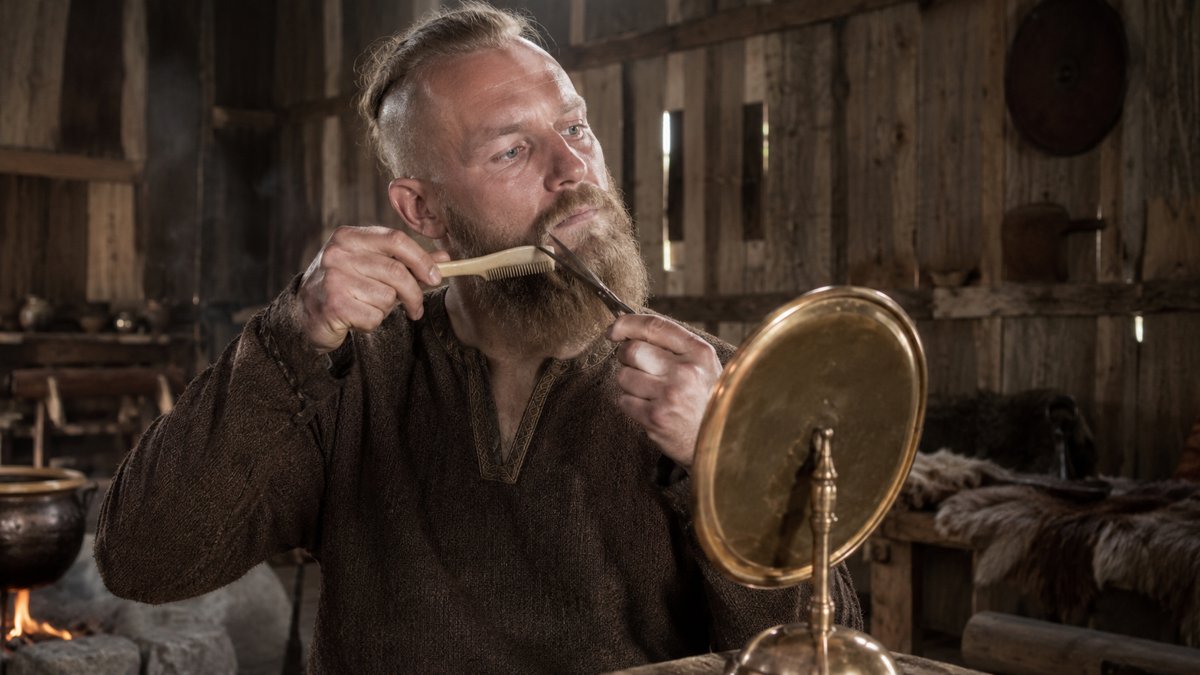
5. The beard: Forked like Sweyn's, pointed like Rällinge, or braided like Fløgstad – it must be combed. A double-sided comb of horn or wood is the authentic choice. Metal hair beads and beard rings, incidentally, are a modern addition; they are not securely attested as Viking-Age hair ornaments.
If you want to complete the look with the right clothes, our article Viking clothing: wool, linen and bright colours will help. And if you are looking for motifs as genuine as a Fløgstad beard, take a look at Authentic Viking motifs for engraving and tattoos.
Here in Alsdorf we engrave to exactly this standard: slate, wood and glass should look like a find, not like a TV set.
For courage. For remembrance. For legends that live on.
What hairstyles did Viking men have? The best evidence shows a short nape with a long fringe or a centre parting (Ælfric, the Fløgstad figure), combined with trimmed, forked or braided beards. Rus princes such as Sviatoslav wore a shaved head with a side lock.
How did Viking women wear their hair? Mostly long, tied into a knot at the back of the head with a tail hanging down – as silver figurines like the one from Hårby and Gotland picture stones show. Whether married women always covered their hair is uncertain.
Did Vikings have undercuts? Not in the form seen in "Vikings". A short nape is attested, and Sviatoslav had a shaved head with a side lock, but there is no evidence for shaved sides with a braid on top.
Did all Vikings have beards? No. Many images show beards, but the men on the Oseberg tapestry have none visible. In the sagas, beardlessness invited mockery, as with Njáll.
Did Vikings bleach their hair? There is no evidence for it. The idea rests mainly on Pliny the Elder, who mentioned a hair-colouring soap among Gauls and Germans some 700 years earlier.
Why have so many Viking combs been found? Because hair care was part of daily life, not least against lice. Antler combs are among the most common finds in settlements and were often placed in graves.
Everyday Viking life · Ibn Fadlan & the Rus · Berserkers · Viking burials · Hedeby.
All Everyday Life & Craft articles →
Coarse brown sacking, a shaggy fur collar, and of course the obligatory horned helmet – that is the Viking of film and …
Read more →Viking jewellery was rarely just decoration. A pair of brooches held the dress, an arm-ring was status symbol and …
Read more →Barely an image of the „real Viking“ reaches us today without dark runic and knotwork tattoos. But how do we actually …
Read more →Most Vikings were not raiders but farmers, traders and craftspeople. A look inside the long house where their lives …
Read more →