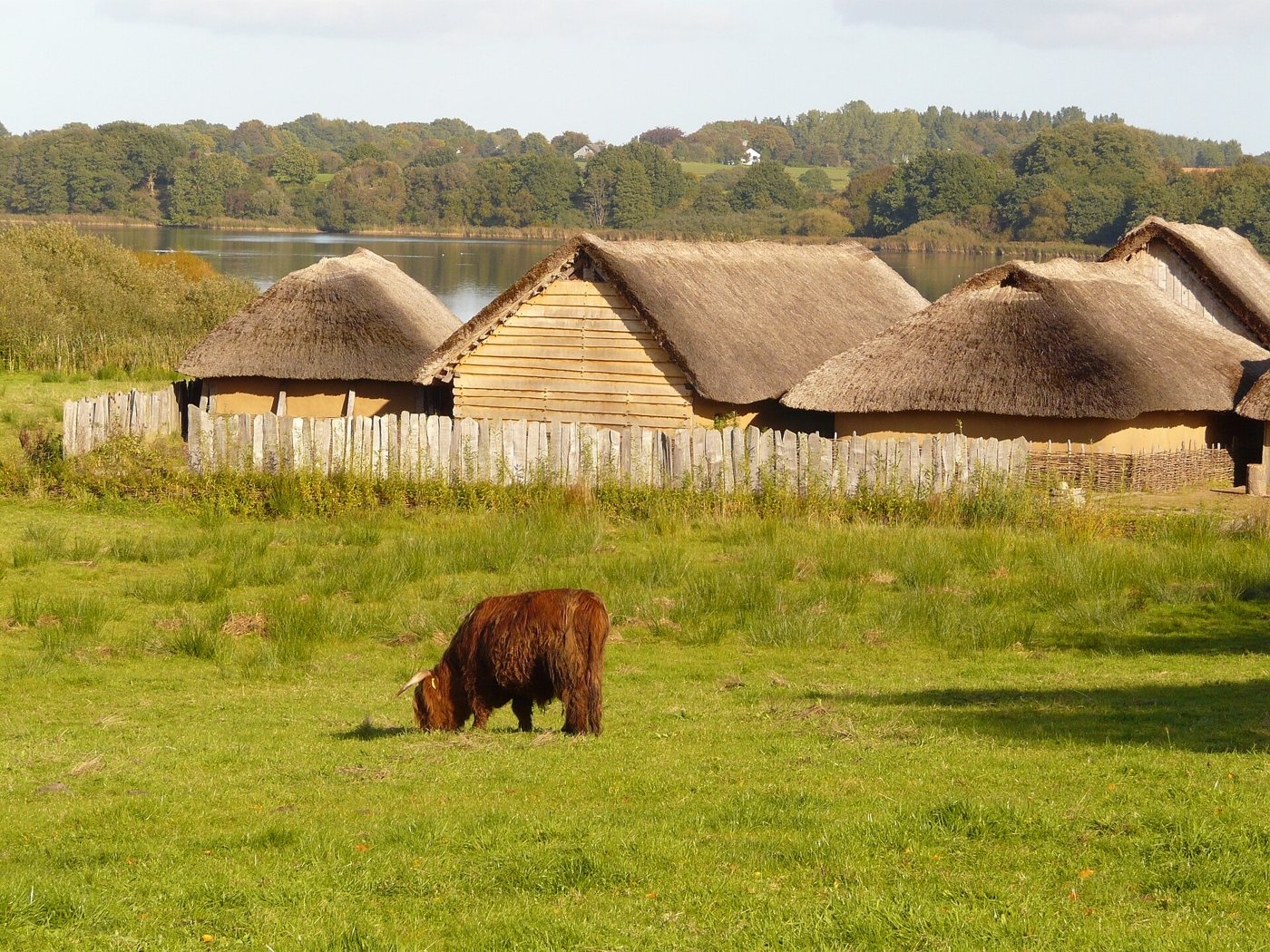
Around the year 965 a stranger came to the Schlei. He came from Tortosa in al-Andalus, Muslim Spain, was Jewish, a merchant and evidently a sharp observer. What he wrote down about the town of "Šlešwīq" is one of the very few eyewitness accounts of a Viking-Age place on what is now German soil. It is a report full of surprises: women who divorce, men with painted eyes, and singing that reminded him of howling dogs.
His full name in the sources is Ibrāhīm ibn Yaʿqūb al-Isrāʾīlī al-Ṭurṭūšī: Ibrāhīm, son of Jacob, the Israelite from Tortosa. Tortosa sits on the Ebro in today's Catalonia and at the time belonged to the Caliphate of Córdoba. The two bynames, called nisba in Arabic, tell us where he came from and what community he belonged to. He was probably a Sephardic Jew, that is, a Jew from Arabic-speaking Spain, and probably a merchant.
Even his religion is less clear-cut than the name suggests. Georg Jacob took him for a Jew, perhaps of North African origin. André Miquel and Abdurrahman El-Hajji saw a Sephardic Jew. In 1991 the historian Peter Engels suggested he might have converted to Islam and kept "al-Isrāʾīlī" merely as a family label. His profession is a matter of interpretation too: Engels stresses his eye for markets, coins and roads, Tadeusz Kowalski wondered whether he was a physician, and El-Hajji saw a diplomat.
What we can say is that he travelled through central Europe in the 960s and met Emperor Otto I, whom the Arabic texts call "Hūtuh". He described Prague as a trading town built of stone and lime, and he knew the realm of the Polish ruler Mieszko I, whom he called "king of the North". That he was sent by the caliph is a popular but unproven idea.
The date of the journey is disputed as well. Jacob put it in 973, Kowalski in 965/966, Miquel in 965. Since the text of the Andalusian geographer al-ʿUḏrī was published in 1965, we have a date from it: the year 350 of the Hijra, which is 961/962, matching a meeting with Otto in Rome after his coronation in February 962. For Hedeby, "around 965" is a safe answer.
There is no secure itinerary. In 1927 Jacob reconstructed a long loop from Bordeaux via Rouen, Utrecht and Schleswig to Magdeburg, Paderborn, Soest, Fulda and Mainz and on to Italy. El-Hajji instead had the journey start in Rome and run via Prague and the land of the Abodrites to Schleswig and Magdeburg. Warnke, Engels and Ducène proposed yet other routes.
At Otto's court. Ibrāhīm says he saw envoys of the Bulgarians at the court of "Hūtuh", king of the Romans. Otto is also said to have told him about a "city of women" somewhere in the north-east, a story that sounds like a fairy tale and is read as one.
Mainz. Al-Qazwīnī preserves a description of Mainz that economic historians still love. Ibrāhīm was amazed to find spices there that grow only in the farthest East: pepper, ginger, cloves, spikenard and galingale. And he saw silver coins, dirhams, struck in Samarkand – according to Jacob's translation in the years 301 and 302 of the Hijra, around 913–915. Dirhams of exactly this kind, from the Samanid realm in Central Asia, turn up in huge numbers in Scandinavia as well.
Prague. The town, he writes, was built of stone and lime and was an important market. Rus and Slavs came from Kraków, Muslims, Jews and Turks from the East, and the goods were slaves, tin and furs. This makes Ibrāhīm the first writer to mention Prague and its Jewish community.
Mieszko I. The ruler of the Poles, "Mšqh" in Ibrāhīm, is his king of the North. He kept 3,000 armoured men whom he equipped himself and paid monthly, and he paid an allowance for every child. It is the earliest reliable description of the Polish state.
Nakon and the Abodrites. In the far west of the Slavic world lay the land of Nakon, a prince of the Obodrites (Abodrites) in today's Mecklenburg. His stronghold stood in marshy ground, and Ibrāhīm explains how such forts were built: find a meadow with water and reeds, mark out a circle, pile up earth and brace it with timber. Scholars usually locate this stronghold at Mecklenburg near Wismar.
Fulda and other places. Al-Qazwīnī's entries that go back to Ibrāhīm also include Fulda and Rouen.
Why would a man from Tortosa travel to the Baltic at all? We don't know, but we know the roads he moved on. In the 10th century al-Andalus was the richest region of western Europe, and Córdoba needed people. The caliph's palace was staffed by many Ṣaqāliba, literally "Slavs", a word used there for slaves and soldiers of European origin. Around 960 Liutprand of Cremona reported merchants from Verdun who castrated boys and sold them to Spain. Prague, with its slave market, was a hub of this trade, and the Elbe Slavs and their neighbours were its victims.
The Radhanites belong in this picture too: Jewish long-distance traders described by the Persian geographer Ibn Ḫurradāḏbih in the 9th century. According to him they spoke Arabic, Persian, Greek, Frankish, Andalusian and Slavic and carried eunuchs, slave girls, brocade, furs and swords from west to east. No link to Ibrāhīm is attested anywhere. A few scholars have suggested he may have dealt in slaves himself; that too remains speculation.
For Hedeby this network is no abstraction. The town lived on long-distance trade, and people were part of the merchandise of the North: Rimbert tells in the Vita Anskarii how Ansgar bought Christian captives free (see slavery in the Viking Age). The silver that paid for it came in large part from the same Central Asian mints whose dirhams Ibrāhīm marvelled at in Mainz. In the North, though, nobody counted them; they were chopped up and weighed. More on that in our article on hacksilver.
Ibrāhīm's own book is lost. We know his observations only because later scholars quoted it, and the chain is long.
The earliest known user is al-ʿUḏrī of Almería, who wrote his Tarṣīʿ al-aḫbār between 1066 and 1085. His pupil al-Bakrī worked the material into his Kitāb al-Masālik wa-l-mamālik, the "Book of Roads and Kingdoms", around 1067/1068. That is where the reports on the Slavs, Prague, Mieszko and Nakon are found. Later authors such as Ibn Saʿīd and al-Ḥimyarī copied al-Bakrī in turn, and part of the Prague passage survives only in al-Ḥimyarī.
The Schleswig passage, by contrast, is known only from Zakariyyāʾ al-Qazwīnī, a scholar from Qazvin in Iran, born around 1203, died 1283. He lived in Iraq, served as a judge in Wāsiṭ and Ḥilla, and witnessed the Mongol conquest of Baghdad in 1258. His Āṯār al-bilād, "Monuments of the Lands", arranges the places of the world by seven climatic zones and alphabetically within each; Šlašwīq sits in the sixth clime. His main source was Yāqūt's geographical dictionary, which supplied almost 360 entries. Whether he read Ibrāhīm directly or through al-ʿUḏrī is an open question.
So between Ibrāhīm's visit and al-Qazwīnī's text lie roughly three hundred years and well over five thousand kilometres, from the Schlei via Spain to the Euphrates and Tigris. Along the way the text was copied, shortened and perhaps reworded, and that applies to every single sentence.
Ferdinand Wüstenfeld published the Arabic edition of al-Qazwīnī's work in Göttingen in 1848; the Schleswig passage is on page 404. The orientalist Georg Jacob translated it into German in 1927, in a volume of Arabic reports on envoys at Germanic princely courts.
One detail makes Jacob's work especially interesting: he wrote before large-scale excavation at Hedeby began. The big campaigns under Herbert Jankuhn only started in 1930. Jacob therefore looked for the "freshwater springs" in ponds in the town of Schleswig, which existed there until the 17th century.
In 1946 the Polish orientalist Tadeusz Kowalski produced a critical edition of the Slavic report in al-Bakrī and showed that Ibrāhīm ibn Yaʿqūb and "al-Ṭurṭūšī" were the same person. The text of al-ʿUḏrī, published in 1965 and naming both parts together, settled the matter. The most recent detailed study of the Schleswig passage is by the Islamic studies scholar Juan Rothenhäusler (2022), on which this article draws most heavily.
The text is short, just a few paragraphs.
The town. Šlešwīq is a very large town at the outermost edge of the world ocean, with springs of fresh water inside it.
The religion. The inhabitants worship Sirius; only a few are Christians and have a church. They hold a feast in honour of their god with eating and drinking, and whoever slaughters an animal – ox, ram, billy goat or pig – hangs it on a pole at the door of his house so that people can see he is sacrificing it to his god.
The poverty. The town is poor in goods and in blessing, and the people live mainly on fish, of which there is plenty.
The children. When a child is born to them, they throw it into the sea to save themselves the cost.
The women. The women have the right to divorce and leave their husbands whenever they wish.
The make-up. Men and women wear an artificial eye make-up that does not wash off and makes them even more beautiful. The Arabic word is kuḥl – the same word, incidentally, that gave English "alcohol".
The singing. And then the line nobody forgets: he had never heard uglier singing than that of the people of Šlešwīq. It was a growl coming out of their throats, like the barking of dogs, only wilder.
Hedeby lay on the Haddebyer Noor, a side arm of the Schlei, and in the 10th century was one of the largest trading places in northern Europe. The semicircular rampart that enclosed the town on the landward side was raised to its present form after 930 and still stands about nine metres high. It encloses some 26 to 27 hectares. Around 968, only a few years after Ibrāhīm's visit, Harald Bluetooth had a connecting wall built to the Danevirke.
Estimates put the population at 1,000 at least, perhaps 1,500 at its peak. In the harbour, divers and excavators found palisades, jetties and shipwrecks, among them the warship Hedeby 1, raised in 1979. More than thirty wells are known, the last datable one from the year 1021. From around 825 Hedeby struck its own coins, modelled on Carolingian types. Arabic dirhams circulated alongside, mostly chopped into pieces and reckoned by weight.
The politics fit the period, too. In the first half of the 10th century Hedeby was ruled by a dynasty that Adam of Bremen brings from Sweden. Two runestones from Hedeby name a king Sigtrygg, son of Gnúpa. In 934 King Henry I campaigned against Gnúpa, and in 948 a bishopric for Schleswig was set up at Ingelheim. By around 965 the town was probably already under the sway of the Jelling kings.
One caveat applies here as well: by 1980 only about five per cent of the settlement area and one per cent of the harbour had been investigated in detail. What is "not attested archaeologically" may still lie in the ground.
The name in the text is Šlešwīq, i.e. Schleswig. But what is described is very probably Hedeby. The town of Schleswig on the north shore of the Schlei only became the centre after Hedeby's decline in the late 11th century; its oldest urban traces date to around 1070. Hedeby was destroyed by Harald Hardrada in 1050 and by Slavs in 1066.
The mixing of names is nothing unusual. Frankish annals mention a place called Sliesthorp in 804, Anglo-Saxon sources say "æt Hæþum", and in the 11th century Adam of Bremen explicitly equates Sliaswig with Heidiba.
Rothenhäusler does run the counter-argument, though. If Ibrāhīm calls the town "poor in goods", that sits badly with an international market. Could he have seen a smaller, poorer settlement on the north shore? Only about ten per cent of Schleswig's twelve-hectare old town has been excavated, so older layers cannot be ruled out. In the end he still favours Hedeby and explains the "poverty" by the visitor's perspective: anyone who knew Córdoba, with its hundreds of thousands of inhabitants, its mosques and baths, would find a town of a thousand people in timber houses rather shabby.
As for the church: no church building has yet been identified archaeologically at Hedeby. But in 1978 a church bell from the early 10th century was recovered from the harbour. Rimbert reports that Ansgar was allowed by King Horik to build a church at Hedeby around 850, for merchants from Dorestad and Hamburg. Ibrāhīm's "few Christians with a church" fit the picture well.
The freshwater springs are probably the town's thirty-plus wells.
The sacrificial animals at the door fit what other sources tell us about pagan feasts in the North. Old Norse has words for the sacrificial meal and the sacrificial drinking, blótveizla and blótdrykkja. Adam of Bremen describes sacrificial animals hung in a sacred grove at Uppsala, and Thietmar of Merseburg reports sacrifices at Lejre. More in our articles on Uppsala and the blót. That the people of Hedeby held a sacrificial feast and displayed the slaughtered animal is plausible. Rothenhäusler adds a sharp question: sacrificing an ox was expensive. If the same people supposedly drowned their children out of poverty, was the whole town feasting, or only a wealthy layer of it?
The worship of Sirius is trickier. There is not a single other piece of evidence for a Sirius cult in the North. Rothenhäusler points out that Sirius is named in the Qur'an (Sura 53:49), where commentators link it to the idolatry of the pre-Islamic Arabs. Al-Qazwīnī, or Ibrāhīm before him, may simply have used a familiar label for "heathens" rather than recording a real observation.
The children thrown into the sea deserve the same suspicion. The story strongly recalls accounts of pre-Islamic Arabia, where killing newborn girls is the very image of barbarism, a practice the Qur'an expressly condemns. Exposure of children in hard times is known in the North from later Icelandic law texts and sagas. As the general custom of a town, though, the claim hardly stands. What we know about childhood in the Viking Age is in our article on Viking children.
The women's right to divorce is a genuine point of debate. On one side, Icelandic sagas and law texts show that a woman could end her marriage by declaring divorce before witnesses and then reclaim the property she had brought in. The historian Auður G. Magnúsdóttir explains Ibrāhīm's line by marriages in which the wife outranked her husband socially. On the other side, Rothenhäusler suspects a cliché here too: Arabic authors like to credit non-Muslim European women with striking freedom, as a foil to their own society. Both can be true at once. More in our article on women in the Viking Age.
The eye make-up is the passage quoted most often today, frequently without any caveat. Rothenhäusler calls it significant above all for its afterlife: it lies behind the dark-rimmed eyes of TV characters and video-game heroes. There is no archaeological evidence of make-up at Hedeby. It is not impossible: trade routes linked the North with cultures where kuḥl was common. What else is known about grooming is in our article on Viking hygiene.
The singing, finally, is a stranger's verdict on music he did not know. The Arabic word dandana means a humming or droning. Rothenhäusler considers a link to the Germanic war chant that Tacitus calls the barditus, but leaves it open. At least as likely: Ibrāhīm heard a drinking bout at the sacrificial feast, and drunk men probably sounded then much as they do now. What we know about music in the Viking Age is in our article on Viking music.
Ibrāhīm is not alone. Set beside the other outside views, a pattern emerges.
Ibn Rusta, a Persian scholar, described the Rus in the early 10th century. They had no fields, he says, lived by trading furs and slaves, and gave a newborn son a sword instead of an inheritance. He praises their clean clothes.
Ibn Faḍlān, the envoy from Baghdad, met the Rus on the Volga in 921/922 and found them splendidly built but unbelievably dirty. His report survives better than Ibrāhīm's: a manuscript in Mashhad preserves a continuous text, and excerpts appear in the same Yāqūt that al-Qazwīnī drew on. You can read it in our reading edition.
Rimbert wrote the life of his teacher Ansgar around 870. He knows Hedeby as harbour, market and mission post, but sees it through a missionary's eyes. Adam of Bremen wrote about the North around 1075, often from the stories of the Danish king Sven Estridsson, and painted pagan Uppsala in the darkest colours.
All these authors look in from outside and write for an audience that wants to be amazed. Ibrāhīm is no exception. His advantage: he was probably really there, he describes a town rather than a myth, and much of what he says matches what has come out of the ground.
Who was Ibrāhīm ibn Yaʿqūb? A traveller from Tortosa in Muslim Spain, of Jewish origin according to his byname and probably a merchant. In the 960s he travelled through central Europe and described Prague, Mieszko I's Poland and Hedeby, among other places.
When did Ibrāhīm ibn Yaʿqūb visit Hedeby? The source gives no exact year. Most scholars date the journey to the 960s, and "around 965" is the usual shorthand.
Did Vikings at Hedeby really wear eyeliner? Ibrāhīm says so, but there is no archaeological proof. It is not impossible, yet a single, late-transmitted sentence is not enough for a general claim.
Where can I read the account of Hedeby? The Arabic passage is in al-Qazwīnī (Wüstenfeld's edition, 1848, p. 404), the German translation in Georg Jacob, 1927. Juan Rothenhäusler's 2022 study offers a modern analysis with translation and is free online.
Why does the report say Schleswig rather than Hedeby? Medieval sources often used the same name for Hedeby and Schleswig. Al-Qazwīnī uses the form Šlešwīq, but by current knowledge the place described is very probably Hedeby.
For courage. For remembrance. For legends that live on.
Hedeby · Ibn Fadlan & the Rus · Viking women · The Danevirke · Ansgar · Viking Trade.
All History & Finds articles →
The Iceni were a Celtic people in eastern Britain, in today's Norfolk. As a client kingdom they at first lived in …
Read more →Soon after the year 205, a defeated army did not march home – it sank to the bottom of a quiet lake in eastern Jutland …
Read more →The Insubres were the mightiest Celtic people of the Po plain in today's northern Italy – part of those Celts whom Rome …
Read more →
