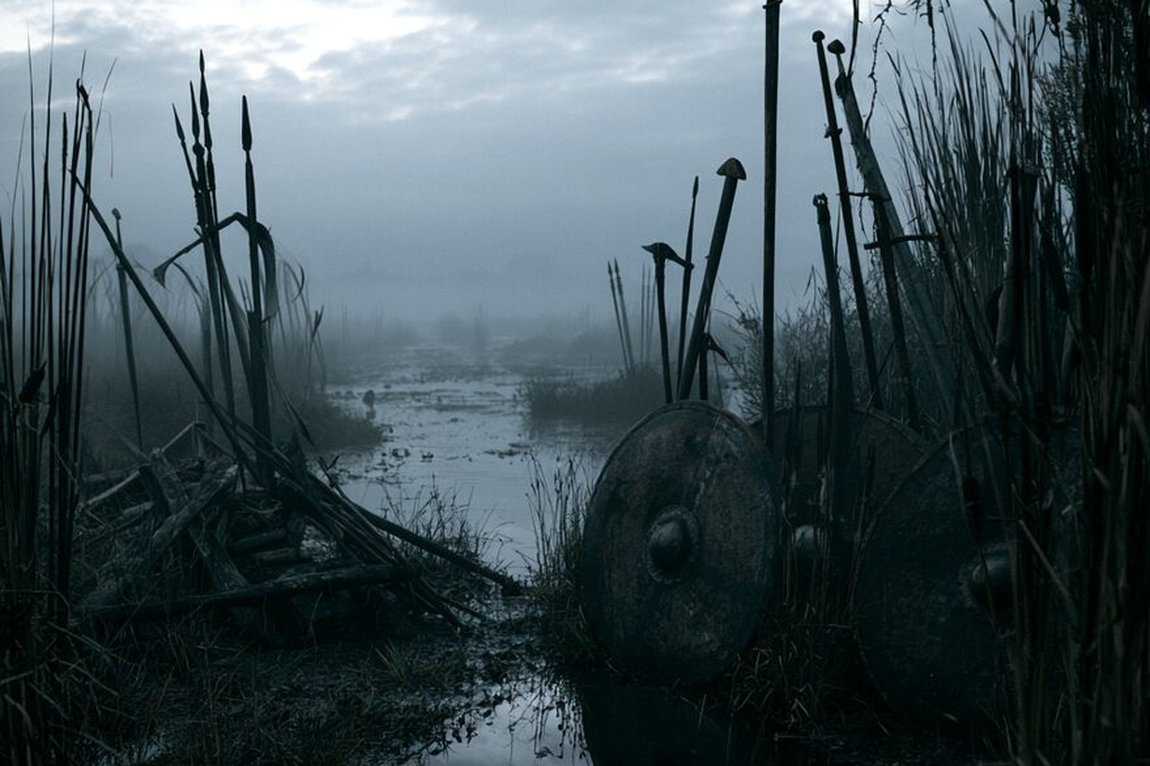
Soon after the year 205, a defeated army did not march home – it sank to the bottom of a quiet lake in eastern Jutland: hacked swords, shattered shields, hundreds of lances. Illerup Ådal is one of the largest weapon sacrifices in the ancient world, and a window into Germanic warfare six centuries before the Viking Age.
Near Skanderborg in eastern Jutland lies an unremarkable valley, Illerup Ådal. Today it is damp meadow; in the 3rd century AD it was a small, clear lake. Into that lake people cast the entire equipment of a defeated army – not carelessly, but in a careful, grim ritual. Swords were bent, shields smashed, spear shafts broken, and then it all sank. What the lake swallowed, it preserved for eighteen centuries: more than 15,000 objects have been recovered so far, and scholars estimate that just as many still lie in the ground.
Illerup Ådal is neither a grave nor a battlefield. It is a thank-offering – the victors gave the gods what they had taken from the enemy. For us it is therefore perhaps the densest single snapshot of Germanic armament in existence: a whole army, man by man, rank by rank, frozen in the mud.
Between roughly AD 200 and 500, people across southern Scandinavia repeatedly sank captured weapons into lakes and bogs. Around twenty such sites are known in Denmark and northern Germany. The logic behind them can be reconstructed from ancient reports and from the finds themselves: whoever won a battle owed a share of the spoils to the deity who had granted the victory. And because a god was not to be fobbed off with half-measures, the booty was made complete and useless before it went into the water. No living person was ever to carry it again. Our overview of the Germanic bog weapon-sacrifice looks at this practice and its great sites in more detail.
The water did the rest. In oxygen-poor bog mud iron rusts only slowly, wood barely decays, and leather and textiles survive at least in traces. That is why Illerup has yielded not a handful of corroded blades but swords with grips, shields with bosses and grip fittings, lanceheads with still-legible marks. What is missing are the protein-rich materials: woollen cloth and leather horse-gear have largely rotted away in the ground.
It all began with drainage. In 1950, workers cutting peat and draining the wet ground struck weapons. A first investigation ran from 1950 to 1956, then the matter rested. Only when a new drainage project loomed in the 1970s did archaeology return: from 1975 to 1985, Jørgen Ilkjær directed a large rescue excavation for the Moesgård Museum near Aarhus.
The result became a life's work. Ilkjær and his team did not merely uncover the finds – they sorted them into equipment sets, compared them with the other bog finds, and from that reconstructed how the army was built. To this day only about 40 per cent of the sacrificial area has been dug. Illerup Ådal thus ranks among the largest and best-documented weapon sacrifices of the European Iron Age.
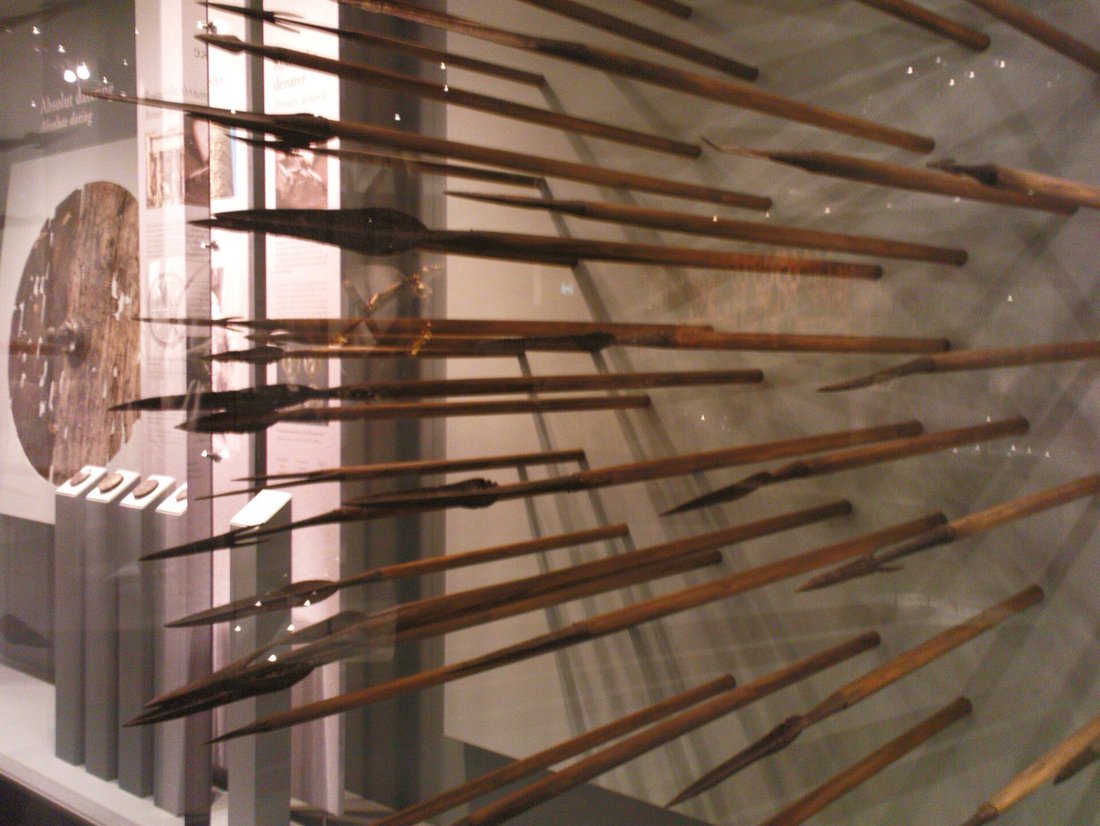
The numbers from the excavated part are striking. The ground yielded, among much else, at least 430 lances and 439 spears, over 200 swords, and around 300 shield bosses with the remains of their wooden shields. Add to that knives, fire-steels, combs, fittings, riding gear and personal belongings – scattered over an area at least 200 metres long. In all it is more than 15,000 objects, kept at the Moesgård Museum.
It is worth pausing on what that means: this is not a scrap heap but the complete material culture of a fighting force. Anyone wanting to place the many weapon types will find the broader frame in our weapons lore; Illerup supplies the evidence in series – not a single showpiece sword but a hundred swords, not one lance but a forest of points.
The most precise date comes from the shields. The tree-rings of the wooden shield boards, studied dendrochronologically, point to a deposition soon after AD 205. The comparison with the Roman coins found alongside is telling: the youngest was struck in 187/188. So a good generation lay between the minting of the money and the army's end – the coins were already old stock when they reached the lake.
Illerup was not a one-off event. The valley was used again and again as a sacrificial site over centuries; smaller later deposits reach into the 4th and 5th centuries. The great complex, however – the defeated army – belongs to the early 3rd century.
The find speaks of cold thoroughness. Blades were bent until they broke. Swords were "killed" – rendered useless – shafts smashed, shield bosses caved in. Some things were apparently bound together, weighted with stones and thrown from the shore into deeper water. This was no blind rage but an act with rules: the booty now belonged to the deity, and what belongs to a god no human may bear.
The best ancient text on this custom comes not from the north at all but from the pen of a late-Roman historian. Orosius describes how a victorious army destroyed everything it had captured rather than keeping it:
Hostes … nova quadam atque insolita exsecratione cuncta quae ceperant pessum dederunt: vestis discissa et proiecta est, aurum argentumque in flumen abiectum, loricae virorum concisae … equi ipsi gurgitibus immersi, homines laqueis collo inditis ex arboribus suspensi sunt. — "The enemy, with a strange and unheard-of curse, destroyed everything they had captured: clothing was torn and thrown away, gold and silver flung into the river, the men's mail cut to pieces … the horses themselves drowned in the currents, and the men hanged from trees with nooses about their necks." Orosius, Historiae adversum paganos V,16,5–6 (translation: Glanz & Gravur)
Orosius is describing an event on the Continent, not Illerup itself. But the principle is the very one the bog attests: victory is turned not into wealth but into an offering. What the enemy carried is destroyed and handed to the powers that decided the outcome.
The most striking result from Illerup is not a single weapon but a statistic. Sort the shield bosses by material, and the army's rank order appears almost by itself. The broad base: around 350 plain iron bosses – the common warriors. Above them a much smaller group: about 30 bronze bosses, plus six decorated with gilded pressed foil – the middle tier. And at the top, a mere handful: five or six shield bosses of silver. A few splendid equipment sets for the leaders, many plain ones for the mass.
This threefold division fits remarkably well with what Roman authors wrote about Germanic armies. Tacitus distinguishes principes (chiefs), comites (retainers) and pedites (foot-soldiers); Ammianus Marcellinus, two centuries later, names a similar structure. The ground at Illerup and the written sources draw the same picture – a tiered retinue army that stayed stable over a long time. How Germanic bands actually fought and organised themselves is explored further in our Germanic warfare.
The commonest weapon was not the sword but the pole-arm. Spears for throwing, lances for thrusting – together well over 800 points. That matches the general picture of the Iron Age, in which the spear was and remained the weapon of the ordinary warrior; the sword, by contrast, cost a fortune and marked status. Illerup shows precisely this social gulf in series.
And the blades are international. A good share of the sword blades are Roman imports, some bearing the stamped maker's marks of imperial workshops. The Germanic peoples obtained first-rate steel across the frontier and mounted it on grips of their own. So the army in the lake was neither isolated nor "primitive" – it was woven into a far-reaching web of trade, pay and weapon transfer.
Illerup is among the earliest sites with runic writing at all. Around ten objects bear short inscriptions in the Proto-Norse elder futhark. Two lance blades read wagnijo – the same mark reappears on three pieces from the bog of Vimose on Funen. That points to at least small-scale serial production: Wagnijo is probably the name of a smith, or of the man who commanded the workshop. On a silver shield grip one reads nithijo tawide – "Nithijo made (it)". A fire-steel bears the name Gauthur.
Most of these early inscriptions are names, not spells. By comparison: the Norwegian lancehead from Øvre Stabu bears the word raunijaʀ, "the tester" – a name for the weapon itself, not for its owner. Here runes are first of all script and labelling, not magic. Whoever had a rune engraved was naming a thing or a person, as plainly as a stamp.
The most exciting question is also the hardest: who was the enemy that perished here? Several trails point north, out of Jutland. The fire-steel with the name Gauthur fits linguistically with Norway. Combs of reindeer and elk antler point to the far north of Scandinavia, where those animals live. The Roman coins, in turn, suggest a group returning from the south – perhaps from pay or plunder beyond the imperial frontier.
From all this, scholarship has sketched a picture: an organised fighting force, perhaps around a thousand men on some fifty boats, setting out from the Norwegian-Swedish area, landing on the Jutish coast – and there beaten by a local power that dedicated the spoils to the gods. More recent studies even think a connection to Roman mercenary service conceivable. The origin reading is not certain; it rests on clues, not on a document. But the direction – a foreign, sea-mobile army from the north – is well founded.
Illerup is the largest, but not the only such place. At Nydam whole rowing boats lay beside the weapons; at Ejsbøl the equipment of around two hundred men was found in clear order; Vimose on Funen yielded some of the oldest runic inscriptions of all; Thorsberg in Angeln, south of today's German-Danish border, gave up showpieces and textile remains; from Kragehul comes a famous rune-inscribed lance shaft. Together these bogs form an archive of the wars of the first half-millennium – victory upon victory, turned into water. How the individual sites relate to one another is shown in our overview of the bog weapon-sacrifice.
Before Illerup, "Germanic army" was a pale phrase from Roman texts. After Illerup it is a tangible body with structure: leaders with silver-mounted gear, a middle layer with bronze and gold, a mass with plain iron. A force that came by sea, carried standardised weapons, bought Roman steel and knew writing. That is no wild horde but an organised, hierarchical fighting force – centuries before the first longship touched a monastery shore.
And it is a story about the seriousness of war. The victors turned their triumph into no profit. They broke what they could have kept, and gave it away. The ground of eastern Jutland preserves that decision to this day – every bent blade a sentence in a prayer we can no longer hear, but can still read.
What is secure: The great Illerup Ådal complex is dated dendrochronologically to soon after AD 205; the youngest Roman coin is from 187/188. From roughly 40 per cent of the sacrificial area, over 15,000 objects have been recovered (including at least 430 lances, 439 spears, over 200 swords, around 300 shield bosses). The shield bosses divide clearly by material – about 350 of iron, around 30 of bronze plus 6 gilded, 5–6 of silver – making three ranks visible. Several objects bear Proto-Norse runes (e.g. wagnijo, nithijo tawide). Housed at the Moesgård Museum, Aarhus.
Myth-check: Illerup Ådal is not Viking treasure. The find belongs to the Roman Iron Age of the early 3rd century – roughly 600 years before the Viking Age. Nor are these riches someone meant to hide; they are the destroyed equipment of a defeated, probably foreign army, consecrated to the gods. To which deity, no source says: a war god of the Týr type, or – in Roman interpretation – Mars, is a natural guess, but an inference, not evidence. And the round numbers are extrapolations from counted fragments of the excavated part, not an ancient inventory. The find in the ground is secure; much of what surrounds it remains reasoned interpretation.
The bog army-offerings · Warfare · Weapon Lore · The Spear · The grove of the Semnones.
All History & Finds articles →
Carved in stone over 1,000 years ago, a king proclaims the unification and baptism of Denmark – the same king whose …
Read more →